

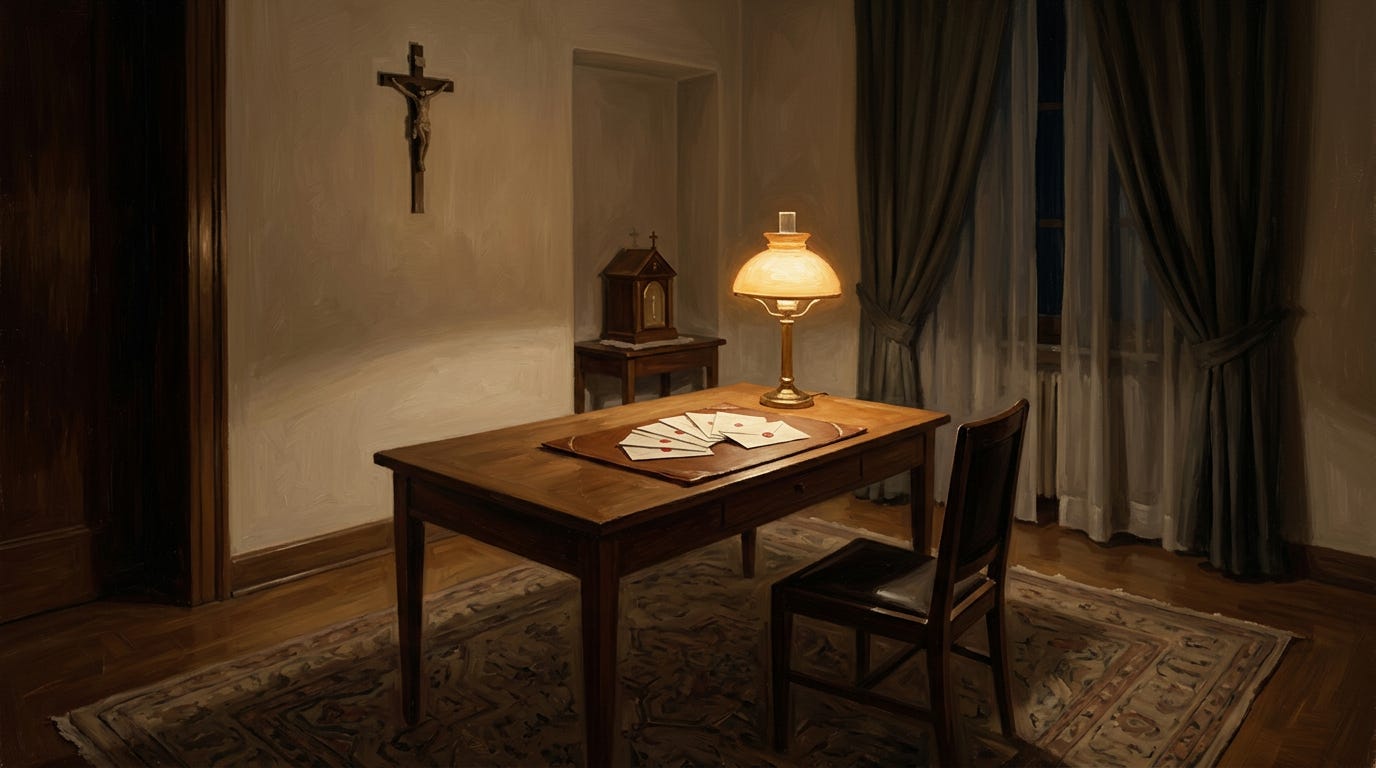
The letters were on the desk.
Pope John had read them all once and had read the two most difficult ones twice, and now he sat at his desk in his study on the third floor of the Apostolic Palace with the letters arranged in a fan on the leather blotter in front of him, in the warm yellow light of the desk lamp, in the quiet of the papal apartments at the ninth hour of the evening. He was tired. He was seventy-seven years old and had been Pope for four months and had already, in that short time, learned something about the tiredness that comes from doing work whose fruits will not be seen in the lifetime of the one who does it. The tiredness was different from the tiredness of the diplomatic postings he had spent most of his career in - Sofia and Istanbul and Athens and Paris and Venice - because in the diplomatic postings the fruits had been small and had ripened within a few years and he had been able to see them ripen. The Council would not ripen in his lifetime. He had begun to accept this. The accepting was itself a form of tiredness he was still getting used to.
He had announced the Council seventeen days ago.
He had announced it in the Basilica of Saint Paul Outside the Walls, on the feast of the Conversion of Saint Paul, before an assembly of seventeen cardinals whom he had convoked without telling them what he was going to say. He had told them three things: he was calling a Roman synod, he was calling an ecumenical council, and he was ordering a revision of the Code of Canon Law. The cardinals had received his words in complete silence. He had expected some kind of response - a murmur of astonishment, perhaps a scattered applause, perhaps a question from one of the more forward of them. There had been silence. The silence had gone on for some seconds. He had understood, standing at the small wooden pulpit in the basilica, that the silence was not the silence of assent. It was the silence of shock. He had continued speaking anyway. He had explained a few things. He had blessed them. He had walked back to the Vatican and had sat down in this same chair at this same desk and had waited for the letters that he knew were going to come.
The letters had come.
Some had come from the very cardinals who had been present at Saint Paul’s. Some had come from curial officials who had not been present but who had received the announcement from the ones who had. Some had come from bishops around the world - the ones outside the curia had generally been more enthusiastic, though a fair number of them had also written in various registers of concern. The letters had come throughout February. The two most difficult ones were the two he had reread this evening. One was from Cardinal Tardini, his own Secretary of State, who had been the first person he had told about the Council idea (Tardini had said, in that first conversation, that it was impossible) and who had now written him a very long, very courteous letter explaining, in the language of Roman diplomacy, that he thought the Holy Father should reconsider the scope of what he had announced. The other was from Cardinal Ottaviani, the head of the Holy Office, who had written a shorter letter that was less courteous and more direct. Ottaviani thought the Council was a mistake.
John sat with the letters.
He had been thinking, for perhaps two hours, about whether he should reply to them tonight or whether he should let them sit until morning. He knew what he would say in either case. He was not going to withdraw the announcement. He was not going to reduce the scope. He was not going to explain himself in a way that would satisfy Tardini’s courteous concerns or Ottaviani’s blunt ones. He was going to continue. What he was thinking about was not the substance of the reply but the tone. He wanted to reply in a way that was firm without being cold, and warm without being weak. He was still working out the tone.
He whispered, in the Bergamasque dialect of his childhood which he sometimes fell back into when he was alone, “Signore. Sono vecchio. Mostrami come rispondere.”
Lord. I am old. Show me how to reply.
He heard a soft cough behind him.
He turned in his chair.
There was a monk standing in the doorway of the study.
The monk was tall and thin and wore a plain habit of undyed wool, the older kind of monastic habit that had not been in common use in western Christendom for many centuries, the kind John XXIII had seen only in illuminated manuscripts from the medieval period. His feet were in leather sandals. His head was tonsured. His hair was white. His beard was short and grey. He was perhaps sixty. His hands were folded inside his sleeves in the way of a monk who was accustomed to keeping his hands inside his sleeves. His eyes were dark and very quiet.
John recognized him. He had read Bruno’s short life during his seminary years at the Roman Seminary in the 1890s. He had read it again during his years in Turkey when he had gone through a stretch of loneliness and had been drawn to the Carthusian writings. He had thought about Bruno often during his years at Venice, when he had felt himself being pulled from the contemplative life he loved into the more public work of a Patriarch. He knew Bruno’s face. He had not known that Bruno’s face looked exactly like this face, but he knew, when he saw the face, that the face was Bruno’s.
He said, in Latin, “Frater Bruno.”
The monk inclined his head.
“Sanctissime Pater.”
Most Holy Father.
John smiled. He had a warm face and the smile went all the way across it. He gestured at the chair on the other side of his desk.
“Frater, don’t call me that tonight,” he said, switching to Italian, which he suspected Bruno would understand well enough. “Call me Angelo. Or call me Roncalli. Or don’t call me anything. Sit down. I am glad you have come. I don’t know why you have come but I am glad. Please sit. Would you like some wine? I have some wine. It is not very good wine. Vatican wine is never as good as people expect. Sit.”
Bruno smiled - a precise smile, of the kind that a monk of his period would have permitted himself - and came into the study and sat in the chair John had gestured at. He arranged his habit carefully. He did not accept the offered wine. He folded his hands again inside his sleeves.
“Angelo,” he said. His Italian was correct but had the odd quality of Italian spoken by a native German speaker who had learned it a very long time ago. “I have come because I have been permitted to come. I have not come for a long time to anyone. I have been asked, in the room where I am, whether I would like to come to you tonight. I said yes. It is not a small privilege.”
“Why me.”
“Because you announced the Council seventeen days ago and you are sitting alone in the middle of February reading letters from cardinals who think you are wrong. I have been alone in similar rooms in different centuries. Reggio Calabria in the year ten ninety-one. La Torre in ten ninety-eight. I know these rooms. The Lord sent me because I know these rooms.”
John looked at Bruno for a long moment.
He was not startled, though he was moved. He had been Pope long enough to have understood that strange things happened around the office of Peter and that one did not always ask for these things and one did not always need to explain them. He had prayed to be shown how to reply to the letters. He had been shown a monk from the twelfth century standing in his doorway. The showing was the answer, or at least the beginning of the answer. He accepted the beginning.
He said, “Tell me about Reggio Calabria.”
Bruno inclined his head slightly.
“Reggio Calabria. The archdiocese of Reggio Calabria was vacant in ten ninety-one. Pope Urban the Second was my former student at Reims. He had summoned me to Rome the year before to serve as one of his advisors, though I had wanted to remain at La Chartreuse. I had left the Chartreuse under obedience. I was in Rome perhaps six months when he told me he intended to appoint me archbishop of Reggio Calabria. I told him I could not accept. He told me that as pope he could compel me. I told him I would accept the compelling but that I would not do the office well and that my heart would remain in a hermit’s cell and that he should choose someone else for the good of the diocese. He was fond of me. He heard me out. He did not compel me. He appointed someone else. He gave me instead permission to found a second Carthusian house in Calabria itself, at La Torre, where I lived out the rest of my life. This was the arrangement. It cost him something. Urban had wanted me to be an archbishop. He had wanted a former teacher in a position of influence. I asked to be a monk in a forest instead. He honored the asking. Not every pope does. He did. I have been grateful ever since.”
John nodded, slowly.
“You refused the archbishopric.”
“I refused. It was the right refusal. Some things one is not made for. Being an archbishop was one of the things I was not made for. Founding hermitages was one of the things I was made for. The Lord is very careful about what He asks of us. He does not usually ask what we cannot do. When we are asked to do something that feels wildly beyond us, sometimes the Lord is stretching us. Sometimes He is asking someone else and we have misheard. I was in the second case in ten ninety-one. You are in the first case in nineteen fifty-nine. There is a difference. It is important to know the difference. May I tell you about the difference.”
“Please.”
Bruno leaned forward slightly.
“You have been thinking, these past weeks, that perhaps you have misheard. That perhaps you were not asked to call this Council. That perhaps you extended the papal office beyond what a seventy-six-year-old bishop of Rome, elected as a transitional pope, was supposed to do. You have been reading these letters” - he glanced at the fan of papers on the desk - “and wondering whether the men who wrote them are seeing something you missed. This is a reasonable thing to wonder. It is what a humble man wonders. You are a humble man. That is one of the reasons you were elected. The cardinals wanted a humble transitional pope. They did not expect you to call the largest council in the history of the Church. They are, in this moment, discovering that humble does not mean small. Humble means unattached to one’s own reputation. You are unattached to your reputation. That is what allows you to call the Council. The men who wrote these letters are more attached to theirs. That is why they are afraid. Their fear is not evidence that you have misheard. Their fear is evidence that you have heard correctly. Do not confuse the two.”
John let out a slow breath.
He had needed to hear this. He had suspected it in his own prayer but had not been entirely certain. Bruno was confirming what his own interior sense had been telling him. He was not misled. The curial fear was not a sign of his error. It was a sign of their attachment.
He said, softly, “Frater. I am not entirely a humble man. I am also stubborn. Perhaps the announcement was more stubborn than humble.”
Bruno smiled again.
“The two are not opposites. A humble man is often stubborn in the small matters and yielding in the large ones. A proud man is often the opposite. You have been stubborn about the Council because the Council is not your idea. It is His. You are yielding about your reputation. You are yielding about the criticisms in the letters. You are yielding about whether Tardini and Ottaviani think well of you. You are unyielding about the Council itself. This is the correct combination. Do not mistake it for pride. The pride would be to insist on your reputation. You are not doing that. You are insisting on the Council. That is different.”
John nodded again.
“The Council will not end in my lifetime,” he said, quietly.
“No. It will not. I want to say this plainly so that you can accept it fully. You will die on the third of June, nineteen sixty-three, at the age of eighty-one, in your bedroom in these apartments. The first session of the Council will have closed the previous December. Three more sessions will follow after your death. The Council will close in December of nineteen sixty-five, under your successor. He will be Giovanni Battista Montini, whom you have appointed archbishop of Milan and whom you will elevate to the cardinalate later this year. He will be a good pope. He will finish what you began. You will not be there to see the finishing. That is correct. Founders do not finish. Founders begin. Others build. You have said this yourself in various ways in your journals. You know it is true. You will experience it. The experiencing will be difficult in the last months. You will accept it.”
John was silent for some while.
He had suspected this also. He had known, in the quiet part of his heart that he consulted before he consulted anyone else, that he would not live to see the Council through. He had been trying not to think about it too directly. Bruno had named it directly. The naming, oddly, was a relief. He would not have to pretend to himself that he might make it to the end. He could plan accordingly.
He said, “Montini. Yes. He will do well.”
“He will do well. Not perfectly. He will have his own struggles. The Council itself will be difficult and its reception will be difficult and there will be many years of contested interpretation. This is normal for councils. Nicaea was contested for sixty years after it closed. Trent was contested for a century and a half. Vatican Two will be contested for at least that long. Do not let this discourage you. The Lord does not judge the Council by whether its reception is smooth. He judges it by whether the bishops of the world, in council with the successor of Peter, spoke what the Spirit was asking them to speak. The bishops will speak what they are asked to speak. The Spirit will be present. The reception is not your problem. Your problem is only to call the Council and to open the first session and to prepare Montini to receive it. That is all. Do that. Trust the rest.”
John was, he realized, weeping a little.
He did not usually weep. He was a stout man of peasant Lombard stock and he considered weeping a small indulgence that ought to be reserved for the correct occasions. He had wept, briefly, at his election - he had wept in the small room off the Sistine Chapel where the newly elected popes vest for the first time, in privacy, before appearing on the loggia. He had wept once in his private chapel three weeks after the announcement of the Council when he had been alone with the tabernacle. He was weeping now for the third time in four months. He was, he suspected, going to weep more often than he had in the previous seventy-six years. The papacy did that to a man.
Bruno waited.
After a while John said, “Frater. I have not spoken with anyone about this. There is no one I can speak with. The men around me are all in their positions and all have their views and all want something from me or want me to do something specific. There is no one I can simply talk with. You are the first person I have talked with in four months who is not trying to move me somewhere.”
“I know. That is why I have been sent. The office of Peter is very lonely. It becomes lonelier as it becomes more consequential. You are entering the period of your papacy in which the loneliness will be greatest. The Lord knows this. He has arranged for you not to be entirely alone. I am one of the arrangements. There are others. You will not always see them. You will sometimes feel them. When you feel that you are not entirely alone in this apartment even when no one is here with you, believe the feeling. You are not entirely alone. The Communion of Saints attends the office of Peter with particular care. There are many who watch. Some of us have been permitted to visit. Others have not. All of us are attending. Do not lose the sense of this. It is one of the consolations of the office.”
John nodded.
“May I ask you something else, Frater.”
“Anything.”
“The Chartreuse. You loved it.”
“I loved it. I loved it in a way that was almost improper for a monk to love a place. The monastic tradition warns against attachment to particular houses. I was attached to La Chartreuse. I built it. It was mine in the way a first house is a first house. When Urban called me to Rome I did not want to come. I came under obedience. I never returned to La Chartreuse in this life. I established La Torre in Calabria and I lived out my remaining eleven years there, and it was a good house and I loved it also, but it was not La Chartreuse. I carried a small grief about La Chartreuse for the rest of my life. I want to say something about this to you. You loved Venice. You loved being Patriarch. You did not want to be Pope. You accepted the election under obedience, exactly as I accepted the call to Rome. You will carry a small grief about Venice for the rest of your life. That is fine. The grief is not a failure of your papacy. It is a sign that you loved Venice properly. Loving what you have left is what a healthy soul does. Do not chastise yourself for the loving. Carry it. It will make you a warmer pope than you would otherwise be. The warmth will matter. The Council you are calling will need a warm pope to open it. Cold popes cannot open councils. Warm popes can. You are warm because you are still, in some part of yourself, the Patriarch of Venice who did not want to leave the lagoon. Do not lose that. Do not let anyone make you cold. Not even Ottaviani. Especially not Ottaviani.”
John laughed.
The laugh came all at once and was loud enough that the two nuns in the kitchen at the far end of the apartments probably heard it. John did not care. It was the first laugh he had laughed in this study since the Council announcement.
“Frater Bruno. You have made me laugh. Thank you.”
“You are welcome. It is not difficult to make you laugh. You are already a warm man. You needed permission to laugh tonight. I have given you the permission. The Lord uses different instruments to give permission. I am one of the instruments. Roncalli, listen to me. Reply to the letters tomorrow, not tonight. Sleep. When you reply, be warm. Be firm. Do not defend yourself. Do not explain. Simply say that you have called the Council and that you thank them for their concerns and that you will continue to consult them as the preparations proceed but that the decision has been made and that the Lord will provide the outcomes. That is enough. Do not write long letters. Cardinals expect long letters from popes. Do not give them what they expect. Short warm firm letters will unsettle them more than long defensive ones. They will not know what to do with your brevity. They will conclude that you are more certain than they had thought. This is correct. You are more certain. Be certain in the letters.”
John was still smiling.
“Short warm firm letters.”
“Yes.”
“You would have made a good pope, Frater Bruno.”
“No. I would have been a terrible pope. That is why the Lord called you to it and let me stay in Calabria. The Lord is very careful about these things. He does not put people in offices they cannot hold. He puts you in the office you can hold. He put me in the office I could hold. He put Urban in his. He put your predecessor in his. He is careful. He will put Montini in yours after you. Trust the arrangements. Do not try to be a different pope than you are. You are the pope for this council. You are enough. Now go to bed, Angelo. It is late. You have letters to write in the morning.”
Bruno rose from the chair.
He came around to John’s side of the desk. He laid his hand on John’s shoulder - the hand was cool and light and firm - and he blessed him, in Latin, in the Carthusian blessing he had composed for his brothers at La Chartreuse nine hundred years before.
“Stet crux dum volvitur orbis. Christus tecum, frater. Amen.”
Let the cross stand while the world turns. Christ be with you, brother. Amen.
John closed his eyes.
When he opened them, the chair on the other side of the desk was empty.
The lamp was still burning. The letters were still on the desk. The apartments were still quiet. But the room felt different. The room felt like a room in which he was no longer entirely alone. He understood, sitting there, that he was going to feel this way for the rest of his papacy. The apartments were not empty. They had never been empty. He had just been given the eyes to see this for a minute.
He rose from the desk.
He walked to his private chapel. He knelt before the tabernacle. He said the evening prayers he said every night. He rose. He walked to his bedroom. He undressed. He got into bed. He slept.
In the morning he rose at four-thirty, as he always did. He said Mass at five in his private chapel. He took a small breakfast. He returned to the study. He replied to the letters. He wrote to Tardini and to Ottaviani and to the seven other cardinals who had written him during the month. Each reply was short. Each reply was warm. Each reply was firm. Each reply thanked the writer for his concerns and confirmed that the Council would proceed and that the writer would continue to be consulted. The replies did not defend. The replies did not explain. The replies were three or four paragraphs each.
He sealed them. He gave them to his secretary for dispatch. He went to his audiences.
The Council proceeded.
Cardinal Tardini, upon receiving his reply, was reported by his own staff to have read it twice, put it down, sat for perhaps five minutes without speaking, and then said, quietly, in the direction of the window: Il Papa ha deciso. The Pope has decided.
Ottaviani was less reconciled. He continued to raise objections through the preparatory commissions and into the Council itself. He did not succeed in delaying or restricting the Council. He remained loyal. He was loyal in the way that certain kinds of Roman officials are loyal - they oppose while obeying, they obey while opposing, and the loyalty is real even when the opposition is real. John understood this and did not resent it.
John XXIII opened the Second Vatican Council on October eleventh, nineteen sixty-two, with the address that came to be known by its Latin title Gaudet Mater Ecclesia - Mother Church rejoices. He preached against the prophets of doom. He preached about medicine of mercy rather than severity. The Council opened. The bishops of the world assembled in Saint Peter’s. The first session ran until December eighth of that year.
John XXIII died on the third of June, nineteen sixty-three, at the age of eighty-one, in his bedroom in the papal apartments, as Bruno had said. His last words, in Italian, were Ut unum sint - that they may be one. He had been thinking about Christian unity.
Cardinal Giovanni Battista Montini, whom John had appointed archbishop of Milan and whom he had elevated to the cardinalate in December nineteen fifty-eight, was elected pope on the twenty-first of June, nineteen sixty-three, taking the name Paul the Sixth. He was, as Bruno had said, a good pope. He finished the Council. It closed on the eighth of December, nineteen sixty-five. He continued as pope until his death in nineteen seventy-eight.
The Council documents have shaped every subsequent generation of Catholic life. The reception of the Council has been, as Bruno predicted, contested. The contest continues. The Lord judges the Council by its faithfulness to what the Spirit asked, not by the smoothness of its reception.
John XXIII was beatified by John Paul II in 2000. He was canonized by Pope Francis on April 27, 2014, along with John Paul II himself, in a ceremony in Saint Peter’s Square attended by hundreds of thousands. His feast is October 11 - the anniversary of the opening of the Council.
Saint Bruno of Cologne, in his room, was pleased.
He continued at La Torre in Calabria, in the arrangements that eternity permits, watching over the men and the women who founded things at moments of institutional resistance. The list was long. It included pope-founders and abbot-founders and lay-founders and secular institute founders and diocesan movement founders. It included John XXIII. It included many others. Bruno was fond of all of them. He continued to visit, when the Lord permitted, the ones who were sitting alone at desks in front of letters that told them they had been wrong.
He was permitted to visit John XXIII once more, in the bedroom in the papal apartments, in the early hours of the third of June, nineteen sixty-three, when John was in his final hours. He stood beside the bed. John recognized him and smiled and did not need to speak. Bruno blessed him one more time. The blessing was the same as the first one. Stet crux dum volvitur orbis. John died shortly after. Bruno walked with him through the door of the room.
The Council was in the middle of its work.
Montini was preparing to be elected.
The Lord was arranging what came next.
The lamp on the desk in the papal apartments burned out at dawn, as lamps do, on the morning after Bruno’s first visit.
John woke early.
He wrote the letters.
The Council proceeded.
For your prayer this week: Saints John XXIII and Bruno of Cologne, you who loved obscurity and were called out of it, you who founded a hermit’s order and you who called the largest council in the Church’s history, pray for those of us who are being called out of the quiet lives we had made peace with into work we did not seek. Grant us the grace to trust that the Lord puts us in offices we can hold, that our warmth is a gift and not a weakness, and that the withdrawal we loved has prepared us for the calling forward we did not want. Amen.
Two Lamps returns next Friday: Saints Teresa of Ávila & Ignatius of Antioch, Teresa’s cell at San José in Ávila, an autumn evening in 1577.
Two Lamps is a weekly short story braiding the lives of two or three saints across the centuries. Sometimes the meeting is rendered as an encounter in eternity. Sometimes as the older saint coming, in vision or in patronage, to the soul of the younger. Sometimes as two friends meeting in one life. The Communion of Saints holds them all as one company.
Two Lamps is written by Deacon Michael Halbrook, a permanent deacon of the Diocese of Springfield in Illinois, serving at St. Elizabeth Parish in Granite City. He writes personally at DeaconMichael.net, serves families through Domus Formation, and publishes the serial novel Ordo: A Chronicle of Lux Perpetua at LuxPerpetua.net. Two Lamps is co-conceived with his son Joseph.