

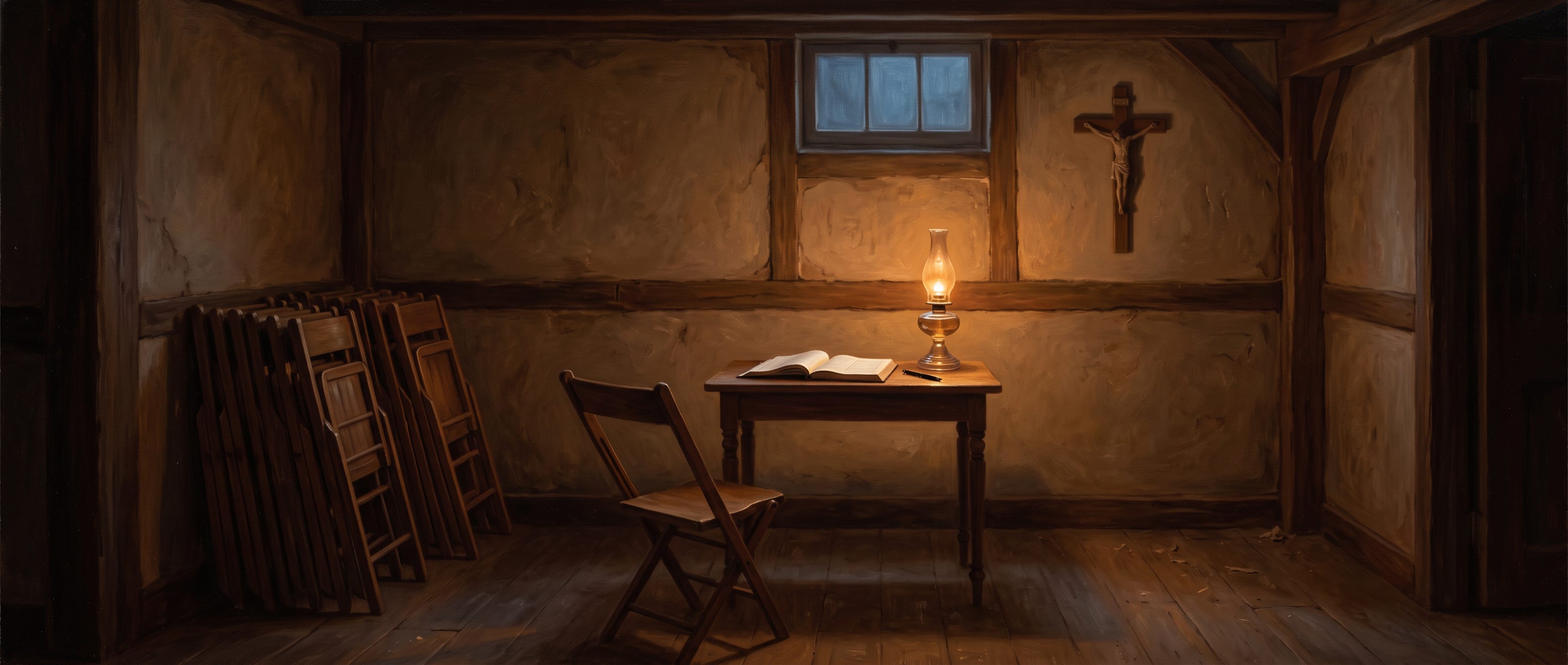
Father McGivney was folding chairs. He had been folding chairs for perhaps twenty minutes now, alone, in the low-ceilinged basement room off the sacristy stairs at St. Mary’s, and the folding was the small task he had given himself to do after the men had gone home so that he did not have to sit down. If he sat down he was going to think about what had happened. He was not sure he was ready to think about what had happened.
The men had come. He had not been sure until yesterday that they would come. He had been telling the parishioners about the meeting for six weeks - after Mass, in the sacristy, at the doors, in the small conversations that happen when a priest walks the neighborhood. He had said, there is a meeting in the basement on the second of October at seven o’clock in the evening; if you are a Catholic man of this parish, and you are willing to think with me about what to do for the widows and the orphans, come. He had said it many times. He had not known whether saying it would produce anyone. He had been prepared to hold the meeting for three men. He had prayed, in the way one prays a small anxious prayer that one does not quite name to oneself, that at least six would come. He had told his mother in a letter last week that he was hopeful for eight.
Twenty-four had come.
They had filled the basement room to the walls. They had sat on the wooden chairs he had arranged in rows, and when the chairs had run out they had stood, and when there was no more room to stand at the back they had crowded onto the stairs. He had counted them, quietly, from the small wooden desk at the front of the room. Twenty-four. He had been unable to look at his notes for the first minute of speaking because his eyes had been full and he had needed the minute to master them. He had mastered them. He had spoken. He had spoken for perhaps an hour. He had told them what he had been thinking. He had told them about the men he had buried in the past two years - Sean O’Malley, whose widow could not pay the rent and had gone with her four children back to Boston to live with her sister; Thomas Reilly, whose widow had been forced by the parish’s fund to take in laundry that had ruined her hands; Patrick Doyle, whose three sons had been placed in the orphanage on Chapel Street because their mother could not keep them. He had said the names. He had known the men. Some of the twenty-four in the room had known the men also. The room had been very quiet when he said the names.
He had told them what he was proposing. A benefit society. Catholic men only. A small dues payment each month, gathered in common, from which the widows and children of any man who died would be supported. Insurance, but insurance owned by them, structured by them, run by them, without the anti-Catholic conditions the WASP-owned insurance companies attached to their policies. Fraternity as well. Because he understood, as he understood most things about the parish, that a man who dies young leaves not only a financial gap but a spiritual one, and that the widows and children need not only money but a community of Catholic men who will look after them.
He had asked whether anyone had questions.
There had been many questions.
He had answered them.
At the end he had asked who would come back. Every hand had gone up. Every one of the twenty-four.
Then they had gone home, and now he was folding chairs.
He folded the last one. He set it on the stack against the wall. He wiped his hands on his cassock, which was a habit his mother had scolded him for since he was ten, and which he had never quite broken. He looked at the room. The room was empty. The room was still full, in a way, of the twenty-four men, in a way that he did not know how to describe to himself. He had been ordained a priest for almost four years. He had assisted at many funerals and many baptisms and many weddings. He had heard confessions in the tens of thousands. He had never before had a night like this. He was twenty-nine years old. He was going to have to sit down eventually.
There was a man sitting on one of the folded chairs.
Father McGivney had not heard him arrive, and the door of the basement had a squeak in the third hinge that made silent entry difficult, and yet a man was sitting on the top chair of the stack, with his feet on the second chair down, in the small careful way that an older priest sits when he does not want to bother a younger priest. He was wearing a black cassock of a cut McGivney did not recognize. It was Italian in some way. It was old in some way. His hair was white. His beard was short and grey. His eyes were kind and unhurried. He looked to McGivney to be perhaps sixty-five, though he had the quality that certain older priests had of looking any age one wished them to look. He was smiling faintly.
“Buona sera, figlio mio,” he said, softly.
McGivney did not respond in Italian. He had never learned Italian. He had learned Latin, of course, at St. Mary’s Seminary in Baltimore, and he could puzzle out enough of the Italian Mass texts to know what he was reading, but the vernacular Italian had never been part of his formation. He looked at the man carefully.
“Sir,” he said, in English, “I do not think we have met.”
“No. We have not.”
“How did you come in.”
“The Lord opened the door for me. He does that sometimes. It saves the effort of using the hinges. May I speak with you for a few minutes.”
McGivney looked at the man again.
He was tired. He had been on his feet for many hours. He had spoken for an hour to twenty-four men and had answered many questions and had thought quickly and prayed silently and had, at the end, been more emptied than he had been in his life. He was aware that he was not thinking clearly. He was also aware that the man in the black cassock was sitting on the top of a stack of folded chairs in his basement, at nearly ten o’clock at night, and that no man of that description had come to the meeting or been anywhere in the parish that McGivney had noticed, and that this was, therefore, either a strange visitor or something else.
“You are welcome to speak with me,” he said, carefully. “But I would ask your name first.”
“Cajetan. Of Thiene.”
McGivney stood very still.
He knew the name. He had studied the saints of the Counter-Reformation in his seminary years - not deeply, but enough to know the major figures - and Cajetan of Thiene had been one of the founders of the Theatine reform, the sixteenth-century Italian who had worked to renew the parish clergy at the time of the Protestant crisis. McGivney had, if he remembered correctly, read a small biography of Cajetan in his second year at St. Mary’s Seminary. Cajetan had founded hospitals. Cajetan had founded a bank for the poor - which had, McGivney was fairly certain, become the Bank of Naples. Cajetan had died in the 1540s, in Naples.
McGivney did not sit down. He did not fall down. He looked at the old priest on the stack of chairs.
“You are dead,” he said, softly.
“I am. For some while. Do not be alarmed. I have come with permission. I have come because tonight was your first meeting and I would like to sit with you for a little while while it settles. This is a thing older priests do for younger priests, when the Lord allows. Do not be afraid.”
“I am not afraid.”
“You are a little afraid.”
McGivney almost smiled. The almost-smile moved across his face and he mastered it, the way he had mastered his eyes at the start of the meeting.
“I am a little afraid,” he said. “You are correct.”
“Sit down, figlio mio. You will fall down soon if you do not.”
McGivney looked around the room. There were no chairs left to sit on. He had folded them all. He looked at Cajetan, who was still sitting on the top of the stack. Cajetan tilted his head at another folded chair - the second one from the top - which McGivney unfolded and set upright and sat down on. His knees, when he bent them, complained in the way his knees always complained after a long day on his feet. He was twenty-nine. His knees had been complaining since he was twenty-two, when he had walked half the state of Connecticut in one summer helping his mother move house after his father died. He rested his hands on his knees. He looked at the old priest.
“Father Cajetan,” he said. “I do not know why you are here. But I am glad. I have been alone with this for a year. I did not know I was going to have twenty-four men in the room tonight. I did not know I was going to be sitting in this basement afterward not knowing what I have done. I am glad someone is here.”
“I know.”
“You know.”
“I know because I sat in a room in Naples in the year fifteen thirty-eight, in a small oratory at the church of San Paolo Maggiore, alone, after the second organizational meeting of a small charitable lending house I had proposed to a handful of merchants and priests. Only nine men came to my meeting. Not twenty-four. But nine was enough for the lending house to begin. It was called the monte di pietà, the mountain of piety, and it was intended to lend small amounts of money to the poor of Naples who were being ruined by the moneylenders of the city, and I sat in the small room after the meeting, and I folded the chairs, and I was more tired than I had ever been in my life, and I did not know what I had done. Someone came to me also that night. His name was Bernardino of Siena. He had been dead for eighty years. He had spent his life preaching against usury, and he had come, I think, to sit with me for the same reason I have come to sit with you. He said very little. He sat. It helped. I am here to do for you what he did for me.”
McGivney did not speak for some while.
He was, he realized, weeping a little. Not much. Not sobbing. Just a small slow leak of what he had been holding through the whole meeting. He had not been able to weep during the meeting because he had needed to speak clearly. He was able to weep now because there was no one who required him to speak clearly. Except that there was someone. There was Father Cajetan, sitting on the top of a stack of folded chairs in the basement of St. Mary’s Church. Father Cajetan was not requiring him to speak clearly. Father Cajetan was letting him weep.
The old priest waited.
After a while McGivney said, “May I ask you something.”
“Anything, figlio mio.”
“The mountain of piety. The lending house. Did you live to see it become what it became.”
Cajetan looked at him for a long moment.
“I did not live to see it become the Bank of Naples, if that is what you are asking. I died in fifteen forty-seven, nine years after the founding. The house was still small when I died. It was serving perhaps a few hundred families a year. It had not yet expanded to a second location. It had not yet been imitated by other Italian cities. The imitations came in the century after my death. The Bank of Naples came in the eighteenth century, two hundred years after the founding meeting. I did not see any of it. I did not know it would happen. I died believing I had begun a small charitable work that would serve Naples for a few decades and then, most likely, fail. I was wrong about the failing. I was not wrong about not seeing. The seeing was not given to me. The seeing was given to those who came after. I am asking you to make peace with this, figlio mio. You will not see what tonight becomes. You will die at some point - I will not tell you when, though I know - and what you have begun tonight will still be a small thing. It will still be twenty-four men in New Haven. It will still be a benefit society for a single parish. It will not yet be what it will become. You are not going to see it become that. That is what the founders of things do not get. The founders begin. The others build. Do not grieve the not-seeing. It is the shape of the vocation. It is my shape. It is going to be yours.”
McGivney let out a slow breath.
“How large,” he said, softly, “will it be.”
“I have been told I may tell you this. It will be very large. It will spread across your country. It will spread across other countries. It will become, at some point in the twentieth century, the largest Catholic fraternal organization in the world. It will provide insurance for millions of Catholic men and their families. It will send men to disasters. It will fund hospitals and seminaries and schools. It will hold the Church up, in your country and elsewhere, when the Church needs holding up. It will do all of this because a young priest in a basement in New Haven refused to accept that Catholic immigrant men should be excluded from the benefits of insurance by the WASP-owned insurance companies of their era. You are not doing something small tonight, figlio mio. You are doing something that will echo. But you will not see the echo. You will die at thirty-eight years old, of a lung condition, in a parish thirty miles from here, and what you will have seen with your own eyes is a growing benefit society of a few thousand Catholic men in New England. You will not see the millions. Do not grieve. The millions will come. The seeing was not given to you. The seeing was given to those who came after.”
McGivney sat very still.
He was not weeping now. He had passed through the weeping into a stillness that he recognized from certain hours of prayer, the stillness that comes when one has been given something so much larger than one had asked for that the receiving of it takes all the interior room one has and leaves nothing left for weeping. He looked at his hands on his knees. They were the same hands they had been an hour ago. They looked different to him. They had been given a work he had not fully understood himself giving them until this moment.
“Thirty-eight,” he said.
“Yes.”
“Nine years from now.”
“Yes. In the parish at Thomaston. In the second week of August, in the year eighteen ninety. You will die of pneumonia after a bout of tuberculosis. Your funeral will be held four days later. Many of your parishioners will come. Some of the men of the Order you are founding tonight will come. They will carry you to your grave in Waterbury, in the town of your birth, and they will not know, as they carry you, what they are carrying. They will think they are carrying their beloved young pastor. They will also be carrying the founder of what will become the largest Catholic men’s organization in the world. They will not know it. You will not know it either. You will simply die at thirty-eight, having given what you had. That is the vocation. That is the shape. Make peace with it now, so that when the time comes you can die without protest.”
McGivney nodded, slowly.
He was, he realized, at peace. Not at peace in the sense of easy. At peace in the sense of resolved - the way a difficult chord in a piece of music is resolved into the tonic and the whole piece can then continue. The nine years were a chord. The chord was resolved. He would live them out. He would build the Order that would build itself. He would die at thirty-eight. Everything was, in some sense that he could not entirely articulate, arranged.
“Father Cajetan,” he said.
“Figlio mio.”
“Thank you.”
“Grazie a te. It is my privilege to have sat with you tonight. I have been waiting for permission to come for many decades. There have been several founders I have wanted to sit with. The Lord chose you. He gave me the permission. It is a joy to me. I am glad to have been sent.”
McGivney bowed his head.
“Will you pray for the Order.”
“I have been praying for the Order. I have been praying for it since the Lord told me your name, which was some years ago. I will continue to pray. I will pray for every widow it supports. I will pray for every child it helps educate. I will pray for every Supreme Knight who will come after you. I will pray for the seventh council of it, in the year two thousand and thirty-something, whose particular meeting I will have the joy of attending in the way I have attended tonight, though of course they will not see me. I will pray. This is a joy to me, figlio mio. It is what the older founders do for the younger. It is what the Lord permits.”
He rose from the stack of chairs.
He came down and stood in front of McGivney, and he laid his hand on McGivney’s head, in the small gesture of blessing that older priests give to younger priests when both know that the younger is being sent. His hand was warm. McGivney closed his eyes.
“Vai in pace, figlio mio. Fai il lavoro. Fidati del non-vedere. Il Signore è con te.”
McGivney did not entirely understand the Italian, but he understood enough. Go in peace, my son. Do the work. Trust the not-seeing. The Lord is with you.
He opened his eyes.
The stack of chairs was still there. The room was empty. Father Cajetan was gone. The small oil lamp on the table by the door was still burning.
Father McGivney sat on the folded chair for some while.
Then he rose. He blew out the lamp. He climbed the sacristy stairs. He walked back to the rectory. He wrote a letter to his mother that night, before he slept - a short letter, saying only that the meeting had gone well, that twenty-four men had come, and that he had been given, unexpectedly, a great gladness at the end of the evening. He did not tell her about Father Cajetan. He would not tell anyone about Father Cajetan. Some things a priest keeps.
He slept.
The Order grew.
By the time of Father McGivney’s death nine years later, on August fourteenth, 1890, in the rectory at St. Thomas Church in Thomaston, at the age of thirty-eight, the Knights of Columbus had established forty-three councils across Connecticut, Massachusetts, and Rhode Island, with several thousand members. He was carried to his grave in Waterbury by men of the Order, as Cajetan had said. Many of his parishioners came, and some of his brother priests, and a small crowd of the twenty-four founding members, and the widows of the men whose funerals he had presided over during his years at St. Mary’s, several of whom had been helped by the small early insurance fund of the Order that Father McGivney had made sure they received before the fund was even fully organized. The men who carried him did not know what they were carrying. That was, as Cajetan had said, the shape.
The Order continued to grow after him. By 1900, it had crossed into every state of the Northeast. By 1910, it was in every state. By 1920, it was international. By the beginning of the twenty-first century, it had over one and a half million members. It supported widows and orphans. It funded seminaries. It built hospitals. It sent aid to disaster zones. It provided insurance to Catholic families in dozens of countries.
Blessed Michael McGivney was beatified on October 31, 2020, at the Cathedral of St. Joseph in Hartford, by Cardinal Joseph Tobin on behalf of Pope Francis, on the eve of All Saints. The miracle that led to his beatification was the healing of an unborn child of an insurance agent of the Order.
The insurance agent of the Order. Cajetan, in the room where he is, smiled when he heard.
He had been to seven organizational meetings of the Order over the decades. He had sat quietly in the back of each of them. No one had seen him. He had blessed each one silently. He had been keeping his promise to Father McGivney.
He would keep it into the next century.
He would keep it until the Lord came back.
The lamp in the basement at St. Mary’s burned out at dawn, as lamps do, on the morning of October third, 1881. The sacristan renewed the oil at Matins. The room was cleaned. The chairs were unfolded and set back in their rows for the next meeting, which was to be held on the sixteenth of October, and to which thirty-six men would come.
The mountain was being built.
The founder had begun.
The seeing was not for him.
The founding was.
For your prayer this week: Blessed Michael McGivney and Saint Cajetan of Thiene, you who founded the mountain of piety in Naples and you who founded the Knights of Columbus in New Haven, you who died before you saw what your work became, pray for those of us who have begun small things and cannot yet see what they will become. Grant us the grace to make peace with the not-seeing, to trust that the mountain is being built, and to do the work of tonight without needing to know what tonight will become. Amen.
Two Lamps returns next Friday: Saint Maximilian Kolbe and Saint Maximilian the Martyr, cell 18 of block 11 at Auschwitz, the night of August 14, 1941.
Two Lamps is a weekly short story braiding the lives of two or three saints across the centuries. Sometimes the meeting is rendered as an encounter in eternity. Sometimes as the older saint coming, in vision or in patronage, to the soul of the younger. The text does not decide for you. The Communion of Saints is the doctrine that holds these meetings as theologically real even when the meeting itself is imagined.
A note from the author: I have been a Knight of Columbus for many years. To write this issue in Father McGivney’s company - in the basement of his own church, on the night of his first organizational meeting - has been a particular privilege. Brother Knights, pray for me. And thank you, Blessed Michael, for what you began. The mountain is still being built.
Two Lamps is written by Deacon Michael Halbrook, a permanent deacon of the Diocese of Springfield in Illinois, serving at St. Elizabeth Parish in Granite City. He writes personally at DeaconMichael.net, serves families through Domus Formation, and publishes the serial novel Ordo: A Chronicle of Lux Perpetua at LuxPerpetua.net. Two Lamps is co-conceived with his son Joseph.
Wow wow wow💕💕💕