

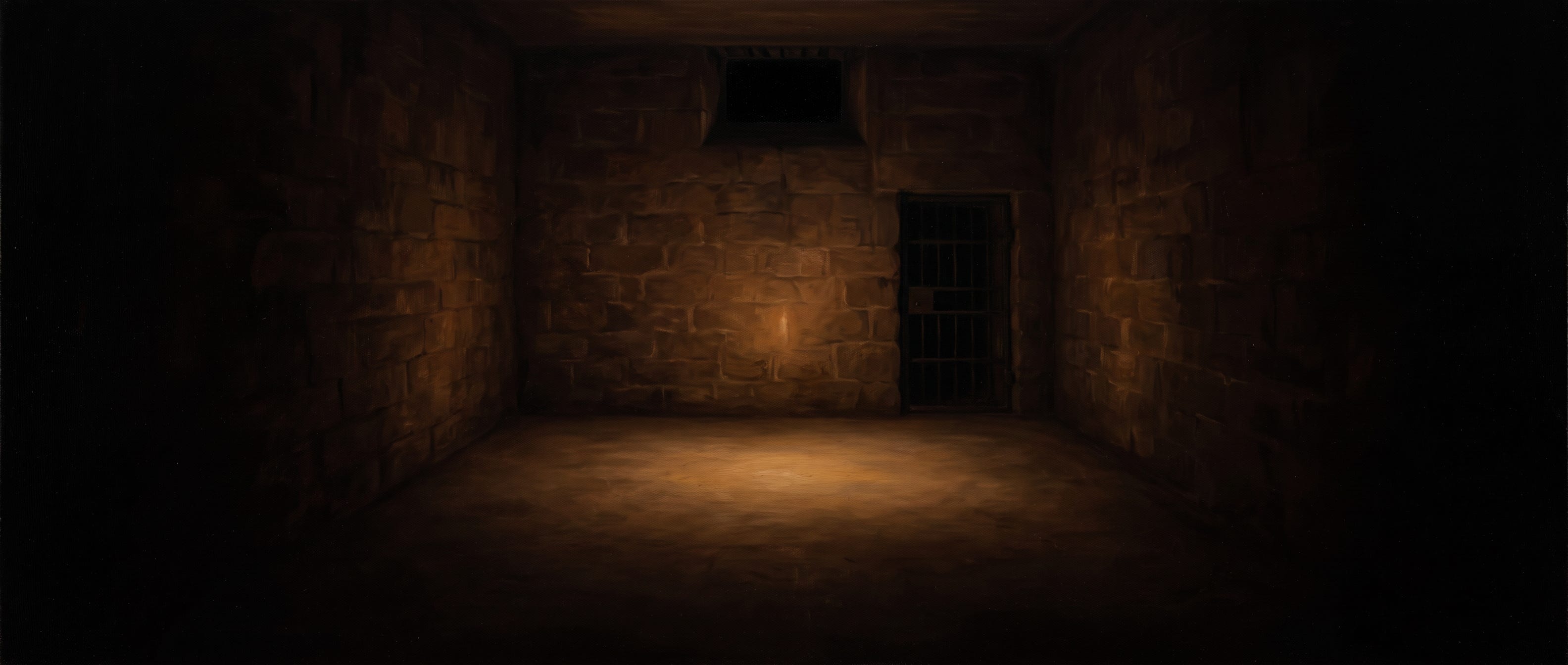
There were four of them left.
Father Kolbe lay on the concrete floor of the small windowless cell in the basement of block 11, in the section of the camp that the prisoners called the death block, and the four of them who were still alive were arranged around the walls of the cell in the way that men who cannot stand any longer arrange themselves - each in the corner or against the wall where he had found himself when he had last been able to move. There was Sigmund by the door. There was Adolf under the small ventilation opening near the ceiling, from which no meaningful air came. There was Jozef against the wall opposite the door, sitting up because he had been sitting up when he had lost the strength to lie down and had not been able to lie down since. There was Father Kolbe, propped in the corner by the door hinge, with his hands folded in his lap.
The other six had died at various points over the past two weeks. Father Kolbe had heard the last confession of each. He had prayed the small prayers of the dying with each. He had sung the Ave Maris Stella over each. His voice had begun to fail him yesterday, so he had sung the last one - poor Kazimierz, who had died at some hour of the previous evening - very softly, with the small breath he had. The Latin was almost unrecognizable at the end. Kazimierz had understood. Kazimierz had smiled a little, and Father Kolbe had blessed him, and Kazimierz had gone.
There were four left.
Father Kolbe did not think he would live to see another dusk. The guards had been coming daily now to check the bunker. They had made no secret of their impatience. The cell was needed. Others would be selected soon in reprisal for some other escape, some other rule broken, some other whim of the camp administration, and the four of them were in the way of what came next. Father Kolbe had heard the German doctor speaking with an SS officer in the corridor yesterday morning. He had not caught all the words. He had caught enough. Phenol. Injection. The heart. He knew what phenol was. He had studied enough medicine at the Franciscan seminary to know what phenol did to a man. A quick death. A cruel one, but quick. He was, he found, grateful. Two weeks in the bunker was long enough. His body was ready.
He had been thinking, in the past hours, about his mother.
She was in Poland still, somewhere - he was not sure whether she was alive or dead. The Nazis had been arresting Franciscans since 1939, and Niepokalanów had been shut down in February 1941, and the friars had been dispersed. He had not had word of her in many months. He hoped she was alive. He hoped she would forgive the Lord for what was happening to her son. He hoped, though this was harder to hope for, that she would be able to remember him as the child who had received the vision of the two crowns at the age of twelve, and had chosen both, and had spent thirty-five years since then living out the choice. He had been given the white crown at eight years old in the same vision when Our Lady had also offered the red. He had accepted both. He had said yes to both without knowing what either would be. The white had turned out to be the priesthood and Niepokalanów and the Militia Immaculatae and the mission to Japan and the small daily obediences of a Franciscan life. The red had turned out to be this. He had not, at twelve, known that the red would come in a basement at Auschwitz. He had said yes anyway. The saying yes had been the whole gift.
He whispered, in Polish, Matko, przebacz Jemu. Jeśli możesz. Mother, forgive Him. If you can.
He was not sure whether he meant his own mother, or the Mother of God, or both. He was not sure it mattered. The prayer was the same prayer.
There was a young man sitting cross-legged on the concrete floor across from him.
Father Kolbe had not heard him come in. The door of the cell was solid iron and had a small barred opening at eye level through which the guards checked on the prisoners. The door had not opened. And yet a young man was sitting on the floor of the cell, cross-legged, in a plain undyed woolen tunic that reached to his knees, with a wide leather belt and short leather sandals. His hair was dark and short. His face was young and steady. He was perhaps twenty. Perhaps twenty-one. The tunic was old in some way. It was not merely worn old. It was old in style - the style of a Roman tunic of the late third century, of the North African provinces, which Father Kolbe had seen in the illustrated books of the Franciscan library at Rome during his student years. The young man’s arms were bare. His forearms had the small scars of a boy who had worked with his hands. He was looking at Father Kolbe.
Father Kolbe looked back.
He did not, immediately, know what to make of the young man. He was too tired for the small work of interpreting hallucinations, which he had experienced in the past several days as the dehydration had progressed, and which he had learned to notice and let pass without giving them attention. He assumed this was another one. He looked at the young man for a while to see whether he would fade.
The young man did not fade.
The young man smiled at him, slightly.
“Brother,” the young man said, in Latin.
His Latin was strange. It was not the Church Latin Father Kolbe had learned at Rome, and it was not the classical Latin of Cicero he had struggled with as a boy at the seminary in Lwów. It was a Latin from somewhere between them, a Latin of the late Roman North African provinces, with a small quick Berber inflection under it. Father Kolbe understood him entirely. He heard the strangeness in the Latin and yet the words landed clearly.
“Brother,” he answered, also in Latin, in a voice so weak that he was surprised he had produced words at all.
“You are Maximilian.”
“Yes.”
“I also am Maximilian.”
Father Kolbe was silent for a moment. His mind was very slow. But it was still working, and it worked now, slowly, to the small realization that had been coming.
“You are the other one,” he said.
“I am the other one.”
“From Theveste. Numidia. Under Diocletian. In the year - “
“Two hundred and ninety-five. On the twelfth of March. I was twenty-one. I was born in the year two hundred and seventy-four to a father named Fabius Victor, who was a Christian and a soldier and a temonarius - a small tax collector for the outfitting of Roman recruits. He was obliged, when I turned twenty-one, to present me to the recruiting agent for the third Augustan legion, which was stationed at Lambaesis. He did present me. I refused to be enlisted. I refused because I was a Christian and because I could not wear the bulla - the leaden disc with the emperor’s image - around my neck, and because I could not swear the military oath, and because I believed then, as I believe now, that the followers of Our Lord do not bear arms for the empire. The proconsul, Cassius Dion, ordered me to be sworn in. I refused. He ordered me to be sworn in again. I refused again. He read out the penalty. I said I did not fear the penalty. He ordered me beheaded. The soldiers took me to the place of execution outside the city. My father followed me and blessed me. I was beheaded by the sword. My father went home to my mother and told her that the Lord had allowed him to send a gift to heaven. He said this cheerfully. He was a good man. I have been waiting a long time to come and see you.”
Father Kolbe closed his eyes for a moment. When he opened them the young Roman was still there.
“Why me,” Father Kolbe said, softly.
“Because we have the same name. Because we did the same thing. Because they have been telling me, in the room where I have been, that another Maximilian would come who would refuse the empire again, and I have been asking, when may I go and see him, and they have said, not yet, not yet, he has not yet been born, he is a child in Poland, he is a young Franciscan in Rome, he is in a Japanese mission, he is back in Poland, he is in Warsaw, he is in Pawiak prison, he is in Auschwitz, he is in the bunker of block eleven, now, brother, now you may go. So I have come. I have come tonight because tonight is the night. I have come to sit with you until they come with the phenol. I have come to walk you home.”
Father Kolbe felt something in his chest that had not been there a moment ago. It was not fear. It was not grief. It was, he thought, a kind of small warm recognition that he had not been alone in this bunker for the past two weeks and was not alone tonight and would not be alone tomorrow when the doctor came with the syringe. He had been carrying nine other men through their dying. He was being carried through his own by a boy from Numidia who had died sixteen hundred and forty-six years earlier and who had come now, wearing a Roman tunic, to sit on the concrete floor of cell 18 of block 11 of the Auschwitz concentration camp of the Third Reich of the German nation.
“Brother Maximilian,” he said.
“Brother Maximilian.”
Neither smiled. But there was, in the small darkness of the cell, something that felt like smiling.
“We refused the same thing,” the young Roman said, after a while.
“Yes.”
“You did not know you were refusing the same thing.”
“No. I have known about you since my seminary years. I have not thought about you often. I did not know you were watching.”
“I have been watching. I have watched every Christian who has refused the empire’s claim on his body. There have been many of us over the centuries. Not many at any one moment. Many across all the moments. I have kept a small list.”
“Show me the list.”
“I will not show you the list. Not now. You will see it when you come home. It is a longer list than you will expect. It includes people you have not heard of. It includes people who did not know they were refusing. It includes some who refused only in their last hour. The Lord counts many kinds of refusal. He is generous about it. I have found this to be one of the more comforting things about the room where I am. The counting is not what we had thought it would be. The counting is much wider.”
Father Kolbe let out a small slow breath.
He had, in the past two weeks, had many long hours to think about what refusal meant. He had refused the empire’s claim on his life by volunteering to take the place of Franciszek Gajowniczek in the selection two weeks ago. He had understood, when he stepped forward, that he was refusing something. He had not been entirely clear about what. He had thought at the time it was a small refusal - he had traded himself for a father of two sons because Gajowniczek had cried out about his wife and children, and because Father Kolbe was a priest without wife or children and had less to lose in the visible sense. He had thought of it as a substitution rather than a refusal. But looking back over the past two weeks, watching the six other men die around him, hearing their confessions, singing their Ave Maris Stella, he had come to understand that the substitution had also been a refusal. He had refused to accept the Reich’s arithmetic, in which nine men and a priest would starve to serve the Reich’s need for a spectacle of intimidation. He had refused by taking Gajowniczek’s place. He had refused by being one who chose rather than one who was chosen. He had refused by making the ten into nine-plus-a-volunteer, which was a different mathematics than what the SS had intended.
He had done what the boy from Numidia had done in his own way. Neither had submitted.
“You refused the bulla,” Father Kolbe said, softly.
“Yes. I refused the bulla.”
“You would not wear the emperor’s image around your neck.”
“No. It was idolatry. The emperor had had no right to the image. The image belonged to Our Lord.”
“I did not have to refuse the bulla. I had to refuse the arithmetic. It is the same refusal. The empire changes what it asks for. The refusal is the same.”
The young Roman nodded, slowly.
“Yes,” he said. “It is always the same refusal. The empire is always asking for the body. The Christian is always giving the body only to the Lord.”
They were quiet for a while.
Somewhere far above the basement, in another block of the camp, a whistle blew for some transfer of prisoners, and the small sound came down through the concrete and the earth and the layers of stone to the small dark cell where the two Maximilians sat. Father Kolbe closed his eyes. He was very tired. But the tiredness was different now than it had been an hour ago. He had a companion. The companion had come a long way. The companion was going to walk him home.
“Brother,” he said, without opening his eyes.
“Yes.”
“Tell me about the beheading. Was it - was it hard.”
“It was quick. My father was watching. My father was pleased. That made it easier. Not everyone has a father who is watching and is pleased. If your father were watching, I think he would also be pleased. From what I have heard, he is watching. He has been watching for years now. He is one of the ones in the room. He was a weaver in Poland. He died when you were young. He has been asking for permission to come with me tonight but the Lord has said he should wait and greet you in the room. He will greet you in the room. He is very proud. Your mother will greet you when it is her time. She will not be far behind you. I am sorry - the Lord has permitted me to tell you this - she will not be far behind you. Please forgive Him. She will be well cared for in the interim. Many are praying for her.”
Father Kolbe was weeping.
He was weeping in the way that men weep when they have run out of water in their bodies. There were no tears. There was only the small movement of the shoulders that would have been weeping if his body had still had the ability to make tears. He wept without tears for perhaps a minute. Then he stopped. He opened his eyes.
“Thank you, brother,” he whispered.
“Brother.”
The other three men in the cell were silent. Sigmund by the door was breathing very slowly. Adolf under the ventilation opening had been silent for some hours. Jozef against the wall was drifting between what small consciousness he had and unconsciousness. None of them could see the boy from Numidia. Father Kolbe understood that this was correct. The visit was for him. The others were being attended by others, whom he could not see. Every soul had its attending. This was one of the arrangements.
“The Ave Maria,” Father Kolbe said, softly.
“Yes.”
“That will be my last word. Tomorrow. When the doctor comes with the syringe. I will lift my left arm - the arm I always lift for the Consecration - I will lift it toward him and I will let him give the injection, and I will say Ave Maria as the phenol enters. That will be my last word.”
“Yes. That will be your last word. I know. I have been told.”
“You will be here.”
“I will be here. I will be sitting where I am now, in this same corner. I will not leave. I have come to walk you home. When you say Ave Maria, I will rise. You will rise with me. We will leave the cell together. We will go through the door in the way that the ones on our side of it move, and we will walk up the stairs of block eleven, and we will walk out through the camp gate, and we will not stop walking. We will walk together to where the room is. Your father will be at the door. Our Lady will be behind him. Our Lord will be behind her. We will walk in. You will kneel. He will lift you up. He will laugh. Thomas has told the other Maximilians about the laughing. It is true. He will laugh. He has been waiting to laugh at you for a very long time, brother. He is very fond of you. That is what I have come to tell you tonight. The Lord is very fond of you. He has been fond of you since you were a small boy in Zduńska Wola. He was fond of you when you accepted the two crowns from His Mother. He was fond of you at every Mass you ever said. He was fond of you when you stepped out of the line two weeks ago and took Gajowniczek’s place. He has been fond of you for every day of the two weeks in this cell, watching you attend the other men. He is very fond of you. He is waiting to laugh at you. Do not be afraid of the laughing. The laughing is the welcome.”
Father Kolbe smiled.
It was a very small smile. His face did not have the moisture left in it to smile widely. But the smile happened. The boy from Numidia saw it. The boy from Numidia smiled back.
“Brother Maximilian,” Father Kolbe whispered.
“Brother Maximilian.”
They sat quietly through the rest of the night.
At some point Sigmund by the door stopped breathing. Father Kolbe noticed. The boy from Numidia noticed also, and inclined his head in a small blessing that the guards, when they came in the morning, would not see. Sigmund’s soul went. It was attended by someone the boy from Numidia recognized but did not name. Father Kolbe was not curious. The attendings were being arranged. He would understand them all soon enough.
The hours passed.
Somewhere near dawn, Father Kolbe prayed the small silent Mass he had been praying in his head every day of the two weeks in the bunker, without bread and without wine, in the way that a priest without altar prays. He said the Suscipe silently as he had learned to say it in his Franciscan formation. He said the Confiteor. He said the Introit, which was, on this the vigil of the Assumption, from the sixteenth verse of the twenty-first chapter of Sirach: In sanctitate mea et beatitudine perseveravi. In holiness and blessedness I have persevered. He said the readings from memory. He said the Preface for the Assumption. He said the Sanctus. He said the Canon. He said the words of Consecration silently, over the wafer of nothing and the cup of nothing, and he received the Body and Blood of Our Lord in the way that men without species receive - by faith, by desire, by the Lord’s condescension to His friends who cannot get to Him by any other means. The Mass ended. He said the Ite, missa est. The boy from Numidia bowed to the invisible altar. The Mass was over.
The morning came.
At noon the door opened. The doctor came in with the German named Bock and a syringe of phenol. Bock looked at the four bodies. Three were dead. One was propped in the corner by the door hinge. That one was Kolbe. Bock came to Kolbe. Kolbe lifted his left arm - the arm he had always lifted for the Consecration. Bock inserted the needle. Kolbe whispered, very quietly, so that only Bock heard and only Bock could remember it later, Ave Maria.
The phenol entered.
Kolbe went.
The boy from Numidia rose from the corner where he had been sitting. He held out his hand. Kolbe rose beside him. They walked together through the door of the cell, through the corridor of block 11, up the stairs, out through the courtyard, past the guards who did not see them, through the gate that said Arbeit macht frei, and beyond the camp, and they did not stop walking, and they walked for what seemed a while and no time at all, and they came to the door.
Fabius Victor was at the door. He was young. He was smiling.
Behind him was another man, older, with the hands of a Polish weaver. He was also smiling. He was crying a little in the way fathers cry when a son they have not seen in a long time arrives.
Behind them was Our Lady. She was holding both crowns in her hands - the white one and the red one - and she was smiling in the way she had smiled at Maximilian when he was twelve.
Behind her was the Lord.
The Lord was laughing.
The laughing was, as the boy from Numidia had promised, the welcome.
Kolbe walked in.
His body was cremated at Auschwitz on the fifteenth of August, 1941, the feast of the Assumption of the Blessed Virgin Mary. His ashes were dumped in a marshy area outside the camp. The site is not marked. It does not need to be. He is not there.
Franciszek Gajowniczek survived the war. He lived until 1995. He told the story of Father Kolbe’s substitution many hundreds of times over the decades - at retreats, at parishes, at conferences, at the beatification ceremony in 1971, at the canonization ceremony in 1982. He would say, whenever he told it, that he could not entirely believe that a man he had never met had stepped forward to die in his place. He said it always with wonder. Father Kolbe, in the room where he was, listened each time. He was still very fond of Gajowniczek. Fondness continues.
Saint Maximilian Kolbe was canonized by Pope Saint John Paul II on the tenth of October, 1982, in St. Peter’s Square, before a crowd that included Gajowniczek and his sons. John Paul II declared Kolbe a martyr of charity. His feast is August 14, the anniversary of his death.
Saint Maximilian of Theveste has been keeping his list. He continues to keep it. The list has grown longer since 1941. The refusals continue. The empire keeps asking for the body. The Christians keep giving the body only to the Lord. Some refuse the bulla. Some refuse the arithmetic. Some refuse both. The counting, as the boy from Numidia said, is much wider than we have been told.
The lamp in cell 18 of block 11 at Auschwitz burned out at dawn, as lamps do, on the morning of August 14, 1941. There was no lamp. But if there had been a lamp, it would have burned out at dawn.
The two Maximilians walked home together.
The room received them.
The Lord laughed.
For your prayer this week: Saint Maximilian Kolbe and Saint Maximilian of Theveste, you who refused the emperor’s image and you who refused the arithmetic of the camp, you who died at twenty-one and you who died at forty-seven, pray for those of us who live in empires that keep asking for the body. Grant us the grace to know when we are being asked to refuse, the courage to refuse when the moment comes, and the peace of knowing that the counting is much wider than the counting we have been told. Grant us, when our own hour comes, a brother from Numidia to walk us home. Amen.
Two Lamps returns next Friday: Saint Alberto Hurtado and Saint Bernard of Clairvaux, the Jesuit residence at Santiago, Chile, an afternoon in October 1951.
Two Lamps is a weekly short story braiding the lives of two or three saints across the centuries. Sometimes the meeting is rendered as an encounter in eternity. Sometimes as the older saint coming, in vision or in patronage, to the soul of the younger. The text does not decide for you. The Communion of Saints is the doctrine that holds these meetings as theologically real even when the meeting itself is imagined.
Two Lamps is written by Deacon Michael Halbrook, a permanent deacon of the Diocese of Springfield in Illinois, serving at St. Elizabeth Parish in Granite City. He writes personally at DeaconMichael.net, serves families through Domus Formation, and publishes the serial novel Ordo: A Chronicle of Lux Perpetua at LuxPerpetua.net. Two Lamps is co-conceived with his son Joseph.