

The word had come at sunset.
The lookout on the tower at San Felipe had sighted a Portuguese ship in the late afternoon, standing perhaps three leagues off the coast, running before a southwest wind, and the runner had come up from the docks to the Jesuit residence at the eighth hour of the evening with the estimate: mid-morning tomorrow, wind holding, perhaps ten o’clock, the ship carrying slaves from Angola, three hundred at the departure, no one knew how many now. The runner had been given a piece of bread and a cup of wine at the porter’s lodge and had gone back down the hill to the docks. The porter had come up to Peter Claver’s cell and had knocked twice and had told him.
Peter Claver had thanked the porter.
He had closed the door.
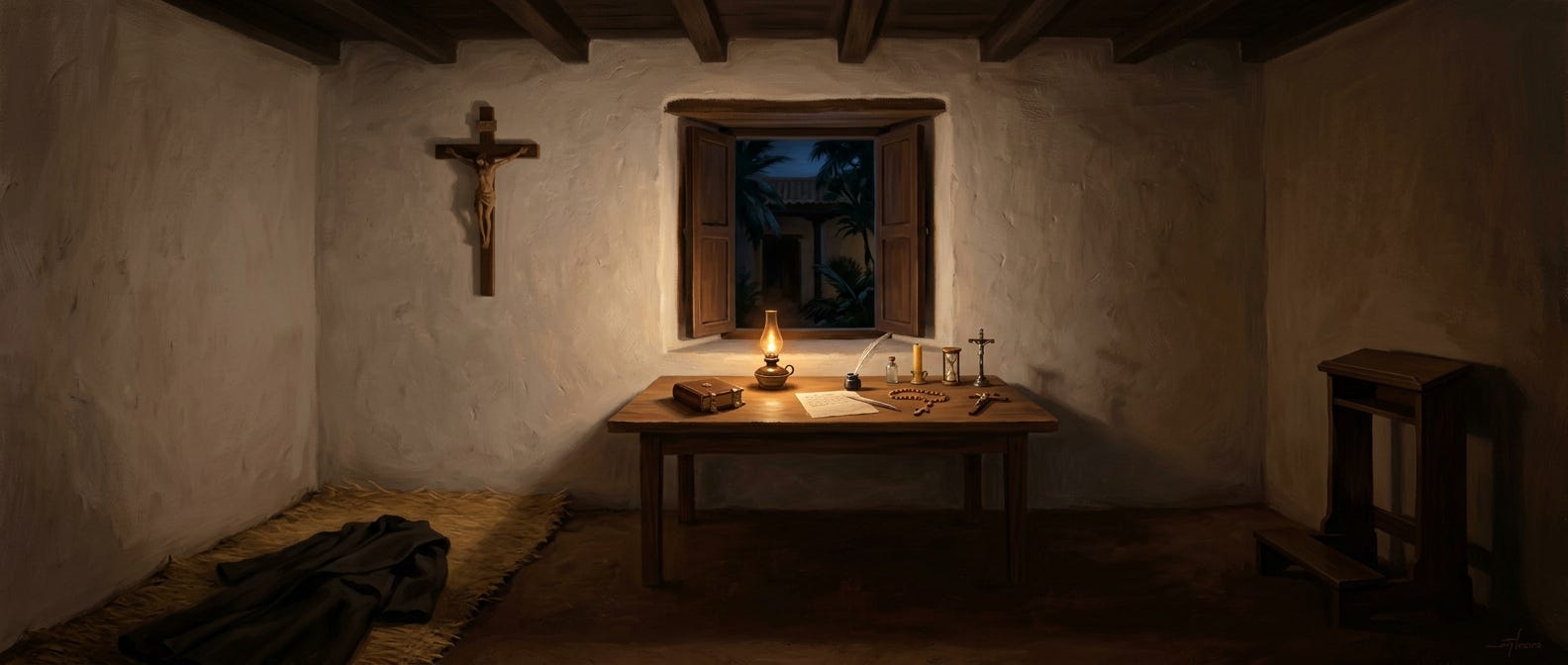
He had knelt at the wooden prie-dieu in the corner of his cell for some minutes without moving. He had said nothing aloud. He had said, interiorly, the formal prayer he had said before every ship for fifteen years now - Domine, dona mihi cor tuum. Da mihi manus tuas. Ostende mihi hominem in illo qui ad me venit. Lord, give me Your heart. Give me Your hands. Show me the man in the one who is coming to me. It was the prayer he had composed for himself the first year, after the first ship, when he had come back to his cell shaking and had understood that he needed a prayer he could say every time and that would be always the same and that would be strong enough for the going. The prayer had held. He had said it perhaps four hundred times now, before four hundred ships. He said it now.
He rose from the prie-dieu.
He crossed the cell to the plain wooden table under the narrow window. The window was open to the courtyard. The Caribbean night was warm and heavy with the smells of the port - salt, tar, rotting fish from the fisherman’s quarter, jasmine from the gardens of the wealthier houses higher on the hill. Somewhere in the courtyard one of the brothers was chanting Compline quietly for himself. A single insect ticked against the oil lamp on the table. The city was settling into its evening.
He began to lay out the supplies.
He had done this before every ship for fifteen years. He knew where each item was without looking - which of the shelves in the cell held the biscuits, which held the linen bandages, which held the jars of lemon juice cut with raw sugar that he brought aboard for the men and women with scurvy, which held the tobacco leaves, which held the pouches of quinine bark ground fine, which held the leather bag with his stole and the silver container of the holy oil and the smaller container of the holy water for baptism. He knew the location of each in the way a soldier knows where his weapons are. The knowing was old. He did not need to think.
He laid them out on the table. Nine items. He counted them as he set them down. The Jesuit training - the Ignatian training - had taught him to count things when he set them down, so that he would know at a glance what was there and what was missing. Everything was there. He would carry them tomorrow. He would carry them down the hill to the docks. He would board the small craft that would row out to meet the Portuguese ship as it entered the outer harbor, and he would climb up the side of the ship on the rope ladder, and he would go into the hold, and he would begin.
He sat down on the low stool by the table.
He was, he realized, very tired.
The tiredness was older than the day. It was the tiredness of fifteen years of ships. It came when he sat down before a supply table and knew that in the morning he would board another ship and would enter another hold and would see what he had seen many times, and that no matter what he did on the ship or in the days after, the trade would continue, and next month there would be another ship, and the month after that another, and this would not end in his lifetime.
He whispered, in Spanish, “Dios mío. Cuánto tiempo.”
My God. How long.
“Not so long as you fear, brother. Not so short as you have hoped.”
Peter Claver turned his head slowly.
There was a man sitting on the straw mat in the corner where he slept, cross-legged, in a plain black tunic that was neither Jesuit nor Franciscan nor any of the habits of Cartagena. The man was perhaps thirty. His face was thin and dark-eyed and had the look of someone who had spent years eating very little. His head was tonsured in a way Peter Claver had not seen except in illustrated books - not the Roman tonsure, not the Celtic, but the older tonsure of the eastern monks, a circular cutting at the crown. His feet were bare and dusty. He was looking at Peter Claver with a directness that was neither threatening nor kind but was very steady.
Peter Claver knew immediately who he was. He was not sure how he knew. He knew.
He whispered, in Latin, “Chrysostomus.”
The man inclined his head.
“Petrus Claver,” he answered. His Latin was odd. It was Latin filtered through the Greek that had been his first language, with a quick Antiochene rhythm in the vowels. “May I sit with you for a while.”
“You are sitting.”
“Yes. But it is polite to ask.”
“Please. Sit. Do you want water. I have water.”
“I do not need water. Thank you. I have been given permission to visit for perhaps an hour. Then I go back. Do not offer me hospitality. It is not necessary. Only tell me about your ship.”
Peter Claver looked at the man for another moment. He was not entirely sure he was awake. He had had strange visitations in the past years - moments when his prayer had gone very deep and figures had come to him in the periphery of his interior sight - but he had never had one that sat on his mat and asked to be told about a ship. He decided to proceed as though the visitor were real. If the visitor were not real, the proceeding would harm nothing. If the visitor were real, the not-proceeding would harm much.
“The ship,” he said. “A Portuguese vessel. From Angola. Three hundred souls at the departure. There will be fewer now. There are always fewer. The voyage takes six or seven weeks. A third is not uncommon. She will be at the outer harbor by mid-morning. I will go out to meet her in a small craft. I will board her before she reaches the docks. I will go into the hold. I will bring water and lemon juice and biscuits and a little tobacco. I will bring the medicines that I have. I will bring my interpreters, who are men and women who were themselves brought here on similar ships in earlier years. I will attend to the dying first. I will baptize those who wish it and who can be brought to understand what baptism is through the interpreters. I will nurse the sick. I will bring the worst cases to the hospital of San Sebastián in the afternoon. I will return to the ship for two or three days after, until all who arrived on her have been sold or moved to the pens. I will visit the pens. That is what I will do tomorrow. It is what I have done four hundred times.”
Chrysostom listened without interrupting.
When Peter Claver had finished he sat quietly for perhaps a full minute. He looked at the table with the nine items laid out. He looked at the cloak folded neatly at the end of the mat, which Peter Claver used for many purposes on the ships and had used to cover the naked shoulders of many hundreds of people. He looked at Peter Claver’s hands, which were calloused and had scars from working with rope and from the cuts that came from working in the holds where iron and wood tore at anyone who moved through them. He looked at Peter Claver’s face.
Then he said, “Brother. I would like to tell you something that I think you already know but that I have been sent to say to you anyway. It is what I have been given to bring.”
“Please.”
“I preached against an empress. Her name was Eudoxia. She was the wife of the emperor Arcadius in the imperial city of Constantinople in the year four hundred, more or less. She was building a very large silver statue of herself in the square outside the great church where I preached. She was throwing games in the hippodrome that drew the crowds away from the liturgy. She was accepting gifts from wealthy landowners that she should not have accepted. She was permitting practices at the court that were - “ he paused - “they were not what a Christian court ought to have permitted. I preached against her. I did not name her at first. I preached against luxury, against the misuse of the poor, against the theatrical entertainments that consumed the imperial treasury while the poor of Constantinople slept in the porticoes of my basilica. She understood I was preaching against her. She sent word that I should stop. I did not stop. I named her by name in a homily in the year four hundred and three. I said, from the pulpit, that Herodias was again dancing, and that she was demanding again the head of John. She had me deposed by a synod of my enemies later that year. I was exiled to a small town in Armenia. I preached to the people there for two years. I wrote letters to the great cities of the empire from that exile. My letters had influence. Eudoxia had me exiled again in four hundred and seven, this time to the far edge of the empire, to Pityus on the eastern coast of the Black Sea. I did not arrive at Pityus. The soldiers escorting me forced me to walk in the sun without hat or cover for many days, until I collapsed. I died at Comana in Pontus on the road, on the fourteenth of September. I was fifty-nine. My last words were Glory to God for all things. I mean it literally. That was what I said, and I have concluded, in the centuries since, that it was true.”
He paused.
“That is what I did,” he said. “I preached against an empress with my mouth. I was killed for it, slowly, on a road. I want you to understand: I preached with my mouth because the Lord had given me a mouth that could preach. He is called Chrysostom because my mouth was one of the tools the Lord had made. I was proud of the mouth. I was proud in the wrong way sometimes. I have been forgiven for the pride. But the mouth was the instrument. I used it against the empress and against the court and against the imperial economy that ran on the labor of slaves and prisoners and the exploited poor. The empress killed me for the using. That is my story. Now I want to say the thing I was sent to say.”
Peter Claver waited.
“You are preaching against an empire also, brother. You are preaching with your body. You are going into the holds of ships. You are climbing rope ladders into places no honorable man of Cartagena will go. You are washing the vomit and the excrement from human beings whom the empire has decided are property. You are giving them the name that Herod could not take from John - the name of son, the name of daughter, the name of sister, the name of brother. You are calling them by their names. The empire wishes them to have no names. You are giving them names. That is the preaching. That is what your body is saying, every time it goes down into a hold. Your body is saying to the empire, these are not what you say they are. These are not property. These are not cargo. These are the beloved of the Lord. I will treat them as such. You cannot make me treat them otherwise. That is the sermon you are preaching. It is being preached in Cartagena the way I preached in Constantinople. The instruments are different. The sermon is the same. I have come to tell you this because I do not think you have entirely realized it. You have thought of yourself as an ordinary priest doing a difficult ministry. You are not. You are one of the great preachers of the age. You preach with your body. The Lord uses both instruments. Do not be tempted to think that only the mouth counts. The body counts also. The body counts often more.”
Peter Claver was silent for a long time.
The insect at the lamp had gone quiet. The chanting in the courtyard had ended. The harbor was quiet at this hour, though the tide could be heard faintly moving against the sea wall in the distance. Peter Claver looked at his hands folded in his lap. He looked at the nine items on the table. He looked at the folded cloak.
He said, “I have wondered whether it is enough.”
“You have wondered whether meeting each ship is enough. Whether one priest with one bag of biscuits can matter against an economy that moves ten thousand people through this port every year.”
“Yes.”
“It cannot end the economy. I want to say that plainly. You cannot end the trade. The Lord did not send you to end the trade. He sent you to be present to the ones who arrive on it. The ending of the trade is His matter. It will take centuries. He is not in a hurry in the way we are in a hurry. He is very patient. The ending will come through many voices and many bodies and many refusals across many centuries. My voice was one. Your body is another. There will be many more - lawyers, theologians, enslaved people who become preachers themselves, popes who will finally say the words that should have been said in the century when your ships were arriving but were not said then because the Church did not yet see clearly what it was seeing. The trade will end. It will not end in your lifetime. It will not end for two hundred years after your lifetime. That is difficult but it is the truth. Your work is to meet the ships. The ending is His. Do not confuse the two. Meeting the ships is the whole of your vocation. Release the ending to Him.”
Peter Claver was weeping. He did not try to stop it. Chrysostom did not comment. He sat quietly. He was in the habit of letting men weep when they needed to weep, and he had been sitting with weeping people for a long time in the room where he lived now.
After some time Peter Claver said, “Brother Chrysostom.”
“Yes.”
“You died on a road.”
“Yes.”
“You did not want to.”
“I did not want to. I was fifty-nine. I had things I had wanted to write. I had letters I had wanted to answer. I had a book of homilies on the Letter to the Hebrews that I had begun and had not finished. I did not want to die on a road in Pontus in the summer heat with a pair of soldiers who despised me. I wanted to finish the homilies on Hebrews. The Lord took me anyway. The homilies on Hebrews I had done so far were preserved and they have been read for many centuries. The ones I did not finish would not have added much, I have come to think. The Lord uses what we have finished. The unfinished He completes some other way. Do not fear an unfinished death, brother. Yours will come at seventy-four, in this cell, in September, in the year sixteen fifty-four. You will not have finished either. It is fine. It will be received. The Lord completes what we have started, in one way or another, always.”
Peter Claver nodded, slowly.
“Seventy-four.”
“Yes. In this cell. You will be very ill in your last years. An unkind attendant will treat you cruelly. You will accept it as your due. It will not be your due. It will be one further participation in what your ministry has been. The Lord will receive it. You will die on the eighth of September, on the vigil of your own feast day as it will come to be. Do not worry about the manner of your dying. It has been arranged. Concern yourself with tomorrow’s ship. Concern yourself with the woman named Anaya and her infant daughter, who will be the first two you baptize in the morning. They will be alive when you come aboard. They will be alive when you leave that afternoon. Anaya will die three weeks from now, of a fever contracted on the voyage. The infant will live to be forty years old and will have her own children and her own grandchildren. Baptize them tomorrow. That is your work. The rest is the Lord’s.”
Peter Claver bowed his head.
The names had struck him. He had not asked for names. Chrysostom had given them anyway. He would remember them tomorrow when he descended into the hold and would look for a woman named Anaya with an infant daughter. He would find them. He would baptize them. He would carry the knowing that the woman would die in three weeks and that the infant would live to have grandchildren of her own. He would carry this knowing lightly, because he understood that the knowing was for tonight and not for tomorrow. Tomorrow he would work in the ordinary way, and he would not act on the knowing, because he was not being given the knowing to change anything but to be told that the going into the hold was received. The going was received. The Lord received it. That was enough.
“Brother John,” he said.
“Brother Peter.”
“Thank you.”
“Grazie a te, come si dice altrove. Or, in the Greek of my prayers, εὐχαριστῶ. Thank you also. It has been my privilege to sit with you tonight. I have been asked to add one thing. I do not add it as instruction. I add it as consolation.”
“Please.”
“There will be others, in the centuries after you, who go where no one else will go. Priests who enter burning buildings to give absolution to the dying. Priests who ride into war zones to hold the hands of soldiers. Priests who go into prisons and into asylums and into places the world has abandoned. They will not know each other. They will not know you either, most of them. Some will know your name and will love it. Most will know your work only in the way that one knows a family resemblance without being able to trace it. You are one of them. You are one of the ones who go where no one else will go. You are on a list, brother. The list is longer than you know. Some of the list has come before you. Most of the list has not yet come. The list will not end until the Lord comes back. I have been permitted to sit with several on the list in the past. I have been sent to you tonight. I will be sent to others in the years to come. You are one of many. Take strength from that. The going has been done before you. It will be done after you. You are not alone in it. You never were.”
Peter Claver was weeping again. He wept for perhaps another minute. Then he was quiet.
Chrysostom rose from the mat.
He came across the cell to the table where Peter Claver sat. He laid his hand on Peter Claver’s head - the hand was warm and dry - and he blessed him, in Greek, in the old Antiochene blessing that he had learned as a young monk on Mount Silpius above his native city, before he had gone to the great church of Constantinople and before he had preached against the empress and before he had died on the road.
“Χάρις τοῦ Κυρίου ἡμῶν Ἰησοῦ Χριστοῦ μετὰ σοῦ. Amen.”
The grace of Our Lord Jesus Christ be with you. Amen.
Peter Claver closed his eyes.
When he opened them the mat was empty.
He sat at the table for a while.
He looked at the nine items. He looked at the folded cloak. He got up and went to the prie-dieu and knelt and said his ordinary evening prayers. He was calmer than he had been all day. He was, he thought, ready for tomorrow. He would sleep for a few hours. He would rise before dawn. He would go down to the docks. He would board the craft. He would row out. He would climb the ladder. He would enter the hold. He would find the woman named Anaya and her infant daughter. He would baptize them. He would attend to the dying. He would carry what he had been trained to carry.
He was one of many. He had known this in some general way. He knew it now in a different way. The Lord had sent him a monk from Antioch to sit on his sleeping mat and tell him he was on a list. He would take the list with him to the docks tomorrow. The list would carry him for the remaining twenty-nine years of his ministry.
He blew out the lamp.
He lay down on the mat.
He slept.
The Portuguese ship arrived at ten-fifteen in the morning, delayed by a shift in the wind. Peter Claver rowed out with his interpreters at nine. He boarded her when she came into the outer harbor. He entered the hold. He found a woman named Anaya with an infant daughter, alive, at the far end of the third row of the lower deck. He baptized them. He baptized eighty-seven others over the two days that followed, and he attended forty-three of the dying, and he brought sixteen of the sickest to the hospital of San Sebastián. Anaya died on the twenty-fourth of the following month, of fever. Her daughter was raised by a family of freed people who had themselves been baptized by Peter Claver eleven years earlier. She lived. She married. She had children. Anaya’s line continued and is continuing. The Lord knows the line by name. The receiving happened.
Peter Claver continued for twenty-nine more years.
He met perhaps three hundred more ships. He baptized, in his lifetime, approximately three hundred thousand people who had been brought to Cartagena as slaves. He fell ill in his later years with what the doctors of the time did not know how to name and what modern physicians have identified as Parkinson’s disease. He was cared for, in his last years, by an attendant who treated him cruelly, and he accepted this cruelty as Chrysostom had said he would, and he did not complain of it. He died at Cartagena on the eighth of September in the year sixteen fifty-four, at the age of seventy-four, as Chrysostom had said. The people of Cartagena crowded into his cell for three days after his death. They took every item from the room as relics, except for the mat and the sheet.
He was canonized in 1888 by Pope Leo XIII. His feast is September 9. He is patron of Colombia, of race relations, of ministry to those of African descent, and of seafarers. His body lies in the Church of San Pedro Claver in Cartagena, which was renamed for him at his canonization. His cell can still be visited. The nine items are not there. Pilgrims still come.
The Church continued to work toward the ending of the trade, slowly, over many centuries, in the way Chrysostom had said. Papal statements against the slave trade began in the fifteenth century and were repeated with increasing force through the seventeenth, eighteenth, and nineteenth centuries. The trade was finally suppressed as a matter of international law in the mid-nineteenth century. Slavery itself as an institution took longer. The Second Vatican Council named it as an intrinsic evil in Gaudium et Spes in 1965, three hundred and eleven years after Peter Claver’s death. Popes have spoken with increasing clarity since. The moral tradition of the Church draws, in these speakings, on many voices - Chrysostom’s homilies against Roman luxury, Peter Claver’s silent witness in the holds of ships, the writings of the antislavery Jesuits and Dominicans of Peter Claver’s own generation, and many more.
The list, as Chrysostom said, is long.
The list continues.
The priests who go where no one else will go continue also. In the century after Peter Claver’s death they went into plague houses. In the century after that they went into factory slums. In the century after that they went into the trenches of the great wars. In the century after that they went into the burning towers of a city on the coast of America, and one of them died there, giving absolution to a firefighter, and was carried out by four other firefighters to a church where he was laid before the altar. He would have known Peter Claver’s name and would have loved it. He would not, most likely, have known Chrysostom’s. It would not have mattered. The line was the line. The going was the going.
The lamp in the cell at the Jesuit residence at Cartagena burned out at dawn, as lamps do, on the morning the Portuguese ship arrived.
Peter Claver was already at the docks.
For your prayer this week: Saint Peter Claver and Saint John Chrysostom, you who preached against an empress with your golden mouth and you who preached against an empire with your body in the holds of ships, pray for those of us who wonder whether our work matters against the great cruelty of our own century. Grant us the grace to trust that meeting the ships is the whole of our vocation, that the ending is His, and that we are on a list of those who go where no one else will go, and that the list is longer than we know. Amen.
Two Lamps returns next Friday: Saint Robert Bellarmine and Saint Hildegard of Bingen, Bellarmine’s study at the Roman College, an autumn afternoon in 1585.
Two Lamps is a weekly short story braiding the lives of two or three saints across the centuries. Sometimes the meeting is rendered as an encounter in eternity. Sometimes as the older saint coming, in vision or in patronage, to the soul of the younger. Sometimes as two friends meeting in one life. The Communion of Saints holds them all as one company.
Two Lamps is written by Deacon Michael Halbrook, a permanent deacon of the Diocese of Springfield in Illinois, serving at St. Elizabeth Parish in Granite City. He writes personally at DeaconMichael.net, serves families through Domus Formation, and publishes the serial novel Ordo: A Chronicle of Lux Perpetua at LuxPerpetua.net. Two Lamps is co-conceived with his son Joseph.
We are sooooo loving these stories every Friday…our hearts overflow with love for our GOD…thank you