

She was twenty.
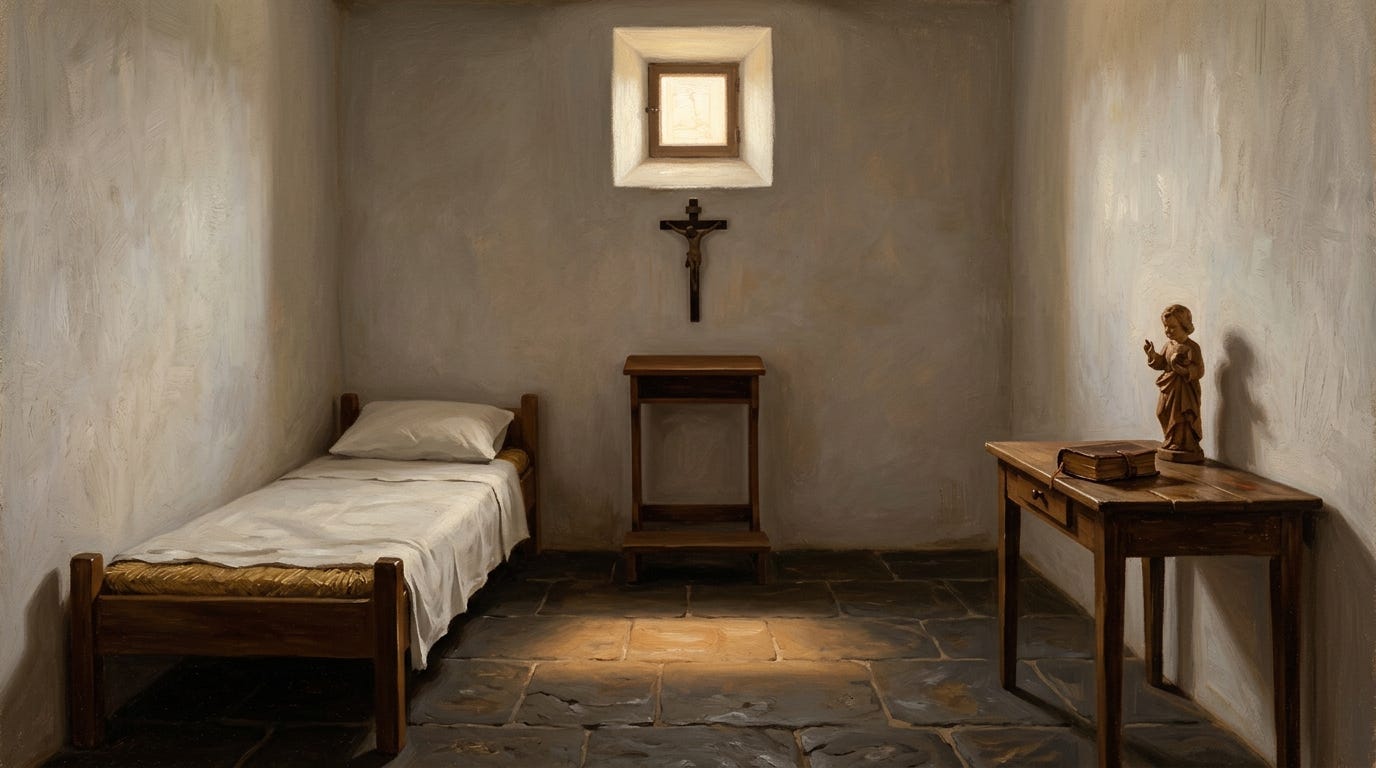
Thérèse knelt at the prie-dieu in her cell on the second floor of the Carmel of Lisieux, in the small room she had been given after her profession three years earlier, with the plain wooden bed against one wall and the plain wooden desk against the other and the single small window above the desk letting in the pale October light that fell across the flagstones in a bar the color of butter. It was the half-hour between None and the community recreation. She had come to her cell to be alone for a little while. She had needed to be alone.
She was tired.
The tiredness was not the tiredness of the body, though her body was tired also. She had helped in the laundry that morning and had taught a lesson to the newest novice - a very shy girl who had entered the Carmel two months earlier and who was still struggling to learn the rules of the community - and she had done both without much difficulty. Her body was young. Her body did what she asked it to do. Her body was not the trouble.
The trouble was interior.
She had been reading, the day before, a book about the life of Saint Teresa of Ávila, a book that her sister Pauline had recommended and that Thérèse had been meaning to read for some months. The book had been beautiful. The book had also been - and she was not sure how to say this to herself, and she was certainly not going to say it to Pauline - the book had been painful. Saint Teresa had founded seventeen monasteries. Saint Teresa had traveled the length of Spain in a covered cart, preaching reform, arguing with cardinals, wearing out three generations of confessors. Saint Teresa had written the Interior Castle, and the Way of Perfection, and the Life, and many other things, and had done all of this while carrying visions and stigmata and ecstasies that had made her the great mystic of her age.
Thérèse was twenty.
Thérèse had been in the Carmel of Lisieux for five and a half years. Thérèse had not founded anything. Thérèse had not written anything, except a few small compositions for feast days that Pauline had asked her to write. Thérèse had never traveled. Thérèse had no visions. Thérèse was not going to have any. Thérèse was going to spend her whole life, if the Lord willed, inside these walls, doing the small work of a small Carmelite in a small provincial French town, and no one outside these walls was going to know she had existed.
She had been thinking about this all morning.
She whispered, in French, Seigneur. Je veux être une sainte. Mais je suis si petite. Je veux aimer. Mais j’ai si peu à donner.
Lord. I want to be a saint. But I am so small. I want to love. But I have so little to give.
She lowered her forehead onto her folded hands on the wooden ledge of the prie-dieu.
She had been saying this prayer for some months now. It was not a new prayer. She had first said it, in something like this form, when she had been at Rome the year before her entry to Carmel, at fourteen, when she had thrown herself at the feet of Pope Leo XIII in the papal audience to beg him for permission to enter Carmel early. She had said it in the small train compartment on the way back from Rome when the Vicar of the Bishop of Bayeux had refused to grant her the permission. She had said it in her novitiate when Sister Marie of Saint Joseph had told her that her little compositions were pretentious. She had said it at her sister Céline’s letters describing the world she had left behind. She had said it many hundreds of times over five and a half years. She was saying it now.
She heard someone else’s voice, very close to her ear, whispering back.
“Petite, oui. Petite comme moi. Et c’est ce qu’il aime chez toi. Ne l’oublie pas.”
Small, yes. Small like me. And that is what he loves about you. Do not forget it.
Thérèse lifted her head.
There was a girl sitting on the edge of her bed.
The girl was young - perhaps sixteen or seventeen - and was very thin, and had pale olive skin and dark eyes and dark hair that had been cut short in the way of a girl who had been sick with fever and whose hair had been cropped by a mother trying to help it grow back. She was wearing a simple grey woolen tunic, tied at the waist with a cord, and a shorter grey mantle over her shoulders, and no veil, only a thin wooden cross on a leather cord around her neck. Her feet were in plain leather sandals of a cut that was very old - the cut was medieval Italian, the leather worked in the way of the hilltowns north of Rome. Her hands were folded in her lap. She was watching Thérèse with the steady attention of a girl who had been waiting for another girl to notice her and was not offended that it had taken a while.
Thérèse did not startle. She was not sure why she did not startle. Perhaps because the girl was so young. Perhaps because the girl’s presence in the cell felt, in some way she could not have explained, less like an intrusion than like an arrival - the way it feels when a sister one has not seen for a long time comes into a room.
She whispered, in French, “Qui êtes-vous.”
Who are you.
“Rose. De Viterbe. Est-ce que tu sais qui je suis.”
Rose. Of Viterbo. Do you know who I am.
Thérèse looked at the girl for a long moment.
She did know. She had read about Rose of Viterbo two or three years earlier, in a Franciscan booklet that Pauline had given her when Thérèse had been struggling with something she could not now remember. She had read the booklet in one afternoon. She had cried at the end. She had remembered that Rose had been thirteen when she had begun to preach in the streets of Viterbo against the Emperor Frederick the Second, and that Rose had been exiled with her family, and that Rose had wanted to be a Poor Clare and had been refused by the Poor Clares of Viterbo because Rose’s family had no dowry to give the monastery, and that Rose had died at eighteen without ever having become the enclosed nun she had wanted to be. Thérèse had remembered thinking, at the end of the booklet, that Rose had done something enormous in a very short life and had done it without ever getting what she had asked for. Thérèse had liked her.
“Je sais qui vous êtes,” Thérèse whispered.
I know who you are.
“Ne me vouvoie pas, petite soeur. J’avais dix-huit ans quand je suis morte. Tu en as vingt. Tu es plus âgée que moi. Tutoie-moi.”
Do not address me formally, little sister. I was eighteen when I died. You are twenty. You are older than me. Speak to me familiarly.
Thérèse almost laughed. She caught the laugh in her throat before it escaped. The laugh had wanted to come. It had been a long time since she had wanted to laugh in her cell.
“Rose.”
“Thérèse.”
They looked at each other. Neither smiled. But there was, in the quiet room, something that was almost smiling.
“Why have you come,” Thérèse said, softly.
“Because you were saying my prayer. The prayer I said when I was your age. Except I was younger than you. I said it for the first time when I was twelve. I was in my mother’s kitchen in Viterbo. The Virgin had come to me the night before and had told me I was to go into the streets and preach against the emperor. I did not want to go into the streets. I was twelve. I was frightened. I said, in my mother’s kitchen the next morning, the same prayer you were just saying. Signore, io voglio essere una santa, ma sono così piccola. Voglio amare, ma ho così poco da dare. Lord, I want to be a saint, but I am so small. I want to love, but I have so little to give. It is the same prayer. I have been permitted to come and tell you that it is the same prayer, and that the Lord loves the prayer, and that He answers it. He answered it for me. He is answering it for you. Do not think you are hearing no answer. The answer is very quiet at first. It becomes louder. You are hearing it. You do not yet know that you are hearing it. In a few years you will know.”
Thérèse sat back on her heels. She rested her hands on her lap. She looked at Rose.
Rose looked back.
They were quiet for a while.
Thérèse said, at last, “He answered you by sending you into the streets. He is not sending me into the streets.”
“No,” Rose said. “He is not. He is sending me into the streets because that was what my time required and I had a voice that carried and there was an emperor to be preached against. He is not sending you into the streets because you have a different voice and your time requires a different kind of preaching. I preached with my mouth in Viterbo. You will preach with your writing from this cell. Your writing will do what my mouth did. It will do more, I think. The Lord is very fond of your writing. He has been fond of it since He gave you the ideas that will become the writing. He will use it in ways you cannot picture. Do not concern yourself with picturing them. The picturing is not your work. The writing is your work. Do the writing. He will do the reaching.”
Thérèse was quiet again.
She had not spoken to anyone about the writing. She had not spoken about it to Pauline, who was the prioress and would have had to give permission for any serious writing project. She had not spoken about it to her sister Marie, who lived in the cell next to hers. She had not really spoken about it to herself, because the desire to write was so small and so uncertain and she was not sure it was not simply a form of pride.
She said, very quietly, “How do you know about the writing.”
“Because I have been sent. I was told, before I came, that you had begun to think about writing. I was told to say a few things about it. This is one of the things. Write it. Do not wait. Ask Pauline for the permission when the time comes. She will give it. You do not need to be a great scholar to write what the Lord is going to give you to write. You need to be small. You are small. That is why He is giving it to you. Small people can carry the small Christ. Large people cannot always. That is the whole of it. The Lord came into the world as an infant. He was carried by the smallest hands available. He is going to be carried by your hands next. Do not resist the carrying. It is what your hands are for.”
Thérèse was weeping now.
She wept quietly, in the way that a woman weeps when she has been trying not to want something for a long time and has just been told she is allowed to want it. Rose did not speak. Rose sat on the edge of the bed and watched Thérèse weep and did not offer a handkerchief, because handkerchiefs were not what Thérèse needed. Thérèse needed to weep. Rose let her weep.
After some minutes Thérèse said, “Rose.”
“Thérèse.”
“You wanted to be a Poor Clare.”
“I did.”
“You were refused.”
“I was.”
“How did you make peace with that.”
Rose looked at Thérèse for a long time. The light in the cell had moved further down the wall. It was almost time for the community bell.
“I did not entirely make peace with it,” Rose said. “Not in this life. I want to tell you the truth. I wanted to be inside a monastery. I wanted the walls and the schedule and the choir and the silence and the sisters. I wanted what you have. I did not want to be a street preacher. I did what the Lord asked because I was fond of Him and because the Virgin had told me directly that this was the work, but I did not enjoy the streets. I was tired all the time. I was cold in the winters. My family was sent into exile and I went with them, and I was more tired then, and my heart began to fail me even then, and I preached in exile also, though fewer people came. I did what I was asked. I did not make peace with the not-being-enclosed. I died at eighteen with a small quiet grief in me that I had not been permitted the enclosure. When I arrived where I am now, the Lord met me at the door, and He put His arms around me, and He said, Rose, I know. I know. It was hard. I am sorry. I could not give you both. I gave you the streets and I gave you the shortness of life so that the streets would end soon. I have kept the enclosure for you here. Come in. And He brought me into a room. The room was very quiet. There were sisters there. They were all waiting. They were the enclosed ones I had wanted to join. They received me. I was received. The Lord had given me the enclosure after all. He had given it to me on the other side. I made peace with it there, not here. I want you to know this. Some peaces are made on the other side. You should not try to make all your peaces in this life. Some are not for this life. Let them be. Carry them here. Bring them across. He arranges them.”
Thérèse was weeping harder now.
She had not expected to hear this. She had thought Rose would tell her that the refusal had been a great gift, that Rose had come to understand in this life that the streets had been the right vocation. Rose was telling her something else. Rose was telling her that some refusals were real refusals, that the interior grief was real grief, and that the Lord did not always resolve the grief in this life. He held it. He carried it forward. He arranged the answer on the other side.
Thérèse had a father in a mental institution in Caen. Her father Louis, whom she loved, who had once been strong and kind and who had walked her hand-in-hand across the beach at Trouville when she was a small girl, was now confined at Bon Sauveur, unable to recognize his daughters most of the time. She had prayed for years that he would be healed. He had not been healed. She had been carrying a small quiet grief about her father that she had not spoken of even to Pauline. She had wondered whether the grief was a failure of faith. She was learning now that it was not. Rose had told her. Some griefs were real. The Lord held them. He did not always resolve them here.
Thérèse said, quietly, “Mon père.”
My father.
“Yes,” Rose said. “I know about your father. He will not be healed. He will die in his illness. He will die at Saint-Sever in La Musse in July of eighteen ninety-four. That is nine months from now. He will not have recognized you at the end. You will grieve. You will not entirely make peace with it in this life either. The Lord will carry it. He will bring it across. You will see your father in the room. He will be himself again. He will recognize you. He will be very glad. You will be very glad. All the years of not-being-recognized will be understood as one small part of what he was carrying for you. He was carrying the loss of himself for you. You have been receiving what he could not name. The receiving will be complete on the other side. It is not complete here. That is fine. You do not have to make it complete here. Carry it. Bring it across.”
Thérèse could not speak.
She lowered her head onto her folded hands on the prie-dieu and wept for perhaps three or four minutes. Rose sat on the edge of the bed and waited. Rose had, when she had lived, watched her own family suffer greatly in exile, and she knew that the weeping of another woman for her father was a form of prayer that did not need to be interrupted. She waited.
After a while Thérèse lifted her head. She wiped her face with the back of her sleeve. She looked at Rose.
She said, “Tell me one more thing before you go.”
“Ask.”
“The writing. Will it matter.”
Rose smiled for the first time. The smile was very warm. It was the smile of a girl who had been waiting to say something and was now going to say it.
“Yes. It will matter. I want to tell you something you will not believe. In the year nineteen twenty-seven, a pope named Pius the Eleventh will name you co-patroness of all the missions of the Church. You. Alongside Saint Francis Xavier, who traveled from Portugal to Japan and baptized tens of thousands and died on an island off the coast of China. You, who will not have left this cloister. You, who will have spent nine years in this cell and will die at twenty-four of a lung disease you have not yet contracted, will be named co-patroness of the missions of the universal Church. Do you understand what this means. It means that the Lord does not measure the reach of a vocation by the distance the body travels. It means that a woman in a cell in Lisieux can be a missionary to Japan and to China and to Uganda and to Peru and to countries that do not yet exist in your century. It means that your writing will be read in every language of the Church. It means that in the year nineteen ninety-seven, a pope named John Paul the Second will name you a Doctor of the Church, only the third woman ever named so at that time. It means the Lord is going to use your smallness in a way you cannot picture. Do not try to picture it. Do the writing. Ask Pauline. She will give the permission. She is your sister and she loves you and she will see what you are doing. Do it. It will matter. It will matter more than you or I can imagine. I have been sent to tell you this. That is why I have come.”
Thérèse looked at Rose.
Rose looked back.
They were both smiling now. The smiles were small. But they were smiles.
Thérèse said, softly, “Rose.”
“Thérèse.”
“Merci.”
“Grazie a te. It has been my privilege to sit with you this afternoon. I have been fond of you for many years, from the room where I am. I have been asking to come. The Lord let me come today because you had been saying my prayer this morning and He wanted you to hear it answered by the girl who had said it first. That is one of the arrangements He makes. When two of His friends have said the same prayer in different centuries, sometimes He lets them meet, so that the older one can tell the younger one that the prayer has been heard. He heard mine. He is hearing yours. Now go to the community. The bell will ring soon. Do the work of the afternoon. Then, tonight, after Compline, begin to think about the writing. Not to write yet. Just to think. In one year and three months you will ask Pauline. She will say yes. You will begin. Do the beginning. The rest is His.”
Rose rose from the edge of the bed.
She came around to Thérèse. She laid her hand on Thérèse’s forehead - the hand was warm and light and steady, in the way an older sister’s hand is when she is blessing a younger sister who is about to go do something difficult - and she blessed her, in Italian, in the Franciscan blessing she had learned as a small girl from her mother in Viterbo.
“Il Signore ti benedica e ti custodisca. Il Signore mostri il suo volto a te e abbia misericordia di te. Il Signore rivolga il suo sguardo a te e ti dia pace. Amen.”
May the Lord bless you and keep you. May the Lord show his face to you and have mercy on you. May the Lord turn his gaze to you and give you peace. Amen.
Thérèse closed her eyes.
When she opened them, the edge of the bed was empty.
The autumn light had moved further down the wall. The community bell rang for recreation.
Thérèse rose from the prie-dieu. She wiped her face one more time with the back of her sleeve. She smoothed her habit. She left her cell and walked down the corridor to the recreation room, where the other sisters were already gathering, and she took her place beside her sister Marie, and she smiled at Pauline across the room, and she did the ordinary work of the afternoon.
That night, after Compline, she lay in her cell and thought about writing.
She did not begin yet. She thought.
Fifteen months later, in January of eighteen ninety-five, at the community recreation on the feast of the Epiphany, her sister Pauline - Mother Agnes, the prioress - asked Thérèse if she would consider writing down some of the memories of her childhood for her sisters to keep. Thérèse said yes. She began that same evening. She wrote through the winter and the spring and the summer, and she finished the first manuscript in January of eighteen ninety-six. She did not know what she was writing. She thought she was writing family memoirs. She was actually writing Manuscript A of what would become the Story of a Soul.
She contracted tuberculosis in April of that same year. She wrote Manuscript B in September of the following year, at the request of her sister Marie. She wrote Manuscript C in June of that final year, at the request of Mother Marie de Gonzague. She finished writing on July eighth, eighteen ninety-seven. She died on September thirtieth of that year, at the age of twenty-four, of tuberculosis. Her last words were Mon Dieu, je vous aime. My God, I love You.
Her sister Louis, Louis Martin, had died on July twenty-ninth, eighteen ninety-four, at the age of seventy, at La Musse, exactly as Rose had said. He had not recognized Thérèse at the end. Thérèse had carried the grief across.
The Story of a Soul was published on September thirtieth, eighteen ninety-eight, one year to the day after Thérèse’s death, in an initial printing of two thousand copies. Within twenty years it had been translated into thirty-five languages. It has never been out of print. It is one of the most widely read spiritual books of the twentieth century.
Thérèse was canonized on May seventeenth, nineteen twenty-five, by Pope Pius the Eleventh. She was named co-patroness of all the missions of the Church, alongside Saint Francis Xavier, on December fourteenth, nineteen twenty-seven, by the same pope. Rose had been correct. She was named a Doctor of the Church, only the third woman so named, by Pope John Paul the Second on October nineteenth, nineteen ninety-seven, on the centenary of her death. Rose had been correct about this also.
Rose of Viterbo, on the other side, was very pleased.
She had waited many years to come and sit with the young French Carmelite who had said her prayer. She had been permitted the visit at last. She had done what she had been sent to do. She had returned to the room where she was, and she had continued the quiet work she did there, which included, among other things, watching over the growing list of young women in the centuries after her who prayed the prayer she had first prayed at twelve. The list was long. It included Thérèse. It included many others who had come and gone. It continued to grow.
Rose’s own body remains incorrupt at the Monastery of Santa Rosa in Viterbo, where pilgrims still visit her. She was canonized by Pope Callixtus III in 1457. She has not yet been declared a Doctor of the Church, though there are Franciscans who have proposed it. Rose, in the room, is not in a hurry. The Doctorate will come when it comes, or it will not. What matters is not the Doctorate. What matters is the girls who say her prayer.
The lamp in the small cell at the Carmel of Lisieux burned out at dawn, as lamps do, on the morning after Rose’s visit.
Thérèse was already awake.
She would begin the writing in fifteen months.
The world would receive it.
The missions would continue.
For your prayer this week: Saints Thérèse of Lisieux and Rose of Viterbo, you who were small and young and who wanted to be saints and to love though you thought you had too little to give, pray for those of us who are also small and young in the vocations we have been given, or small and old in the vocations we still carry. Grant us the grace to trust that the Lord uses small hands to carry the small Christ, that some griefs are held for the other side, and that the reaching is His to do while the writing is ours. Amen.
Two Lamps returns next Friday: Saints John XXIII & Bruno of Cologne, the papal apartments at the Vatican, an evening in February 1959.
Two Lamps is a weekly short story braiding the lives of two or three saints across the centuries. Sometimes the meeting is rendered as an encounter in eternity. Sometimes as the older saint coming, in vision or in patronage, to the soul of the younger. Sometimes as two friends meeting in one life. The Communion of Saints holds them all as one company.
Two Lamps is written by Deacon Michael Halbrook, a permanent deacon of the Diocese of Springfield in Illinois, serving at St. Elizabeth Parish in Granite City. He writes personally at DeaconMichael.net, serves families through Domus Formation, and publishes the serial novel Ordo: A Chronicle of Lux Perpetua at LuxPerpetua.net. Two Lamps is co-conceived with his son Joseph.