

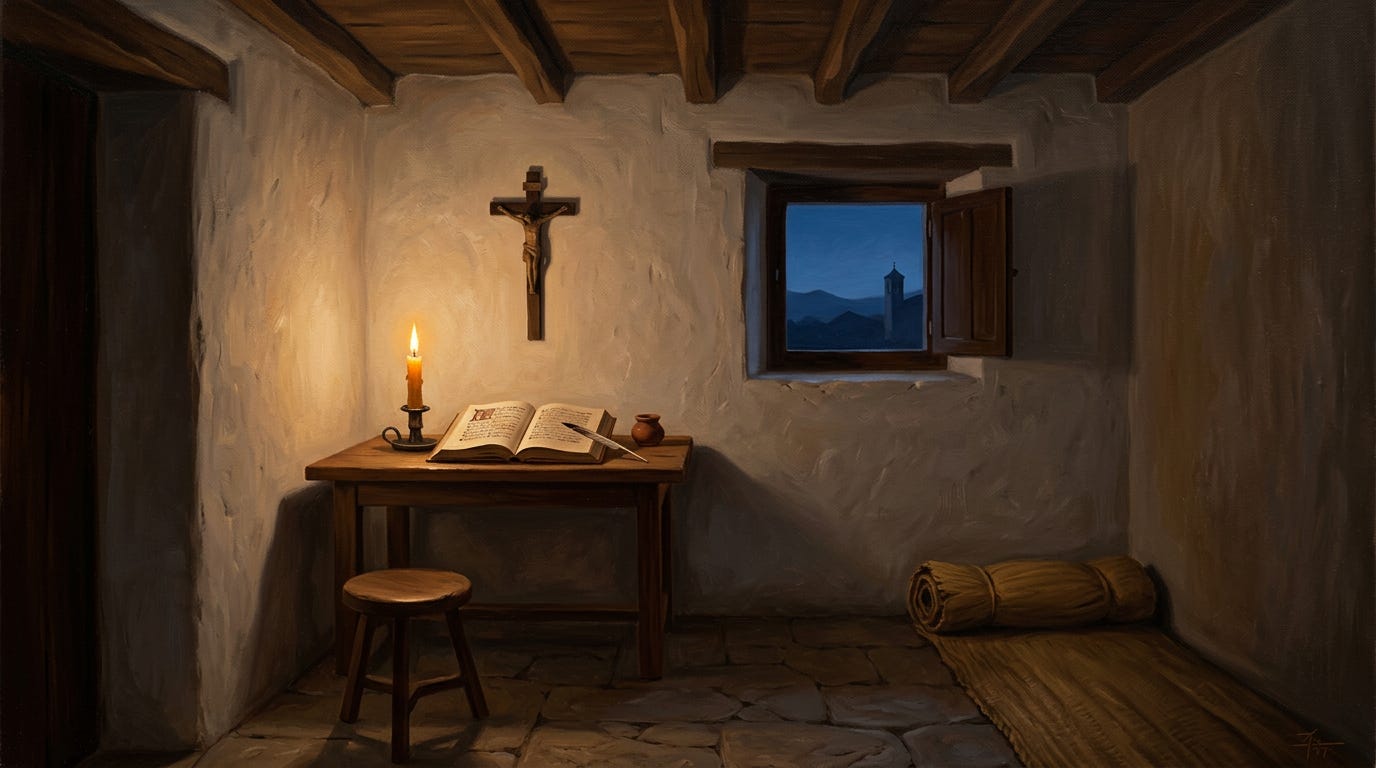
The manuscript would not cooperate.
Teresa sat at the plain wooden desk in her cell on the upper floor of the monastery of San José, in the first house of the Discalced Reform, in the town of her birth, and she looked at what she had written that afternoon and she did not like it. She had been writing since May. She was somewhere in the sixth mansion of the seven she had planned - which was to say, somewhere in the description of the interior room in which the soul suffers a great deal in preparation for the mystical marriage, though the suffering is also, at the same time, a great joy. She was having trouble with the both-at-onceness of it. Every sentence she wrote about the suffering came out sounding as though the suffering was only suffering. Every sentence she wrote about the joy came out sounding as though the joy was only joy. She could not seem to write a sentence that held them together. She had been trying since after None.
She was sixty-two.
She was also tired. She had been on her feet most of the morning dealing with a small crisis in the kitchen - one of the novices had let the beans burn and had cried about it - and she had heard confessions in the afternoon for two hours, and she had gone through the correspondence from Alba and from Toledo and from Andalusia, and she had answered the letter from Fr. Gracián that had needed answering, and she had received the small delegation of townspeople who had come to the door asking her to pray for a sick child, and only now, in the last hour before Compline, was she free to sit at the desk and write. This had been the pattern for most of the summer. The writing happened in the small hour of the day that was left over after everything else. The writing was tired writing. She was not sure the writing was as good as it needed to be.
She whispered, in Spanish, Señor. Ayúdame. Esto no está saliendo.
Lord. Help me. This is not coming out.
There was a man sitting on the low wooden stool by the door of her cell.
She did not startle. She had learned, over four decades of interior life, not to startle at the various visitations that came to a soul that had been kept in prayer for many years. Sometimes they were true visitations. Sometimes they were fatigue. Sometimes they were the enemy pretending to be a visitation. She had learned to look carefully before deciding what any given appearance was.
The man was old but not very old - perhaps in his late sixties. He was thin. He wore a plain rough tunic of undyed wool, cinched at the waist with a leather belt, and he was barefoot. His hair was grey and cut short. His beard was short and grey. His wrists had the reddened marks of chains that had recently been removed. His eyes were dark and very lively - the eyes of a man who was going somewhere he was glad to be going. His hands were folded in his lap. He was watching her with a kind of amused affection that she recognized. It was the affection of a fellow religious who had spent enough time in a monastery to know what a nun looked like when she was frustrated with her manuscript.
She looked at him for a long moment.
She said, in Latin - because the man did not look like a Spaniard and she did not know what else to try - “Quis es tu, frater?”
Who are you, brother.
He answered in Latin also - a Latin that was heavily inflected with what she thought must be Greek. “Ignatius. Antiochenus. Episcopus.”
Ignatius. Of Antioch. Bishop.
Teresa set down her pen. She sat back in her chair. She looked at the man with great attention.
She knew the name. She had read the letters as a young woman - the seven letters he had written on the road to Rome, in the year one hundred and seven or one hundred and eight, on his way to the arena. She had read them in a Latin translation her uncle Pedro had given her when she was twenty and still living at home before she entered the Carmel of the Incarnation. She had loved them. She had loved especially the letter to the Romans, in which he had begged the Christians of Rome not to interfere with his martyrdom, in which he had written the sentence that had stayed with her ever since: Frumentum Dei sum, dentibus bestiarum molar, ut panis mundus Christi inveniar. I am the wheat of God; let me be ground by the teeth of the wild beasts, that I may be found the pure bread of Christ.
She had thought about that sentence many hundreds of times over four decades. She had thought about it when she had been ill. She had thought about it during the interior sufferings that had come with the seventh mansion, before she had understood what to call them. She had thought about it in the past year while she was struggling with the Calced brothers who did not want the Reform to succeed. The sentence had never left her.
She whispered, in Spanish, Ay, Dios mío.
Oh, my God.
“You have read the letters,” Ignatius said, in Latin. His mouth had something like a smile at one corner.
“I have read them. Since I was twenty. The letter to the Romans I have almost by heart.”
“That is a great gift to me. That my letter is still being read fourteen hundred years after I wrote it. I did not expect it to survive at all. I wrote it in one afternoon, on a piece of parchment, in a house at Smyrna where I was being held between marches. I did not think about whether it would be preserved. I thought only about persuading the Romans not to intervene. I was very worried the Romans would intervene. They had connections. They could have had the sentence commuted. I did not want the sentence commuted. I wanted to be ground by the beasts. I wrote the letter to persuade them not to spoil my dying. It was a practical letter about a specific matter. I did not know it would be read by nuns in Ávila fourteen hundred years later. This is one of the surprises of the room where I am. The letters we write for one purpose are used by the Lord for other purposes we do not anticipate. This is worth remembering. You are writing right now. You do not know for whom you are writing. The Lord knows. He is using it for people who have not yet been born. Do not concern yourself with the reception. Concern yourself with the writing. Write well. He arranges the rest.”
Teresa laughed.
The laugh came from her belly, in the way her laughs usually did. She was known in the community for her laughter. She had a peasant Castilian laugh that startled visitors and delighted the novices. She had not laughed in her cell all week. It felt good to laugh.
“Brother Ignatius. Are you here to tell me to keep writing.”
“I am here to tell you to keep writing. I am also here to tell you a few other things. May I sit closer. This stool is very hard.”
“There is another stool by the desk. Bring it. My cell is small. Everything is close together in a small cell.”
Ignatius rose and brought the stool and sat opposite her at the desk. He looked at the manuscript. He could not read the Spanish but he could see the shape of the pages - the scratched-out lines, the marginalia in her compressed hand, the way the ink had smeared where her hand had rested. He nodded slowly.
“You are struggling.”
“I am struggling. I am trying to describe the sixth mansion. In this mansion the soul is suffering greatly but is also rejoicing greatly, and I cannot get my sentences to hold the two things together. Every sentence goes to one side or the other. I need a way of writing that holds both. I have not found it yet.”
Ignatius was quiet for a moment.
Then he said, “I had the same difficulty. When I was writing to the Romans about being ground by the beasts, I needed the reader to understand two things at once. I needed them to understand that the grinding was terrible - because if they thought it was easy, they would not honor what they were reading, and they would come and try to spoil it out of a false compassion. But I also needed them to understand that the grinding was a great joy - because if they thought it was only terrible, they would think me mad, and they might come and try to spoil it out of pity for a madman. So I had to write sentences that made the same thing sound both dreadful and delightful in the same breath. I remember the day I wrote them. I was in the house at Smyrna. I was tired. I had been on the road for eight weeks. My wrists hurt. The soldiers had been especially rough that week. And I sat with a piece of parchment on my knee, and I wrote frumentum Dei sum, dentibus bestiarum molar - I am the wheat of God, let me be ground by the teeth of the wild beasts - and I understood as I was writing that the wheat is glad to be ground. Not brave. Not resigned. Glad. Wheat is glad to be ground because wheat has been waiting all its life to become bread. That was the sentence I needed. The gladness is inside the grinding. The suffering does not need to be hidden. The joy does not need to be hidden. They are inside each other. That is the whole thing.”
Teresa looked at him for a long moment.
Then she looked at her manuscript. She looked at the sentences she had been trying to write all afternoon. She looked back at Ignatius.
She said, softly, “The gladness is inside the grinding.”
“Yes.”
“You had to find a metaphor to hold them together. You found the wheat.”
“I found the wheat. The Lord gave me the wheat. I had been walking through fields of wheat all across Asia Minor. The wheat was everywhere. I was already thinking about it. When I sat down to write, the wheat was there. I took what was in front of me. The Lord uses what is in front of us. You are in a Carmelite convent in Castile. Look around you. What is in front of you. Take that. The metaphor for the sixth mansion is in your kitchen or in your garden or in the town where you were born. Look for it. It will be there. When you find it, you will know.”
Teresa was quiet for a long time.
She was thinking. She was thinking about her kitchen. She was thinking about the novice who had cried over the burned beans. She was thinking about her garden, where the last of the autumn vegetables were being harvested. She was thinking about the fire in the kitchen hearth. She was thinking about the flames that consumed the wood and made bread and warmth and light out of what had been a dry log. Wood being consumed and becoming useful.
She was also thinking about something else. The Interior Castle - the whole book - was already a household metaphor. She had built the entire work around the image of a soul as a castle with seven rooms. She had been using the metaphor for months. But the metaphor was too grand for what she was trying to say in the sixth mansion. The castle was a nobleman’s image. She needed something poorer. Something more like Ignatius’s wheat.
She whispered, La lumbre.
The fire.
“What did you say,” Ignatius said.
“The fire. In the mansion, the soul is being burned. Being consumed. As a log is consumed in the hearth. The log does not complain. The log does not resist. The log becomes flame. The flame is warmth for others. The consuming is glad. Is that right, Brother Ignatius. Is that the way to hold them together.”
Ignatius smiled slowly.
“That is one way, sister. It is not the only way. But it is the way that is available to you tonight. Write it. You will refine it later. Get it down. The refining comes with time. The getting-it-down cannot wait. It waits for no one.”
Teresa reached for her pen.
She dipped it in the small clay inkwell. She looked at the page. She wrote a sentence. She looked at the sentence. She smiled. It was not a perfect sentence. But it held both things at once. The suffering and the joy. The consuming and the becoming. She had needed the wheat to find the fire. She would rewrite the passage tomorrow to be sure the fire worked. But she had it now.
She looked up at Ignatius.
“Brother. Thank you.”
“You are welcome, sister. I have wanted for many years to sit with you. I have been reading your writings from the room where I am. I have been fond of your writings for as long as they have existed. You write in a way that reminds me of my own writing - direct, warm, with a bit of complaining about the difficulty of the writing embedded in the writing itself. I like that. I did that also. My letter to the Romans has some complaining in it about how difficult it is to write while chained. Your Interior Castle has some complaining about how difficult it is to write under obedience when you would rather be doing other things. The complaining is part of the writing. It gives the reader permission to notice that writing is difficult. This is a gift to the reader. Keep the complaining. Do not edit it out.”
Teresa laughed again.
“Brother. You have read what I have already written.”
“I have read what you have already written. I have also read what you have not yet written. I am at some advantage. Do not ask me for details. I have been forbidden to give you spoilers. The Lord likes you to be surprised by what you produce. It keeps you humble. I will tell you only that what you are writing now, when it is finished, will be received by the Church with great gratitude. It will be read by nuns and by laypeople and by other Doctors of the Church for many centuries. It will be, in fact - “ he paused, apparently deciding whether to continue - “in 1970, four hundred years from now, you will be named a Doctor of the Church by a Pope Paul the Sixth. You will be the first woman ever named so. There have been others named since. But you will be first. I want you to know this. The writing will matter. I am not permitted to tell you more.”
Teresa’s face changed.
She had gone through many strange interior experiences in her life. She had been suspected of heresy. She had been examined by the Inquisition. She had been told by various learned men that women should not write theology. She had been told by some of her own confessors that her mystical experiences were probably demonic. She had had to fight, all her life, for the right to write and for the right to have her writings read seriously. She had not expected, tonight, to be told that four hundred years from now she would be named the first woman Doctor of the Church.
She whispered, in Spanish, No es posible.
It is not possible.
“It is possible. It has been arranged. I have said too much. Do not think about it. Do not let it change how you write tomorrow. Write the sixth mansion. Write the seventh mansion. Finish the book. It will take you until the end of November. Then set it aside. Then let the Church do with it what the Church will do. You are not concerned with the reception. The reception is His. Your work is the writing. Do the writing. Trust the rest.”
Teresa was silent for a while.
She was thinking, again, about the Reform. She was thinking about John of the Cross, who was still safe in his friary at Ávila but whom she had been worrying about for months, who she knew was in danger from the Calced brothers who did not want the Reform to succeed. She was thinking about Fr. Gracián, exiled to Andalusia. She was thinking about the whole fragile structure she had spent the last fifteen years building. She was thinking about her own age, and her health, and how many years might be left to her, and whether the Reform would survive her, and what the Lord was arranging.
She said, quietly, “Brother. Tell me one thing.”
“Ask.”
“John of the Cross. Fr. Juan. The little friar who has helped me with the Reform. Is he going to be all right.”
Ignatius looked at her for a long moment.
“He will suffer. He will suffer soon. Within two months he will be seized by Calced brothers and imprisoned at Toledo. He will be held for nine months in a small dark cell. He will be beaten. He will be humiliated. He will nearly die. He will escape in August of the next year. He will survive. He will write, during and after that imprisonment, some of the greatest mystical poetry in the Christian tradition. He will be named a Doctor of the Church in 1926. He will die at forty-nine. His suffering will be terrible. His suffering will also be fruit. I want you to know this so that when the news arrives in December, you will not despair. You will grieve. You will pray. You will not despair. He is going to be all right. Not in the way you would wish. He is going to be all right in the deeper way. His imprisonment will produce the Spiritual Canticle and the Dark Night of the Soul and the Ascent of Mount Carmel. Those works will not exist without the imprisonment. The Lord is arranging this too. It is difficult. It is not a mistake. Trust it. Do not try to prevent it. You could not prevent it in any case. It is arranged.”
Teresa was weeping now.
She wept in the practical Castilian way she wept when she had to weep - fully, without hiding, but without excessive drama. She reached into the sleeve of her habit and took out a linen cloth and wiped her face with it and then folded the cloth and put it back into her sleeve. Ignatius waited. He was a man who had escorted his own dying across half the Roman Empire. He knew how to wait while a woman wept.
After a while Teresa said, “Thank you, brother. For telling me.”
“You are welcome. I have been permitted to tell you these few things. Now I must go. My hour is nearly finished. Before I go I want to say one more thing about the wheat and the fire. You are also being ground, sister. You are being ground by the ecclesiastical politics of your century. You are being ground by the Calced brothers who resent your Reform. You are being ground by the Inquisition. You are being ground by your own poor health. You are being ground by the writing itself, which is difficult. Do not resist the grinding. You are becoming bread. You are becoming bread for the sisters in this house and for the sisters in the other houses you have founded and for the sisters and brothers in Discalced Carmels that will be founded after you across many centuries and across every continent. You are becoming bread for the readers of the Interior Castle for four hundred years. You are becoming bread for Doctors of the Church who have not yet been born. The grinding is producing the bread. Do not resent the grinding. The wheat is glad to be ground because the wheat has been waiting all its life to become bread. You are the wheat, sister. Be glad.”
Teresa bowed her head.
She did not speak for perhaps a full minute. Then she looked up at Ignatius and she smiled - a full open Castilian smile, not the composed smile she gave in the community, but the smile she smiled when she was alone or with the sisters she loved best.
“Brother Ignatius. I will be glad. I will try.”
“Good. That is all He asks. Trying. Not succeeding. Trying. He does the rest.”
Ignatius rose from the stool.
He came around to her side of the desk. He laid his hand on her head - the hand was warm and callused, in the way an old bishop’s hand is warm and callused from many years of blessing - and he blessed her, in Greek this time, in the blessing he had learned as a young Christian in Antioch a century after the death of the Lord.
“Ἡ χάρις τοῦ Κυρίου Ἰησοῦ Χριστοῦ μετὰ τοῦ πνεύματός σου. Amen.”
The grace of the Lord Jesus Christ be with your spirit. Amen.
Teresa closed her eyes.
When she opened them the stool by the door was empty. The one at the desk was empty also.
The manuscript was in front of her. The pen was in her hand. The ink was drying in the small clay inkwell. The candle on the desk had burned down another inch since Ignatius had arrived.
She dipped the pen. She wrote.
She wrote for another hour, until the bell rang for Compline. She had found the passage about the fire in the sixth mansion. She would refine it tomorrow. Tonight she had it in a rough form. It was enough for tonight.
She rose. She smoothed her habit. She went down to the chapel for Compline.
She sang with the community. She returned to her cell. She said her evening prayers. She lay down on the straw mat. She slept.
She rose at four-thirty. She said the Office. She said Mass with the community. She returned to her writing at the small hour left over between everything else. She finished the sixth mansion within a fortnight. She wrote the seventh mansion in November. She finished The Interior Castle on November 29, 1577, six months after she had begun.
Fr. Juan de la Cruz was seized by Calced Carmelites at Ávila on December 3, 1577, four days after Teresa finished the book. He was taken to Toledo. He was imprisoned in a small cell for nine months. He was beaten. He was humiliated. He nearly died. He escaped in August 1578. He survived. He wrote, in the imprisonment and in the years after, the Spiritual Canticle, the Dark Night of the Soul, and the Ascent of Mount Carmel, exactly as Ignatius had said. He died at Úbeda in December 1591, at the age of forty-nine. He was canonized in 1726. He was named a Doctor of the Church in 1926, exactly as Ignatius had said.
Teresa lived five more years after finishing The Interior Castle. She continued to found houses when her superiors permitted. She continued to travel Spain in her covered cart with her small band of sisters. She continued to be worn down by the ecclesiastical politics of the Reform. She continued to be ground. She continued to become bread.
She died at Alba de Tormes on October 4, 1582, at the age of sixty-seven. She was canonized in 1622. She was named a Doctor of the Church on September 27, 1970, by Pope Paul the Sixth - the first woman ever named so, exactly as Ignatius had said. Her feast is October 15.
Saint Ignatius of Antioch, in his room, was very pleased.
He had been permitted to visit her that once. He continued to read her writings, from where he was, in the way that writers read each other across the centuries in the small library the Communion of Saints maintains for its own. He was fond of the Interior Castle. He was especially fond of the passage on the fire in the sixth mansion. He had helped a little with that passage. He was pleased with the helping.
He continued also to visit, when the Lord permitted, other writers who were struggling with their sixth mansions - which is to say, with the passages in their own works where they needed to hold suffering and joy together in the same sentence, and where the sentence was refusing to come. There were many such writers in the fourteen centuries since his own writing. He had been permitted to visit some of them. Not all. He was often on the list of those who had been asked to help. He was glad to be on the list. The list, as those of us on it know, is very long.
The candle in the cell at San José burned out at dawn, as candles do, on the morning after Ignatius’s visit.
Teresa was already at the desk.
She was writing the passage about the fire in the sixth mansion, in its refined form.
The wheat was becoming bread.
For your prayer this week: Saints Teresa of Ávila and Ignatius of Antioch, you who wrote the Interior Castle in the last hours of long days and you who wrote seven letters on a forced march to your own martyrdom, pray for those of us who are trying to write sentences that hold both suffering and joy together, and for those of us who are being ground by circumstances we did not choose. Grant us the grace to see that the wheat is glad to be ground because the wheat has been waiting all its life to become bread, and to become bread for the ones who need us. Amen.
Two Lamps returns next Friday: Saints Anthony Mary Claret & John of Capistrano, a missionary chapel in rural Cuba, an autumn evening in 1854.
Two Lamps is a weekly short story braiding the lives of two or three saints across the centuries. Sometimes the meeting is rendered as an encounter in eternity. Sometimes as the older saint coming, in vision or in patronage, to the soul of the younger. Sometimes as two friends meeting in one life. The Communion of Saints holds them all as one company.
Two Lamps is written by Deacon Michael Halbrook, a permanent deacon of the Diocese of Springfield in Illinois, serving at St. Elizabeth Parish in Granite City. He writes personally at DeaconMichael.net, serves families through Domus Formation, and publishes the serial novel Ordo: A Chronicle of Lux Perpetua at LuxPerpetua.net. Two Lamps is co-conceived with his son Joseph.
Your stories are a wonderful blessing; their message grows within as the days pass on. Thank you