

The mission was ending.
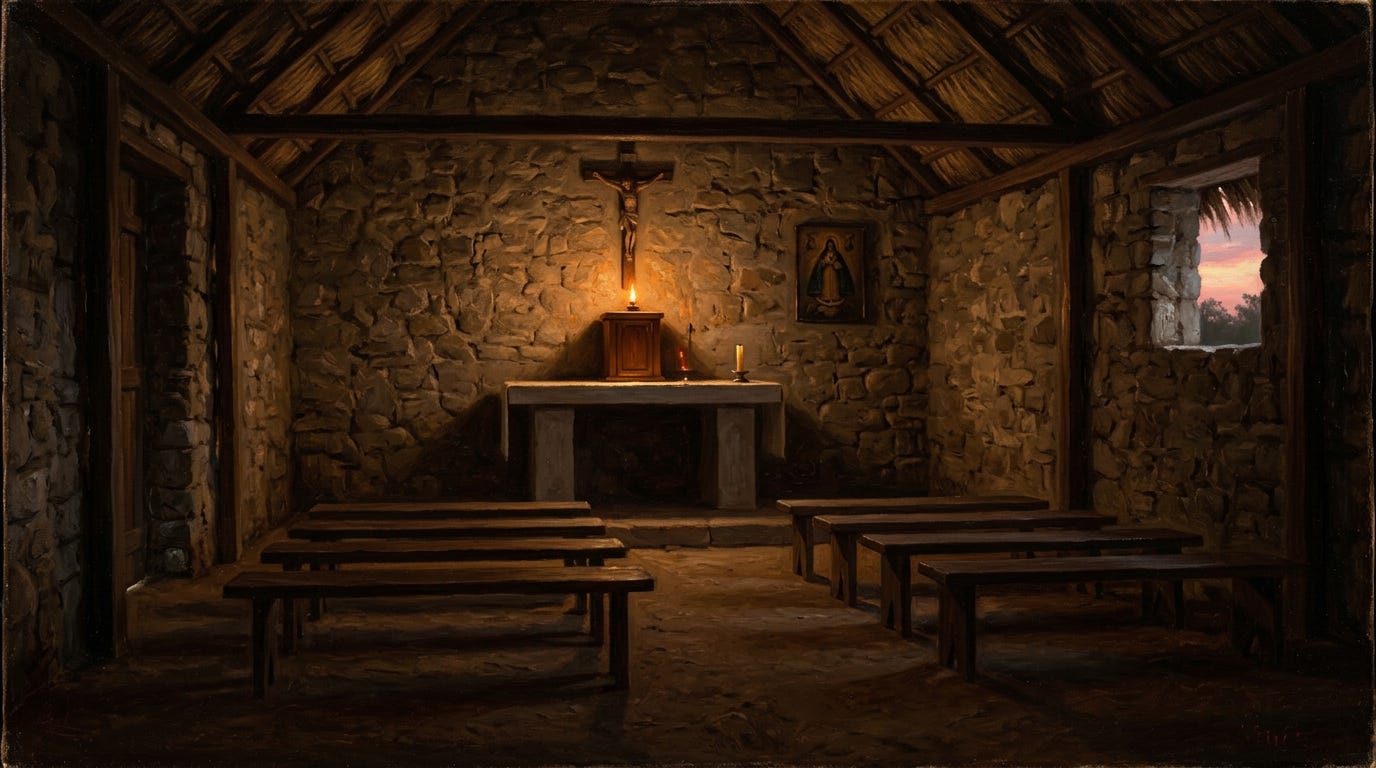
Padre Claret sat on the plain wooden bench at the back of the mission chapel in the hills outside Bayamo, in the archdiocese of Santiago de Cuba, in the stone church that a farmer named Don Esteban had built for the village of San Antonio thirty years earlier with his own hands and with the help of a friar who had passed through. The chapel was very simple. It had a plain stone altar with a wooden tabernacle. It had a wooden crucifix above the altar. It had a painted image of Our Lady of Charity of El Cobre on the wall to the right of the altar - Cuba’s patroness, whose shrine at El Cobre was two days’ ride to the southeast. It had a badly carved wooden statue of Saint Anthony of Padua on the wall to the left. It had eight wooden benches for the congregation. It had one window on each side wall. It had a thatched roof over wooden beams. The floor was packed earth.
Padre Claret had been preaching in this chapel for three days.
He had arrived from Manzanillo on Wednesday evening, at the end of an eleven-hour ride through the hills, with two young priests of his diocese who were being formed in the practice of the popular mission. He had said Mass at dawn each day and had preached for two hours to the small congregation - the entire population of the village and the outlying farms. He had heard confessions each afternoon for many hours, sitting on this same bench with a purple stole around his neck, until the last penitent had gone. He had baptized eleven children on Saturday morning. He had confirmed thirty-two adults and children on Saturday afternoon under his episcopal authority. He had witnessed four marriages on Sunday morning. He had preached for a final two hours on Sunday afternoon and had blessed the congregation as the sun was going down, and now the congregation had gone home to their farms and their houses, and the two young priests were in the pastor’s residence next to the chapel eating the meal that Don Esteban’s wife had prepared for them, and Padre Claret was alone in the chapel.
He was tired.
He had been tired for three years. He had arrived in Cuba in February of 1851, at the age of forty-three, as archbishop of Santiago de Cuba, and he had immediately begun the practice of the popular mission which he had refined over ten years of preaching missions in Catalonia. He had said Mass, he had heard confessions, he had preached, he had baptized, he had confirmed, he had established the congregation of Missionary Sons of the Immaculate Heart of Mary that would carry on the work after him. He had done this without stopping for three years. He was not going to stop. He had understood, when the Holy Father had asked him to accept the archdiocese, that he had been asked to do this until he could no longer stand. He was still standing. He would continue standing. But he was very tired tonight.
He whispered, in Catalan - the language of his childhood which he sometimes fell back into when he was alone - Senyor, dóna’m força. Que jo pugui continuar.
Lord, give me strength. That I may continue.
He heard the sound of someone sitting down on the bench beside him.
He turned his head slowly.
There was an old friar sitting on the bench.
The friar was thin and tall and old - perhaps seventy - and wore the brown wool habit of a Franciscan Observant of an older cut than Padre Claret had seen in the modern communities. The habit was patched in three places at the sleeves. The friar’s feet were bare. His head was tonsured. His hair was white and cropped short. His beard was short and grey. His hands were folded inside his sleeves in the way of a mendicant friar. His eyes were bright and very direct - the eyes of a man who had preached in front of large crowds for many decades and who was accustomed to holding attention. He was watching Padre Claret with the pleased expression of an old preacher who has come to sit with a younger preacher at the end of a long day.
Padre Claret looked at him for a long moment.
He was not startled. He had experienced enough interior visitations over the years - some genuine, some imagined, some he had never been sure about - that he had learned to look at any unexpected companion with a steady attention and to decide slowly what to make of it. This friar, he could see immediately, was not the enemy. The eyes were wrong for the enemy. The enemy did not have bright direct eyes. The enemy had eyes that shifted. This friar’s eyes were as steady as they had been when he had first turned his head.
He said, in Spanish, “Fray. Yo no lo conozco.”
Brother. I do not know you.
The friar answered in Latin, in a voice that was old but was still strong.
“Giovanni da Capestrano. I have come to sit with you for perhaps an hour. My Spanish is very poor - I never learned it well in life - so we will speak in Latin, if you will forgive me. Your Latin is functional, I know. We will manage.”
Padre Claret sat very still.
He knew the name. He had read a short life of Capistrano when he was a young Vincentian seminarian at Vic, and had read it again some years later when he had been preparing sermons on the missionary saints. He knew the outlines - the lawyer-turned-friar, the disciple of Bernardino of Siena, the decades of preaching missions across Italy and Germany and Bohemia and Poland and Hungary, and, at the end, the defense of Belgrade against the Ottomans in 1456, when Capistrano had been seventy years old and had ridden with the peasant army and had exhorted them to hold the walls. Belgrade had held. The Ottoman advance had been turned back for a generation. Capistrano had died of plague within three months of the battle. He was one of the great itinerant preachers of the medieval Church. Padre Claret had preached about him twice.
He said, in Latin, “Frater Giovanni. It is a great honor. Please, sit. I mean - you are sitting. It is a great honor that you are sitting.”
Capistrano smiled slightly.
“You are tired, Antonio. Do not concern yourself with courtesies. I have come precisely because you are tired. The Lord permits me to come sometimes to preachers who are tired. It is a great pleasure for me. I was often tired myself. There is a specific consolation an old preacher can offer a younger preacher that no one else can offer, and I have been permitted, this evening, to offer it. Sit. Rest your back against the wall. I will speak for a little while. You will listen. Then we will speak together. Then I will go. It will be an hour. You will feel better afterward.”
Padre Claret did as he was told. He leaned back against the wall of the chapel. The stone was cool through his cassock. His back hurt. He closed his eyes for a moment.
Capistrano began to speak.
“I preached my first mission in 1416, at Perugia, after I had been in the Franciscan Observance for four years. I had come to the Franciscans late. I had been a lawyer and then a judge and then a governor of Perugia. I had been captured in a war between Perugia and Malatesta, and I had been imprisoned, and I had had a religious conversion in the prison. I had renounced my marriage - it had never been consummated; my wife entered a Poor Clare monastery and lived a holy life; the annulment was granted by the Church - and I had joined the Franciscans. I was thirty. I began preaching at thirty-three. I preached for the next forty years. I preached in Italy for the first twenty. I preached in Germany and Bohemia and Poland and Hungary for the second twenty. I preached in the field, in the plaza, in the church, in the marketplace. I preached in Latin to the learned and in the vernacular to the unlearned. I preached, when I was in Germany, with an interpreter beside me who translated my Latin sentences into German as I spoke, and the crowds understood, and I could feel them understanding, and it was a great grace. I preached often for three hours at a time. I heard confessions after the sermons for as many hours as there were confessions to be heard. I was tired for forty years. I did not stop. I want to say to you tonight, Antonio, that the tiredness was not a mistake. The tiredness was the work. If a preacher is not tired, the preacher is not preaching. Not the tiredness of one hard afternoon. The tiredness of a lifetime. That tiredness is what preachers are made of. You are that tiredness now. Be glad of it. Do not resent it. It is the shape of the vocation.”
Padre Claret was silent for some while.
Then he said, softly, “Frater. I am glad you have come.”
“I am glad also. Please - I want to ask you something. What are you thinking about tonight.”
Padre Claret opened his eyes.
“I am thinking about the eleven children I baptized this morning,” he said. “Some of them may not receive another visit from a priest for many years. There are not enough priests in this archdiocese. Some of the villages in the eastern mountains have not had a priest visit them since before Cuba became a colony. I baptize the children. I bless them. I ride away. I do not know when a priest will come next. I have been thinking that I ought to found a native seminary. I have begun the work. It will take many years. I will not see it produce very many priests in my lifetime. That is what I am thinking about.”
Capistrano nodded slowly.
“You will see it produce some. Not enough. It never feels like enough. It never is enough. There are always more villages than priests. This is one of the true griefs of the missionary bishop. I want to tell you: the villages that do not receive a priest for many years are still known to the Lord. The children you baptize this morning are His children whether a priest visits them again in ten years or not. The Mass is being said for them in the Roman basilicas even when it is not being said in their village. The Communion of Saints is present in their village even when a bishop is not. You are doing what you can. You cannot do more than what you can. The rest belongs to the Lord. He will care for the villages you cannot reach. He has been caring for them since before Cuba was called Cuba. He will care for them after. Do not grieve too much about the villages you cannot reach. Grieve a little. Grieve the way an honest bishop grieves. Then continue. The seminary will be founded. Some priests will be trained. Some villages will be reached. This is the pattern. It is not perfect. It is what the Lord asks of you. It is enough.”
Padre Claret let out a slow breath.
The breath released a tightness in his chest that had been there for months. He had been carrying, since arriving in Cuba, the sense that the archdiocese was too large for one bishop and that his failure to reach every village was a personal failure. Capistrano was telling him that this was not exactly right. The archdiocese was too large for one bishop. The failure to reach every village was not exactly a failure. It was the shape of the work. He could grieve it a little. He was not supposed to grieve it enormously.
He said, “Frater. May I ask you about Belgrade.”
Capistrano smiled again. It was a wider smile this time.
“Antonio. Everyone asks about Belgrade. It was one afternoon of a forty-year preaching career. But it was the afternoon that people remember. It is fine. I will tell you about it.”
He paused, gathering the memory.
“I was seventy. I had been sent by Pope Callixtus to preach the defense of Christendom after Constantinople had fallen three years earlier. The Ottoman Sultan Mehmed had turned his attention to Hungary, and he had brought his army to besiege the fortress at Belgrade, which was the key to the middle Danube. If Belgrade fell, the road to Vienna would be open. All of central Europe was in danger. The Hungarian king Ladislas would not come. The Hungarian magnates would not come. Only a general named János Hunyadi came, with his regular troops, and I came, with the peasant army I had raised by preaching from village to village for three months. I had between fifty and sixty thousand men. Most of them were farmers with agricultural implements for weapons. Hunyadi had five thousand professional soldiers. Mehmed had a hundred and fifty thousand men and the largest cannons the world had yet seen. The siege began on the third of July. The bombardment lasted three weeks. The walls were breached in several places. On the twenty-first of July the Ottomans launched a general assault. Hunyadi’s troops repelled it in the citadel. On the twenty-second of July - the feast of Saint Mary Magdalene - the peasants I had led went out through the broken wall on their own initiative, without orders, in a great rush, and they attacked the Ottoman camp. They set fire to the artillery emplacements. Mehmed himself was wounded. The Ottoman army broke and fled. Belgrade was saved. Central Europe was saved for a generation. Pope Callixtus ordered the ringing of church bells at noon in every Christian church in Europe, to mark the victory. The noon bell that still rings from Catholic churches on Fridays is a memorial of that afternoon. I was there. I had ridden into the battle with a large crucifix in my hand and I had shouted at the peasants to attack in the name of Jesus. I was seventy years old. I nearly fell off my horse three times. I was, that afternoon, more alive than I had been in perhaps twenty years. It was the great afternoon of my life. It was also, in another sense, the least important afternoon of my life. It was one afternoon in a forty-year career of ordinary preaching missions in ordinary villages to ordinary Christians, and the ordinary preaching missions were what I had been made for, and Belgrade was an unexpected coda to the ordinary work. I want to tell you this, Antonio, because you also will have unexpected codas in your work. You will not see them coming. When they come, you will do them. They will not be the work. The work is what you have been doing for three days here at Bayamo. The work is the ordinary preaching missions. The Belgrades are the coda. Do not confuse them. If the Belgrades come, do them. But the ordinary is what you are for.”
Padre Claret nodded slowly.
He was thinking about what Capistrano had said. He was thinking about the eleven children he had baptized this morning and the sixty parishioners he had confirmed this weekend and the thousands of confessions he had heard in the past three years. He was thinking that Capistrano was right. This was the work. The riding through the hills, the sleeping in the parish houses, the eating the meals of the farmers who hosted him, the preaching for two hours in village chapels and plazas - this was what he was for. There would perhaps be a Belgrade for him too. He did not know what it would be. Some unexpected coda. He did not need to know. He needed to keep doing the work.
He said, “Frater. I have one more question.”
“Ask.”
“I have been shown in prayer that something will happen to me in about two years. I do not know what. Only that it will change what I am doing. I have been trying not to think about it. Can you tell me what it is.”
Capistrano looked at Padre Claret for a long moment.
“I have been given permission to tell you a few things,” he said. “Not all of them. Some things the Lord likes to be surprises. I will tell you these three. First: in Holguín, in February of 1856, a man will attempt to kill you with a knife. He will slash your face. You will not die. You will carry the scar for the rest of your life. It will be considered by the faithful of Cuba as a mark of your martyrdom, though your martyrdom will not be until later. Second: the Queen of Spain will recall you to Madrid in 1857 to serve as her confessor. You will not want to go. You will go under obedience. You will serve her for eleven years. It will be a difficult service. She is a difficult queen. Third: the revolution of 1868 will drive you into exile with the royal family. You will die in France, at the Cistercian abbey of Fontfroide, on the twenty-fourth of October, 1870, at the age of sixty-two. You will die in a foreign country, far from Cuba, far from Catalonia, in a religious house that is not your own, among monks who did not know you when you were an archbishop. It will not be the death you would have chosen. It will be the death the Lord has arranged. It will be a good death. You will be canonized by Pope Pius the Twelfth in 1950. Your relics will be returned to your beloved Vic in Catalonia. That is what will happen. I have been permitted to tell you this so that you may prepare interiorly. Do not resist the assassination attempt when it comes. Do not resist the recall to Madrid. Do not resist the exile. Do not resist the death at Fontfroide. Each is part of the continuous mission that is your life. The mission is not the preaching in Cuba only. It is also the assassination attempt, and the service to the queen, and the exile, and the dying among strangers. All of it is one mission. Do not divide it into the parts you like and the parts you do not. Receive all of it. It has been arranged. He knows what He is doing.”
Padre Claret was weeping.
He had not wept in some time. The tears came slowly. He wiped them with the sleeve of his cassock. Capistrano waited. Capistrano had listened to many hundreds of confessions in his life and had watched men weep at various stages of them, and he knew that the weeping needed to happen without being interrupted.
After some time Padre Claret said, “Frater. Thank you.”
“You are welcome. I have been fond of you for many years, from the room where I am. I read your sermons when the Lord permits me to read the sermons of my brother preachers who are still working. Your sermons are good. They are direct. They are warm. They do not condescend. The people of Cuba understand you. They will remember you long after you have died. The seminary you are founding will produce more priests than you expect - not many in your lifetime, but many in the decades and centuries after. The Missionary Sons you are gathering will spread across the world. By the time of your canonization in 1950, they will be in every continent. They will continue to grow. In the year 2026 they will be in ninety-five countries. You are founding something whose reach you cannot see. This is the way of missionary founders. You do not see. You found. Others build. The seeing is not for you. The founding is.”
Padre Claret nodded, slowly.
He was calmer now. His back still hurt. He was still tired. But something in the interior of him had settled. He understood now what was going to happen in the next sixteen years. He did not need to resist any of it. He could ride to the next village tomorrow morning and continue the ordinary work of the ordinary preacher. In two years he would receive the knife attack in Holguín. In three years he would be recalled to Spain. In fourteen years he would be driven into exile. In sixteen years he would die at Fontfroide. All of it was one mission. He could carry all of it. He could carry it because he had been told, tonight, that it had been arranged, and that the arrangement was not a punishment. It was a shape.
He said, “Frater. Will you bless me before you go.”
“I will bless you. Rise.”
Padre Claret rose from the bench. He knelt on the packed earth floor in front of the bench.
Capistrano rose also. He came to stand in front of Padre Claret. He laid both hands on Padre Claret’s head - the hands were bony and cool and firm - and he blessed him, in Latin, in the Franciscan blessing that Francis of Assisi had given to Brother Leo six centuries earlier and that the Franciscan tradition had used ever since.
“Benedicat tibi Dominus et custodiat te. Ostendat faciem suam tibi et misereatur tui. Convertat vultum suum ad te et det tibi pacem. Dominus benedicat te, frater Antoni. Amen.”
May the Lord bless you and keep you. May he show his face to you and have mercy on you. May he turn his countenance to you and give you peace. The Lord bless you, brother Antonio. Amen.
Padre Claret closed his eyes.
When he opened them the bench was empty.
The chapel was dim. The candle on the altar had burned down another inch. The sanctuary lamp before the tabernacle burned steadily. Outside, through the small window, the last of the tropical evening had gone. The sound of the crickets in the fields had begun.
Padre Claret rose from the packed earth floor. He genuflected before the tabernacle. He walked out of the chapel and across the yard to the pastor’s residence. The two young priests were finishing their meal. They rose when he entered. He blessed them. He accepted the plate of black beans and rice that Don Esteban’s wife had kept warm for him. He ate quietly. He went to the room they had prepared for him. He slept.
At four in the morning he rose. He said the Office. He said Mass at five. He blessed the congregation who had come to see him off. He mounted his horse. He rode with the two young priests toward the next mission, at the village of San Isidro, two days to the south.
The mission at San Isidro lasted four days.
He rode on.
He continued to ride, and to preach, and to hear confessions, and to baptize, and to confirm, and to say Mass, for two more years. He gave, in his time in Cuba, over eleven thousand sermons. He baptized approximately three hundred thousand souls. He confirmed over one hundred thousand. He established schools and hospitals. He founded the Congregation of Missionary Sons of the Immaculate Heart of Mary in Cuba. He advocated for the humanity of enslaved Africans in the colonial system, doing what an archbishop could do within the constraints of the empire in which he served.
On February 1, 1856, in the town of Holguín, a man named Antonio Pérez attacked Padre Claret with a knife as he was leaving the church. The blade cut Padre Claret’s face from the corner of the mouth to the ear. He did not die. He was scarred for the rest of his life, exactly as Capistrano had said. He returned to the pulpit within a week.
On March 18, 1857, Queen Isabella II of Spain formally requested that Padre Claret be recalled from Cuba to serve as her personal confessor. He returned to Spain in April of that year. He served the Queen for eleven years, exactly as Capistrano had said. It was a difficult service.
The revolution of September 1868 forced Queen Isabella and her court into exile in France. Padre Claret went with them. He spent his last two years in the exile household in Paris, and then, when his health failed, at the Cistercian abbey of Fontfroide in the French Pyrenees. He died there on October 24, 1870, at the age of sixty-two, exactly as Capistrano had said. He died among monks who had not known him when he was an archbishop. It was the death the Lord had arranged. It was, by the accounts of those who were with him, a good death.
He was beatified by Pope Pius XI on February 25, 1934. He was canonized by Pope Pius XII on May 7, 1950, exactly as Capistrano had said. His relics were returned to his beloved Vic in Catalonia, where they remain. His feast is October 24.
The Congregation of Missionary Sons of the Immaculate Heart of Mary - the Claretians - now serves in over ninety countries. It grew slowly at first. It continues to grow.
Saint John of Capistrano, in the room where he is, is very pleased.
He had been permitted to visit Padre Claret that one evening in the mission chapel at Bayamo. He had said what he had been sent to say. He continued to read the sermons of preachers who were still working, in the way that the Communion of Saints permits its members to attend to the ongoing work of the Church. He was especially fond of the Missionary Sons. He watched them spread across the world. He noted, with the quiet satisfaction of an old preacher watching a younger preacher’s work continue, that Padre Claret’s founding had turned out to be larger than Padre Claret had ever imagined.
Capistrano had also been permitted, in October of 1870, to visit Padre Claret one more time - in the small cell at the abbey of Fontfroide, on the morning of the twenty-fourth, in the hour before Padre Claret died. He had sat with him. He had reminded him that the death at Fontfroide was part of the continuous mission. Padre Claret had recognized him. Padre Claret had smiled the small tired smile of an archbishop who had been in exile for two years and who was finally going home. Capistrano had walked with him through the door.
The Belgrade of Padre Claret’s life had been, in the end, not one great afternoon but sixteen years of ordinary rides through the hills of Cuba, and eleven years of difficult service at a difficult court, and two years of exile, and one good death among strangers. Not a great afternoon. A great life. Capistrano had understood this. He had lived a similar life himself, with the actual afternoon at Belgrade included. He had told Padre Claret that the ordinary was what a preacher was for. He had been right.
The candle on the altar in the small mission chapel at Bayamo burned out at dawn, as candles do, on the morning Padre Claret rode toward San Isidro.
He rode.
The Church continued.
The list of itinerant preachers grew.
For your prayer this week: Saints Anthony Mary Claret and John of Capistrano, you who preached across Cuba and you who preached across Europe, you who saved Belgrade and you who baptized three hundred thousand souls in one archdiocese, pray for those of us who are tired at the end of long days in ordinary vocations. Grant us the grace to know that the tiredness is not a mistake, that the ordinary is what we are for, and that the Belgrades of our own lives - when they come - are the coda and not the work. Amen.
Two Lamps returns next Friday: Saint Anselm of Canterbury and Saints Simon & Jude the Apostles, Anselm’s study during his exile at Lyon, an autumn afternoon in 1098.
Two Lamps is a weekly short story braiding the lives of two or three saints across the centuries. Sometimes the meeting is rendered as an encounter in eternity. Sometimes as the older saint coming, in vision or in patronage, to the soul of the younger. Sometimes as two friends meeting in one life. The Communion of Saints holds them all as one company.
Two Lamps is written by Deacon Michael Halbrook, a permanent deacon of the Diocese of Springfield in Illinois, serving at St. Elizabeth Parish in Granite City. He writes personally at DeaconMichael.net, serves families through Domus Formation, and publishes the serial novel Ordo: A Chronicle of Lux Perpetua at LuxPerpetua.net. Two Lamps is co-conceived with his son Joseph.