

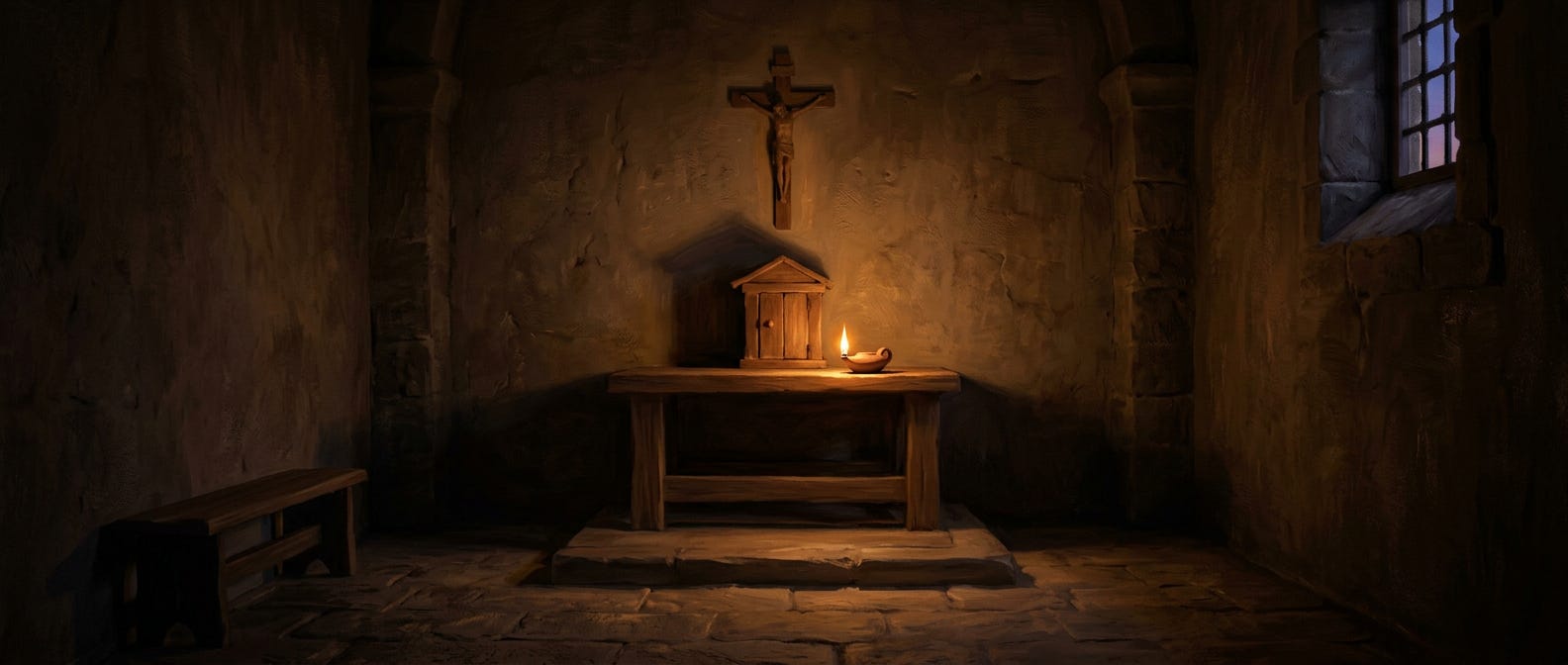
The chapel was small.
Augustine knelt on the worn stone before the low wooden altar, in the small chapel that Gregory had built into the fabric of his family villa on the Caelian Hill twenty years before, when Gregory had still been a young monk here and not yet Pope, and the chapel had been the private oratory of the community of the brothers of Saint Andrew. The community had grown. The villa had been made into a monastery. Gregory had left the monastery to become the Pope. But the chapel had remained what it had been - small, plain, dim, with the single oil lamp burning before the tabernacle and the wooden crucifix above the altar and the polished stone floor worn slightly by twenty years of monks’ knees. Augustine had prayed here every evening for the past nine years, since he had first come as a novice. He was now perhaps forty-five. He was the prior. He had thought he would be the prior for the rest of his life. He had been happy with the thought.
Tomorrow morning he was leaving Rome.
The Holy Father had asked him. Six weeks ago the Pope had summoned him to the papal residence and had told him, in the direct way the Pope had of telling difficult things, that Augustine had been chosen to lead a company of forty monks to the island of Britain, to the tribes of the Angles, to preach the gospel to the pagans of the far north. The Pope had told him this in an ordinary voice, without ceremony, at the end of a business audience about the year’s grain distribution. Augustine had not spoken for perhaps a full minute after the Pope had finished. The Pope had waited. Augustine had said, finally, Yes, Holy Father, if you wish it. The Pope had said, I wish it. But more importantly, He wishes it. I would not send you if I did not know that. Go and prepare.
He had prepared.
He had selected the forty. He had provisioned them. He had studied the maps. He had received letters of recommendation for the Frankish bishops along the route. He had spoken with the Pope four more times about specific matters - which liturgical books to bring, which relics, which vestments, how to comport themselves before pagan kings, how to comport themselves before the Christian queens some of those kings had married. He had done all of it well. The forty were packed. They were sleeping in the guest house tonight. They would leave at dawn.
He knelt in the chapel and could not stop shaking.
The shaking had begun about an hour ago. He had been in the small refectory eating the evening meal with the brothers when he had felt it in his hands - a small tremor that had come and had not gone. He had set down his spoon. He had finished the meal by will alone. He had come to the chapel afterward and had knelt to pray and had felt the shaking move from his hands up his arms and into his chest. He was not sure he could stop it. He was not sure whether it was fear or something else. He was not sure it mattered. He was going to have to leave at dawn regardless of what was happening to his body.
He whispered, in Latin, Domine, sum servus tuus. Domine, sum servus tuus. Fac mihi secundum voluntatem tuam. Lord, I am Your servant. Lord, I am Your servant. Do with me according to Your will.
He had been saying this prayer for six weeks. It had helped, most of the time. It was not helping tonight.
There were footsteps in the corridor outside the chapel.
He did not turn his head. The brothers came into the chapel at various hours of the evening for their own prayer, and it would have been rude to look up and disturb whichever brother was arriving. He kept his eyes on the tabernacle. He kept praying his prayer. The footsteps came into the chapel. They paused just inside the door. They came slowly toward him, and then they stopped, and then he heard the small movement of a man kneeling on the stone beside him.
He glanced sideways.
It was Gregory.
Augustine started to rise, in the immediate motion of a monk who has discovered his abbot is beside him, but Gregory laid a hand on his forearm and pressed him gently back down. Gregory himself remained on his knees. They were shoulder to shoulder before the tabernacle. Gregory was in a plain black tunic and cloak, without any of the papal insignia. He had walked. He had not been carried in the litter. He had come from the Lateran on his own feet, in the early summer evening, up the Caelian slope to the monastery he had left six years before. He had done this without escort. He had done it without announcement.
They knelt together for perhaps ten minutes.
Neither spoke. Gregory prayed with his eyes closed. Augustine prayed with his eyes on the tabernacle. The oil lamp burned steadily. The chapel was cool. The shaking in Augustine’s hands had quieted. He was not sure why. He suspected the quieting had something to do with the man beside him, who had spent decades kneeling on this same stone before this same tabernacle and whose stillness was a kind of instruction.
After a while Gregory whispered, without opening his eyes, “Do you want me to stay while you finish your prayer, or shall we speak now.”
Augustine whispered back, “Speak, Holy Father. I have been finishing the prayer for an hour and it will not finish.”
Gregory opened his eyes. He looked at the tabernacle for another moment. Then he turned his head slightly toward Augustine, still on his knees.
“It will not finish tonight,” he said. “That is not a failure. It is only that some prayers are meant to be carried a long distance and not concluded before the walking begins. This is one of them. You will finish it on the boat crossing to Britain, perhaps. You will finish it in a cell at Canterbury. You may not finish it at all. That is acceptable. The Lord does not require every prayer to be finished. He requires only that we keep at them.”
Augustine let out a breath he had not known he was holding.
“Holy Father.”
“Not tonight, Augustine. Not in this chapel. Call me Gregory. I came up the hill on my own feet so that I could be Gregory again for one evening. I have missed being Gregory. The Pope does not have permission to kneel in this chapel; the Pope must remain at the Lateran and receive petitioners. Gregory has permission. Gregory has been given the evening. Do not deny him.”
Augustine nodded, slowly.
“Gregory.”
“Yes.”
They sat back from the kneelers and settled themselves on the low wooden bench that ran along the north wall of the chapel. Gregory arranged his cloak carefully. Augustine folded his hands in his lap. The oil lamp threw their shadows against the plaster of the opposite wall - two seated men, in profile, side by side.
Gregory said, “You are afraid.”
“Yes.”
“How afraid.”
“I have been shaking for an hour. My body is not obeying me. I have been telling myself, since the Holy Father - since you - first spoke with me six weeks ago, that the fear would settle. It has not settled. It has been growing. Tonight it has become - “ he gestured vaguely at his own body - “this.”
Gregory nodded.
“I want to tell you something,” he said. “I have not told this to anyone in some years. I will tell it to you tonight because it is yours to hear. Twenty-eight years ago I was about your age. I was living in this monastery. I was a monk here, as you have been. I was very happy. I had left the prefecture of Rome the year before to become a monk, and I had given up the house of my father and the political future the family had prepared for me, and I had spent the year in genuine happiness, praying the Office and studying the Scriptures and eating simply and sleeping on a plank. It was the best year of my life, I think. I have never been that happy since.”
He paused.
Augustine waited.
“One afternoon,” Gregory said, “I was walking in the Forum. I was going to buy some parchment for the scriptorium. I passed the slave market at the edge of the Forum. I had passed it many times. I did not usually look. That day I looked. There were three boys standing on the platform. They were perhaps ten or eleven years old. They had very fair skin. They had hair the color of straw. I had never seen human beings who looked like that before. I stopped. I asked the trader who they were. He said, Angli, dominus. From Britain. I said, And are they Christians? He said, No, dominus. Pagans. All that country is pagan. I stood there for a long time. I looked at the three boys. They did not look back at me. They were tired and small and had been in the market for many hours, I think. Something happened inside me. I said, in the voice one uses when one is not certain who one is speaking to but is nevertheless speaking to Someone, Lord, I will go. I will go and bring them home to You. Send me.”
“You said this.”
“I said this. Standing in the Forum. Looking at three tired boys with straw-colored hair. I went back to the monastery. I went that same evening to the Pope. Pope Pelagius. I asked him for permission to lead a mission to Britain. He was surprised. He was slightly amused. He said, Gregory, you are a Roman senator’s son, you are a monk of the Caelian, you have never left Italy, why do you want to go to a barbarian island in the north? I said, Because I saw three boys in the market today and I have promised them. He did not laugh at me. He gave me the permission. I left within two weeks. I took twelve monks with me. We got as far as Ostia. We had passage on a ship for Marseille. We were on the wharf. The wind was rising. The captain was calling us to board.”
He paused again.
“And the messenger from the Pope arrived,” Augustine said, quietly.
“Yes. The messenger. Pope Pelagius had recalled me. The Roman people had gone to him in a crowd, when they had heard I was leaving. They had said, You cannot let him go. Rome needs him. He belongs to us. Pelagius had listened to them. He had sent the messenger. The messenger arrived at the wharf at Ostia perhaps twenty minutes before the ship was to sail. He handed me the letter. The letter said, Return to Rome immediately. The mission is annulled. I stood on the wharf. I read the letter three times. I told the twelve monks to unload the baggage. We went back to Rome that afternoon. I have not left Italy since.”
Augustine was silent.
He had heard part of this story before, in fragments - it was known in the monastery, the story of how Gregory had almost gone to Britain - but he had never heard Gregory tell it himself. He had never heard the specific detail of the wharf at Ostia, of the letter arriving twenty minutes before the ship sailed, of the unloading of the baggage in the afternoon.
“Gregory,” he said, softly.
“Yes.”
“You have been carrying it.”
“I have been carrying it. For twenty-eight years I have been carrying it. I have carried the three boys with the straw-colored hair. I have carried the promise I made to them in the Forum. I have carried the ship at Ostia and the messenger and the unloaded baggage. I have carried the not-going. When I became Pope six years ago I understood what I had to do. The Lord had not released me from the promise. He had only moved the fulfilling of it out of my body and into someone else’s. That someone else is you. I chose you carefully. I have been watching you for years. You are the one. You are going to Britain because I cannot. You are going to bring my three boys home. They will not be the same three boys. They have been dead for twenty-eight years, I imagine, or they are old men now working in Roman houses. Their grandchildren are in Britain. You are going to bring the grandchildren home. That is what the mission is. It is my promise being kept by your feet.”
Augustine let out a breath that was almost a small sob.
He had not expected to hear this. He had thought the mission was Gregory’s idea in the abstract - the sort of large administrative project a pope generates. He had not known it was a promise. He had not known Gregory had been carrying a promise for twenty-eight years and was now handing it to him.
“I do not know that I can do it,” he said, quietly.
“You cannot,” Gregory said. “That is correct. You cannot. I could not either. That is why the Lord asks it. He asks precisely what we cannot do, so that when the doing happens, we know it was Him. Do you understand this, Augustine. I am not sending you because I think you are strong enough. I am sending you because you are weak enough. The strong men would credit themselves. The weak men will credit the Lord. He is looking for a weak man who will not credit himself. You are the weak man. I am glad you are shaking. Go and shake in Britain. The Angles will see the shaking and they will know, in the quick way that people know these things, that whoever is doing the mission is not you. That is the whole point of missions. The missionary is not the one doing the mission. The Lord is doing the mission. The missionary is only the shape He does it through. Shake. Shake all the way there. Shake in Kent. Shake in front of King Aethelbert. Shake at your first baptism of a pagan king. The shaking is correct. Do not try to stop it. It is the small physical proof that you are the right man.”
Augustine was weeping now.
He was weeping in the way that a large man weeps when the tears come slowly and are gathered at the eyes and are wiped away with the back of the hand and are followed by others. He wept for some minutes. Gregory did not speak. Gregory looked at the tabernacle. He had said what he needed to say. He would let Augustine weep as long as Augustine needed.
After a while Augustine said, “Gregory.”
“Yes.”
“Will you write to me. When I am there.”
“I will write to you every month. I will write to you until I die or until you die, whichever comes first. I will send you liturgical books. I will send you relics. I will send you additional monks when the mission grows. I will send you my counsel on every question you ask. I will send you my prayers - though those will be sent already, before you ask. I have been sending you my prayers since the moment I told the Roman people that I would send you in my place. I have been carrying you in my prayer. I will keep carrying you. I do not think either of us has many years left. I am fifty-six. My health has not been strong. You are perhaps fifteen years younger than I am, and you are healthier, but the journey and the climate of Britain will not be kind to you. We will each of us die in the next decade, I suspect. Perhaps within the same year. That is a great thing. The Lord is arranging that too. The founder of the mission and the leader of it will both go home at about the same time, having done what the Lord asked, and it will be finished. Or rather, it will be handed on. The mission does not end when we die. It goes on. Others will build. That is how it always is.”
“The founders begin. The others build.”
“Yes. That is a saying my old master used to have. Where did you hear it.”
“You told it to me perhaps five years ago, when we were speaking about a scriptorium project. I have never forgotten it.”
“Ah. Then I told it to you. I had forgotten I had said it. It comes from a monk of my acquaintance who died many years ago. He was a difficult man. He was correct about many things. This was one of them. Take it with you to Britain. The founders begin. The others build. You are a founder, Augustine. You will begin. You will not see what your beginning becomes. You will hand the work on to someone whose name you do not yet know. He will hand it on to another. The Church of the English will grow across many centuries out of what you begin at Kent. You will see very little of it. That is correct. Do not grieve the not-seeing. It is the vocation of every founder.”
Augustine nodded, slowly.
He was calmer now. The shaking in his hands had stopped. Something had settled in him during the last minutes. He was not going to have his fear taken from him. He understood this. The fear was going with him to Britain. But the fear was no longer an obstacle to the going. The fear was part of what he was bringing. The Lord wanted the fear. The Lord was using it.
They knelt together again for a while.
The evening had come on fully by now, and the oil lamp was the only light in the chapel, and the small square of the window near the ceiling showed only the last blue of the Roman summer twilight above the roofs of the Caelian. Somewhere in the monastery the brothers were singing Compline. The chant came faintly through the walls. It was the Nunc dimittis. The prayer of Simeon in the temple, holding the child, saying, Lord, now let Your servant depart in peace, according to Your word. Augustine listened to the chant. He thought Simeon had known something about being sent that had not been obvious to him before tonight.
Gregory rose from the kneeler.
He came around in front of Augustine. He laid both hands on Augustine’s head, in the old formal blessing that a pope gives to a bishop being sent, which Gregory had not yet formally given to Augustine because Augustine had not yet been consecrated a bishop and would not be until after his mission had been received in Kent. Gregory gave the blessing anyway, in the informal way that friends bless friends who are leaving in the morning.
“Vade, Augustine. Vade in nomine Patris, et Filii, et Spiritus Sancti. Vade et non pertimescas. Deus tecum est.”
Go, Augustine. Go in the name of the Father, and of the Son, and of the Holy Spirit. Go and do not be afraid. God is with you.
Augustine kissed Gregory’s hand.
Gregory helped Augustine to his feet.
They stood together in front of the tabernacle for a moment. Then Gregory turned and walked out of the chapel, quietly, without ceremony, in the same plain black tunic he had come in. He walked back down the Caelian slope in the summer evening. He walked to the Lateran on his own feet. He was the Pope again by the time he arrived. He had been Gregory for perhaps two hours. It had been enough.
Augustine remained in the chapel.
He knelt again before the tabernacle. He prayed for some while longer. The Compline chant in the corridor had ended by now. The monastery was quiet. He was going to sleep for a few hours. He was going to rise before dawn. He was going to walk out of this chapel and out of this monastery and down the Roman roads and up through Gaul and across the Channel and into a country he had never seen where he did not know the language and where the people worshipped gods whose names he had not learned and where he might die within the year of illness or violence or exposure or all three. He was going to do this shaking.
He was, he thought, ready.
He rose. He kissed the altar. He went to his cell.
The forty left at dawn.
Augustine turned back in southern Gaul. He had heard, at the monastery of Lérins, so many terrible stories of the Angles that he had lost his nerve, and he had ridden back to Rome to ask Gregory to annul the mission. Gregory had refused. Gregory had written him a letter that was firm and warm at the same time, in the way Gregory could write when he wished to. The letter said, in essence, It would be better never to have begun a good work than, having begun it, to turn back. Go. I will send you my continued prayers. Do not be afraid. Augustine had received the letter and had wept for a day and had then continued.
They landed in Kent in the spring of 597. King Aethelbert received them warily, in the open air, on the Isle of Thanet, because he had been told that the Christian monks had powers of illusion and he did not want to be enclosed with them under a roof. Augustine and the monks approached him in procession carrying a silver cross and a painted board with an image of Our Lord and chanting the litany. Aethelbert listened. Aethelbert gave them the small ruined church of Saint Martin in Canterbury, which had been used by his Frankish Christian wife Bertha, and told them they were welcome to preach if they could. They preached. Many were converted. Aethelbert himself was baptized before the year 601. Ten thousand of his subjects were baptized in a mass baptism on Christmas Day, 597.
Augustine was consecrated bishop by the Frankish bishops before the mass baptism. Gregory raised Canterbury to an archdiocese and made Augustine the first Archbishop.
Augustine died on the twenty-sixth of May, in the year six hundred and four. He was buried in the abbey he had founded at Canterbury.
Gregory died on the twelfth of March, in the same year, two months before Augustine. He was buried at Saint Peter’s in Rome, as the popes are.
The two of them arrived home within two months of each other, as Gregory had suspected they would. Gregory, when he arrived, went out through the door of the room to receive Augustine when Augustine came in two months later. Augustine walked into the room shaking. He was, by then, an old man and a bishop and had spent his last decade preaching to pagans in a language he had learned late. He was still shaking. Gregory embraced him. Gregory said, in the plain Latin he had always used with him, You did it, Augustine. You did the mission.
Augustine said, No, Gregory. He did it. I only shook.
Gregory said, That is what I told you. That is why He chose you. Come. There are three boys here who want to meet you. They have been waiting since I was in the Forum.
The three boys with the straw-colored hair had been waiting. They had died young, as slaves. They had died Christian in the room, though they had never been baptized in life. The Lord had brought them home in a way they had not lived to see. They came forward. They met Augustine. They thanked him.
Augustine, still shaking, was received.
Gregory laughed.
The Lord, watching, laughed also. He had been arranging the whole thing for twenty-eight years, and it had been finished at last, and everyone was home.
The Church of the English grew. It grew for many centuries. It sent out its own missionaries in time - to the Frisians, to the Saxons of Germany, to the Norwegians, to the Icelanders, and eventually across a great ocean to a country called America, where a young Irish immigrant named McGivney would one day be born and would grow up in a Connecticut parish that traced itself, by seventeen centuries of unbroken succession, back to Augustine and to Aethelbert and to Kent and to the shaking man who had walked out of a small chapel on the Caelian Hill one summer morning in 596.
The lamp in the small chapel of Saint Andrew burned out at dawn, as lamps do, on the morning the forty left Rome.
Gregory was at the Lateran when the sun rose. He was already back to being the Pope.
But he had been Gregory for one evening. It had been enough.
For your prayer this week: Saint Gregory the Great and Saint Augustine of Canterbury, you who carried a promise for twenty-eight years and you who shook all the way to Kent, pray for those of us who are being sent, or who are sending, or who have made promises we cannot ourselves keep. Grant us the grace to trust that the mission is not ours but His, that our weakness is the very reason He chose us, and that the shaking is not a failure but the small physical proof that we are the right ones. Amen.
Two Lamps returns next Friday: Saint Peter Claver and Saint John Chrysostom, Peter Claver’s cell at the Jesuit residence in Cartagena de Indias, an evening in the 1620s as another slave ship approaches the harbor.
Two Lamps is a weekly short story braiding the lives of two or three saints across the centuries. Sometimes the meeting is rendered as an encounter in eternity. Sometimes as the older saint coming, in vision or in patronage, to the soul of the younger. Sometimes, as tonight, the meeting is simply between two friends in one life, in one century, in one small chapel, on one summer evening. The Communion of Saints holds them all as one company.
Two Lamps is written by Deacon Michael Halbrook, a permanent deacon of the Diocese of Springfield in Illinois, serving at St. Elizabeth Parish in Granite City. He writes personally at DeaconMichael.net, serves families through Domus Formation, and publishes the serial novel Ordo: A Chronicle of Lux Perpetua at LuxPerpetua.net. Two Lamps is co-conceived with his son Joseph.