

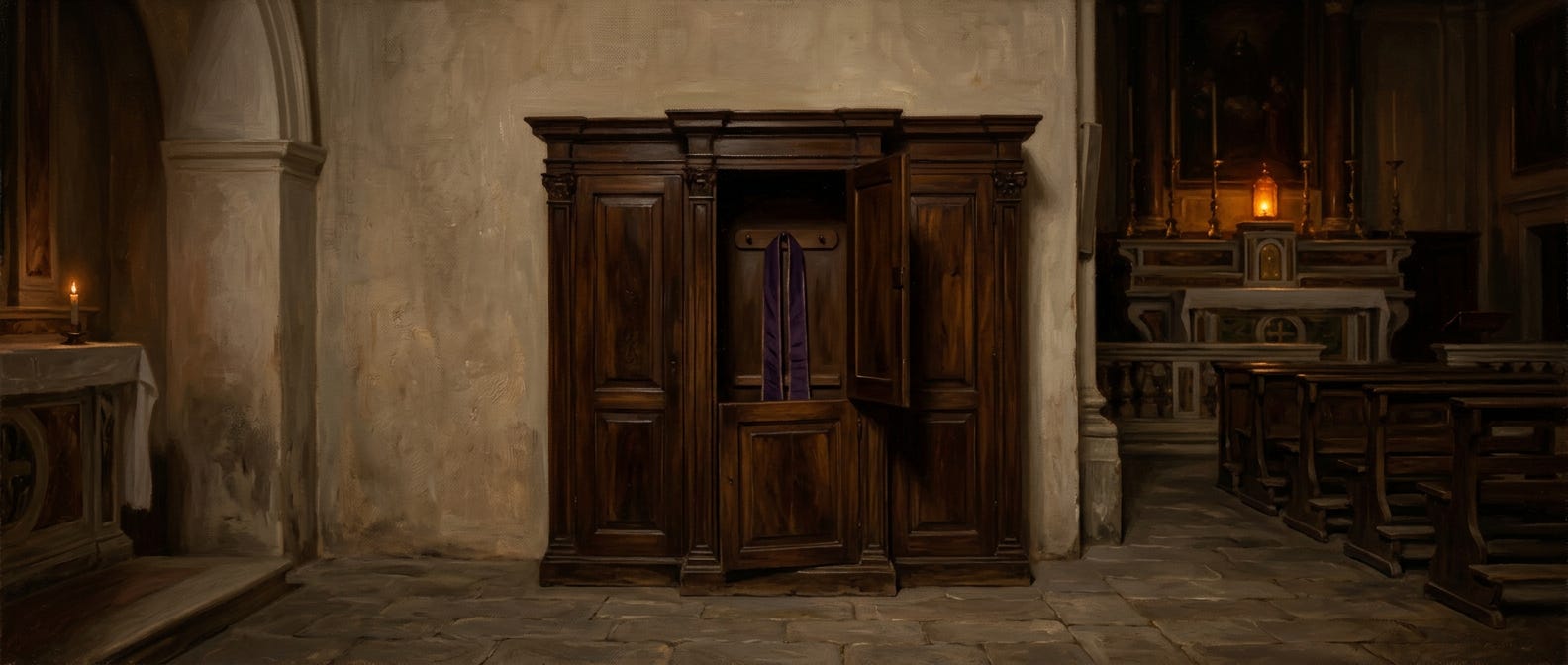
The last penitent had gone.
Padre Pio remained on the wooden bench in the confessor’s compartment, in the confessional set against the north wall of the church of Santa Maria delle Grazie at San Giovanni Rotondo, at the far end of the friary corridor that connected the church to the cloister where his cell was, though the cell was very far away tonight, and he was not entirely sure he would be able to walk to it. He had been in the confessional since four-thirty in the morning. It was now some hour after ten in the evening. He had eaten a piece of bread and drunk a cup of water at eleven. He had not eaten since. His body did not want food. His body wanted only to lie down and to weep, and he had trained his body over many years not to weep in the confessional, so he did not weep now, but he could feel the weeping just under the surface of his chest, waiting for him to be alone.
He was, now, alone.
The last penitent had been a young woman from Foggia. She had come by train and by bus and had waited in the church since before dawn. She had needed a very long confession. She had needed him. He had given her what she needed. He had been kind with her in the way he had learned to be kind, over many years, with the ones who came to him with something heavy that had been carried for a long time. He had given her absolution. He had watched her leave the confessional straightened in a way that a soul is straightened when it has laid down a weight. That was the fruit. That was what all of the hours were for. He had held to that fruit for the twenty minutes since she had left, because holding to the fruit was what kept him from weeping.
He sat now in the wooden bench.
His hands hurt. The bandages were fresh - he had changed them at the noon break, when he had also drunk his cup of water - but the bandages had been soaking through for some hours now, and he could feel the wetness against his palms. The stigmata had been with him for eighteen years. They still hurt. He had told a bishop once that they hurt in a way that a physical wound could not entirely explain, and the bishop had not written this down, and it was probably better that the bishop had not written it down, because the way in which they hurt was not the sort of thing that translated well to episcopal correspondence. They hurt. That was enough. The Lord had given him the wounds. The Lord could take them away when He wished. The Lord had not taken them away. That was the arrangement.
Padre Pio closed his eyes.
He heard the door of the penitent’s compartment open, and the sound of someone kneeling on the wooden kneeler on the other side of the screen.
He opened his eyes.
He was, he realized, being asked to hear another confession. It was after ten in the evening. The church should have been closed. The porter should have locked the outer door an hour ago. Someone had come in anyway. Someone was on the other side of the screen. Padre Pio’s body was saying, quietly, that it could not do another confession tonight. His body had been saying this for four hours. He had ignored his body for four hours. He would ignore it again. He was a priest. There was a soul on the other side of the screen. He would hear the soul.
He whispered, in Italian, “In nomine Patris, et Filii, et Spiritus Sancti. Sono qui, figlio mio.”
There was silence on the other side of the screen for perhaps a full breath.
Then a voice - old, quiet, in a French-accented Italian that Padre Pio had not heard in his lifetime - said, “Non sono venuto per la confessione, Padre. Sono venuto per stare con te.”
I have not come for confession, Father. I have come to be with you.
Padre Pio sat very still.
The voice on the other side of the screen was not any voice he had heard before. But he knew the voice. He knew the voice in the way that a priest knows another priest’s voice after long correspondence, even when the correspondence has been across a great distance and across a great difference of language. He had never corresponded with the voice. He had read about the voice. He had read about the voice many times. The voice belonged to the parish priest of a small village in France where the parish priest had died seventy-seven years ago, and where the parish priest had spent the last thirty years of his life in this same posture, on this same kind of wooden bench, for the same hours of the day, hearing the same sorts of confessions from souls who had traveled the same sorts of distances.
Padre Pio whispered, “Curato d’Ars?”
“Sì, fratello. Sono io. Jean-Marie.”
Yes, brother. It is I. Jean-Marie.
Padre Pio did not speak. He was, for the first time all day, unable to find the words that a priest is trained to find. He sat with his eyes closed and with his hands - the wounded hands, the bandaged hands, the hands that had been raised in absolution perhaps three hundred times today - resting on his knees. He could feel a trembling begin in his shoulders. He was not going to weep in the confessional. He had trained himself over eighteen years not to weep in the confessional. He would not weep now. But he was going to sit for a while in silence, and the visitor on the other side of the screen was going to let him.
After a long time Padre Pio said, “Perché sei qui, fratello.”
Why are you here, brother.
“Perché tu sei stanco. E perché io conosco questa stanchezza. E perché il Signore ha detto che potevo venire.”
Because you are tired. And because I know this tiredness. And because the Lord has said that I might come.
Padre Pio bowed his head.
“Fratello Giovanni,” he said. “Vuoi entrare da questa parte.”
Would you come around to this side.
“No, fratello. Voglio restare qui. Voglio essere un penitente per un’ora. È da molto tempo che non lo sono. Mi farà bene. E ti farà bene anche a te, credo, sapere che c’è qualcuno dall’altra parte del setto che non è venuto per confessare peccati. Che è venuto solo per stare con te. Molti dei tuoi penitenti oggi ti hanno chiesto qualcosa. Io non ti chiedo nulla. Sto seduto. È tutto ciò che faccio. Puoi parlare o non parlare. Puoi piangere o non piangere. Puoi dormire, se vuoi. Sto seduto. Sono qui. Non me ne vado.”
No, brother. I want to stay here. I want to be a penitent for an hour. It has been a long time since I was one. It will do me good. And it will do you good, I think, to know that there is someone on the other side of the screen who has not come to confess sins. Who has come only to be with you. Many of your penitents today have asked you for something. I ask you for nothing. I am sitting. That is all I am doing. You can speak or not speak. You can weep or not weep. You can sleep, if you wish. I am sitting. I am here. I am not going.
Padre Pio was weeping now.
He wept quietly, in the way that a man who has trained himself for many years not to weep in public weeps when the training relaxes. The tears fell on his bandaged hands and darkened the linen. He did not wipe them away. He did not have the energy to wipe them away. He sat with his eyes closed and let them fall. On the other side of the screen the visitor was silent, and Padre Pio could hear, very faintly, the sound of the visitor’s breathing, and he could hear also the movements a man makes when he is kneeling on a hard wooden kneeler for a long time and is trying not to shift his weight in a way that would disturb the man on the other side of the screen. The visitor knew how to do this. The visitor had done it for many years, on his own kneeler, on the other end of many long days.
After some while Padre Pio said, “È così pesante, fratello.”
It is so heavy, brother.
“Lo so. È stato pesante anche per me. Ho pensato molte volte di andarmene. Sai questo. L’hanno scritto nei libri. Sono fuggito ad Ars tre volte per raggiungere la Certosa. Sono stato ripreso ogni volta e riportato indietro. Non volevo essere un curato di parrocchia. Volevo essere un eremita. Il Signore aveva altri piani. Sono rimasto ad Ars. Ho ascoltato le confessioni per trent’anni. Alcuni giorni credevo che stessi facendo qualcosa. Molti giorni non lo credevo. Ho continuato a farlo. Adesso, dalla parte in cui sono, so che i giorni in cui non credevo di stare facendo qualcosa erano i giorni in cui il Signore stava facendo di più. Il credere non era necessario per il fare. Il fare era ciò che Lui chiedeva. Il credere era un bonus che a volte ricevevo e a volte no. Non hai bisogno di credere che stai facendo qualcosa, fratello. Devi solo continuare a sedere qui. Il Signore fa il resto. Lo fa attraverso di te. Lo faceva attraverso di me. Lo farà attraverso altri dopo di te. Le confessioni non finiranno.”
I know. It was heavy for me also. I thought many times of leaving. You know this. It is in the books. I fled from Ars three times to reach the Chartreuse. I was retrieved every time and brought back. I did not want to be a parish priest. I wanted to be a hermit. The Lord had other plans. I stayed at Ars. I heard confessions for thirty years. Some days I believed I was doing something. Many days I did not. I continued doing it. Now, from the side I am on, I know that the days when I did not believe I was doing anything were the days the Lord was doing the most. The believing was not necessary for the doing. The doing was what He asked. The believing was a bonus I sometimes received and sometimes did not. You do not need to believe you are doing something, brother. You only need to keep sitting here. The Lord does the rest. He does it through you. He did it through me. He will do it through others after you. The confessions will not end.
Padre Pio kept his eyes closed.
He had heard, over many years, all of the standard theological explanations of what the confessional was doing. He had read them in his Capuchin formation. He had read them in the manuals and the treatises. He knew them by heart. He had never heard the explanation quite this way. He had never heard someone say that the believing was not necessary for the doing. He had assumed, all his life, that his belief in the fruit of the sacrament was part of what made the sacrament fruitful. He was learning tonight, from a French country priest on the other side of a wooden screen, that this was not entirely correct. The Lord was the one doing the sacrament. Padre Pio was the instrument. The instrument did not have to believe. The instrument had to be present, and had to say the words, and had to raise the wounded hand.
He said, quietly, “Fratello. Ho pensato spesso che i miei penitenti meritassero un confessore migliore di me.”
I have often thought that my penitents deserved a better confessor than me.
“Sì. Ho pensato la stessa cosa per trent’anni. Non è vero. Non era vero per me. Non è vero per te. I tuoi penitenti hanno ricevuto il confessore che il Signore ha voluto che ricevessero. Il Signore ti ha voluto in questa cabina, con queste mani, con queste ferite, in questo villaggio dell’Italia meridionale, in questo secolo. Non è un errore. Non stanno ricevendo un secondo migliore. Stanno ricevendo il primo. Sei il primo. Sei ciò che il Signore ha scelto. Fidati della scelta. Non ti chiede di credere di essere all’altezza. Ti chiede solo di restare seduto. Sei seduto. Questo è sufficiente.”
Yes. I thought the same thing for thirty years. It is not true. It was not true for me. It is not true for you. Your penitents have received the confessor the Lord wanted them to receive. The Lord wanted you in this booth, with these hands, with these wounds, in this village in southern Italy, in this century. It is not a mistake. They are not receiving a lesser second-best. They are receiving the first. You are the first. You are what the Lord chose. Trust the choosing. He does not ask you to believe you are worthy. He asks you only to remain seated. You are seated. This is sufficient.
Padre Pio wept again.
He wept for perhaps two or three minutes. Vianney was quiet. Vianney kneeled on the wooden kneeler on the other side of the screen and did not shift his weight and did not speak. The old Curé of Ars had, in his lifetime, heard many hundreds of penitents weep in the way Padre Pio was weeping now, and he had learned from these that the weeping was itself a form of prayer that did not require accompaniment. He accompanied it by his silence. It was the accompaniment he had learned to give.
After the weeping had settled Padre Pio said, softly, “Fratello. Ti attaccava il diavolo. Ad Ars. Ti attaccava fisicamente.”
Brother. The devil attacked you. At Ars. He attacked you physically.
“Sì. Lo faceva. Lo chiamavo il grappin. Il rampino. Mi tirava fuori dal letto. Bruciava il mio letto una volta. Faceva rumori nella canonica di notte. Mi lasciava lividi. Era reale. Non era la mia immaginazione. Il vescovo non mi credeva del tutto ma nemmeno mi contraddiceva. Sapeva che qualcosa stava accadendo. Ho imparato a non aver paura. Il diavolo attacca sempre chi confessa. La confessione lo fa arrabbiare. Perché nella confessione perde le anime che pensava di aver vinto. La rabbia è la rabbia di un perdente. Non è la rabbia di un vincitore. Ho imparato a ricordarmelo. Ti attacca anche te. Lo so. Molti sanno. Continua a non aver paura. Lui è già stato sconfitto. La sua rabbia è la rabbia di uno che sa di aver perso. Non ha nessun potere reale su di te. Ha solo la capacità di infastidirti. Fastidio non è potere. Fastidio è quello che rimane a chi ha perso.”
Yes. He did. I called him the grappin. The hook. He would pull me out of bed. He burned my bed once. He made noises in the rectory at night. He left bruises on me. It was real. It was not my imagination. The bishop did not entirely believe me but did not entirely contradict me either. He knew something was happening. I learned not to be afraid. The devil always attacks those who hear confessions. Confession makes him angry. Because in confession he loses souls he thought he had won. The anger is a loser’s anger. It is not a winner’s anger. I learned to remember this. He attacks you also. I know this. Many know. Continue not to be afraid. He has already been defeated. His anger is the anger of one who knows he has lost. He has no real power over you. He only has the ability to annoy you. Annoyance is not power. Annoyance is what remains to the loser.
Padre Pio smiled, for the first time all day.
The smile was small. It was mostly interior. But it was a smile. Vianney could not see it through the screen but Vianney could hear it in the quality of Padre Pio’s next breath, and Vianney smiled also, on his side, without saying anything.
They were quiet for some time.
The church around them was very quiet. Somewhere in the friary a friar was walking down a corridor - Padre Pio could hear the footsteps very faintly through the walls. A candle at the side altar of the Sacred Heart guttered and steadied. The night outside was cool for southern Italy in October. There were no stars visible through the high windows above the nave. The lamp before the tabernacle burned steadily. This lamp Padre Pio had lit himself before Mass this morning. It would burn until sometime near dawn, when the oil would be exhausted and the sacristan would replenish it before the first Mass at five.
Padre Pio said, “Fratello. Cosa devo fare adesso.”
Brother. What should I do now.
“Adesso vai a letto, fratello. Puoi camminare fino alla tua cella. Il Signore ti darà la forza per i cinquanta passi. Non è troppo lontano. Vai. Dormi. Il Signore veglierà su di te mentre dormi. Domani mattina alle quattro e mezza tornerai in questa cabina. Ci saranno di nuovo trecento anime in attesa. Le ascolterai. Sarà pesante. Continuerai. Sono stato con te stasera perché il Signore mi ha lasciato venire. Non tornerò ogni sera. Ma sarò con te sempre, in un modo diverso. Ti guardo. Ti amo. Sono uno dei tuoi. Non sei solo. Ci sono molti di noi. Anche il santo Curato Sarto era un confessore prima di essere un papa. Ci sono altri. Molti altri. La lista dei confessori è lunga. Continua la lista. Sei uno di noi. Siamo con te.”
Now go to bed, brother. You can walk to your cell. The Lord will give you the strength for the fifty steps. It is not too far. Go. Sleep. The Lord will watch over you while you sleep. Tomorrow morning at four-thirty you will return to this booth. There will be three hundred souls waiting again. You will hear them. It will be heavy. You will continue. I was with you tonight because the Lord let me come. I will not return every evening. But I will be with you always, in a different way. I am watching you. I love you. I am one of yours. You are not alone. There are many of us. The holy tailor-pope Sarto was a confessor before he was a pope. There are others. Many others. The list of confessors is long. Continue the list. You are one of us. We are with you.
Padre Pio bowed his head.
“Grazie, fratello Giovanni.”
“Grazie a te, fratello Pio. È stato un onore stare con te stasera. Il tuo lavoro è ricevuto. Ogni ora è ricevuta. Ogni assoluzione è ricevuta. Nessuna è persa. Il Signore le raccoglie tutte. Ne fa un tesoro. Il tesoro si accumula. Non lo vedi. Un giorno lo vedrai. Non oggi. Vai a letto.”
Thank you, brother. It has been an honor to be with you tonight. Your work is received. Every hour is received. Every absolution is received. None is lost. The Lord gathers them all. He makes a treasure of them. The treasure is accumulating. You do not see it. One day you will see it. Not today. Go to bed.
Padre Pio heard the sound of Vianney rising from the kneeler.
He heard the door of the penitent’s compartment open and then close, softly. He did not open his eyes to look. He knew that if he opened his eyes and looked into the church, no one would be there. He kept his eyes closed. He remained on the wooden bench in the confessor’s compartment for perhaps another minute. Then he rose.
His body did not want to rise. He rose anyway.
He walked out of the confessional. He crossed the church. He genuflected before the tabernacle. He walked through the side door into the corridor that connected the church to the cloister. He walked the fifty steps to his cell. The Lord gave him the strength for the fifty steps, as Vianney had said. He arrived at his cell. He closed the door. He sat on the edge of his bed. He was crying again, quietly, in a way that was neither grief nor exhaustion but was closer to gratitude. He said the evening prayers he said every night. He lay down. He slept.
At four-thirty the next morning the friary bell rang for the first Office. Padre Pio rose. He said Mass at five, as he did every morning. He entered the confessional at six. The line of penitents already stretched down the nave and out the front door of the church into the piazza. He heard confessions until noon. He ate a piece of bread and drank a cup of water. He returned to the confessional at one. He heard confessions until nine. He heard confessions the next day. He heard confessions the day after. He heard confessions for thirty-two more years.
He died on the twenty-third of September, nineteen sixty-eight, at the age of eighty-one, in his cell at the friary of Santa Maria delle Grazie. His last words were Gesù, Maria. Jesus, Mary. The stigmata had disappeared from his hands and feet in the three days before his death. His body was displayed in the church where he had heard confessions for so many decades, and where a very large crowd had gathered, and where the crowd remained for four days, and where the crowd was in some sense still gathering, sixty years later, because it has become a very large pilgrimage site and pilgrims still come.
He was beatified in 1999. He was canonized on the sixteenth of June, 2002, by Pope John Paul II, in Saint Peter’s Square, before what was at the time the largest crowd ever gathered for a canonization. His feast is September 23.
The confessional at San Giovanni Rotondo is preserved. Pilgrims still visit it. Some of them kneel on the wooden kneeler on the penitent’s side. Some of them wonder, though most do not know, that on an evening in the autumn of 1936 a French country priest who had died in 1859 had knelt there for an hour to be with the exhausted Italian friar on the other side of the screen. The story is not in the official biographies. It was not the sort of story Padre Pio would have told to a bishop. But he told it once, in the mid-1960s, to a young Capuchin novice who had asked him, in a general way, what had sustained him through the many years of the confessional. Padre Pio had smiled his small smile and had said, “Ci sono stati altri confessori. Non ero solo.”
There were other confessors. I was not alone.
The novice had not entirely understood the answer at the time. He understood it, later.
Saint John Vianney continued to keep his list of confessors from the room where he was. The list grew across the twentieth and the twenty-first centuries. The Church’s need for confessors did not diminish. The lines of penitents outside confessionals in Italian and French and American and Filipino and Nigerian and Brazilian churches continued to form on Saturday afternoons and on the days before great feasts, and priests continued to sit for the hours, and Vianney watched them, and blessed them silently from the room where he was, and prayed for them, and sometimes - when the Lord let him come - visited one of them on a difficult evening in the way he had visited Padre Pio in the autumn of 1936.
The line of confessors is long. It continues.
The lamp before the tabernacle in the church of Santa Maria delle Grazie at San Giovanni Rotondo burned out at dawn, as lamps do, on the morning after Vianney’s visit.
The sacristan replenished it before the first Mass.
Padre Pio entered the confessional at six.
He heard the first penitent.
He continued.
For your prayer this week: Saint Padre Pio and Saint John Vianney, you who sat in confessionals for eighteen hours a day for many decades, you who bore stigmata and grappin and the anger of the loser, pray for the priests who sit in confessionals in our own century, who are fewer than they should be and are tired in ways their people do not always see. Grant them the grace to know that they are not alone, that the list of confessors is long, that the believing is not necessary for the doing, and that the Lord gathers every absolution into His treasure and none is lost. Amen.
Two Lamps returns next Friday: Saints Thérèse of Lisieux & Rose of Viterbo, Thérèse's cell at the Carmel of Lisieux, an autumn afternoon in 1893.
Two Lamps is a weekly short story braiding the lives of two or three saints across the centuries. Sometimes the meeting is rendered as an encounter in eternity. Sometimes as the older saint coming, in vision or in patronage, to the soul of the younger. Sometimes as two friends meeting in one life. The Communion of Saints holds them all as one company.
Two Lamps is written by Deacon Michael Halbrook, a permanent deacon of the Diocese of Springfield in Illinois, serving at St. Elizabeth Parish in Granite City. He writes personally at DeaconMichael.net, serves families through Domus Formation, and publishes the serial novel Ordo: A Chronicle of Lux Perpetua at LuxPerpetua.net. Two Lamps is co-conceived with his son Joseph.