

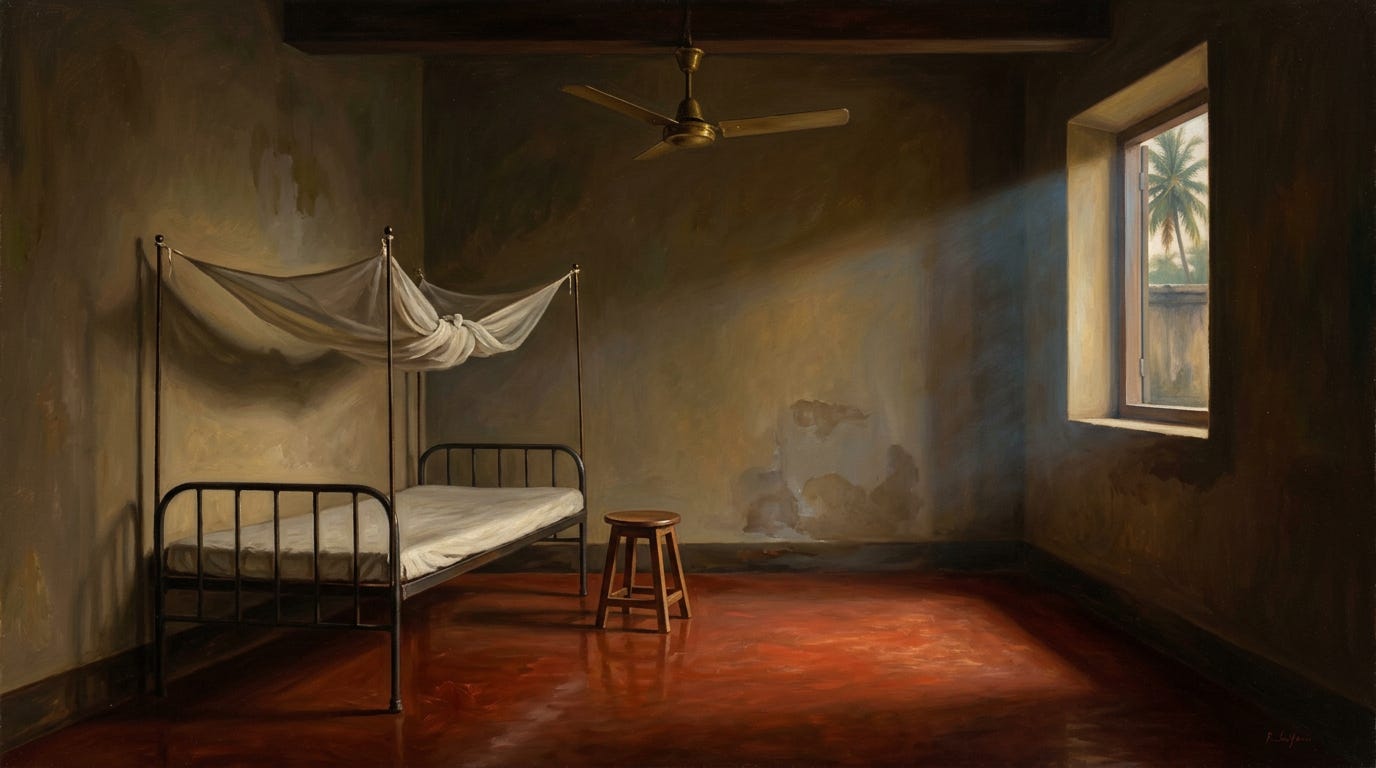
The fan was not turning.
The fan was an old ceiling fan, brass-bladed, hung from the wooden beam above her cot, and it had stopped turning two days ago when the small generator at the convent had run out of fuel, and the brothers in the village had not yet brought the new fuel because the monsoon road from Pala had been washed out in last week’s rains. Sister Alphonsa lay on the cot in the small infirmary cell and looked at the unmoving fan above her, and she was not bothered by the heat, although the heat was considerable. She had spent most of the last twelve years not being bothered by various things. The fan was one of them.
She was thirty-five. She had been a Franciscan Clarist for almost nineteen years. She had been sick for most of them. She was now, finally, very sick, and she understood that this sickness was the last one, and that the road from Pala being washed out was a small grace because it meant that the doctor from Kottayam would not be coming, and the doctor would not be giving her any more of the painful medicines that were not curing her, and she would be left in peace.
She lay on her side because her stomach hurt too much to lie on her back. The cot was a narrow iron one with a thin mattress. The mosquito netting was tied up at the head and the foot because the small sister who attended to her, Sister Annamma, had said the netting made her too hot. Through the window of the small cell she could see the edge of the courtyard, and the wall beyond, and beyond the wall the very top of the coconut palm that grew in the next yard, the long fronds moving slightly in whatever small wind was coming from the river to the west. She could hear, faintly, the small bell at the parish church across the village ringing for some matter she did not know - perhaps a funeral, perhaps the small evening Mass, perhaps only the sacristan being playful, because the sacristan at the parish church was a young man and was sometimes playful. She did not need to know. The bell was company. She lay with her head on the small pillow and she watched the coconut palm move beyond the wall and she breathed the breath that was becoming difficult and she waited for whatever was next.
A man was sitting on the small wooden stool by her cot.
She had not heard him come in. The door of the infirmary cell had a latch that was not silent, and the floor of the corridor outside was made of polished red oxide that announced footsteps clearly, and she had heard nothing. She turned her head slowly on the pillow to look at him, because the turning was an effort, and she saw him in the soft late-evening light through the window, and she did not at first know what to make of what she saw.
He was an old man, but the kind of old that did not look quite old, the way she had read about in certain holy books. His skin was the color of old teak, weathered by many suns of many kinds. His hair and beard were dark and short and his eyes were the deep eyes of a man who had spent much of his life in light too strong for soft eyes. He wore a long simple wrap of undyed cotton, knotted at the shoulder, in the way she had seen in old paintings in the Malayalam children’s catechism her great-uncle had used when he taught her her first prayers. His feet were bare. They were the feet of a man who had walked a great deal in his life. The stool he sat on was the small wooden stool that Sister Annamma sat on when she came in to feed her broth. He sat on it as though he had been sitting on small wooden stools for a long time.
She looked at him for some while.
He looked back at her.
After a while she said, very softly, in Malayalam, the language she had spoken every day of her life and which was still the easiest language for her even in this fevered week, “Vandanam, achan.” Greetings, father.
He inclined his head.
He spoke in Malayalam.
It was a Malayalam she did not quite recognize. The words were the words she knew - Vandanam, makal - greetings, daughter - but the shaping of them was different, slower, more deliberate, like a man speaking a language he had learned from listening rather than from speaking. There was something underneath the Malayalam that was older. She could hear it. She had spent her life listening to her great-uncle pray the Syriac of the old liturgy, and she knew the sound of a tongue that was not native to a speaker who was nevertheless making it work. The old man at her cot was speaking through Malayalam from some other tongue underneath.
“Achan,” she said again. Father. It was what one called a priest. “Who are you.”
“I am a brother of yours,” he said. “From a long time ago. From very far west of here.”
She closed her eyes for a moment because the small effort of keeping them open was tiring. When she opened them he was still there. The fan was still not turning. The light at the window had moved a small distance further down the wall.
“From the west.”
“From a place called Galilee. You have read about it. The Lord lived there. I lived there with Him.”
She did not move. She did not cry out. She had been ill for a very long time and the small surprises of the world had been falling away from her, one by one, in the past months. She had begun to suspect, in the past two weeks, that some of the people in the room were not always the people she could see, and she had not minded this. She had thought it might be the morphine or it might be the fever or it might be the Lord beginning to show her things. She had not asked the doctor. She had not even asked the priest. She had decided that whatever was happening was acceptable and that she did not need to inquire.
But the man on the stool was not a fever-image. The man on the stool was solid. The man on the stool was casting a faint shadow on the red oxide floor in the angle of the late-evening light, and the shadow was the shadow of a real person, and she had been watching his hands and his hands had the small involuntary movements of a real person’s hands.
“From Galilee,” she said.
“Yes.”
“Who lived with the Lord.”
“Yes.”
She watched him.
“I have read about twelve men who lived with the Lord,” she said. “And I have heard, all my life, since I was a small child in my great-uncle’s catechism class, that one of those twelve men came to my country and preached the Lord here and was killed for it at Mylapore. I have been told all my life that I am a daughter of his church. I have prayed at the place of his blood. I went there with my aunt when I was nine years old. I have always thought that he was watching me, although I did not always know whether the thinking was correct.”
The old man almost smiled.
“The thinking was correct,” he said.
She lay very still.
“Thomas,” she said.
“Yes.”
“Apostle.”
“Yes.”
The small bell at the parish church across the village finished ringing whatever it had been ringing. The silence after the bell was the silence of a Kerala evening in monsoon season - the small drip of water from the eaves where a recent shower had left moisture, the distant call of a man to his cattle on the path beyond the convent wall, the soft buzz of a single mosquito that had got past the netting. She listened. He listened. Two people who had both spent much of their lives listening, listening together.
“You have come a long way,” she said.
“I have come no distance at all.”
“Then I have.”
“No, child. You have not. You are in your own country. You are in the country I gave to you. You have never left it. I have only come to the place I planted, to see what has grown.”
Alphonsa was very quiet.
She had spent her life inside the Syro-Malabar Catholic Church, which traced itself back to Thomas the Apostle and his preaching at Cranganore in the year fifty-two of Our Lord. She had been told this since she was small. She had been told it by her great-uncle who was a priest, and by the bishop who had confirmed her, and by the chaplain at the convent, and by Father Romulus her spiritual director who was now Father Romulus of the Carmelites and was at this hour at the parish church across the village because he had been told she did not have many days left and had come yesterday from Tellicherry and was waiting to give her the last rites at whatever hour she should ask for them. She had been told all her life that she was a daughter of Saint Thomas. She had not, in any of those tellings, expected Saint Thomas to come and sit on the stool by her cot.
“To see what has grown,” she said.
“Yes.”
“Tell me. What you see. Tell me whether it has been the right harvest. Whether what I have done has been part of what you began.”
He was silent for some time.
“I have been told,” he said, “that I should not show you the whole harvest. The whole harvest is the Lord’s matter and not yours. The Lord does not give His friends the full sight of their own work, because their own work is not theirs, and because the seeing of it would distract them. So I cannot tell you all of what you have done. I can tell you only this. I went to Kerala in the year fifty-two, after I had been to many places that did not receive me well, and the country received me. The country was already half-ready. The Jews of the southern coast were already there, and they had been listening for the Lord without knowing they were listening, and many of them came to me and asked for the bread and the wine, and I gave it to them, and others came also, and we built small churches, and I went also up to Mylapore and there I was killed. The Lord allowed me to be killed and the killing was the seed. I did not see what would grow from the seed. I did not see it for nineteen hundred and fifty years. I have been watching. I have been watching all of it. I have not always been allowed to attend the growing personally. I have been allowed to attend you. Tonight. Because you are the first. You are the first canonized woman of the church I planted. You will be canonized in a way that has not yet happened, by a pope who has not yet been born, in a year that is still far off. You will be raised to the altars of the universal Church. You will be the first daughter of mine that the whole Church will name as a saint. I have come to attend the daughter who will be the first.”
Alphonsa closed her eyes.
When she opened them she was crying without sound. She had not cried in many months. The crying was a small slow thing of her ruined body. She did not try to stop it.
“Achan,” she said.
“Makal.”
“I have not done anything.”
“You have done what was given to you to do. You have suffered well. You have prayed well. You have taught the children well in the years when your body let you teach. You have written the small letters to the brothers and sisters of the convent in the years when your body let you write. You have offered the body that did not work to the Lord, every morning of every year, for the conversion of India. The offering has been heard. India is being converted by it. Not in the way you think conversion looks. In a different way. A slow way. A way that takes centuries. The offering is part of what is doing the converting. I tell you this because you should hear it before you go home. You have not done nothing, child. You have done a great deal. The not-knowing of what you have done is a mercy. If you had known the size of it you would not have been able to bear it. The Lord did not want you to bear it. He wanted you to bear only the small daily thing that He gave you. You bore that. You bore it well. The rest is in His hands and not yours.”
She did not speak for some time.
The light had moved further down the wall. The small piece of late afternoon that had been on the floor by the door was almost gone now. The cell was darkening. Outside, the coconut palm beyond the wall had stopped moving because whatever wind there had been was gone. The Kerala evening was beginning to settle into its long slow blue.
“Apostle,” she said.
“Daughter.”
“Tell me about Him.”
“About the Lord.”
“Yes. While you are here. I have read about Him for thirty years. I have prayed to Him for thirty years. I have offered my body to Him every day. I have spoken to Him in the Eucharist a thousand times. But I have not heard from someone who saw Him. Tell me one thing about Him. Anything. A small thing. The thing you remember best. I would like to carry something of Him into the room where I am going. Something from someone who saw Him with the eyes of the body.”
The old apostle looked at his hands.
He looked at his hands for some while.
When he raised his face to her his eyes were full.
“He laughed,” Thomas said. “He laughed often. The painters have not painted this, because the painters have not been told. He laughed at small things. He laughed at the way Peter ate his bread. He laughed when the children climbed onto Him in the village squares and He pretended to be a horse. He laughed when John told a joke that was not very good. He laughed at His mother, gently, when she scolded Him for something He had not done. He had a laugh that came up from the chest and that did not stop quickly. He laughed at Himself sometimes also. When His Father gave Him gifts He had not asked for, He laughed. When His Father took things away from Him He had asked to keep, He did not laugh, but He did not weep either; He sat quietly for a little while. When He came back to us after the resurrection He laughed when He saw us, because we were so afraid and so confused and we did not yet understand, and we were like small children to Him then, and He laughed at us with the deepest tenderness, and we did not mind, because the laughing was already healing what was broken in us. That is what I would like to tell you. He laughs. He has been laughing for two thousand years. He will be laughing when you see Him. He will be laughing not at you but with you. He has been wanting to laugh with you for a long time. Do not be afraid of the laughter. The laughter is the welcome.”
Alphonsa was weeping more freely now.
She did not try to stop it.
“Thank you, achan,” she said.
“Daughter.”
“Will you stay until Father Romulus comes.”
“I will stay until you ask me to go.”
“Stay.”
“I will stay.”
The old apostle did not move from the stool. He sat with his hands on his knees, the way the old men of Kerala still sit on small wooden stools in the evening watching the rain come, and he kept his eyes on her, and she kept her eyes on him, and the cell darkened slowly. After some time she heard, faintly, the footsteps of Father Romulus in the corridor, and she heard the small voice of Sister Annamma at the door, asking whether the sister was awake, and she said yes, awake, in a voice that was steadier than she had expected. The door opened. The lamp was carried in.
When she looked back at the stool it was empty.
She did not need to look closely. She did not need to check the shape of the dust on the floor, or to ask whether the man had really been there. She had been told what she needed to be told. The Lord laughed. The Lord had been laughing for two thousand years. She was being welcomed into a laughing room. The laughing was part of the welcome.
She made her confession to Father Romulus. She received the last anointing. She received the Eucharist. She prayed the small evening prayers with him, in the Malayalam she had prayed them in every evening of her life since she was small. When he had finished she thanked him. She told him she would see him in the morning if she was still here. She said Jesus, Mary, Joseph, I give you my heart and my soul, which was the prayer she had been praying every evening of her last weeks. She closed her eyes.
She did not see the morning.
She died in the early hours of July twenty-eighth, in the year nineteen forty-six, at the convent at Bharananganam, in the country that Thomas the Apostle had come to in the year fifty-two.
She was thirty-five.
She was canonized in 2008 by Pope Benedict XVI, sixty-two years after her death, in a ceremony at St. Peter’s Square attended by a great delegation from Kerala. The Indian Catholics gathered in the square waved their flags. The bells rang across all of Kerala. Fireworks were lit. The cemetery where she had been buried became a chapel. The chapel became a pilgrimage site. The pilgrimage site received thousands every year, from every state of India and from many countries beyond, and many of them reported small healings, and some of them reported large ones. The first canonized daughter of the Syro-Malabar Catholic Church had begun her public work.
The old apostle, on the other side, was pleased.
He had been waiting nineteen hundred and fifty years for the first one to be raised to the altars, and the first one had been a woman from Kerala with burnt feet and a body that had not worked, and he had attended her on the night before she went home, and he had told her about the laughing of the Lord, and she had taken the laughing with her into the room where she was going.
The harvest is the Lord’s matter.
The seed was Thomas’s matter.
The bearing of the seed - in a small cot in a small cell in a small village in monsoon Kerala in 1946 - was Alphonsa’s matter.
All three matters are one matter.
The lamp in the cell burned out at dawn, as lamps do, on the morning the sister died.
The old apostle, watching, smiled.
The Lord, watching also, laughed.
For your prayer this week: Saint Thomas the Apostle and Saint Alphonsa of the Immaculate Conception, you who carried the seed to the southern country and you who bore the seed into the first flower of its women, pray for those of us who do not see what we are doing while we are doing it, who suffer in our small cells without knowing what the suffering is for, who are being attended to more closely than we know. Grant us the grace to trust that the harvest is the Lord’s matter, that our matter is only the small daily one, and that the Lord laughs in the room where we are going. Amen.
Two Lamps returns next Friday: Saint Pier Giorgio Frassati and Saint Kateri Tekakwitha, the small cemetery at Kahnawake, Quebec, the night of July 4, 1925.
Two Lamps is a weekly short story braiding the lives of two or three saints across the centuries. Sometimes the meeting is rendered as an encounter in eternity. Sometimes as the older saint coming, in vision or in patronage, to the soul of the younger. The text does not decide for you. The Communion of Saints is the doctrine that holds these meetings as theologically real even when the meeting itself is imagined.
Two Lamps is written by Deacon Michael Halbrook, a permanent deacon of the Diocese of Springfield in Illinois, serving at St. Elizabeth Parish in Granite City. He writes personally at DeaconMichael.net, serves families through Domus Formation, and publishes the serial novel Ordo: A Chronicle of Lux Perpetua at LuxPerpetua.net. Two Lamps is co-conceived with his son Joseph.
This brought tears to my eyes. ♥️