

He had not wanted to make the journey.
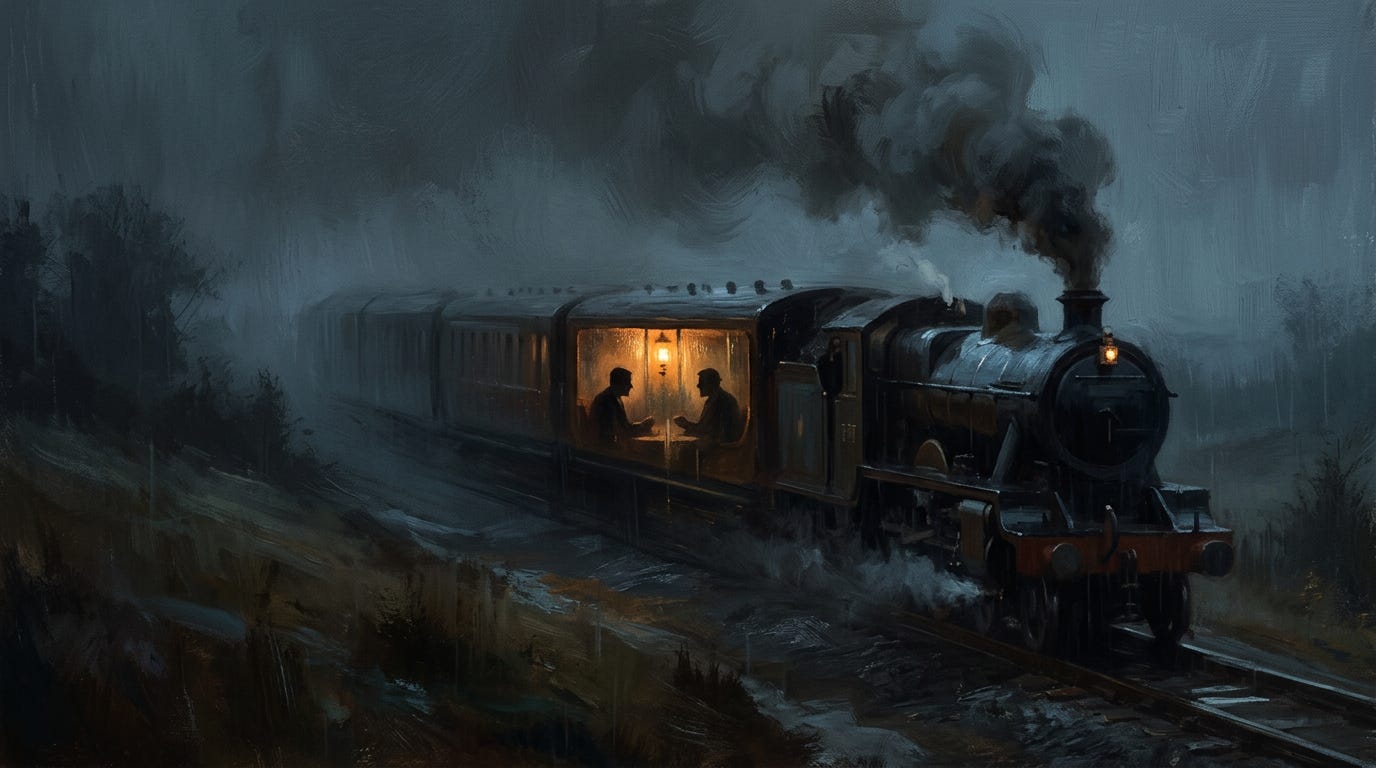
Newman was sitting alone in the compartment with the book on his knees, the rain on the window darkening the world beyond it into a long gray smear, and he was thinking about how he had not wanted to come. The Birmingham Oratory had been pressing him for some weeks to go down to London for a meeting at the Brompton house, and his fathers had finally arranged it so that he could not refuse without giving offense, and now he was on the express, and his eyes were too poor for reading, and he had brought the book anyway because it gave him something to hold. He looked down at the cover. An Essay on the Development of Christian Doctrine. He had written it in 1845. He was eighty-seven years old. He had not opened the book in perhaps ten years. He did not, he realized, know any longer whether he agreed with it.
The train rocked gently through the falling evening. The gaslight in the brass fitting above his head burned with the steady small flame that gaslights burn with, and the rain streaked the window in long slow lines, and the upholstery of the compartment was the dark green plush that was used in those years for first-class carriages. He had the compartment to himself. He had paid for the privilege, or rather the fathers had paid for it, knowing that he could no longer manage a crowded carriage. He laid his spotted hands flat on the cover of the book and closed his eyes for a moment, because his eyes were tired, and he thought about whether his life had been faithful or only lukewarm.
The train began to slow.
He opened his eyes. They were coming into a station. He could see the lights of it through the rain, and he could hear the long iron sigh of the brakes, and he thought it must be Coventry, or perhaps Rugby, he could not tell from where the train was on the line. The train stopped. Doors slammed somewhere down the carriage. He heard the porter’s whistle. After a moment the door of his own compartment opened.
A man stepped in.
He was wearing a curious dark woolen tunic that fell below his knees, gathered at the waist by a rope, and over it a long brown mantle of the same coarse weave, and his sandals were leather and his ankles were bare. His hair was iron gray and short. His beard was short and unkempt in the way that a working man’s beard is unkempt rather than the way an artist’s beard is unkempt. He was perhaps fifty-five years of age, or sixty, although Newman had the sudden impression that age was not quite the right word. He sat down on the seat opposite Newman without speaking. He folded his hands in his lap. The door of the compartment closed behind him without his having touched it. The whistle blew and the train began to move.
Newman looked at the book in his lap. He looked at the man across from him. He looked at the book again.
“Sir,” he said carefully, in the voice he used when speaking to strangers, “I think you have entered the wrong compartment.”
“No,” the man said.
His Latin was clear. It was a Latin Newman knew well, the Latin of Augustine and of Jerome, the Latin of the Western Fathers in the late centuries when the empire was beginning to come apart. Newman had spent his life in this Latin. He had translated it, taught it, prayed in it, written letters in it to friends now dead. He understood the man entirely.
“You are speaking Latin,” Newman said.
“Yes.”
“You are wet from the rain.”
“I am,” the man said, looking at his sleeve as though noticing this for the first time, “and yet I am not.”
Newman looked at him. The wool of the tunic did appear damp at the shoulders, where rain might have settled, but the wet did not seem to be soaking in. The shoulders darkened and did not become darker. The man was looking back at him with an expression that was not unfriendly but was also not particularly accommodating. He was waiting for Newman to understand.
Newman’s hands, on the book, began to tremble very slightly. He laid them flatter against the cover, to steady them.
“You have come a long way,” he said at last, in Latin.
“I have come no distance at all.”
“From Lérins.”
“That is where I lived. I am not there now.”
“No.”
The two of them sat for a while in silence. The train picked up speed. The rain on the window had become harder, and the gaslight in the brass fitting flickered faintly with the rocking of the carriage, and the compartment smelled of wet wool and of the brilliantine that Newman had used on his hair that morning, although Newman did not register the brilliantine because one does not register the smell of one’s own grooming, and he did register the wool, but he was not certain whether the wool was his own coat, hung on the hook beside the door, or the strange tunic of the man across from him.
“You know who I am,” the man said.
“Yes.”
“Say it.”
“Vincent. Of Lérins.”
“Yes.”
“You are dead.”
“I am.”
“For some time.”
“For some time.”
Newman looked at the book in his lap. He could not bring himself to lift it. He thought about Vincent’s Commonitorium, which he had read first as an Anglican undergraduate, in the library at Trinity, and then again when he was a young Tractarian, and again when he was making his way toward Rome, and again when he was old. He had, he thought, perhaps known Vincent’s pages better than he had known any other writer of the Christian centuries except Augustine. The famous principle had been in his mind for sixty-five years. Quod ubique, quod semper, quod ab omnibus creditum est. What has been believed everywhere, always, by all.
“You have come because of the book,” Newman said.
“Yes.”
“You have read it.”
“I have read it.”
“You disagree.”
Vincent was quiet for a moment.
“I do not know yet whether I disagree,” he said. “That is why I have come. I have read it many times, in the place where I read now, which is not a place but is also not nothing. I have come to ask you what you meant.”
“You have read the book many times.”
“Yes.”
“And you cannot tell what I meant.”
“I cannot tell whether what you meant is what I meant. There is a difference. I would like to know.”
Newman lifted his hands from the cover. They were cold. He looked at the book. An Essay on the Development of Christian Doctrine. He had written it as an Anglican, in the months before he was received into the Catholic Church, and he had written it in a kind of fever, knowing that if his thesis was right then he must become Catholic, and he had finished the book and gone to Father Dominic at Littlemore three days later. The book had made his conversion. Or he had used the book to do what he was already going to do. He had never been entirely sure of the order.
“Tell me first,” he said, “what you meant. I have spent my life trying to understand what you meant. I would like to hear you say it.”
Vincent did not answer at once. He looked at the rain on the window. The train was crossing some bridge or other. Newman could hear the iron pulse of the wheels change pitch as they crossed the joints.
“I meant,” Vincent said, “that the Church does not invent. That what we have, we received. That when one of us claims to have found something new, we are right to be suspicious, because the One who taught us did not change His mind in the centuries since He went home. The deposit was given. We do not add to it. We hold it.”
“Yes.”
“That is what I meant.”
“Yes,” Newman said. “That is what I have always understood you to mean. And I have agreed with you.”
“Have you.”
“Yes.”
“Then explain to me,” Vincent said, and he turned his eyes from the window back to Newman, “the book that lies on your knee. Because the book seems to me to say that doctrine grows. That a doctrine which was small in the second century is larger in the fifth, and larger again in the thirteenth, and larger again in your own age. That a thing held in seed becomes a thing held in flower. The book does not deny that the seed and the flower are the same plant. I grant you this. But the book seems to say that the flower is more than the seed, and that the more is also doctrine, and that the more was given by the same Spirit who gave the seed, and is therefore to be held by all the faithful as part of what they have received.”
“Yes.”
“And I do not know,” Vincent said, “whether what you call growth is what I called fidelity, or whether what you call growth is what I called corruption. The two look very similar from a distance. I have spent fourteen hundred years looking at them from a distance. I have come to ask you to show them to me from where you stand.”
Newman sat very still. Outside the window the lights of a small town went past, and the rain, and the long darkness of fields beyond. He thought about how to begin. He had spent his life thinking about how to begin. His sentences in those late years were long and carefully balanced, and he composed them in his head before he spoke them, the way a man who is going blind composes a path in his head before he walks it.
“I will tell you,” he said at last, “what I have come to believe. I will tell you and you may judge whether it is fidelity or corruption. I have been judged on this question by men I respected and by men I did not respect, and I have been judged badly by some and well by others, and I have grown old enough that I do not any longer require to be judged well. But I would like to be judged truly. By you, I should like very much to be judged truly.”
“Then tell me.”
“I believe,” Newman said, “that the deposit of faith was given once and forever, at Pentecost, in the upper room. I believe that nothing has been added to it. Nothing can be added to it. Whoever adds is condemned. We agree on this.”
“We agree.”
“But I believe also,” Newman said, “that what was given at Pentecost was given as a living thing. Not as a stone. Not as a number written in a book. As a life. And a life, even when it is wholly itself from the moment of its conception, must yet unfold in time. The infant does not know it has a soul. The boy does not know what manhood is. The man does not know what old age teaches. He is the same person throughout. He is wholly himself at every stage. But he is not at twelve what he is at eighty. He is at eighty what was contained in him at twelve, made actual, made known, made his own. The Church is such a person. The faith she received in the upper room is wholly hers from the upper room. But she did not know, in the upper room, that she would have to think about Arius. She did not know she would have to think about Nestorius. She did not know she would have to think about the relation of grace and freedom in the way that Augustine made her think about it, or about the procession of the Spirit in the way that the East and the West would later argue about, or about the Eucharist in the way that the medievals would think about it, or about Mary in the way that my own century has come to think about her. She did not know, and yet she knew. The thinking was not new. The thinking was the unfolding of what was already there.”
Vincent listened. His face did not move. The train rocked. The gaslight flickered and steadied.
“Go on,” he said.
“I have given seven notes,” Newman said, “by which one may distinguish a true development from a corruption. I will not list them. They are in the book, which you have read. I will say only the one that I think you would find hardest, and I will say it because I think you would find it hardest, and I would rather give you my hardest first.”
“Give it.”
“A true development preserves the type of the original. A corruption changes the type. The infant becomes the man, but the infant does not become a horse. The seed of the apple becomes the apple tree, but the seed of the apple does not become an oak. If the doctrine of the Trinity that we hold in 1888 is the same kind of thing as the doctrine of the Trinity that the apostles held in the year 50, then we have a development. If it is a different kind of thing, we have a corruption. You and I, brother, have the same test. We have only described it differently. You looked across the centuries and asked whether a doctrine had been held always. I looked along the centuries and asked whether the type had been preserved. We are asking, I think, the same question.”
There was a long silence. The train was crossing another bridge. The rain had softened into a thinner rain, almost a mist now, and the lights of the carriage made small cones of warm yellow against the gray of the window. Vincent was looking at his hands, which were folded in his lap. They were a working man’s hands. They had transcribed manuscripts, perhaps, and broken bread, and dug at the kitchen garden of the monastery on the island. They were not the hands of a man who had thought of himself as a saint.
“I have spent fourteen centuries,” Vincent said at last, “being read as your opponent. By men who liked me and by men who did not like me. By men who loved your book and by men who hated it. I have been used as a weapon against you. I have been quoted in pamphlets. I have been made to say things I did not say, in languages I did not speak.”
“I know.”
“I would like to put down the weapon,” Vincent said. “If you will let me.”
“I will.”
“Then I will say this. I came to argue with you. I have been preparing to argue with you for a long time. But you have answered, before I asked, the only question I had. You have not said that the deposit grows. You have said that the understanding of the deposit grows, and that the deposit itself is what it has always been, and that the growing understanding is the work of the same Spirit who gave the deposit. That is what I should have said, if I had been given another book to write. I did not think to say it. I did not see in the fifth century what was needed in the nineteenth. You saw it. You said it. I have come to thank you.”
Newman bowed his head.
He did not weep. He had not wept easily in many years. But something behind his face moved, and his hands, which were on the book, became suddenly steady, the way a man’s hands become steady when he has been waiting for a long time to be told a particular thing and has been told it.
“I have been,” he said, “a long while wanting to know whether you forgave me.”
“There was nothing to forgive.”
“There seemed to me to be something.”
“There was nothing. You were doing what I would have done, in the time you were given, with the books I had not been given to write. The Lord does not ask the same work of every age. He asked the watching of the deposit from me. He asked the unfolding of it from you. The watching and the unfolding are the same labor. We are friends, brother. I have come to tell you that we are friends.”
Newman sat with his head bowed. He was eighty-seven and a cardinal of the Roman Church and he had been read in his lifetime as the most controversial theologian writing in the English language and he had borne it and the bearing had cost him more than anyone except a few close friends had ever known. He sat with his head bowed and did not speak. The train rocked. The gaslight burned. After a while he raised his head and looked at the man across from him and saw that the man was smiling, very slightly, and that the smile was not pity but recognition, and that the recognition was a fourteen-hundred-year-old man recognizing him as kin.
“Where are you going,” Vincent asked.
“To London. To meet with the Brompton fathers. A small matter.”
“And after.”
“Back to Edgbaston. To the Oratory. To my room.”
“To die there.”
“I think so. Yes. Not tonight. But soon. Within two years, I think. The body is letting me know.”
“Yes.”
“You will be there.”
“I will be there. I will not be the only one. We will all be there. It is what we do. We do not stop attending. The attending is a great deal of what we do.”
“Thank you.”
“Brother.”
The whistle blew. The train was beginning to slow. Newman could see, through the streaked window, the first pale lights of the great northern outskirts of London, the low brick warehouses and the gas works and the long terraces of houses, all of them softened by the rain into a smudged gold. They were perhaps half an hour from Euston. He thought he should ask the man across from him whether he would stay until the station, but the question seemed wrong, the way questions are sometimes wrong, and he did not ask it.
“I have one thing to ask you,” he said instead.
“Ask.”
“My book. The one on my knee. Should it stand?”
Vincent looked at the book. He looked at Newman. He looked at the book again.
“It should stand,” he said. “Not because it is finished. Not because it is without error. Because the men who come after you will need it, the way the men who came after me needed me, and the Lord does not give us the books we ourselves require. He gives us the books that the next ones require. Your book is for the next ones. Let it stand.”
“Yes.”
“Brother.”
“Brother.”
The train slowed further. The lights of London were nearer now, brighter, more numerous, the dome of some distant church visible against the wet sky. Newman looked at the book in his lap. When he looked up the seat across from him was empty, and the door of the compartment was still closed, and the brass handle was still polished and dry, and the rain was still on the window, and the gaslight was still burning, and the long green of the upholstery was untouched in the place where Vincent had sat.
He held the book in both hands.
Twenty-two minutes later the train pulled into the great glass-and-iron shed of Euston Station. The porter knocked at the compartment door. Newman gathered his coat and his book and his hat. He stepped down onto the platform, where one of the Brompton fathers was waiting for him in the gaslit damp, and he allowed himself to be helped, and he said nothing about the conversation he had had on the train, then or ever, although in the two years remaining to him he was sometimes seen, in his last illness, to lay his hand on the cover of the book on his bedside table, and to leave it there for a long time, smiling slightly, as a man smiles who has been told something he had been waiting a long while to hear.
He died on the eleventh of August, 1890, in his room at the Oratory in Edgbaston. The book stood. The next ones needed it.
The lamp beside his bed burned out at dawn, as lamps do.
For your prayer this week: Saint Vincent of Lérins and Saint John Henry Newman, you who watched and you who unfolded, you who guarded the deposit and you who showed how the same deposit lives through the centuries, pray for those of us who do not always know whether the work we are doing is fidelity or innovation. Grant us the grace to trust that the Spirit who gave the faith continues to teach it, and that He does not waste the labors of His friends. Amen.
Two Lamps returns next Friday: Blessed Margaret Pole and Saint Edith of Wilton, the Tower of London, the morning of May 27, 1541.
Two Lamps is a weekly short story braiding the lives of two or three saints across the centuries. Sometimes the meeting is rendered as an encounter in eternity. Sometimes as the older saint coming, in vision or in patronage, to the soul of the younger. The text does not decide for you. The Communion of Saints is the doctrine that holds these meetings as theologically real even when the meeting itself is imagined.
Two Lamps is written by Deacon Michael Halbrook, a permanent deacon of the Diocese of Springfield in Illinois, serving at St. Elizabeth Parish in Granite City. He writes personally at DeaconMichael.net, serves families through Domus Formation, and publishes the serial novel Ordo: A Chronicle of Lux Perpetua at LuxPerpetua.net. Two Lamps is co-conceived with his son Joseph.
This touches such deep emotions. I went and looked up Vincent as I was not familiar with him at all. 🔥 Amazing story, thanks!