

He could not speak.
Father Charbel lay on the simple wooden pallet in the small stone cell of the hermitage of Saints Peter and Paul, in the mountains above Annaya, and the eight days that the Lord had given him after the stroke were passing slowly. It was the fifth of them. The Divine Liturgy on the sixteenth had ended when he had raised the small chalice at the elevation and had begun to say, in the Syriac of the Maronite prayer he had said tens of thousands of times, Aboun d’shrara, ho breh, dbicho l-Ok, qabel dashno hono d’meth halofain - Father of truth, behold Your Son, a sacrifice pleasing to You. Accept this offering of Him who died for me - and had reached the word offering and had not been able to finish the sentence. The word had been the last word. He had fallen to the stone floor with the Blessed Sacrament in his hand. The brothers had come. They had carried him back to the small cell. He had not spoken since. The stroke had taken his voice and had taken his ability to move his right side, and the doctor from the monastery had come and had shaken his head and had told the abbot that Father Charbel would not last many days more, and Father Charbel had heard the doctor say this, and had been at peace with it. He was seventy years old. He had been a hermit for twenty-three years. He had been ready for some while.
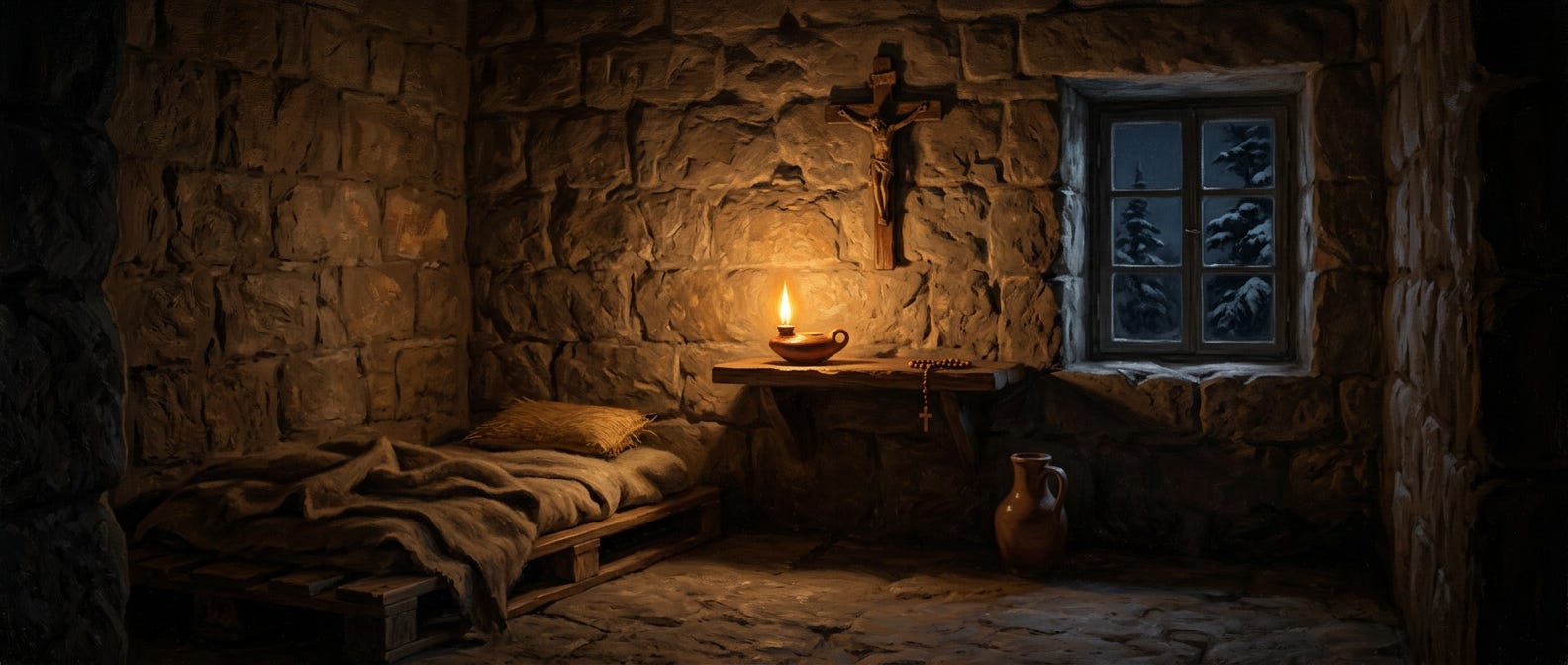
The cell was cold.
He had never permitted a fire in this cell, in all his years here. He had lived through twenty-three winters in the mountains of Lebanon without a fire, because the small suffering of the cold had been one of the small offerings he had chosen to make to the Lord, and the Lord had accepted it, and the cold had been an old companion. The brothers had wanted to bring a small brazier to the cell now that he was dying. He had refused with his eyes when they had proposed it. They had understood. They had not brought the brazier. They had piled additional wool blankets over him instead, and he was warm enough, and he was grateful.
The small oil lamp on the wooden shelf by the door was burning.
The lamp was the one lamp in the cell. It burned each night from Compline until the brothers came in at Matins to renew it. It was made of pressed olive oil from the trees on the slope below the monastery, and the small clay dish that held the oil had been made by a village potter he had known as a boy in Bkaa Kafra, and the wick was cotton spun by one of the sisters of the small convent in the valley. Everything in the cell had been given to him by someone. He had always taken this as a small parable of the whole of the monastic life - one does not own; one receives; one gives back what one can.
He looked at the lamp.
He watched the small flame.
He waited.
A woman was sitting on the floor at the foot of the pallet.
He did not know when she had come. He had not heard the door. She was sitting on the cold stone floor with her knees drawn up and her arms around her knees, in the posture of a woman who has spent much of her life sitting on floors and does not need a chair. She was perhaps sixty. Her hair was long and gray and was bound simply behind her head. She wore a dark heavy garment, roughly the color of an olive tree in winter, cut in a way he did not recognize - a shape that was Eastern but not any of the several Easts he knew, an older East, an East from before the shapes of clothing his village had inherited. Her feet were bare. Her face was weathered by many winds. Her eyes were dark and very still.
She was looking at him.
He looked back.
She spoke. She spoke in Aramaic, in the western dialect that had been spoken in Galilee two thousand years earlier and that he could not have known and yet knew. He heard the words. He understood them. He also could not speak. But he could listen, and she seemed to know that he could listen, and to be content with that.
She said, “Brother. You cannot speak. That is well. I will speak enough for both of us. I have been quiet for a very long time. It is my turn.”
He watched her.
The stroke had left his eyes working. He could still look. Looking had always been his primary work in the hermitage - looking at the Blessed Sacrament, looking at the cross above the small altar, looking at the small oil lamp, looking at the faces of the brothers who came to him occasionally with questions. The looking had been the ministry. The looking had been what the hermit does. He looked at her now with the whole of the looking he had.
She smiled, slightly.
“You wonder who I am. I will tell you. I am Mary. I lived in a town called Magdala. It was a fishing town on the sea in Galilee. I met the Lord when I was young. He cast seven demons out of me. I do not want to tell you what the seven demons were. It is not necessary. I followed Him after that. I was with Him when He died. I was one of the women at the tomb on the third morning. I was the first to see Him alive again. He said my name and I turned around and He was there. I ran and told the others. Peter did not believe me at first. John came running with Peter. They saw. They believed. The Lord had already gone by then; He had given me the seeing before He gave it to them, because He wanted me to have it first, and I do not know entirely why. I have thought about it for two thousand years. I still do not know. He does things that way sometimes. He has His reasons. He does not always tell His reasons. I have learned not to ask.”
Charbel closed his eyes for a long moment.
He had heard this woman named in the Gospels many times. He had prayed the Office of the Dead many times over the years and had heard her name in it. He had preached, in his years before the hermitage, a very few homilies about her - about her presence at the tomb, about her being the apostle to the apostles, about her later tradition. He had not, in any of those homilies, imagined that he would meet her. He had not imagined that she would come and sit on the floor of his cell in Mount Lebanon on the fifth night of his dying. He was, he found, not surprised. The near-dying had removed most of his capacity for being surprised. He was only grateful.
He opened his eyes.
She was still there.
“I have come tonight,” she said, “because the Lord sent me. He often sends me to the ones who have spent long years in silence. It is my ministry now. It was not my ministry when I was alive. When I was alive I was the one who spoke - the one who ran to tell Peter, the one who told the disciples about what had happened at the tomb. I was, for the first days after the Resurrection, the mouth of the Lord’s return. I have thought sometimes that the Lord chose me for that particular work because He knew I would spend the second half of my life not speaking. The tradition of the western church says I went to Provence and lived in a cave for thirty years, praying in silence. The tradition of the eastern church says I went to Ephesus with the mother of the Lord and spent my last years there quietly. I will tell you what happened. I did both. I lived in the cave first and then went east and lived by the sea near Ephesus. Both traditions are correct in what they remember. The traditions do not usually contradict each other; they only remember different pieces of the same life. I mention this because it is the kind of small thing a hermit might like to know. The tradition remembers what it needs to remember. What actually happened is generally more than what any one tradition preserves.”
Charbel looked at her steadily.
He wished he could smile. He tried to move his face to make a small smile. He did not know whether the smile came. She looked at his face and something in her expression softened, and he suspected that the smile had come, at least a little, and that she had received it.
She continued.
“I have come to sit with you. I have come because the Lord likes when the hermits sit with the hermits. I was a hermit for the last part of my life, brother, though the western world was slow to remember this. I lived alone in the cave at Sainte-Baume in the Provençal hills, and I saw very few people, and I spent whole years without speaking a word aloud. I did not need to speak. The Lord and I had said what we needed to say to each other at the tomb, when He said my name and I turned around, and everything that has come since has been my sitting with that saying. My whole hermit life was the sitting with the saying. I do not think I ever added anything new to it. I only lived inside it. That is what a hermit does. That is what you have done. You have not been an original theologian. You have not composed a rule. You have not written mystical treatises. You have sat with the saying. The Lord came to you at your first Divine Liturgy, when you were ordained, and He said your name, or He said something to you that was as good as saying your name, and you have spent forty years sitting with that saying. That is what the hermitage is for. The hermitage is not for producing anything. The hermitage is for the sitting. The sitting is the fruit. The fruit does not have to be legible to anyone. The Lord can read it. That is enough.”
She was quiet for a moment.
Outside the cell, somewhere in the winter dark of the mountain, a small wind moved through the cedars. The cedars of Lebanon were old. They had been old when Solomon’s men had come for them for the Temple. They had grown in this soil for many thousands of years. The small wind in them made the sound of a very slow ocean.
“The Lord has been pleased with you,” she said. “I want you to know that. I know it because I know Him and because I have spent two thousand years watching Him watch His hermits. He is pleased with you. He does not need your speaking, and He has now taken your speaking for the last days, so that you may know clearly that the speaking was not what He wanted from you. He wanted the sitting. You have sat. He is pleased. He is coming for you in three days.”
Charbel closed his eyes.
He heard her.
Three days.
He had thought perhaps four. He was pleased that it was three. The eighth day would be Christmas Eve. He had been quietly hoping that the Lord would let him die on Christmas Eve, because he had always loved Christmas, and because coming to Him on the eve of the Incarnation felt like a small poetry of a fitting kind. He had not asked for it. One does not ask the Lord for such small poetries. But he had hoped, and now he understood that the hoping had been heard, and that the arrival would be on the day he had hoped for.
He opened his eyes.
He looked at her again.
There was so much he wanted to ask her. He wanted to ask her about the tomb. About the moment when the Lord had said her name. About the demons she had refused to describe. About the years in the cave. About the years by the sea at Ephesus. About the death of the Mother, whether Mary of Magdala had been there, whether the passing of the Mother had been as beautiful as the pious tradition claimed. About whether the Lord truly laughed as much as certain fathers had suggested. About whether Peter had ever forgiven Him and been forgiven by Him fully for the denial. About all of it. He wanted to ask about all of it. He could not speak. He looked at her with all the asking he had.
She saw it.
Of course she saw it.
“I will tell you two things, brother,” she said, softly. “You are asking me many things. I cannot answer all of them. I will answer two. The two I choose are the two I think you most want.”
He waited.
“The first,” she said. “The Lord truly laughed. Thomas has told this to another one of you, I understand, quite recently. Thomas is telling the truth. The Lord laughed at us often. He laughed at Himself sometimes. He laughed at His Mother once when she scolded Him about a small thing He had not done. She laughed too, after. He had a good laugh. It came up from the chest. I heard it many times. I have heard it also in the two thousand years since, but differently - the Lord in eternity laughs in a way that is like the laughing I remember and is also more, and I cannot describe the more. You will hear it in three days. You will know it when you hear it. It is the welcome. Thomas told his sister about the laughter. Now I am telling you. You will not have to wait to hear it. You will hear it soon.”
Charbel felt something move in his chest.
It was not the stroke. The stroke had settled in and was not moving. It was something else. It was, he thought, joy - the small physical warmth of joy that had visited him at various points in his hermit life, always unexpectedly, always as a small confirmation from the Lord that the hard cold nights were not being wasted. The joy was in him now. He rested in it.
She continued.
“The second thing, brother. Peter. You wanted to ask about Peter. About the denial. I will tell you. Peter wept for many years about the denial. He carried it with him. He carried it even after the Lord had asked him three times whether he loved Him and had received his answer three times and had told him to feed the sheep. Peter carried it into old age. He carried it into his own crucifixion, which he asked to have upside down because he did not think himself worthy of dying as the Lord had died. The Lord accepted this. It was a good gesture. But Peter carried the denial into it. I want you to know: when Peter went home, the Lord met him at the door, and the Lord took Peter’s face in His hands, and the Lord said to Peter, in the way the Lord speaks to His friends in the room where He is, that the denial had been forgotten before it had been committed, that Peter had been fully loved throughout and that no denial had touched the loving. Peter wept then. Peter has been weeping intermittently ever since, out of joy, and the Lord has been laughing at him gently for the weeping, in the way one laughs at a beloved friend who has finally understood something one has been trying to tell him for a long time. Peter is happy in the room where he is now. He weeps sometimes still. But the weeping is not sorrow. The weeping is what happens to a man when he has finally been believed by the One he most wanted to be believed by. You have wanted to know that, brother. I have told you. Peter is well. He sends his blessing to a fellow fisher of men.”
Charbel felt tears at his eyes.
He had not cried in many years. His body did not cry easily anymore. But the tears came now, and one moved slowly down the side of his face into the wool blanket, and he did not try to stop it.
She sat quietly.
The lamp burned.
After a while she said, “I will stay with you tonight, and I will come again tomorrow, and I will come the night after. On the third night, which is Christmas Eve, I will be with you at the end. You will not be alone. The brothers will be here also. But I will be here in the way I am here now. I will bring the others. Peter will come. John will come. Thomas will come. The Mother will come. The Lord will come Himself. You will not have to travel far. You will simply open your eyes at the last, and we will all be here, and He will say your name, and you will turn around, and there He will be. It will be the same for you as it was for me. It has been the same for me for two thousand years. It will be the same for you. That is what the sitting was for.”
Charbel closed his eyes.
He was very tired. But the tiredness was different now. It was not the tiredness of a body running out. It was the tiredness of a man who has been given permission, finally, to sleep because he has been told the arrival is arranged.
He slept.
She sat by the pallet.
The lamp burned steadily through the night. The brothers came at Matins to renew the oil. They did not see her. They saw only the sleeping hermit and the small candle by his bed. They renewed the oil. They said the small prayers of Matins in the corridor outside so as not to disturb his sleep. They went back to the monastery.
Mary of Magdala remained.
She was there the next night also. And the night after.
On the eighth day, which was the twenty-fourth of December, in the year eighteen ninety-eight, in the mid-afternoon, with three brothers around the pallet and the abbot at the foot of the bed and the small oil lamp still burning in the winter light, Father Charbel opened his eyes.
He opened them because he heard someone say his name.
The saying of the name was not out loud. It was not in the ear. It was in the place where his name had lived all his life, in the interior room where the Lord had been saying his name since he was a boy in Bkaa Kafra, since he had first learned to pray at his mother’s knee. The name was said. He turned toward it. The turning was not a physical turning. It was the turning that the Magdalene had described - the turning at the tomb, the turning of a soul that has heard itself called and is now looking toward the one who has called it.
The Lord was there.
The Lord was laughing.
The laughter was the welcome.
Charbel arrived home.
He was seventy years old. He had been a monk for forty-five years. He had been a hermit for twenty-three. He had said very little in his life and had thought that this was correct, and Mary of Magdala had told him three nights before that the thinking had indeed been correct, and the Lord Himself had now confirmed it in the manner of confirming that saints receive when they come home. His face on the pallet, when the brothers looked at him, was smiling. The smiling stayed on his face for the rest of that day, and for the next day, and for a great many days after.
Four months later they opened his tomb because a strange light had been coming from it at night. His body was incorrupt. It exuded a fluid that the doctors could not identify and that has been identified now, in the Church’s judgment, as one of the small physical signs the Lord occasionally gives when He is particularly pleased with the sitting a hermit did. The fluid has continued to flow. Thousands of small healings have been reported at the tomb. The healings have not stopped. They are continuing tonight.
The Maronite Church remembers.
The Western Church remembers.
The saint of the sitting is honored on the twenty-fourth of July by the Roman calendar and on the third Sunday of July by the calendar of his own church, which is the calendar he learned to pray by and which the Lord meets him in on the day of his feast each year, still.
The lamp in the hermitage of Saints Peter and Paul burned out at dawn, as lamps do, on the morning of Christmas Day, when the brothers came to prepare the body for burial.
Mary of Magdala, on the other side, was among the ones who received him.
She was, as promised, in the front row.
She was, as she had said, no longer speaking. She did not need to speak. She had already told him what she needed to tell him, on the fifth night of his dying, on the cold stone floor of a small cell in Mount Lebanon in the winter of 1898, in the Aramaic he could not have known and yet knew.
Two hermits.
One saying.
The saying was enough.
For your prayer this week: Saint Mary Magdalene and Saint Charbel Makhluf, you who sat with the saying at the tomb and you who sat with the saying in the mountain, you who lived long years in caves and cells to no visible fruit, pray for those of us whose lives will not be legible to anyone but Him, whose work is only the sitting, whose long silences are the whole of the offering. Grant us the grace to trust that the sitting is not wasted, that the Lord reads the fruit even when no one else can, and that the welcome, when it comes, will be a laughter. Amen.
Two Lamps returns next Friday: Saint Ignatius of Loyola and Saint Bridget of Sweden, the small room at the Society’s headquarters in Rome, an evening in the summer of 1556.
Two Lamps is a weekly short story braiding the lives of two or three saints across the centuries. Sometimes the meeting is rendered as an encounter in eternity. Sometimes as the older saint coming, in vision or in patronage, to the soul of the younger. The text does not decide for you. The Communion of Saints is the doctrine that holds these meetings as theologically real even when the meeting itself is imagined.
The Maronite Church is the only Eastern Catholic Church that has never broken communion with the See of Rome. It is one of the great treasures of the universal Church. If this story moved you, consider learning more about it - the Maronite communities in the United States welcome visitors warmly, and the Divine Liturgy in Syriac is one of the ancient inheritances that the Latin-rite reader may not know he has a share in.
Two Lamps is written by Deacon Michael Halbrook, a permanent deacon of the Diocese of Springfield in Illinois, serving at St. Elizabeth Parish in Granite City. He writes personally at DeaconMichael.net, serves families through Domus Formation, and publishes the serial novel Ordo: A Chronicle of Lux Perpetua at LuxPerpetua.net. Two Lamps is co-conceived with his son Joseph.