

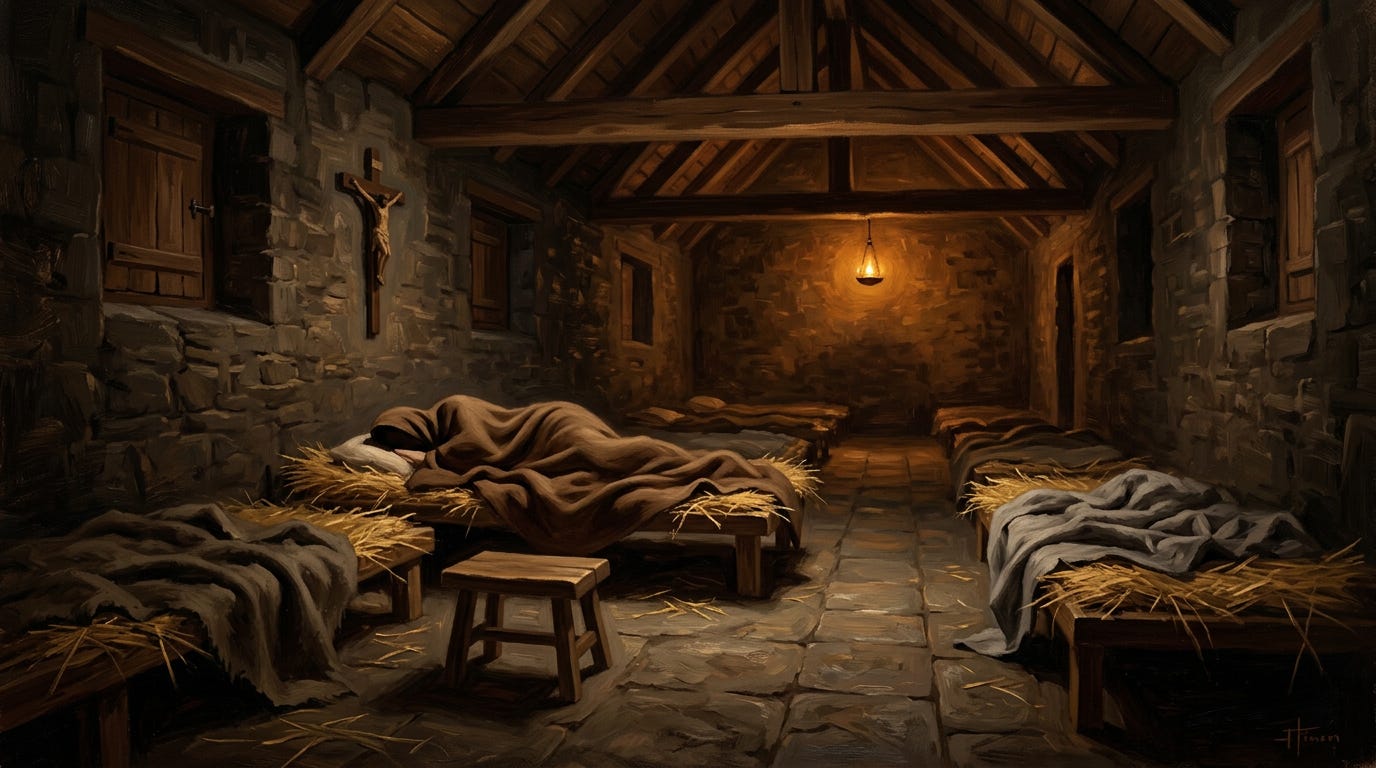
The ward was quiet.
Elizabeth sat on a low wooden stool at the foot of the pallet that belonged to a woman named Ilse, in the hospital of Saint Francis that Elizabeth had built the previous year with the last of the dower her husband’s family had been forced to return to her, in the town of Marburg on the Lahn river in the Landgraviate of Hesse, in the autumn before her twenty-fourth and final year. Ilse was sleeping. Ilse had come in three weeks earlier with what the sisters called the wasting fever - a common enough illness in the autumn - and had been very close to dying when she had arrived. She was less close to dying now. She might live. Elizabeth had been sitting with her for the last hour, as she sat with most of her patients when she was not doing one of the other hundred things the hospital required. She had been praying quietly while she sat. She had been thinking, in the parts of her mind that could think while she was praying, about the next winter and about whether the hospital would have enough fuel.
She was twenty-three.
She was tired in the specific way that a young widow is tired who had been the Landgravine of Thuringia at nineteen, had buried her husband Ludwig in Italy on his way to the Crusade in September of 1227, had been driven from the court at the Wartburg the following year by her husband’s brother, had surrendered the raising of her three small children to her in-laws because she could no longer feed them herself, had taken the habit of the Third Order of Saint Francis at twenty-one, and had spent the last two years building and running a hospital for the poor and sick of Marburg with the labor of her own hands and the strict spiritual direction of Konrad of Marburg, who was not gentle with her. She had been losing weight for a year. She had been coughing since the summer. She was not going to live through the next year. She did not know this consciously, but she suspected it in the way that saints often suspect these things without being told. She was not afraid.
She whispered, in the German of her Thuringian household - the language she had spoken for ten of her twenty-three years, since being sent from Hungary at four to be raised at the Wartburg as the betrothed of Ludwig - Herr. Gib mir noch ein Jahr.
Lord. Give me one more year.
She heard someone sit down on the pallet across the narrow aisle.
She did not turn immediately. She had learned, in the last two years of hospital work, to let the small sounds of the ward be what they were without interrupting her prayer. A patient shifting in sleep. A sister passing in the corridor. A rat in the rafters. Most of the sounds did not require attention. She finished the prayer she had been saying. Then she looked across the aisle.
A woman was sitting on the empty pallet opposite Ilse’s.
The woman was perhaps forty-five - which, in the thirteenth century, was old - and wore a long blue woolen gown of fine make, with a white linen veil and wimple that framed a face that was not Thuringian and not Hungarian and not any face Elizabeth immediately recognized. The woman’s hair, visible at the edge of the wimple, was dark red. Her eyes were grey. Her hands were folded in her lap. A silver cross hung at her breast on a chain of fine Scottish workmanship. Her shoes, barely visible under the hem of the gown, were leather worked in a pattern Elizabeth had not seen before. She was watching Elizabeth with the patient affection of an older woman who had been waiting for a younger woman to notice her.
Elizabeth said, in Latin, which she had learned at the Wartburg as a girl, “Domina. Quae es tu?”
Lady. Who are you?
The woman answered in Latin also, in a Latin that had the careful cadence of a woman who had learned it as a second language late in life and spoke it correctly but slowly.
“Margareta. Scotorum regina. Olim. Quondam.”
Margaret. Queen of the Scots. Once. Formerly.
Elizabeth sat very still.
She knew the name. Her chaplain Father Berthold had read to her, two summers earlier during one of her periods of recovery from illness, from a Latin life of a Scottish queen who had died in Edinburgh Castle in 1093 after having founded many churches and schools and almshouses in Scotland and after having died within days of her husband and son being killed at the siege of Alnwick. Elizabeth had liked the Scottish queen in the reading. The Scottish queen had been born an English princess, had been driven into Scottish exile with her mother and her brother Edgar Ætheling after the Norman Conquest, had married King Malcolm III mostly for political reasons, and had ended up loving him in a way neither of them had expected, and had spent her reign using the Scottish royal treasury to help the poor. Elizabeth had thought, when Father Berthold had finished the reading, that she would like to meet Margaret someday. She had not expected to meet her in the ward of the hospital at Marburg.
She whispered, in Latin, “Domina Margareta. You have been dead for a hundred and thirty-seven years.”
“I have been dead for a hundred and thirty-seven years. Yes. In the room where I am, the counting goes differently. One does not notice the years in the way one noticed them while living. I have come tonight because the Lord permits me to come, and because you have been asking Him for one more year, and because I have been asking Him for a long time if I might come to you. He said yes. May I speak with you for an hour. Then I will go.”
“Please.”
Margaret rose from the pallet and came across the narrow aisle and sat beside Elizabeth on the end of Ilse’s pallet, with Ilse sleeping between them. The two queens sat together looking at the sleeping woman. The autumn evening had gone entirely dark outside the hospital windows. The single oil lamp at the end of the ward cast the only light.
Margaret said, softly, “You were a queen.”
“I was. For six years. From sixteen to twenty-two. I married Ludwig when I was fourteen; I became Landgravine when his father died and Ludwig succeeded at sixteen. I was driven from the court the year after Ludwig died on Crusade. I have not been a queen for two years. I am now a Franciscan tertiary who runs a hospital. I do not miss the being-queen. I miss the being-wife. Ludwig was good to me. I had not expected him to be. Royal marriages were not arranged with that expectation, as you know. He was good to me anyway. I miss him every day.”
Margaret nodded.
“Malcolm was good to me also. I had not expected him to be. I had been dragged to Scotland in exile at twenty-one and had been given to him in marriage at twenty-four for political reasons that had nothing to do with me, and he was an older widower with a kingdom full of warring clans and he had no particular reason to love his new English bride. He loved me anyway. He learned to read because I was reading. He could not read before he married me. He learned so that he could read beside me in the evenings. He was not a subtle man. He had been subtle enough to learn to read for me. It was his great tenderness. He was killed with our son Edward at Alnwick on the thirteenth of November, 1093. I died at Edinburgh Castle three days later. I had known he was dead before anyone told me. I had been dying anyway. The news of his death released me to stop waiting. I want to say to you: the loving of the husband, when it is given, is one of the great graces of a royal marriage. The two of us received it. Many do not. We did. Do not forget that you received it. It will matter in the next year.”
Elizabeth lowered her head.
She had not spoken of Ludwig in some weeks. Konrad, her spiritual director, discouraged dwelling on him. Konrad believed that a widow should turn entirely to Christ and that memory of the husband could become an obstacle to that turning. Elizabeth had tried to do what Konrad asked. She had turned. She had not entirely stopped missing Ludwig. Margaret was telling her that the missing was not an obstacle. The missing was one of the graces that had made her who she was.
She said, softly, “Domina. My director tells me I should not think of him.”
Margaret looked at Elizabeth with an expression Elizabeth could not entirely read.
“Your director is Konrad of Marburg. I know him from where I am. He is a good man in some ways and a hard man in other ways. He is harder with you than the Lord requires him to be. Do not entirely stop obeying him - he is your director and you have promised obedience - but do not entirely believe him on this matter either. The Lord gave you Ludwig. The Lord let you love him. The Lord did not then take the love away by taking Ludwig. The love continues. It continues in the room where Ludwig is now, and it continues in you. You can think of him. The thinking is not an obstacle to Christ. The thinking is one of the places Christ meets you. Konrad does not entirely understand this because Konrad has never been married. You have been married. You know. Trust what you know. Do not say this to Konrad. Say it only to yourself. And to me. Tonight.”
Elizabeth was crying now. She had not cried about Ludwig in a year. She had promised Konrad that she would not. She was crying now anyway, quietly, with her face turned down so that if a sister passed the ward door she would not see. Margaret waited. Margaret had been widowed herself, briefly, in the days between her husband’s death and her own, and she knew what it was to cry about a husband without being able to say to anyone how much one had loved him.
After a while Elizabeth lifted her head and wiped her face with the rough wool of her sleeve.
“Domina. Tell me about the children.”
Margaret knew which children she meant. Elizabeth had three - Hermann, who was now eight; Sophie, who was six; and Gertrude, who was three, born after Ludwig had already left for the Crusade and whom Ludwig had never seen. Elizabeth had surrendered their raising to Ludwig’s family when she had been driven from the Wartburg. She had not seen any of them in a year.
“Your children will be well,” Margaret said. “Hermann will die at nineteen, childless, and the Landgraviate will pass through his sister. I am sorry; I would not tell you this except that you have asked and the Lord has permitted me to answer. Sophie will marry Henry II of Brabant and will become the mother of the first Landgraves of Hesse - the dynasty that will rule this country for the next six hundred years will descend from her. Her children will remember you as their grandmother Saint Elizabeth, and they will build churches in your name across Hesse. Gertrude - the one Ludwig never saw - will become abbess of Altenberg and will live until 1297. She will spend her life in a Premonstratensian monastery praying for you and for her father. She will remember you better than anyone, because the memory she has of you will be the one she constructs from what others tell her, and the construction will be done with great love. Your line continues through Sophie. Your memory is kept by Gertrude. Hermann goes early but gently. The children are in the Lord’s hands. He is tender with the children of saints. Do not worry about them more than a mother must.”
Elizabeth bowed her head again.
She said, quietly, “Domina. I had wanted to see them again before I die. I have been asking.”
“You will not see them again in this life. I am sorry. Konrad will not permit the visit. He believes that a Franciscan tertiary should have severed the family tie. He is wrong on this also. But he is the director you have been given, and the Lord has used even his hardness to make you what you are becoming. You will not see the children in this life. You will see them in eternity. Hermann will come to you first, in 1241, when he dies at nineteen. Sophie will come at the end of a long and good life. Gertrude will come last, having lived longer than any of you. You will have them all. The waiting is hard. The waiting is not forever. That is what the Communion of Saints is for, sister. The reunion.”
Elizabeth nodded slowly.
She had not thought of it quite that way. She had thought of the Communion of Saints as a doctrine about the great saints and the ordinary dead. She had not thought of it as the specific promise that she would hold her three children again, each in turn, as they came to her across the decades of their own lives. Margaret was telling her that the doctrine was more personal than she had allowed herself to understand.
She said, “Domina. Tell me one more thing before you go.”
“Ask.”
“My own dying. When.”
Margaret was quiet for a moment.
“On the seventeenth of November, 1231. One year from this evening, almost to the day. You will be twenty-four. You will die in this hospital, in your own bed in the small room off the chapel, of the wasting fever you have been fighting since the summer. Your sisters will be with you. Konrad will be with you. You will receive the sacraments. Your last words will be in German and will be about the little bird you saw at the window a few hours before your death - you will say, Nun ist Stille - now it is quiet. You will die peacefully. You have one more year. It is not the long life you hoped for. It is the life the Lord has arranged. You will use it well. You will continue the hospital. You will continue to wash the sick with your own hands. You will not eat enough. You will not sleep enough. Konrad will continue to be harder with you than he should be. The Lord will make something of all of it that neither you nor Konrad can see. The Pope will canonize you within four years of your death. Pope Gregory IX. The fastest canonization of the thirteenth century. The whole of Christendom will know your name by 1236. Hospitals will be named for you in every Catholic country for the next eight hundred years. The parish where the man who is writing this story serves in Illinois in the year 2026 will be named for you. You will not know any of this while you are dying. It is fine. You do not need to know it. You need only to continue the work for one more year.”
Elizabeth looked at Margaret for a long moment.
She said, softly, “A parish in Illinois in 2026.”
“Yes.”
“What is Illinois.”
Margaret almost laughed.
“A place that will not exist as a named place for another five hundred years. In a country that will not exist for six hundred years. It does not matter. What matters is that eight hundred years from this evening, a congregation of Catholics will gather on Sunday mornings in a church named for you and will ask you to pray for them. You will pray for them. You have been praying for them, from the room where you will be, for eight hundred years before they existed. The praying runs both ways in time. This is one of the deeper secrets of the Communion of Saints. Do not try to understand it tonight. Know only that the praying you do now reaches people who will not be born for many centuries, and that their praying for you reaches you back here in 1230 as you sit beside this sleeping woman. The time is not what we think it is in this life. It is something else in the room. You will see.”
Elizabeth was crying again. She did not wipe her face this time. She let the tears fall.
Margaret rose from the pallet.
She came to stand in front of Elizabeth. She laid both hands on Elizabeth’s head - the hands were cool and smelled faintly of the heather that Margaret had loved in life - and she blessed her, in the Gaelic that Malcolm had taught her and that she had come to love in the years of her marriage.
“Gu beannaicheadh Dia thu agus gu glèidheadh e thu. Gu seall e a ghnùis riut agus gu dèanadh e tròcair ort. Gu tog e a ghnùis riut agus gu toir e sìth dhut. A phiuthar. Amen.”
May God bless you and keep you. May he show his face to you and have mercy on you. May he lift up his face to you and give you peace. My sister. Amen.
Elizabeth closed her eyes.
When she opened them the pallet opposite was empty. Ilse was still sleeping. The oil lamp at the end of the ward was still burning. The autumn night was still dark outside the windows.
Elizabeth rose slowly from the stool. She tucked the thin blanket more closely around Ilse’s shoulders. She blessed her in silence. She walked out of the ward. She walked down the corridor to the small chapel she had built at the end of the hospital. She knelt before the tabernacle. She prayed for her children. She prayed for Ludwig in eternity. She prayed for Konrad, which was not always easy. She prayed for the hospital. She prayed for the next winter. She prayed for the one year she had been given.
She rose from the kneeler. She walked to her small room off the chapel. She lay down on the straw pallet. She slept.
She rose at four. She went to the ward. She found Ilse awake and asking for broth. Elizabeth brought her broth. Ilse drank it. Elizabeth sat with her.
Elizabeth continued the work of the hospital for the next twelve months.
She washed the sick with her own hands. She begged bread in the town when the hospital’s own supplies were short. She received Konrad’s spiritual direction, which continued to be rigorous. She did not complain about Konrad. She did not stop loving Ludwig in the interior of her heart, though she did not speak of him to Konrad. She prayed for her children every evening.
She died on November 17, 1231, in the small room off the chapel at the hospital at Marburg, of the wasting fever that her body had not had the strength to resist. She was twenty-four. Her sisters were with her. Konrad was with her. She received the sacraments. Her last words, in German, were Nun ist Stille - Now it is quiet. She had seen a bird at the window earlier that day and she had been thinking about the bird. She died peacefully, exactly as Margaret had said.
She was canonized by Pope Gregory IX on May 27, 1235, less than four years after her death - the fastest canonization of the thirteenth century. Her remains were enshrined in the magnificent church of Saint Elizabeth at Marburg, which was built over the hospital where she had died and which still stands. The shrine was destroyed during the Protestant Reformation in the sixteenth century, and her bones were dispersed, but the church remains and pilgrims still visit. She was declared one of the great patronesses of charitable works. Hospitals bearing her name have been established in every Catholic country for the last eight hundred years, including a parish in a small river town in Illinois, in the United States, that was founded in her honor in the twentieth century and where a certain permanent deacon serves in the twenty-first.
Her son Hermann died at Creuzburg on January 3, 1241, at the age of nineteen, exactly as Margaret had said. Her daughter Sophie married Henry II of Brabant in 1240 and became the mother of the dynasty of Landgraves of Hesse that ruled the country until the twentieth century, exactly as Margaret had said. Her daughter Gertrude became abbess of Altenberg and lived until August 13, 1297, dying at sixty-nine after a long life of prayer for her mother and father, exactly as Margaret had said. All three children, in their turn, were received in eternity by Elizabeth, as Margaret had promised.
Saint Margaret of Scotland, in the room where she is, continues to visit royal and formerly-royal women who are running hospitals and almshouses and schools under difficult spiritual direction. The list is not long - the specific combination is rare - but it is long enough to keep her occupied. She was canonized by Pope Innocent IV on September 19, 1250, some years after Elizabeth’s own canonization. The two queens have continued, in the arrangements that eternity permits, to compare notes about the specific grace of loving one’s husband when the husband was given for political reasons and turned out to be given also for love. They have found much to say. They have taught other queens to say similar things. The company of royal widows in the Communion of Saints is a specific company with specific conversations. Margaret and Elizabeth are two of its elders.
The oil lamp in the hospital ward at Marburg burned out at dawn, as lamps do, on the morning after Margaret’s visit.
Elizabeth was already awake.
Ilse was drinking broth.
The hospital continued.
For your prayer this week: Saints Margaret of Scotland and Elizabeth of Hungary, you who were queens and chose the poor, you who loved your husbands through political marriages that the Lord made into tender ones, you who ran hospitals and schools and almshouses with the last of your dowers, pray for those of us who are running institutions for others with the last of what we have, and for those of us who are grieving husbands or wives we did not expect to love. Grant us the grace to know that the loving of the spouse is not an obstacle to the loving of Christ, that the children are in His hands, and that the praying runs both ways in time. Amen.
Two Lamps returns next Friday: Saint Andrew the Apostle and Saint Andrew Dũng-Lạc, Andrew Dũng-Lạc’s prison cell at Hanoi, the night of December 20, 1839.
Two Lamps is a weekly short story braiding the lives of two or three saints across the centuries. Sometimes the meeting is rendered as an encounter in eternity. Sometimes as the older saint coming, in vision or in patronage, to the soul of the younger. Sometimes as two friends meeting in one life. The Communion of Saints holds them all as one company.
Two Lamps is written by Deacon Michael Halbrook, a permanent deacon of the Diocese of Springfield in Illinois, serving at St. Elizabeth Parish in Granite City. He writes personally at DeaconMichael.net, serves families through Domus Formation, and publishes the serial novel Ordo: A Chronicle of Lux Perpetua at LuxPerpetua.net. Two Lamps is co-conceived with his son Joseph.