

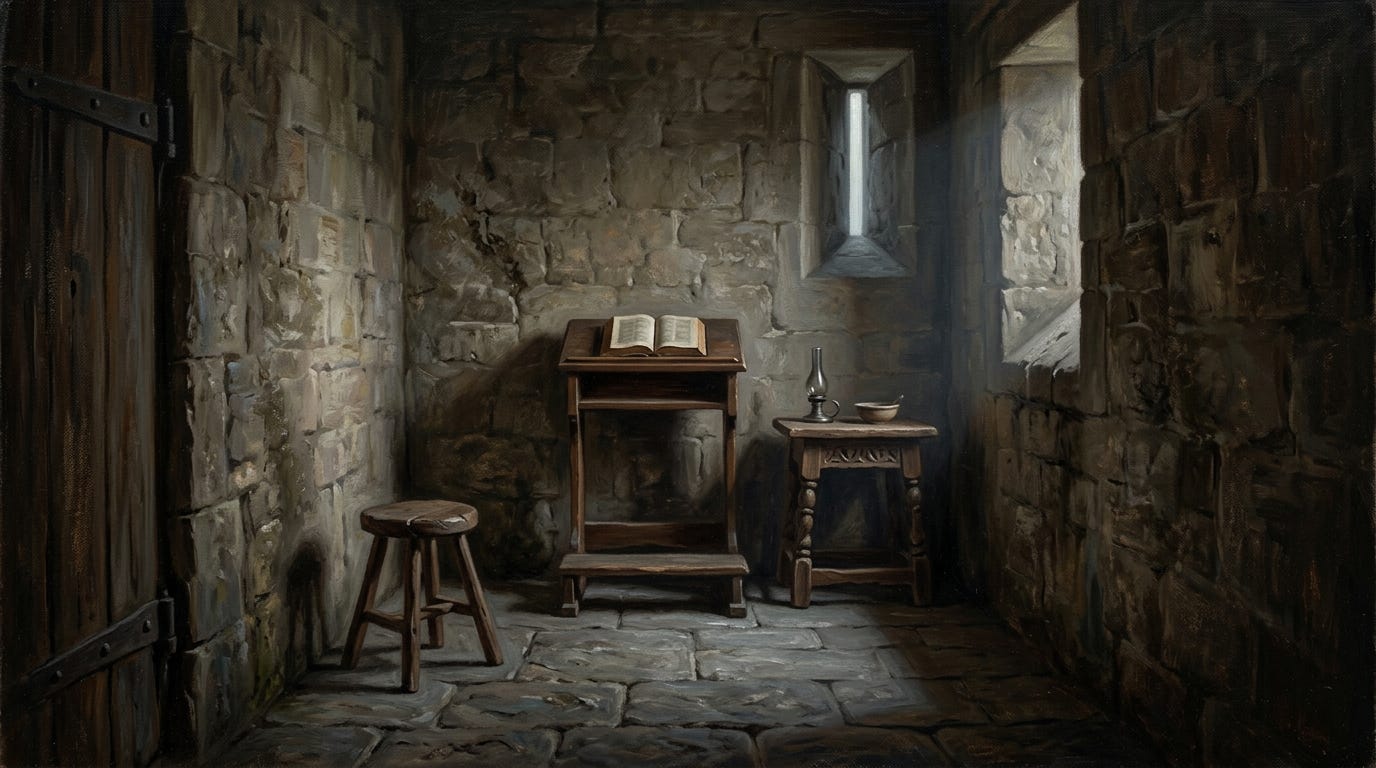
The girl came in before the lamps were lit.
Margaret was already awake. She had not slept much in the past two and a half years and she had not slept at all in the past four hours, since the priest had come and gone and she had made her last confession and received the body of the Lord under the form of bread, the bread that was kept for the prisoners in a small wooden pyx by the chaplain because the Tower no longer permitted Catholic Mass to be said in its chapels except quietly and at strange hours. She had been kneeling at the small wooden prie-dieu they had let her keep, and she had been praying the Hours, although she did not have a breviary anymore and was praying them from memory, which was not difficult for her because she had been praying them for sixty years. She was sixty-seven years old. She was the last of the Plantagenets. She was to be killed in the morning.
When she heard the soft sound at the door of the chamber she did not at first turn. The guards did not knock softly. The guards rattled. The chamber-women who were permitted to attend her did not knock at all, having long since been instructed simply to enter. Whoever was at the door was neither.
Margaret rose from the prie-dieu with some difficulty, because her knees were not what they had been, and because she had been kneeling for a long while, and she crossed the small stone room and laid her hand on the iron of the door.
“Yes?” she said, in a voice she made calmer than she felt.
“I am with you,” the voice said.
She did not know the voice. She did not know what to do with the words, which in English were a strange formation for a stranger at a door, and which seemed to have been chosen by someone who had translated them from a different language and not chosen the closest English. She slid the bolt - the door bolted from the inside in those days, although it bolted also from the outside, and the outside bolt was the one that mattered - and she opened the door a hand’s width.
A girl was standing in the passage.
She was perhaps seventeen, perhaps twenty, perhaps older or younger - Margaret could not tell because the lamps had not been lit and the only light came from the small high window of Margaret’s cell, behind her, falling out into the passage in a thin gray bar. The girl was wearing the black habit of an English nun, but the habit was older than any habit Margaret had ever seen, and the wool was woven in a pattern that was not a pattern Margaret recognized. Her veil was simple and her hair beneath it was fair and her face was very young and very still.
“Sister,” Margaret said, in the voice she had learned from her own mother, who had been a duchess, “you are not permitted on this passage. The guards will hurt you. You must go down.”
“They cannot see me, my lady.”
“What.”
“They cannot see me. I have come for you. I will go in if you will let me.”
Margaret looked at her. She looked past the girl, down the passage, where she knew two yeomen of the Tower stood at the end of the corridor, where they had stood for the past twenty-eight months, and she could see the orange of their lantern faintly around the corner, and she could hear the low murmur of one of them speaking to the other, the way men speak in the watches of the night to keep themselves awake. The men had not heard her open the door. The men had not heard the girl approach.
Margaret stepped back from the doorway and let the girl in.
The girl came in quietly. The door swung shut behind her without Margaret having moved to close it. The bolt did not slide; the door simply settled into the frame and did not open again. The girl walked across the cell to the prie-dieu, and she looked at it, and she looked at the small wooden pyx on the table beside it, where the priest had left a few crumbs of the morning’s host wrapped in a white cloth in case Margaret should wish to receive again before the end, although the chaplain had said gently that the morning would come soon and there would not be time. She turned from the pyx and looked at Margaret.
“My name is Edith,” she said.
“Edith.”
“I lived at Wilton.”
“At Wilton.”
“In Wessex. The abbey at Wilton. I was the daughter of the king.”
Margaret stood very still. She knew the name. She had not heard it spoken in many years, and she could not at first remember what she knew, and then she remembered. Edith of Wilton. The Anglo-Saxon princess who had refused the crown and remained a nun. Five hundred years dead. There had been a shrine to her, before the dissolution, in the church at Wilton. The shrine had been pulled down four years ago. Margaret had heard about it from her cousin, who had heard it from a man who had been there when the commissioners came.
“You are dead,” Margaret said.
“Yes.”
“You died very young.”
“I was twenty-three.”
“My God.”
“I am with you, Margaret.”
Margaret did not move. The girl - the saint, she corrected herself, the saint, although the girl looked so ordinary in the cold gray light, like one of the novices Margaret had seen sixty years ago in the quiet houses of her childhood - the saint was looking at her with the kind of patient attention that Margaret had not received from a human face since she had been brought to this place. The chamber-women were kind in their way but they were frightened. The chaplain was kind but he was hurried. The girl was neither frightened nor hurried. The girl had time. The girl, Margaret understood slowly, had nothing but time.
“They are coming for me at seven,” Margaret said.
“Yes.”
“They have not given me notice but my woman has heard from the cook that the scaffold is being made ready in the courtyard. It is being made ready inside the walls and not on Tower Hill, because they are afraid of the people.”
“Yes.”
“There will not be many to see it. Perhaps a hundred and fifty. The witnesses they have summoned. The king has not made it public.”
“No.”
“I do not know whether that is mercy or cowardice.”
“It is neither,” Edith said. “It is fear. The king is afraid of you.”
Margaret almost laughed. She had not laughed in some weeks. The almost-laugh moved across her face and did not quite arrive.
“He is afraid of an old woman in a cell.”
“He is afraid of what you are. He is afraid of the kingdom you remember. He is afraid that the people remember it also. He is right to be afraid. The remembering is not over.”
Margaret sat down on the small wooden stool by the table. She had been standing for a long time and her legs were tired. The girl - Edith, she thought, Edith - did not sit. There was no other stool. Edith stood quietly by the prie-dieu and looked at the lamp, which was unlit, and after a moment the lamp began to burn, although no one had touched it, and the small flame settled and steadied, and Margaret looked at the flame and did not ask how it had come to be there.
“Why have you come,” Margaret said.
“Because the kingdom you remember is the kingdom I helped to begin.”
Margaret looked at her.
“I do not understand.”
“I lived in the time when this kingdom became Christian. Not in the first years - those were Augustine of Canterbury and his monks - but in the years afterward, when the abbeys were being founded and the prayers were being learned and the churches were being built. My father gave land to abbeys. My mother gave the rest of her life to one. I gave the whole of mine. I lived in Wilton for as long as I lived, which was not very long, and I prayed the Hours there, and I taught the novices, and I died at twenty-three of a fever, and the people who buried me said I had been a good nun, and the abbey kept my name for five hundred years, and pilgrims came to my tomb, and the kingdom was the kingdom I had given my life into, and the kingdom was Christian, and the kingdom was Catholic, and the kingdom prayed for its dead.
That kingdom is the one your king has broken. He has broken it deliberately. He has broken it because he wanted a different wife. He has broken five hundred years of work because he wanted to marry a particular woman and was told no. The broken thing is the thing I helped to make. The broken thing is the thing you are dying for. I have come to be with you because I am the one this is happening to also. The pulling down of my shrine was the same act as the building of your scaffold. We are inside one act, Margaret. It is being done to both of us. I have come because I would not have you go down to it alone.”
Margaret put her hands together in her lap. She did not weep. She had used up her weeping months ago, in the early part of her imprisonment, when she had wept for her son Reginald, who was on the Continent, who was a cardinal, who was the reason she was being killed - because Reginald had defied Henry, and Henry could not reach Reginald, and so Henry had reached the mother. She had wept then. She had stopped weeping when she had understood that the weeping was not changing anything and that what was being asked of her was something the weeping was not equal to. She had been dry-eyed for many months now. She found, sitting in her cell with the saint who had built her kingdom, that the dryness was holding. She was grateful for that. She had not wanted to weep at the end.
“The king,” she said carefully, “is not the kingdom.”
“No.”
“I have said this often.”
“I know.”
“I have said it to my women. I have said it in my prayers. I have said it in the letters I am no longer permitted to write. The king is one man. The kingdom is the people, and the saints, and the dead, and the prayers, and the abbeys he has pulled down, and the shrines he has emptied, and the work of seven hundred years. He cannot break it. He has only torn the cloth on the surface. The thread is still there.”
“Yes.”
“Tell me that.”
“The thread is still there.”
“Tell me again.”
“The thread is still there, Margaret. The kingdom is not gone. The kingdom is hidden. It has been hidden before. It will be hidden again. The hiding is not the ending.”
“How long.”
“How long is the hiding.”
“Yes.”
“I do not know. I am not given to know that. I am given only to know that the hiding is not the ending. I am given to know that you are part of the not-ending. Your dying is not an ending. Your dying is a thread that goes through the cloth and ties it to the next century. You will not see the cloth made whole. I did not see it either, and I had it once and watched it be loved, and your king and his sons and his counselors will work for many years to forget that the cloth was ever there, and they will partly succeed and partly not, and the partly-not is where you and I will live, in the people who will remember without quite knowing why they remember, in the children who will be baptized in churches that the king’s commissioners did not pull down, in the old women who will keep a rosary hidden under a floorboard, in the priests who will say Mass in attics. The thread will be carried by hand through the cold years. We will carry it. The dead will carry it. The Lord will carry it. And one day, in a century I cannot see, the cloth will be re-woven. Not the same cloth. A new cloth, with the old thread still running through it. That is what is happening, Margaret. You are part of what is happening.”
Margaret bowed her head.
“I am very afraid,” she said.
“Yes.”
“I am not afraid of dying. I am afraid of the manner of it. They are sending a man who has not done it before. My woman heard. The headsman has not done a noblewoman before. He is afraid also.”
“Yes.”
“It will not be quick.”
“It will not.”
“How many.”
Edith did not answer at once. She did not turn her face away. She looked at Margaret with the steady patient attention she had been giving her since she had come in.
“I cannot tell you that,” she said. “I will not tell you that. You will know it when it happens, and after, the knowing will not matter. I will tell you only this. I will be there. I will not turn away. I will not let you be alone in it. I have come to you in the hour before dawn because I will be with you in the hour after dawn also. I am not a stranger who came to comfort you and will leave. I am the place this is happening from. The kingdom is here. I am here. I will be in the courtyard.”
“You will be in the courtyard.”
“Yes.”
“With the others.”
“What others?”
“My son,” Margaret said, and her voice was very small. “My son Reginald. He is on the Continent. He will not be there. He cannot be there. They will not let him come. He will not know I am dead until weeks after. I am afraid he will think I died alone.”
Edith was quiet for a moment.
“He will know,” she said. “Not in the way you mean. Not by letter. He will know in the way the dead know things. He has prayed for you every day for two and a half years. The praying is its own knowing. He will be in his room in Italy at the moment you die, and he will not know that he knows, but he will know. He will pause in what he is doing. He will look up. He will not be able to say why. Years later he will think back to that morning and he will understand what the pause was.”
“How can you tell me that?”
“Because it is what happens. Because I have been watching it happen for five hundred years to mothers and to sons. Because the prayers between you are the same kind of thread I have been speaking of. They do not break. They are not breakable. The king has not been given the power to break them. No king has.”
Margaret put her face in her hands.
She did not weep. She kept the dry promise she had made to herself. But she sat with her face in her hands for a long while, and Edith stood beside the prie-dieu and did not move and did not speak, and the small lamp on the table burned, and the gray bar of light from the window slowly grew, and somewhere outside the cell the first of the morning bells of the city began to ring, faintly, from across the river. Margaret heard them. She had heard them every morning for twenty-eight months and she had counted them every morning, and they were her clock and her companion, and she heard them now, on this last morning, and she was glad of them.
She lifted her face.
“Sister,” she said.
“My lady.”
“I am not your lady. I am a prisoner of the king and a Catholic of the old faith and the daughter of a duke whose line is being ended in me. I am not your lady. You are mine, if anyone is. You are the lady of the kingdom that does not end. Tell me what to do.”
“Pray the Hours.”
“With me.”
“With you. Until they come.”
Edith came to the prie-dieu and knelt beside it on the stone floor, her habit pooling around her, and Margaret rose from the stool and came to the prie-dieu and knelt at it the way she had knelt at it for the past four hours and the past twenty-eight months and the past many years, and the two women - the seventeen-year-old saint who had been dead for five hundred and fifty-six years and the sixty-seven-year-old countess who would be dead in less than two hours - prayed Lauds together in the cell at the Tower. They did not need a breviary. They both knew it. Edith prayed in the Anglo-Saxon Latin she had learned at Wilton, with the soft late-Saxon vowels, and Margaret prayed in the Latin of her own century, which was different but not different enough that they could not pray together, and the two Latins met in the cell and made one Latin, and the Lord they were addressing did not mind which century the Latin came from, because He had given the Latin to both of them and to the centuries between and to the centuries that would come after.
When they had finished Lauds Edith rose. Margaret remained kneeling.
“Will you stay until they come.”
“Yes.”
“They will not see you.”
“They will not see me. You will see me.”
“Yes.”
The bells of the city had stopped ringing now and the gray light at the window was a little less gray and Margaret could hear, in the courtyard below, the small sounds of the scaffold being finished. She closed her eyes. She did not open them when the bolt of the door slid back at seven o’clock and the captain of the yeomen came to fetch her. She rose without his help. She did not look back at the cell. She walked between the two yeomen down the stone passage and down the narrow stair into the gray courtyard, where about a hundred and fifty witnesses stood silent in the wet grass, and where the scaffold stood low and badly built, and where the executioner was a young man who was visibly afraid.
She climbed the steps.
She knelt at the block.
She forgave the executioner aloud, in the form prescribed for noble deaths in those years, and she commended her soul to God, and she laid her head on the block.
The first blow did not kill her.
Neither did the second.
She did not cry out.
She was not alone.
In the side of the courtyard, where no one was looking, a girl in an Anglo-Saxon habit stood with her hands folded, and her face was very still, and she did not turn away, and Margaret saw her, although no one else did, and Margaret kept her eyes on the girl until the eleventh blow, which was the one that ended it.
In Italy, in his rooms in Viterbo, Cardinal Reginald Pole looked up from the letter he had been writing.
He paused. He set down his pen. He could not have said why. He sat for a long moment in the morning sun. Years later, when he learned the date and the hour, he would think back to that morning and he would understand what the pause had been.
The thread did not break.
It went through.
The lamp in the empty cell at the Tower burned out at seven thirty, when the chamber-woman came in to take it away.
But the kingdom Margaret had refused to give up was still there, hidden, threaded through the cold years, carried by hand. It is still there. The hiding is not the ending. The cloth, in time, will be re-woven.
For your prayer this week: Blessed Margaret Pole and Saint Edith of Wilton, you who built the kingdom in its first centuries and you who would not let it be unbuilt in its breaking, pray for those of us who feel that the kingdom has been broken and who do not yet see the cloth being re-woven. Grant us the grace to carry the thread by hand through cold years, trusting that the hiding is not the ending. Amen.
Two Lamps returns next Friday: Saint Charles Lwanga and Saint Justin Martyr, the royal enclosure at Munyonyo, Uganda, the night of June 2, 1886.
Two Lamps is a weekly short story braiding the lives of two or three saints across the centuries. Sometimes the meeting is rendered as an encounter in eternity. Sometimes as the older saint coming, in vision or in patronage, to the soul of the younger. The text does not decide for you. The Communion of Saints is the doctrine that holds these meetings as theologically real even when the meeting itself is imagined.
Two Lamps is written by Deacon Michael Halbrook, a permanent deacon of the Diocese of Springfield in Illinois, serving at St. Elizabeth Parish in Granite City. He writes personally at DeaconMichael.net, serves families through Domus Formation, and publishes the serial novel Ordo: A Chronicle of Lux Perpetua at LuxPerpetua.net. Two Lamps is co-conceived with his son Joseph.