

He came down from the walnut tree in the middle of the afternoon.
Anthony had built the cell in the upper branches himself, or rather his brother Tiso had built it for him at his request, after Anthony had spent the spring telling Tiso he could not write any longer in the friary because the people kept finding him. The people had been finding him in Padua and outside Padua and along the roads and in the chapels and in the cloister gardens. The people came to him because they had heard him preach, or because their cousin had heard him preach, or because their mother had heard him preach in some marketplace twenty years earlier when he was still in Lisbon and the story had traveled and the cousin’s mother was now ill and the cousin wanted Anthony to come and pray over her, and Anthony had loved the people and could not bring himself to refuse them, and the cost of not refusing them had been visible for some time on his face. Tiso had built the cell in the walnut tree. The cell was small. The branches held it. Anthony went up to it each morning by a wooden ladder and he came down each afternoon by the same ladder, and in the hours between he wrote, and prayed, and looked out at the tops of the chestnuts and oaks of the Veneto countryside, and tried to finish the sermons for the feasts of Saints Peter and Paul which would fall at the end of the month and which he was very nearly certain he would not live to preach.
He was thirty-six. He had been a Franciscan for ten years. He had dropsy, although that word would not be the word the medical men of his century used; the swelling in his legs had reached his knees and his breath was short and his sleep was fitful and his hands trembled when he wrote. He had been told by the brother who tended him that he should rest. He had agreed. He had come down from the cell in the early afternoon, intending to go to the small chapel beside the hermitage to pray, because his prayers in the cell had become difficult lately, and the chapel was nearer the ground and somehow easier on him. He had walked the short path between the walnut tree and the chapel slowly, because the walking was not what it had been. He had reached the door. He had pushed it open.
The chapel was empty.
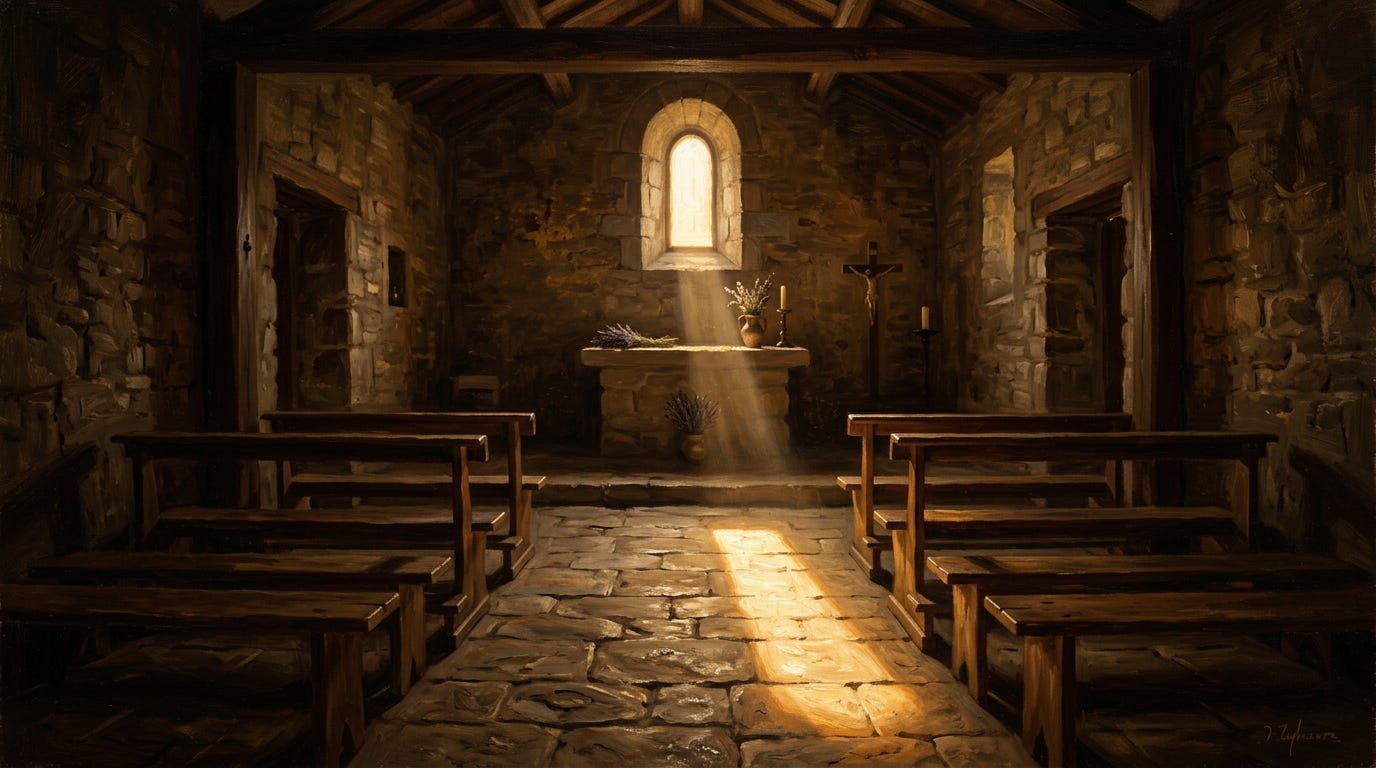
That was what he had wanted. He stepped in and let the door close behind him. The chapel was very small - one room, perhaps fifteen feet on its longest side, with a single low altar at the eastern end and three rows of simple wooden benches and a small high window above the altar through which the late afternoon light was falling in a long warm bar across the stone floor. The smell was the smell of dry stone and old wax and the lavender that one of the lay brothers had cut and laid on the altar that morning. Anthony walked up the aisle slowly. He genuflected, with effort, before the altar. He went into the front bench and lowered himself onto his knees on the wooden kneeler.
He closed his eyes.
After a moment, somewhere behind him, someone began to hum.
He did not at first turn. He thought he had imagined it. He had been hearing things lately, small sounds at the edge of hearing, the way men hear things when they have been pushing themselves past their bodies for a long time. He kept his eyes closed and listened. The humming continued. It was a melody he did not know. It was not Italian. It was not the kind of melody that came from the troubadours or from the marketplace songs or from the chants he had learned at Coimbra. It was different. It moved differently. It went up the way a vine goes up - in slow climbing twists, with small pauses, as though the singer were finding the way as he went. The voice was an old voice. The voice was not unpleasant.
Anthony turned his head.
A man was sitting in the back bench.
He was old - perhaps sixty-five, perhaps older - and he was wearing a long brown tunic of a cut Anthony did not recognize, gathered at the waist with a broad cloth band, and over it a kind of shawl or mantle of the same brown wool, and his sandals were laced with leather thongs up the ankle in a fashion Anthony had seen in old books but had not seen on a man’s foot. His beard was long and gray. His hair was short and gray. His eyes were closed. He was humming. He had not noticed Anthony, or he had noticed Anthony and was not allowing the noticing to interrupt the hum.
Anthony watched him for some while.
The man did not open his eyes. He hummed for perhaps another verse - Anthony could hear it as a verse, although he could not have said where the verse was beginning or ending - and then the humming slowed and softened and stopped, and the man opened his eyes.
His eyes met Anthony’s.
The eyes did not seem surprised.
“Brother,” the man said.
His Latin was very strange. It was Latin, but Latin spoken by someone for whom Latin had been a second language even when he had known it, and that had been a long time ago. There was Greek in it, and there was something else underneath the Greek - a third language, older, that Anthony could hear but could not name. Anthony was a man who had spent his life on languages. He had preached in Portuguese and in Latin and in Italian and in the various Italian dialects of the towns he had passed through, and he had learned French in his year in Provence, and he had begun to learn German before his health had made it impossible, and he was confident in his ear for languages, and his ear told him that the man in the back bench was not from any country he had ever heard of.
“Brother,” Anthony said carefully.
“I have interrupted your prayer.”
“You have not interrupted my prayer. I have not yet begun.”
“Then I have interrupted your beginning.”
“You have not. The humming was not unwelcome.”
The man almost smiled. He inclined his head a small degree.
“That is generous of you. The humming was an old habit. I was given it before I was given Latin, and I have never stopped, and when I find myself in a quiet place where the Lord is, I begin again, and I do not always remember to ask whether I am welcome.”
“Where the Lord is,” Anthony repeated.
“He is here.”
“Yes.”
Anthony rose carefully from his knees. The rising was slow. The old man watched him without offering to help, which Anthony appreciated, because the offering of help by other men had become one of the small humiliations of his last weeks, and the old man seemed to know this without being told. Anthony came down the short aisle and sat on the front bench, sideways, so that he could see the old man in the back. He folded his hands in his lap. The light from the high window had moved a little since he had come in, and the warm bar on the floor was now resting just at the edge of the old man’s sandal, although the old man’s sandal did not seem to be quite in the light, the way a thing is in light, but only beside it.
“You are a deacon,” Anthony said.
“How did you know.”
“The cut of your tunic. There was a brother at Coimbra, an Egyptian, who had taken his orders in the East and who wore a tunic something like that, although the cloth was different, and the cloth band at the waist was not as wide. You are a deacon of an Eastern church.”
“I was a deacon. I am still, I suppose. They do not undeacon you in the place where I am now.”
“No.”
“I have been a deacon for fifteen hundred years and a small fraction more.”
Anthony was quiet for a moment.
“Brother,” he said, “you have come a long way.”
“I have come no distance at all.”
“Then I have.”
“No,” the old man said, “you have not. We are sitting in the same room. I think the room is the chapel near your walnut tree, although I am not entirely sure of the geography. The geography is not what it once was for me.”
“You know about the walnut tree.”
“I know the things that are given to me to know about you. I know the tree. I know that you write in it. I know that you are not well. I know the names of your sermons for the feasts at the end of the month, although I do not know whether you will preach them.”
“You do not know.”
“No. The not-knowing is one of the few things that has not been taken away from me. I am grateful for it. It would be tiresome to know everything.”
Anthony almost laughed. He had not expected this old man, with his strange Latin and his older humming, to be a man who said things like it would be tiresome. He had expected him to be more solemn. The almost-laughing felt strange in his chest, which was already tight, and he was careful with the almost. He let it move through him and settle.
“Tell me your name,” he said.
“Ephrem. Of Edessa. I lived in the place that you would now call Mesopotamia, in the fourth century after Our Lord. I died in the year that you would call three hundred and seventy-three, of a sickness that I caught from the people I was nursing. I wrote a great deal. Most of what I wrote was sung. The songs were sung in Syriac, which was the tongue I was given and which is the tongue I was humming a moment ago. I am sorry the humming did not have words. I have stopped using words for a long time when I am alone. The words come back when I have someone to sing with. I have not had someone to sing with in some while.”
“You were a hymnographer.”
“I was a deacon who sang. Hymnographer is a Greek word that someone gave me later. I did not call myself by it. I was not so grand.”
“Three hundred thousand verses of the Bible, the Greeks say, you wrote into hymns.”
“They exaggerated. It was a great deal but it was not three hundred thousand. They wanted me to be more than I was. I was not so much. I was a deacon. I sang. I taught girls to sing. I wrote what I could so that the people who could not read could nevertheless know.”
Anthony looked at his hands. They were trembling slightly, the way they trembled now in the late afternoons. He folded them tighter in his lap, to still them.
“I have spent my life,” he said, “doing what you did. In a different language and a different shape, but the same work. I have spent it in words. I have stood in marketplaces and in churches and in the open air, and I have spoken to people, and I have used the words I had been given to use, and I have tried to make the gospel plain to people who could not read. I have done it for ten years. I have done it for as long as my body would let me. I think my body is no longer going to let me.”
“No.”
“You do not contradict me.”
“I do not. There is no kindness in contradicting a dying man about the fact that he is dying. He has worked hard for the knowing of it. He should not be required to argue.”
“Yes.”
“You have done what I did. I have done what you do. We have done it differently. I have come because I would like to speak with you about the doing of it. I do not know how much time you have for the speaking. I will not take more than you can give.”
“How long will you stay.”
“Until the light leaves the floor. The light is leaving slowly. We have perhaps an hour.”
“That is enough.”
“Yes.”
The old man rose from the back bench and came up the short aisle and sat on the bench across the aisle from Anthony. He did not sit close. He left the small space of the aisle between them. He folded his own hands in his own lap, in a position very much like Anthony’s, and the two of them sat for a moment without speaking, and the late afternoon light moved a small distance further across the stone floor.
“Tell me,” Ephrem said, “what you have learned. About the doing. I would like to hear what a preacher learns. I have not had many preachers in my life. The Syriac church did not preach as you do. We sang and we read the Scriptures aloud and we taught in small classes, but we did not stand in marketplaces. The standing in marketplaces is a Western thing and a later thing and I would like to hear about it from a man who has done it well.”
Anthony looked at him.
“How do you know I have done it well.”
“Because the people came to you. The people do not come to a bad preacher. They go away.”
“That is true.”
“Tell me.”
Anthony was quiet for a moment. He was thinking how to begin. He was not used to being asked. He was used to standing in a square and beginning of his own accord, with the words that came to him, and the people listened or did not listen, and he kept going. He was not used to a single old man asking him to explain himself.
“I have learned,” he said, “that the words are not the work. The words are the carriage. The work is the soul of the listener, and the words are what carries the gospel to it, and a good carriage is one that does not throw the passenger out on the road. The carriage must be light enough to move and strong enough to hold and shaped to the road it is on. The road in Padua is not the road in Lisbon and is not the road in the marketplace at Coimbra. The carriages must be different. But the passenger is the same. The gospel is the same. It is always the gospel that one is carrying. If you forget what is in the carriage you become a builder of fine carriages and not a preacher.”
“Yes.”
“That is what I have learned. It took me a long time.”
“I have learned the same thing. In a different shape. The hymns are also carriages. The hymns must move and hold and be shaped to the people who will sing them. I wrote hymns for women, and for children, and for the old men who sat at the back of the assembly and could not see well, and for the women who washed the dead, and for the catechumens at the Easter Vigil. The hymns were different. The Lord was the same. The Lord was always what was in the hymn.”
“Yes.”
“The carriage and the hymn are not different things. Or rather: they are different things, but they are doing the same work. We are colleagues, brother.”
“Yes.”
“I have come to tell you that we are colleagues. I have come because I have been waiting for fifteen hundred years to tell a Western preacher that he is doing what I did, and that I am his brother, and that the song and the sermon are one work, and that the Lord uses both because the people are not all the same and the gospel must come to them in the language they will receive. I could not say this in my time. There were no Western preachers in my time. The Latin Church was still small in the East and was barely speaking. I could not have said it then. I have come to say it now. To you. Because you are very tired, and because the Lord wanted you to know it before you go home.”
Anthony bowed his head.
He did not weep. He had not wept easily in many years - not since his early days as a friar, when he had wept often, the way young friars do. He had grown out of it. But something behind his face moved, and he sat for a while with his head bowed, and Ephrem did not speak, and the light continued its slow journey across the stone floor.
After a while Anthony said, “Brother. Will you sing for me. Before the light goes.”
“I will sing for you.”
“What will you sing.”
“A hymn I wrote for the catechumens at the Easter Vigil in Edessa. They sang it as they came up out of the water. I have not sung it since I died. It will be in Syriac. You will not understand the words. The words will not matter. The Lord will translate. He always does.”
“Yes.”
Ephrem closed his eyes. He drew a breath. He began to sing.
The voice was old but the singing was not old. The voice was the voice of a man who had sung every day of his life and had continued to sing through fifteen centuries of being dead. The melody was the same vine-climbing line that Anthony had heard him hum before, but with words now, and the words were Syriac words and Anthony did not know them, and Anthony understood them anyway. The hymn was about water. The hymn was about the water that comes up to meet a man and washes him, and about the water at the wedding at Cana, and about the water in the side of Christ on the cross, and about the water that the deer pants for in the psalm, and about the water that flows from the temple in Ezekiel’s vision, and about the water that the catechumens were standing in, in the church at Edessa in the year three hundred and seventy, with the candles burning and the priests in their dalmatics and the dawn just beginning to come up through the eastern window. Anthony saw it. He saw it as Ephrem sang. He saw it with the part of him that had been seeing things for ten years from pulpits and from the steps of churches and from the carts in the marketplaces, the seeing-with-the-mind that the Lord had given him as the chief tool of his trade.
The hymn ended.
Anthony sat very still.
“Brother,” he said.
“Brother.”
“That is what I have been doing. In a different shape. That is what I have been doing for ten years.”
“Yes.”
“I did not know it was a song.”
“It is a song. All of it is a song. The sermons are also songs. They have a different rhythm and they do not always have a melody but they are songs because they are made of breath and they are addressed to the Lord through the people, and that is what a song is. You have been singing for ten years, brother. You did not know it. You know it now.”
“Yes.”
The light had left the floor. The bar of warm afternoon was gone. The chapel was in a softer evening light now, gray-gold, the kind of light that comes in through high windows in early summer when the day is long. Ephrem was looking at his hands. Anthony was looking at his.
“You will go now,” Anthony said.
“I will go now. I have given you what I came to give.”
“Where will you go.”
“Home.”
“Where is home.”
“Where you are about to go, brother. We will see each other again. You will know me when you see me. I will be the one humming.”
Anthony almost laughed again. The almost-laugh moved through him, gentler this time.
“I will know you.”
“Yes.”
“Brother Ephrem.”
“Brother Anthony.”
The old man rose. He inclined his head, once, in the small Eastern bow that Anthony had seen the Egyptian deacon at Coimbra make when leaving the presence of a senior friar. He turned and walked down the aisle and to the door. He laid his hand on the latch. He paused. He looked back.
“The walnut tree is a good place to die,” he said. “The Lord likes trees. He spent a great deal of His public ministry under them. Do not be afraid of the going. The going is a small distance. We are all already on the other side, waiting.”
“Thank you.”
“Brother.”
He went out. The door closed gently behind him. Anthony sat in the front bench and did not rise. The light continued to soften. After a while he got up, with effort, and walked down the aisle to the door, and pushed it open. The path between the chapel and the walnut tree was empty. The grass was unflattened. The summer dust on the path was undisturbed. A small swallow was crossing the sky above the walnut. Anthony stood in the doorway and watched it go.
He went back to the cell in the tree.
In the morning he tried to write. He did not get very far. The hand was not steady. He laid the quill down. He lay on the small mat and he closed his eyes and he heard, very faintly, somewhere at the edge of hearing, a humming, and he smiled, and the smile stayed on his face for some while.
Eight days later the brothers carried him in a cart back toward Padua, because he had asked to die there, and on the road he became too weak to continue, and they stopped at the convent of the Poor Clares at Arcella, and there, on the thirteenth of June, in the late afternoon, with three brothers around his bed and the song of the late spring birds coming through the window, he closed his eyes for the last time.
He was thirty-six.
The crowds at his funeral could not be numbered. The bishop preached. The miracles began that day and continued for centuries.
In a small chapel at Camposampiero, in the empty afternoon, the lavender on the altar slowly dried.
The walnut tree stood for many years.
The lamp before the tabernacle in the chapel burned out at dawn, as lamps do, on the morning of the canonization, which was the next year, which was the fastest canonization the Church had ever performed.
Brother Ephrem, on the other side, smiled when he heard.
He hummed for a while.
Then he went to find the next one.
For your prayer this week: Saint Ephrem the Syrian and Saint Anthony of Padua, you who sang and you who preached, you who carried the gospel in hymns and you who carried it in sermons, pray for those of us who are not always sure whether the work we are doing is being received. Grant us the grace to know that the song and the sermon are one work, that the carriage and the hymn are doing the same labor, and that the Lord uses what is given to Him in whatever shape it comes. Amen.
Two Lamps returns next Friday: Saint Romuald and Saint Aloysius Gonzaga, the infirmary of the Roman Jesuit College, Rome, late June 1591.
Two Lamps is a weekly short story braiding the lives of two or three saints across the centuries. Sometimes the meeting is rendered as an encounter in eternity. Sometimes as the older saint coming, in vision or in patronage, to the soul of the younger. The text does not decide for you. The Communion of Saints is the doctrine that holds these meetings as theologically real even when the meeting itself is imagined.
Two Lamps is written by Deacon Michael Halbrook, a permanent deacon of the Diocese of Springfield in Illinois, serving at St. Elizabeth Parish in Granite City. He writes personally at DeaconMichael.net, serves families through Domus Formation, and publishes the serial novel Ordo: A Chronicle of Lux Perpetua at LuxPerpetua.net. Two Lamps is co-conceived with his son Joseph.
I wait all week for these. They are beautiful prayer like meditations. ( My grandmother always called him St Anthony of Lisbon, she was annoyed that he was given the Padua designation - but then she was Portuguese and she used to tell me he was too. What can you do.)