

The fever had come and gone three times.
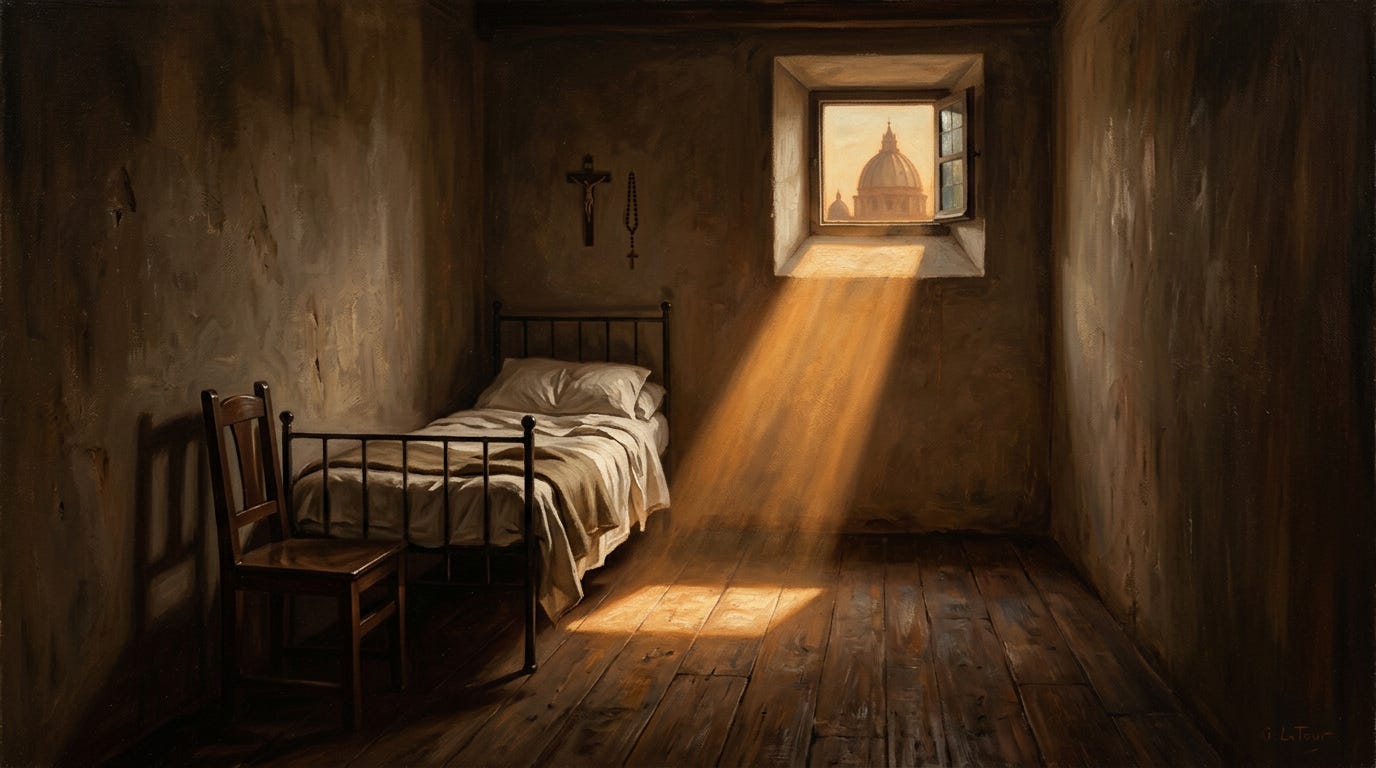
Aloysius lay on the narrow cot by the window of the small infirmary cell at the Roman College, with the linen sheet pulled up to his chin because the brothers had said he must be kept warm even in the heat of the Roman summer, and the heat was considerable. The window was open. He had asked for it to be open. The infirmarian had said it was unwise. Aloysius had said it was a small unwisdom and that he would like to hear the city, and the infirmarian had bowed and opened the window, because the rector had given instructions that the young brother was to be indulged in any reasonable request, and the brothers of the College had all of them understood, since the second fever, that the young brother was not going to survive the summer.
He was twenty-three.
He had been a Jesuit for eight years. He had been a Christian, in the way he understood the word, for many years more than that - since he was seven, when he had first made the resolution that became the organizing fact of his life, the resolution to belong to God alone. He had spent the years between seven and fifteen disappointing his father. He had spent the years between fifteen and twenty-three disappointing no one, except perhaps the family chaplain who had hoped he would become a priest of the diocese rather than a Jesuit and who had not been able to talk him out of the Society. His father had died nine months ago. His mother was in Castiglione with his younger brothers. He had not seen any of them in two years.
He had caught the plague at the end of April, in a house in the Trastevere quarter, where he had been carrying a man on his back to the Jesuit hospital. The man had died the same evening. Aloysius had developed the first symptoms a week later. The first fever had broken. He had returned to the work for ten days. The second fever had broken also. He had not returned to the work, because the rector had forbidden it and he had been obedient. He had been obedient since he was seven. He found the obedience easier than most things.
The third fever had not broken. It had softened, in the past two days, into something quieter, but it had not left. He understood that it would not leave. He had told this to Father General Acquaviva, who had visited him yesterday, and Acquaviva had not contradicted him, which Aloysius had appreciated. Aloysius did not have time for being contradicted on matters about which he was correct.
He lay with his head turned toward the open window. He could see, beyond the rooftops, the dome of the Gesù in the late afternoon light. He could hear the bells of various churches across the city - they had been ringing irregularly all day for various votive Masses, because Rome was a city of bells and a city of fevers and the bells were always ringing for someone - and he could hear, faintly, the cries of vendors from the street two storeys down. He had been listening to the city for some hours. He liked it. He had been raised in a small mountain town in Lombardy and had spent his life in courts and colleges and houses of the sick, and the city of Rome was the one place where he had felt, in the past few years, the kind of belonging that he had not felt in his father’s house. The city was his city. He would die in it.
There was a man sitting in the wooden chair by the foot of the cot.
Aloysius had not heard him come in. The door of the cell was closed. The infirmarian had left half an hour ago and was not due back until Vespers. The chair, when he had last looked at it, had been empty. He turned his head to see the man more clearly.
The man was old.
He was very old. Older than any man Aloysius had seen in his life, and Aloysius had seen many old men in the Jesuit houses, because Jesuits had a habit of living long despite their work. The old man was perhaps seventy-five, perhaps eighty. His beard was white and full and reached his chest. His head was bald. His face was the color of old olive wood, weathered to a fine grain. He wore a habit Aloysius did not recognize - long, white-grey, undyed, with a hood pushed back, and a leather belt at the waist, and sandals of a cut Aloysius had only seen in old illuminations. The habit was not Franciscan and not Cistercian and not any of the Roman orders Aloysius knew. He looked at it for a moment. He understood it must be Camaldolese, although he had not seen a Camaldolese habit in person. He had read about them. The Camaldolese were the white hermits. They lived in cells in the Apennines. They had been founded by a man named Romuald, in the eleventh century, who had walked all of Italy looking for hermits to gather and reform.
Aloysius understood, then, who was sitting at the foot of his bed.
He did not cry out. He had not cried out at anything since he was a child. He looked at the old man steadily and the old man looked at him steadily, and after a moment the old man inclined his head in the small monastic bow of greeting, and Aloysius inclined his own as well as he could from the pillow, and the small bow was returned.
“Father Romuald,” he said. He said it in Italian, because his Latin was unsteady from the fever.
“Brother Aloysius.”
The old man’s Italian was strange. It was Italian filtered through five hundred years of being dead, with notes of Latin underneath it and notes of a Ravenna dialect underneath the Latin. Aloysius understood him entirely. He had spent his life on languages, and he had a quick ear, and even in a fever he could parse what an old hermit said to him.
“I have read about you,” Aloysius said.
“I have read about you also.”
“You have read about me.”
“They write about you, in the place where I am now. The brothers of the next centuries already know your name. You will be canonized within a hundred years of your death, more or less. They will make you a patron of young men who study. They will paint many pictures of you with a lily and a crucifix, and almost none of those pictures will look like you, which is what generally happens with paintings. You will be venerated for almost everything except the thing you actually did. The thing you actually did will be slightly inconvenient for the painters. They will gloss it. I have come to tell you that I do not gloss it.”
Aloysius was silent for a moment.
“What do you think I actually did,” he said.
“You walked away from your patrimony. You were the eldest son of a Marquis. You had been raised to be a soldier and a courtier. Your father had bought you a position in the household of the King of Spain when you were nine years old. You had been at the courts of Spain and Florence and Mantua. You had been told, from the time you could understand speech, that the world was already yours. You walked away from it. You signed it over to your brother. You knelt in front of the Father General of the Society of Jesus and you asked to be made a novice, and Acquaviva accepted you, and you spent the eight years you were given here doing exactly the work you came here to do, which was nursing the bodies of strangers. You died of the work. You died of carrying a dying man to a hospital on your back. The painters will not show that. The painters will show you with a lily because the lily is easy. I have come to tell you that I have spent my own life walking away from a different patrimony, and that I recognize what you did, and that the recognition has been a long time coming.”
Aloysius was quiet for some time.
The fever was rising again, a little. He could feel it at the edge of his hairline, a small slow heat. He had become familiar with the way the fever moved. It would crest in a few hours and break in the early morning, and he would have another day, and the day after that, and possibly two more days, and then it would not break, and that would be the day. He had three days left, he thought. Perhaps four. He had not asked anyone to confirm this. The asking would have been a kind of complaint, and he did not complain.
“You walked away from your patrimony,” he said.
“I did.”
“Tell me how.”
The old man shifted slightly in the chair. He was solid enough to shift the chair. The chair creaked. The creak was a small odd sound in the small odd room - that this man, who had been dead for five hundred and sixty-four years, could nevertheless make a wooden chair creak when he moved.
“I was twenty,” Romuald said. “I was the son of a Ravenna noble. My father was a violent man. He had taken offense at a relative over a matter of land, and the relative had been intransigent, and my father had challenged him to a duel. The duel was on a hillside outside the city. I was made to attend. I was made to attend because my father wanted me to learn what it meant to defend the honor of our house. I attended. The duel was short. My father killed the relative. The relative fell on the grass and bled and died while I watched, and my father wiped his sword on the grass and stood there breathing, and I stood there looking at the body and at my father, and I understood, in that moment, what my patrimony was. My patrimony was the sword in my father’s hand. My patrimony was the body on the grass. My patrimony was the violence that had been called honor for the eight hundred years of my family’s name in that city. I left the hillside. I did not say anything to my father. I walked down the hill and into the city and out the eastern gate and to the monastery of Sant’Apollinare in Classe, which was the nearest Benedictine house, and I knocked on the gate and I asked to be received. I was a novice within the week. I never went back to my father’s house. I never saw my father again.”
Aloysius listened.
“You went into the desert.”
“I went into a monastery first. I went into the desert afterward, after some years, when I had found that the monastery was not where the Lord wanted me. I went into the hills above Ravenna and I lived as a hermit, and then I went looking for other hermits, and then I began to gather them, and then I founded houses for them, and I spent the rest of my life walking back and forth across Italy, founding hermitages and reforming monasteries. I died at Val di Castro in the year of our Lord one thousand and twenty-seven, in a hermitage I had built myself, in the cell I had been praying in for years. I was about seventy-six. I had been a hermit for fifty-five years. I had not entered a court in any of those years. I had not held coin in my hand. I had not heard music made by a professional musician. I had not eaten meat. I had not slept on a bed. I had been very strict about all of it. I was a difficult man, brother. I tell you this so that you do not mistake me for a sweet old monk. I was harsh with the brothers I gathered. I was harsh with myself. I came to the office of the hermit because I had seen, on a hillside outside Ravenna at the age of twenty, that the world my father had given me was a world I could not stay in, and the hermit’s cell was the place I was given to go to instead. I went there. I did not look back.”
“Yes.”
“And I have come here, today, because you also did not look back. You went the other way. You went into the world I had left. You went into the plague houses of Rome. You went to the dying. You carried a man on your back. That is not what I did. I did not carry men on my back. I sat in my cell and prayed for them. We did not do the same work, brother. We did the opposite work. I have come because the opposite work is the same work.”
Aloysius closed his eyes for a moment. The fever was a little higher. He opened them again. He wanted to be clear-headed for what came next.
“Explain,” he said.
“The work is the patrimony refused. The work is what one does instead. I refused the patrimony of the sword and I went to the cell. You refused the patrimony of the court and you went to the plague house. The cell and the plague house are not the same place. But they are both the other place. They are both not the father’s house. The Lord uses both. The Lord is in both. He is in my cell at Val di Castro and He is in your infirmary at the Roman College. He is the same Lord. He does not require all of His friends to do the same thing. He requires only that they refuse what is not Him, and that they go where He sends them. He sent me to the desert. He sent you to the body of a dying stranger you carried on your back. The sending is the office. The where-He-sent-you is not the office. Do not confuse them. The painters will confuse them. They will paint you with a lily and they will think the lily is the office. The lily is not the office. The office is the carrying.”
Aloysius lay still.
He was very tired. He had been tired for many weeks. The tiredness had become its own way of being awake. He understood, with the part of him that had been a Jesuit for eight years and a Christian for sixteen, that what the old hermit was telling him was the thing he had needed to hear and had not known he had needed to hear. He had been worried, in the past weeks, about a small thing that had been growing larger in his mind. He had been worried that his eight years of work had been the wrong work. He had been worried that he should have been a Carthusian or a Camaldolese, and that the active life of the Society had been a compromise with the world, and that the carrying of dying men on his back had been a kind of spiritual dilettantism compared with the long silent prayer of the hermits in their cells. He had not told anyone this. He had not even fully told himself. But it had been there, in the back of his mind, in the long fevered hours of the past two weeks. And now an old hermit had come to sit in his chair and tell him that the active and the contemplative were both the work, and that the Lord had sent him to where He had sent him, and that the carrying was the office.
“Father Romuald,” he said.
“Brother Aloysius.”
“I have been worried. About a thing. I have not told anyone.”
“You have been worried that you should have been a hermit.”
“Yes.”
“You have been worried that I would arrive at your cell and tell you that you wasted your life on plague victims when you could have been praying in the Apennines.”
“Yes.”
“I have arrived at your cell, brother. I have not told you that.”
“No.”
“I have told you the opposite. Believe me. I am the one who would know. I spent fifty-five years in the cell and I came here today to tell you that what you have done was the same work. The Lord does not need every man to be Romuald. The Lord made me Romuald and made you Aloysius and made the next one to be someone else, and the office is the refusal of what is not Him, and the going where He sends you. You went where He sent you. You went well. You went all the way to the end of the going. You are twenty-three and you are dying of plague because you went all the way. There are not many who go all the way. I went all the way in my own direction. You went all the way in yours. We have done the same work in the opposite shape. I have come to tell you that you may stop worrying about the shape. The shape was correct. The shape was given to you. The shape was the one He wanted from you. Stop worrying. Die well. The Lord is pleased.”
Aloysius let out a breath.
He had not realized that he had been holding it. He had been holding it for some hours, perhaps for some weeks. He let it out. He felt the small uncoiling in his chest that he had felt sometimes after confession, when the priest had said the words of absolution and he had understood that what had been weighing on him was being lifted away. He had not been to confession in three days. The infirmarian had been bringing the priest each morning. He had not asked for absolution today because he had thought he did not need it. He understood now that what he had needed had not been absolution. What he had needed was a confirmation, from someone who had the right to confirm, that the shape of his life had been the shape the Lord had wanted. Romuald had the right to confirm. Romuald was confirming.
“Thank you,” Aloysius said.
“Brother.”
“How long will you stay.”
“Until the fever crests. Then I will go. The brothers will come at Vespers and you will be alone with them, and the priest will come for the anointing tomorrow, and the days after that will be the days. I will not be in the room for those days. I will be in the room above the room. You will not see me. You will know I am there. The hermits of the centuries will sit with you those last hours. We have a habit of attending the dying. The hermits of the Apennines know about the Roman College. We know about everything. We are paid to know.”
Aloysius almost smiled. He had not expected the dry humor at the end. He had read that Romuald was severe and had pictured a man of unbroken sternness. The dryness was a small additional kindness. He understood, in the moment, that the great hermit-founder of the white monks had a sense of humor, and that this also was something the painters would not paint, and that he was learning a great deal today that he would not have a chance to share with anyone.
“I will tell the Lord,” he said, “when I see Him. That I learned this from you.”
“He already knows. He sent me.”
“Yes.”
“Brother.”
“Father Romuald.”
The old man rose from the chair. The chair creaked again as he rose. He came to the side of the cot and laid his hand on Aloysius’s forehead, and his hand was cool and dry and steady, and the fever, which had been rising, did not break but quieted, and Aloysius closed his eyes for a moment under the hand.
When he opened them the chair was empty.
The door was still closed. The infirmarian had not returned. The bells of the various churches were ringing the half-hour before Vespers. The dome of the Gesù was in shadow now, the late afternoon light having moved past it. The Roman summer was settling into its long evening.
He lay quietly with his hands folded on the linen sheet.
After a while he said, in a low voice, to no one and to everyone, Lord, I am pleased to go where You sent me. I am pleased to die in the city. I am pleased that the carrying was the office. Thank You for sending Father Romuald. Thank You for the chair, and for the hand. Thank You.
The infirmarian came in at Vespers.
He brought the small evening cup of broth. Aloysius drank a little of it. He told the infirmarian, in a quiet voice, that the afternoon had been a good afternoon. The infirmarian noted this in the small book he kept by the door, in which he wrote each day what the dying brother had said, because the Society wished to preserve any words of importance from a member who was dying in such a manner. The infirmarian wrote: A good afternoon. The brother is at peace.
Six days later, on the twenty-first of June, in the early hours of the morning, with the Father General Acquaviva at his side and Father Bellarmine in the corner of the room praying the Office of the Dying, Aloysius Gonzaga went home.
He was twenty-three years and three months old.
He was canonized in 1726, one hundred and thirty-five years after his death. The painters got busy almost at once. They painted him with a lily. They painted him with a crucifix. They painted him in his Jesuit cassock looking heavenward with great purity.
They did not, mostly, paint him carrying a dying man on his back.
That part of the story was kept by the hermits.
The lamp by the cot burned out at dawn, as lamps do.
For your prayer this week: Saint Romuald and Saint Aloysius Gonzaga, you who walked into the desert and you who walked into the plague city, you who refused the sword and you who refused the court, pray for those of us who are not always sure whether the shape of our life is the shape the Lord wanted from us. Grant us the grace to stop worrying about the shape, to trust that He sent us where He sent us, and to die well in the office He gave us. Amen.
Two Lamps returns next Friday: Saint Lawrence of Rome and Saint Francis of Assisi, the hermitage at La Verna in the Tuscan Apennines, an evening in late summer 1226.
Two Lamps is a weekly short story braiding the lives of two or three saints across the centuries. Sometimes the meeting is rendered as an encounter in eternity. Sometimes as the older saint coming, in vision or in patronage, to the soul of the younger. The text does not decide for you. The Communion of Saints is the doctrine that holds these meetings as theologically real even when the meeting itself is imagined.
Two Lamps is written by Deacon Michael Halbrook, a permanent deacon of the Diocese of Springfield in Illinois, serving at St. Elizabeth Parish in Granite City. He writes personally at DeaconMichael.net, serves families through Domus Formation, and publishes the serial novel Ordo: A Chronicle of Lux Perpetua at LuxPerpetua.net. Two Lamps is co-conceived with his son Joseph.