

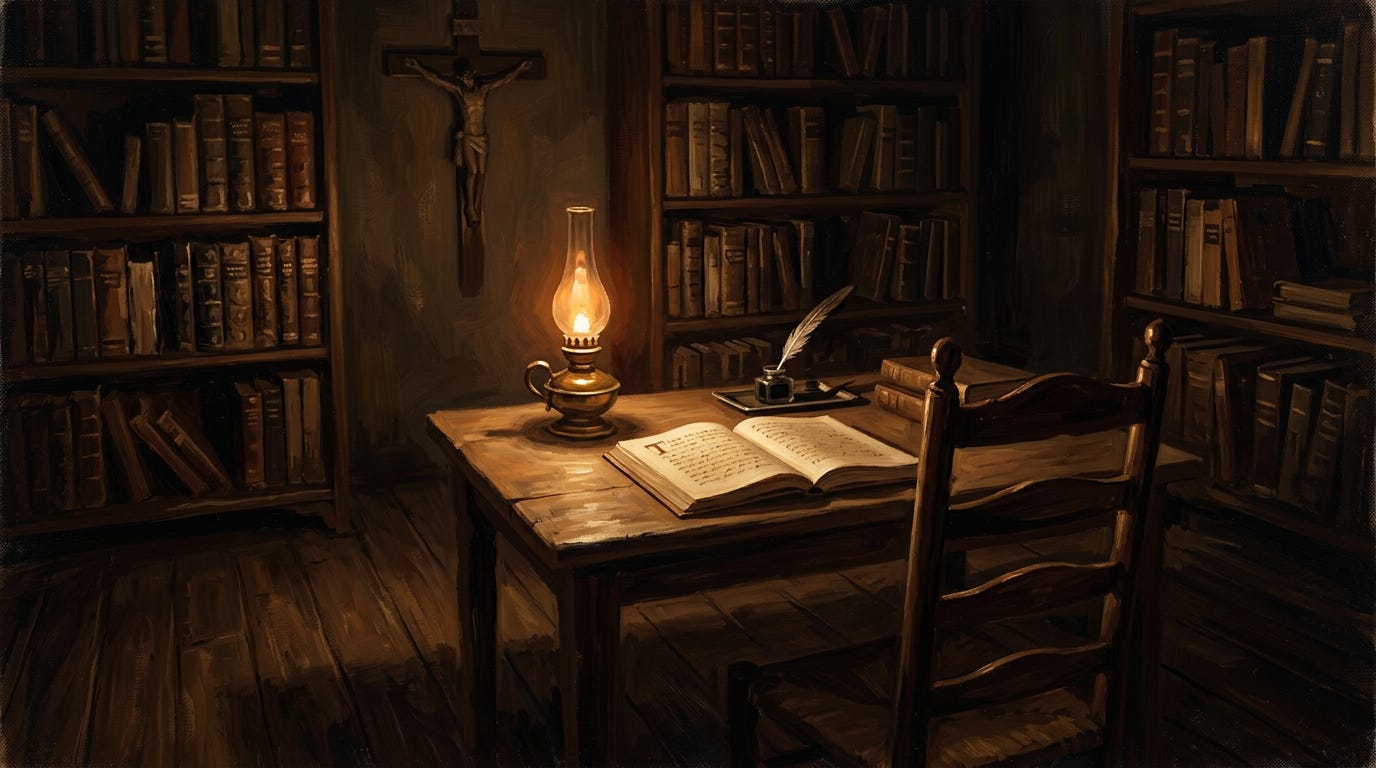
She had not expected company.
The library at Echt was small by the standards of the great houses she had known in her youth, when Husserl’s seminar room in Freiburg had felt like the whole world and the books on the shelves had been weapons in a war she still believed could be won by argument. Here in the Dutch Carmel the books were fewer and the war was different. She had come at half past ten, after Compline, because she could not sleep and because the manuscript on the desk in the corner would not finish itself by being avoided. The summons had come in the afternoon. She and Rosa were to be ready by five. The Gestapo had given them a number of suitcases and a number of kilograms and the freedom to choose what to carry into the rest of their lives.
She lit the lamp.
The man in the white habit was already seated at the desk.
She did not cry out. She was a philosopher before she was anything else, and a philosopher learns early that the first response to the strange is to attend. He was large. That was the first thing. Not tall so much as substantial, the way a column is substantial, with the slow gravity of someone whose body has been organized around stillness. His habit was Dominican, not Carmelite, and old in a way that was not the oldness of wear but the oldness of style, as though the cut of it had been settled before her grandmother was born and several grandmothers before that. His hands were folded on the manuscript. He was reading what she had written.
She closed the door behind her.
“Brother,” she said in Latin, because Latin was the language one used when one did not yet know what kind of encounter one was having, “you are reading my work.”
“I am reading your work,” he said. He did not look up. His Latin was not her Latin. It was older and rougher and at the same time more exact, the Latin of someone who had thought in it rather than learned it. “It is not finished.”
“It will not be finished.”
“No,” he said. “I do not think it will.”
He turned a page. She watched him. The lamp threw his shadow long against the wall of books and she saw, for the first time, that the shadow did not behave the way shadows behave. It was steady where the lamplight wavered. It was, she thought, the shadow of something that did not require this lamp.
She understood then who he was. She did not say his name. To say his name would have been to make a claim about the order of reality that she was not yet prepared to make, and the discipline of phenomenology had taught her to let the appearance disclose itself before she named it. She sat down across from him. The chair was the one Sister Antonia used during recreation. The wood was warm.
“You have come a long way,” she said.
“I have come no distance at all.”
“Then I have.”
“Yes.” He looked up. His eyes were not what she had expected. She had expected the eyes of a scholar, the slight inward focus of a man who has spent his life in books, but his eyes were level and outward and entirely on her, and she felt herself read in a way she had not been read since the last conversation with Husserl, when the old man had looked at her and seen, without saying so, that she was lost to him forever because she had become Catholic. “I have read your Endliches und ewiges Sein,” he said. “Finite and eternal being. You have been generous to me in it.”
“I have been honest in it.”
“That is the same thing, when one is writing about me.”
She almost smiled. “You disagree with parts of it.”
“I disagree with parts of it.”
“Tell me which parts.”
He did not answer at once. He set his hand flat on the manuscript she had been working on, the unfinished pages of Kreuzeswissenschaft, the science of the cross, the study of John of the Cross that the Prioress had asked her to write and that she had not been able to put down even when the world began to come apart around her. He did not look at the pages. He looked at her.
“Tell me first,” he said, “why you wrote this one.”
“You can read it.”
“I have read it. I want to hear you say it.”
She considered the question. She had been asked it before, by sisters who did not understand why she was spending the last good months of the European peace writing about a sixteenth-century Spanish Carmelite when there was so much present darkness to attend to. She had given them all the same answer, which was the true answer, but she had not given the answer to herself.
“Because I do not believe,” she said slowly, “that the intellect is excused.”
He waited.
“I have spent my whole life,” she said, “believing that thinking is a way of loving. That to attend carefully to what is, with the whole power of the mind, is already a form of worship, because what is, is given. I do not think I was wrong. I do not think you think I was wrong.”
“I do not.”
“But I have come to believe also,” she said, “that the intellect is not the last thing. That there is something at the center of the human person that the intellect cannot reach by its own power, and that this something is not a defect of the mind but the place where the mind is overtaken. John calls it the night. I do not know what to call it yet. I am writing the book to find out.”
“You will not finish the book.”
“No.”
“Does that grieve you?”
She thought about it. The lamp wavered. Outside the window, somewhere in the Dutch summer night, a dog was barking at nothing, and farther off a train was moving along the rails toward some destination that she now knew to be also her own.
“It grieves me less than it would have grieved me a year ago,” she said.
“Why.”
“Because I have come to believe that the book is not the work.”
He nodded once, slowly, and she saw something move across his face that she could not name. It was not approval. Approval would have been a smaller thing. It was recognition. She understood, with the part of her that had been a phenomenologist and was still a phenomenologist even now, that this man had said the same sentence himself, on a different night, in a different language, and that he had paid for it.
“December the sixth,” she said. “1273.”
“You know the date.”
“Everyone knows the date. You celebrated Mass and afterward you would not write any more. Reginald asked you why. You said all that I have written seems like straw to me. And then you wrote nothing for the rest of your life, which was not very long.”
“Three months.”
“Three months.”
He was quiet for a while. The shadow on the wall did not move.
“Sister,” he said, and the word was not pious in his mouth, it was exact, “do you know what I saw.”
“No.”
“Neither do I. I saw it and I do not know what I saw. That is the difficulty. The intellect was given what it had asked for and the intellect did not have the capacity to hold it. What I had written was not wrong. I want you to understand that. I have been told, in the centuries since, that some of my readers believe I repudiated the Summa on that morning. I did not repudiate it. I saw what it was for.”
“Straw.”
“Straw is the husk. Straw is what carries the grain to the threshing floor. Straw is necessary and straw is not the bread. I had spent my life writing straw and the straw was good straw and on that morning I saw the grain and after that I could not pretend that the straw was the grain. That was all. It was not despair. It was the opposite of despair.”
She found that her hands were trembling. She put them flat on the desk.
“You are telling me,” she said, “that what I am doing tonight, this manuscript, these pages I will not finish - “
“I am telling you nothing. I am telling you what happened to me. I am not the one to tell you what is happening to you. You will know it yourself, in the morning, when they come.”
“In the morning.”
“Yes.”
She looked down at the pages. Kreuzeswissenschaft. The science of the cross. She had been writing, when the lamp had gone out and she had risen to come down here, about the dark night of the spirit, the second night, the deeper one, in which the soul is stripped not of its consolations but of its capacity to know that it is being held. She had been writing about it because she had been reading John and because she had begun, in the past months, to suspect that she was being asked to live what she was writing about. She had not wanted to suspect this. She had wanted to finish the book.
“I do not want to go,” she said.
“No.”
“I am not afraid. That is not what I mean. I have offered it already. I offered it on the day they told us what was being done to our people, and I have offered it again every day since, and I will offer it tomorrow morning when they put me on the train. I am not afraid of dying. I am afraid - “
She stopped.
“You are afraid,” he said, “that the offering is also straw.”
She looked at him. Her eyes were dry. She had not wept for months. She had used up that capacity somewhere in the spring, when the news from Germany had become unbearable and she had understood that bearing it was now her work.
“Yes,” she said. “I am afraid that the offering is also straw.”
He was quiet for a long time. The lamp burned. Somewhere in the house a sister coughed in her sleep and the sound came faintly through the walls.
“Listen to me,” he said.
She listened.
“I cannot tell you what you will see. I did not see what John saw and John did not see what I saw and you will not see what either of us saw. That is the nature of it. The Lord does not repeat Himself in the souls of His friends. He gives each one her own face of Him, and the face He gives is the face that one was made to see. You will see your own face of Him. I do not know what it will be. I know only that the seeing will not be in the manuscript, and it will not be in the offering, and it will not be in the train, and it will not be in the place the train is going. The seeing will be in Him. The manuscript and the offering and the train and the place are the straw. They are good straw. They are necessary straw. They are not the grain.”
“Then what is the grain.”
“The grain is what He is doing in you. Which you cannot see, because you are inside it. Which I could not see, because I was inside it. Which John could not see, because he was inside it. The seeing comes after.”
“After what.”
He smiled then, for the first and only time. It was a small smile and it did not last.
“After the straw,” he said, “is burned.”
She did not answer. She could not. She sat with her hands flat on the desk and the manuscript between them and the man in the white habit across from her, and she understood that he had not come to comfort her. He had come to refuse to comfort her, which was a different thing and a greater thing, and she understood also that this refusal was itself the comfort, because it was the truth, and because the truth was the only thing left in the room that mattered.
After a long time she said, “Will you stay until morning.”
“No,” he said. “You do not need me to stay. You have John. You have had John for a long time. I came because I wanted to see you. I have wanted to see you since I read your book.”
“You read my book.”
“I read all of them. I read the ones the people write about me. I am curious about myself. Do not tell anyone.”
She almost laughed. She did not, but she almost did, and she understood that the almost was a gift, and that she would carry it with her into the morning, and onto the train, and into the place the train was going, and that he had given it to her on purpose.
“Brother Thomas,” she said.
“Sister Teresa Benedicta.”
“Pray for me.”
“I have been praying for you. I will not stop.”
She looked down at the manuscript. When she looked up, the chair across from her was empty, and the lamp was burning steadily, and the shadow on the wall was only her own.
She sat for a long while. Then she took up the pen.
She wrote until almost four. She did not finish the book. She had not expected to finish the book. She wrote the next paragraph, which was the paragraph she had not been able to write before, about the soul that has been stripped of the certainty of its own offering and is asked to offer anyway, in the dark, without confirmation, on the testimony of nothing but the One who asks. She wrote it cleanly and she did not strike anything out. When she was finished she capped the pen and laid it across the page and went upstairs to wake Rosa.
The Gestapo came at five.
She walked out of the Carmel of Echt into the thin Dutch dawn carrying a small bag, with her sister beside her, and the manuscript stayed on the desk where she had left it, and the grain, wherever it was, was not in the manuscript, and she knew this now, and she walked toward the car without looking back.
In Auschwitz, on the ninth of August, she would die.
In the library, the lamp burned out at dawn, as lamps do.
The shadow on the wall was gone.
For your prayer this week: Saint Thomas Aquinas and Saint Teresa Benedicta of the Cross, you who saw what the intellect cannot hold and offered what the offering could not justify, pray for those of us who are still inside the work, who cannot yet see what He is doing, who are asked to trust the grain we have not seen. Amen.
Two Lamps returns next Friday: Saint Matthias and Saint Joan of Arc, the field below the tower at Beaurevoir, Picardy, autumn 1430.
Two Lamps is a weekly short story braiding the lives of two or three saints across the centuries. Sometimes the meeting is rendered as an encounter in eternity. Sometimes as the older saint coming, in vision or in patronage, to the soul of the younger. The text does not decide for you. The Communion of Saints is the doctrine that holds these meetings as theologically real even when the meeting itself is imagined.
Two Lamps is written by Deacon Michael Halbrook, a permanent deacon of the Diocese of Springfield in Illinois, serving at St. Elizabeth Parish in Granite City. He writes personally at DeaconMichael.net, serves families through Domus Formation, and publishes the serial novel Ordo: A Chronicle of Lux Perpetua at LuxPerpetua.net. Two Lamps is co-conceived with his son Joseph.