

The ledger would not balance.
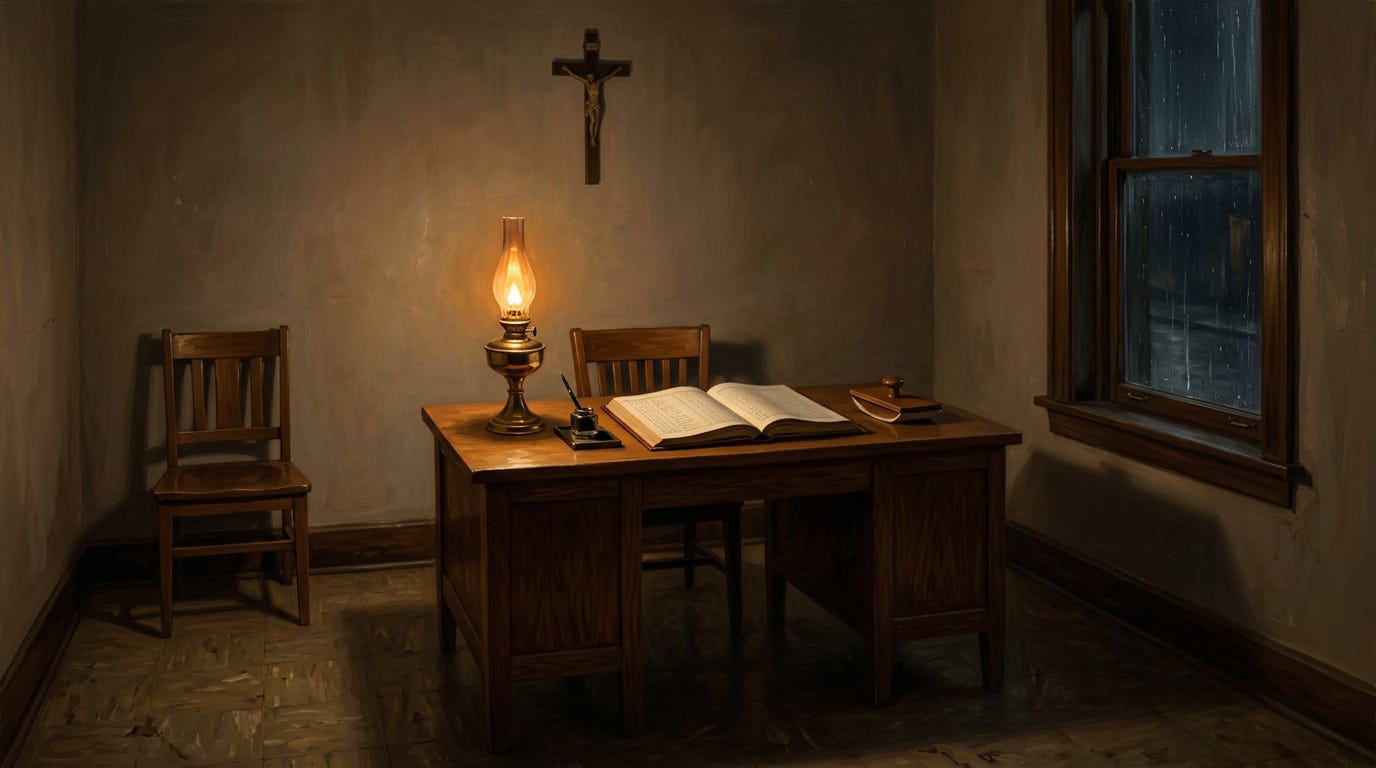
Mother Cabrini sat at the plain oak desk in her office on the second floor of the mother house of the Missionary Sisters of the Sacred Heart, at the corner of Lytle Street in the near west side of Chicago, in the office she had used whenever she was in the city for the past eight years, with the single gas lamp burning at her elbow and the November rain sounding against the window behind her. She had been working on the accounts since after supper. The accounts were for the Columbus Hospital, which she had founded in 1905 and which had expanded three times since. The third expansion, completed the previous spring, had cost more than the estimate. She was looking at the difference now. She had been looking at it for an hour. The difference would have to come from somewhere.
She was sixty-three.
She was tired in the specific way that a foundress is tired who has established sixty-seven institutions in twenty-four years across three continents and who has crossed the Atlantic twenty-four times and who is now the superior general of a congregation with members in Italy, Spain, France, England, the United States, Nicaragua, Argentina, and Brazil, and who is the primary fundraiser for all of these institutions, and who speaks English poorly after twenty-four years in America because she has never had enough time to study it properly, and who is losing weight again. She had been losing weight since the summer. She was not going to lose much more. There was a point at which her body would refuse to continue, and she was close to that point, and she knew she was close to that point. She was not going to slow. The accounts would not balance themselves.
She whispered, in Italian - the language she still thought and prayed in - Signore. Aiutami con questi conti.
Lord. Help me with these accounts.
She heard a soft knock at the door.
She turned her head. She said, in English with her heavy Lombard accent, “Enter.”
The door opened.
A very old woman came into the office.
The woman was perhaps eighty, bent and thin, in a plain dark habit that Mother Cabrini did not immediately recognize as either Sacred Heart or any of the other congregations she knew. The habit was French in cut, early nineteenth century, worn smooth at the sleeves from many years of use. A plain wooden crucifix on a long cord hung at her waist. Her face was deeply lined. Her hands were worn with the kind of work that women religious do in frontier missions - chapped from washing dishes in cold water, calloused from gardening, veined from age and hard use. Her eyes were very clear. She was smiling.
Mother Cabrini rose from her desk.
She knew the face. She had seen it in a small lithograph in a book about the American missions that one of her sisters had brought from France ten years earlier. The old woman in the lithograph had been standing in front of a log building in frontier Missouri. The caption had said Mère Duchesne, fondatrice. Mother Cabrini had kept the book. She had read it twice.
She whispered, in French - the language she had learned imperfectly during her two years in France in her thirties - “Ma Mère. Vous êtes Duchesne.”
Mother. You are Duchesne.
Rose Philippine Duchesne inclined her head.
“Je suis Duchesne. Ma chère Francesca. Puis-je m’asseoir? Je suis vieille et j’ai fait un long chemin ce soir.”
I am Duchesne. My dear Francesca. May I sit? I am old and I have come a long way this evening.
Mother Cabrini gestured at the chair opposite her desk. Duchesne crossed the office slowly - she had the careful walk of a very old woman who has learned not to trust her balance - and lowered herself into the chair with a small sigh. She folded her hands in her lap. She looked at Mother Cabrini for a long moment.
“You have been working on accounts,” Duchesne said, in a careful French that she was speaking slowly for Mother Cabrini’s sake.
“Yes. The hospital expansion. The estimate was too low. I am trying to find where the difference will come from. I will find it. I always find it. But tonight I am tired and the finding is slower.”
Duchesne nodded.
“I spent forty years finding the differences. Not on the scale you are working at - my institutions were small frontier schools and I had three of them at the most - but the finding is the same work. One prays. One writes to benefactors. One cuts back on one’s own meals. One finds. The Lord does not always make it easy. He makes it possible. There is a difference. The difference between easy and possible is the space in which founders live.”
Mother Cabrini laughed once - a short tired laugh, the laugh of a woman who had heard something she had thought herself and had not expected to hear from someone else.
“The space in which founders live. Yes. I will remember that.”
“Good. I came because you have been praying for some help tonight. The Lord sent me. I am not sure why me in particular - He has many foundresses available to send. Perhaps because you and I are a specific kind of foundress. We both wanted to go somewhere else. We were both sent here. We have been serving a country that was not our own for most of our vocational lives. That is a specific vocation. Not every foundress has it. You and I have it.”
Mother Cabrini sat back in her chair.
“You wanted China,” she said.
“I wanted China. Since I was eight years old. I had read a book about the Jesuit missions in China and I had decided, at eight, that I would go to China as a missionary. I entered the Visitation convent at seventeen partly with that idea still in me. The French Revolution closed the convent before I could pursue it. I was dispersed for twelve years. I rebuilt. I joined the Society of the Sacred Heart at thirty-five. I continued to want China. Mother Barat permitted me to come to America when I was forty-nine. I came to Louisiana first, then to Saint Charles in Missouri. I spent the next thirty-four years in America. I never saw China. In my seventy-first year I was permitted to go to the Potawatomi in Kansas for one year. The children I taught there did not speak French. I did not speak Potawatomi. They called me Quah-kah-ka-num-ad - the woman who prays always - because when I could not teach, I knelt in the chapel and prayed. The praying was my work for that year. I did not do much else. I was sent back to Saint Charles after a year. I died at Saint Charles at eighty-three. I never went to China. You wanted China also. The Lord sent you here. I want to say to you what I wish someone had said to me earlier: the wanting of China was not wrong. The not-going was not a failure. The Lord uses the wanting to send us where He actually needs us to go. The wanting is the beginning. The going is His to direct. We do not pick the going. We only pick the wanting.”
Mother Cabrini was quiet for a while.
She had been told, by various spiritual directors over the years, that her redirection to America had been providential and that she should not grieve China. She had accepted this intellectually. She had never entirely accepted it in her heart. She had continued to want China for twenty-four years in America. She had not said this to anyone. Duchesne was saying something more useful than the spiritual directors had said. Duchesne was saying that the wanting was not the mistake. The wanting was part of the sending. The two were connected.
She said, softly, “I have founded institutions in eight countries. I have crossed the Atlantic twenty-four times. I have not gone to China. I would still like to go to China.”
“I know you would. You will not go. You have perhaps four more years. The four years will be spent between here and Italy, with brief visits to your houses in Latin America. You will not go to China. The Lord will arrange China through others. Your Missionary Sisters will reach China in the 1920s, after your death. They will serve there for many decades. The reach of your congregation will be as the Lord arranges it. He does not need you to go personally. He needs you to found. The founding is what you were made for. The sending is what He does.”
Mother Cabrini bowed her head.
She was not weeping. She had rarely wept in her life. She was, however, very still, in the way she became still when something important was being said to her and she wanted to receive it without interference.
After a while she said, “Ma Mère. Tell me about the finances.”
Duchesne smiled.
“The finances were always difficult. I established the Saint Charles school in 1818 with almost nothing. The log cabin we taught in had gaps in the walls and the children wore shawls indoors in winter. I wrote letters to France begging for funds. The letters took six months each direction. I was often several hundred dollars in debt. I never defaulted. The Lord sent what was needed at the moments it was needed. He did not send surplus. He sent enough. I came to understand, in my decades at Saint Charles, that enough is what He gives. Surplus is a trap. Surplus makes a foundress believe that she is managing well. Enough keeps her on her knees. You have been on your knees for twenty-four years. Stay on them. The accounts will balance. Not because you are clever. Because He sends enough. Tonight He will send a benefactor to your office tomorrow with a donation that will cover the hospital difference. I am not permitted to tell you the name. I am permitted to tell you that the donation will come. Do not worry the accounts further tonight. Go to bed. Tomorrow will bring what you need.”
Mother Cabrini laughed again - a longer laugh this time.
“Ma Mère. You are being very practical.”
“I was a frontier foundress. We were all practical. Impractical foundresses do not last on the frontier. I lasted thirty-four years. I was practical. I am still practical, in the room where I am. Being dead has not made me mystical. It has made me more practical. I see more clearly from where I am now what the Lord is actually doing. He is doing practical things. He is sending benefactors tomorrow. Trust Him. Go to bed.”
“I will go to bed.”
“Good. Before you go I want to say two more things. May I say them.”
“Please.”
Duchesne leaned forward slightly. The oak desk was between them. The gas lamp was casting warm light on both their faces.
“The first: you will die on the twenty-second of December, 1917, in Columbus Hospital. The one you founded. You will die in the small room on the third floor that you have reserved for your own use when you are in Chicago. You will die of a fever that your body, worn down by thirty-eight years of founding, will not have the strength to resist. You will be sixty-seven. You will die in Advent, in the week before Christmas, at six in the afternoon. Your sisters will find you. They will have known for some time that it was coming. You will not be surprised. You will be ready. I want you to know this so that you may prepare interiorly in the time remaining. Four more years. You will spend them well.”
Mother Cabrini nodded slowly.
Duchesne continued.
“The second: you will be the first United States citizen to be canonized. Pope Pius XII will canonize you on July 7, 1946, in Rome. I was canonized in 1988 by John Paul II, so I will have been waiting for you in the room for twenty-nine years by that time, and I will clap when the announcement comes. That is not a dignified thing for a saint to do. I do not care. I will clap. You are an immigrant to America, like me. The country you did not entirely want to be in will claim you first. This is one of the Lord’s quiet ironies. You wanted China. You got America. America will make you its first canonized citizen. The Church will declare you patroness of immigrants. Your name will be known in every immigrant parish in the United States for at least the next hundred years. You did not engineer this. You simply founded institutions and loved the people the Lord sent to them. He has done the rest. I have come tonight to tell you that He will continue to do the rest. Do not try to manage the reception. Manage the accounts. Manage the sisters. Manage the next hospital. The reception is His to arrange.”
Mother Cabrini was weeping now. She had not expected to weep. She wiped her eyes with the handkerchief she kept in the sleeve of her habit. Duchesne waited. Duchesne had taught small frontier children in Missouri for thirty-four years and she had learned to wait while a strong woman wept briefly and composed herself.
After a few minutes Mother Cabrini said, “Ma Mère. I did not know.”
“You did not need to know. You know now. Use it well. Four years is enough to prepare. You will do it. You have been preparing for this death your whole life without knowing you were preparing. The preparation is almost complete. These last four years are the final sanding of the wood. The piece is almost finished.”
“Thank you.”
“You are welcome. I am going to rise now. Before I rise I want to bless you. May I?”
“Please.”
Duchesne rose slowly from the chair. She came around the desk. She laid her thin old hand on Mother Cabrini’s head and she blessed her in the French of the Society of the Sacred Heart, in the formula Mother Barat had taught her in 1804.
“Que le Sacré-Cœur de Jésus vous bénisse et vous garde. Que son amour vous soutienne. Qu’il vous conduise jusqu’au bout. Ma sœur. Amen.”
May the Sacred Heart of Jesus bless you and keep you. May his love sustain you. May he lead you to the end. My sister. Amen.
Mother Cabrini closed her eyes.
When she opened them the chair was empty.
The rain was still sounding against the window. The gas lamp was still burning. The ledger was still open on the desk with its unbalanced numbers.
Mother Cabrini sat still for perhaps two minutes.
Then she closed the ledger. She put it in the drawer. She rose from the desk. She extinguished the gas lamp. She walked down the corridor to her bedroom. She said her evening prayers briefly. She went to bed.
In the morning she rose at five. She said Mass in the mother house chapel at six. She ate her breakfast. She returned to her office. At eleven in the morning a Mr. Giovanni Battista Caruso, an Italian-born grocer who had made a small fortune supplying produce to several Chicago hotels, arrived unannounced at the mother house asking to see Mother Cabrini. He explained, in Italian, that his wife had died at Columbus Hospital three months earlier and that she had been treated with such kindness by the sisters that he wished to make a donation in her memory. He named a figure that covered the hospital expansion difference with a modest surplus. Mother Cabrini thanked him. She did not mention that she had been told the night before that he would come.
She continued her work.
She spent the next four years founding more institutions, visiting her existing institutions, crossing the Atlantic three more times, and gradually losing the weight her body had already begun to lose that November. She died on December 22, 1917, at Columbus Hospital in Chicago, in the room on the third floor she reserved for her use. She was sixty-seven. She died at six in the afternoon on a Saturday, in Advent, exactly as Duchesne had said. Her sisters found her. They had known for some time that it was coming. She was not surprised. She was ready.
She was beatified on November 13, 1938, by Pope Pius XI. She was canonized on July 7, 1946, by Pope Pius XII, the first United States citizen ever to be declared a saint, exactly as Duchesne had said. She was declared patroness of immigrants on September 8, 1950. Her relics are preserved at the Cabrini Shrine at Mother Cabrini High School in Washington Heights, New York. The Missionary Sisters of the Sacred Heart now serve in seventeen countries, including China, where they arrived for the first time in 1926, nine years after Mother Cabrini’s death. Her feast is November 13.
Saint Rose Philippine Duchesne, in the room where she is, continues to visit immigrant foundresses who are working on accounts that will not balance. The list is long. It grew throughout the twentieth century as the American Church absorbed waves of immigration. It continues to grow. Rose Duchesne was canonized on July 3, 1988, by Pope John Paul II. When Mother Cabrini had been canonized forty-two years earlier, Duchesne had clapped in the room, as she had promised. It was not dignified. She did not care. The two foundresses have continued, in the arrangements that eternity permits, to compare notes about the specific difficulties of founding Catholic institutions in a country that one did not entirely want to be in. They have found much to discuss. They have found much to laugh about. The laughing is long. The laughing continues.
The gas lamp in the office at the mother house in Chicago burned out at dawn, as lamps do, on the morning after Duchesne’s visit.
Mother Cabrini woke at five.
The benefactor arrived at eleven.
The accounts balanced.
For your prayer this week: Saints Frances Xavier Cabrini and Rose Philippine Duchesne, you who wanted China and were sent to America, you who crossed oceans and died in countries not your own, you who founded institutions that still serve immigrant communities a century and more later, pray for those of us who are running institutions whose accounts will not balance, and for those of us who are serving in places we did not choose. Grant us the grace to know that the wanting is not the mistake, that the sending is His to arrange, and that the enough He sends is sufficient for the day. Amen.
Two Lamps returns next Friday: Saints Margaret of Scotland & Elizabeth of Hungary, Elizabeth’s hospital at Marburg, an autumn evening in 1230.
Two Lamps is a weekly short story braiding the lives of two or three saints across the centuries. Sometimes the meeting is rendered as an encounter in eternity. Sometimes as the older saint coming, in vision or in patronage, to the soul of the younger. Sometimes as two friends meeting in one life. The Communion of Saints holds them all as one company.
Two Lamps is written by Deacon Michael Halbrook, a permanent deacon of the Diocese of Springfield in Illinois, serving at St. Elizabeth Parish in Granite City. He writes personally at DeaconMichael.net, serves families through Domus Formation, and publishes the serial novel Ordo: A Chronicle of Lux Perpetua at LuxPerpetua.net. Two Lamps is co-conceived with his son Joseph.
Thank you for your splendid stories…every Friday, all 10 of us enjoy them with such joy in our hearts