

He was nearly blind.
Francis had been nearly blind for some months now, since the failed treatment at Rieti where the doctors had cauterized his temples with a hot iron in the hope of saving what was left of his sight, and the treatment had not worked. He could see shapes. He could see the difference between day and evening. He could not read, which mattered less than it would have mattered to another man, because he had always cared more for what was sung than for what was written. He could not see the wounds on his hands clearly anymore, which mattered more, because the wounds on his hands and his feet and his side were the last gift he had been given, and he had liked to look at them, and now they were a presence he felt rather than saw.
He was sitting on the straw mat in the small cell that Brother Leo had prepared for him on the side of the mountain at La Verna. He had asked to be brought up here for one more visit before the end. The brothers had not wanted to bring him - the climb was hard, and the autumn was coming, and he was forty-four years old in a body that had been used as he had used it - but he had asked, and they had not been able to refuse, and so they had carried him up the steep path on a litter, with the September air thinning as they went, and the wind carrying the first cold of the season off the higher peaks. He had wept when they reached the top. He had not been able to help it. La Verna was where the wounds had come, two years ago. The mountain was where the Lord had finished writing on him.
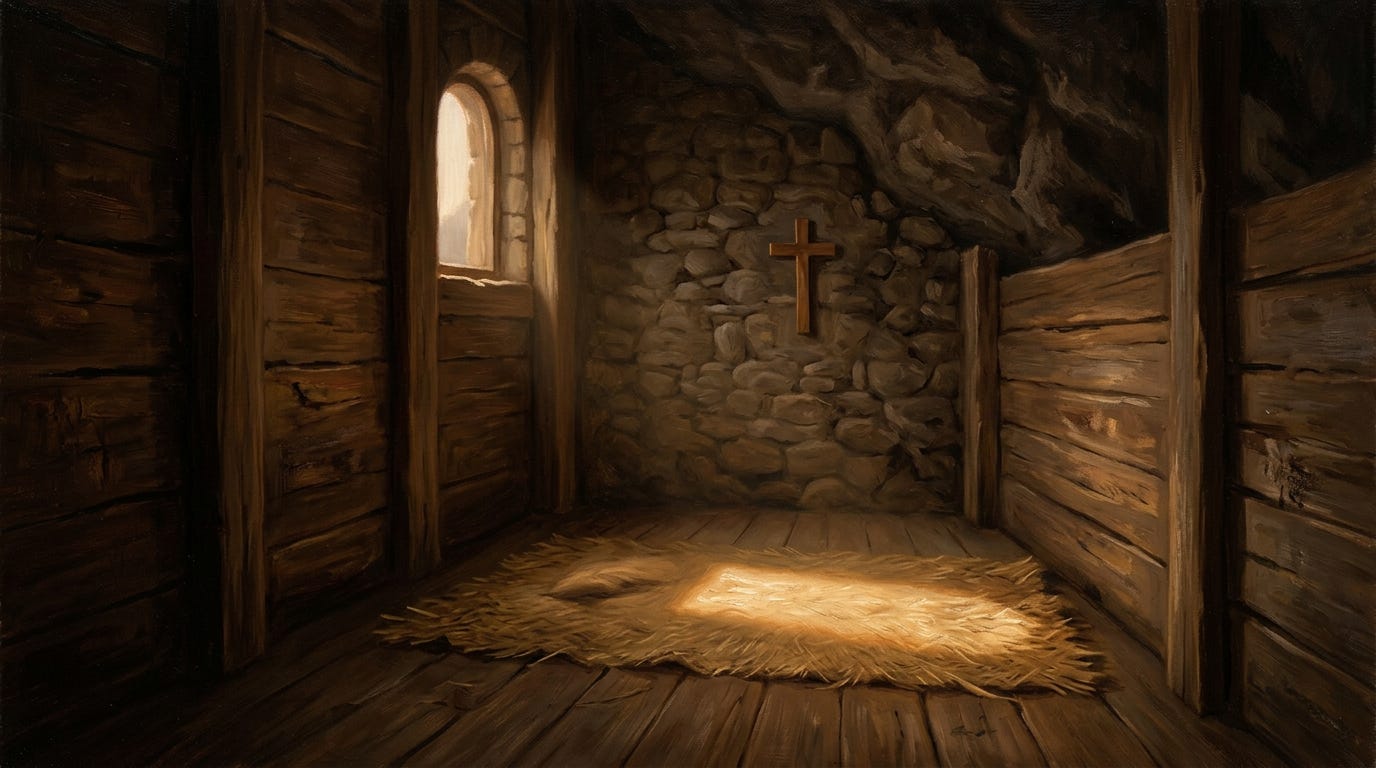
The cell was simple. One wall of unmortared stone, set against the larger rock of the mountainside. Three walls of rough plank. A wooden door with a leather hinge. A small high opening that served as a window. A straw mat. A wooden cross on the wall, plain, perhaps a hand’s span. Nothing else. Brother Leo had wanted to bring up a bench for him. He had refused the bench. He sat on the mat, with his back against the stone, and he could hear, beyond the cell, the wind in the firs, and far below the cell the sound of the small bell from the church where the brothers were beginning Vespers, and beyond all of that the long evening silence of the Casentino valley as it ran out toward the east.
He did not see the man come in.
He heard the door, and he heard the small movement of a body settling onto the floor of the cell, and he turned his face toward where the sound was, and he saw the shape of a man in the dim light, sitting cross-legged on the floor across from him, and he could not make out the features of the man’s face because he could not make out the features of any face anymore, but he could make out that the man was wearing a long pale tunic, and that the tunic was belted with a wide cloth band, and that the cut of the tunic was old. Older than any tunic he had seen, in his life of seeing tunics in the streets and farms and chapels of Italy. He had spent his life among many cuts of cloth. This was an older cut.
“Brother,” Francis said softly, in Umbrian.
The man answered in Latin.
“Brother.”
His Latin was not the Latin Francis had been hearing for forty-four years. It was the Latin of someone for whom Latin had been a living tongue rather than a learned one. There was a Roman directness in it, and beneath the Latin there was something else, perhaps Greek, perhaps Aramaic, the way old languages sit in the bones of a man even when he is speaking a different one. Francis listened to the texture of the voice for a moment. He knew, without being able to see the face, that he was being visited.
“I cannot see you well,” Francis said, still in Umbrian, because his Latin was not strong and because he wanted to be honest about what he had to work with. “My eyes are not what they were.”
“That does not matter,” the man said. He spoke Umbrian also now, easily, although the underneath of his voice was still the older language. “We are not meeting for the seeing.”
“For what, then.”
“For the recognition. The recognition does not need eyes. The recognition is older than eyes. It is what one deacon gives to another.”
Francis sat very still.
He had been a deacon for sixteen years. He had never been ordained priest. The Bishop of Assisi had ordained him to the diaconate in or around 1210, when the brotherhood was small and Francis was still in his twenties, and the bishop had asked him after the ordination whether he wanted to continue toward the priesthood, and Francis had said no, and the bishop had not pressed. Francis had stood beside many priests of his order at many altars in the years since. He had served the Eucharist. He had read the Gospel. He had preached. He had baptized when there was no priest. He had buried the dead. He had washed the feet of lepers in the way the deacons in Rome had once washed the feet of the poor at the basilicas. He had thought about the office often. He had not been ordained beyond it.
The man across the cell was waiting.
“You are a deacon,” Francis said.
“I was a deacon. I am still, in the place where I am now. They do not unmake a deacon any more than they unmake a baptism.”
“What is your name.”
“My name is Lawrence. I lived in Rome. I served Bishop Sixtus, who was the Pope, in the third century after Our Lord. I was killed by the prefect Valerian’s men in the year that you would call two hundred and fifty-eight. I have been waiting for some while to come and see you. The Lord has finally given the leave.”
Francis closed his eyes. He did not need them open for the moment that was happening. He sat with his eyes closed and he felt, through the worn fabric of his habit, the wall of the mountain pressing against his back, and he felt the strange peace that had been in him intermittently for the past two years since the wounds had come, the peace that was not the absence of pain but a different kind of presence with the pain. He understood that this man across from him in the cell - this old Roman deacon who had been a young man when he died, almost a thousand years before the brotherhood at Assisi had been founded - was here in the way the saints come, which is the only way they come, which is in the eternal now of the One who had sent both of them.
“Brother Lawrence,” he said.
“Brother Francis.”
There was a long silence. Outside the cell the small bell at the church had stopped. Vespers was beginning. The brothers would be singing the Deus in adiutorium meum intende now, and Francis could just hear, faintly, the line carried up the mountain on the autumn air, and he was glad to hear it. He had spent his life loving that line. O God, come to my assistance. It was the line a deacon could pray any moment of any day and it would be the right line.
“You can hear them,” Lawrence said.
“Yes. I cannot see them. I can hear them. The hearing has been enough for some time now.”
“Yes.”
“Why have you come now. To this cell. On this mountain.”
“Because you are about to go home, brother, and I wanted to come and sit with you before you do, because I have been a deacon waiting to talk to another deacon for nine hundred and seventy years, and you are the one I have wanted to talk to. There were others I could have come to. You are the one I came for.”
Francis was quiet.
“Why me,” he said.
“Because you understood the office.”
“Many have understood the office.”
“Many have held the office. Few have understood it. You understood it from the beginning. You did not become a priest because you understood the office. You stayed in it because you understood that it was its own thing, and that the Lord had ordained certain men to be deacons forever, and that the diaconate was not a step on a stair. You understood that. You lived inside the understanding for sixteen years. You are dying inside the understanding. I came because that is rare, and because when it is found it deserves to be visited.”
“You did the same.”
“I did. In a different way. Tell me how you did it. I would like to hear about it from you.”
Francis sat for a moment with his hands folded in his lap. He could feel the wounds in his palms. They were quiet today. They were sometimes loud and sometimes quiet. He had learned not to ask why. He had learned, in the past two years, that the wounds had a life of their own and that his job was to carry them and not to interrogate them.
“I will tell you,” he said. “I will tell you in the way a man tells things who is no longer a young man. I learned the office slowly. I did not understand it at the beginning. I thought, when I was first ordained, that the diaconate was the threshold. I was waiting on the other side. I was preparing for what would come next, which I assumed would be the priesthood, because that is what the bishops thought of when they thought of orders, and I had not yet learned to think with my own head about it.”
“What changed.”
“The lepers.”
“Yes.”
“I had been told, before I was ordained, to go to the lepers. The Lord had told me. I had told no one else, because the telling no one else was part of what He had asked. I went to the lepers. I washed them. I ate with them. I held their hands when they were dying. I did this for several years before the brotherhood began. I was not yet a deacon when I began. But when the bishop ordained me, and when I knelt in front of him, and when he laid his hands on my head, I understood, with a part of me that had not understood it before, that what he was ordaining me to was what I had already been doing. The office was not a future thing I was being prepared for. The office was the form of what I had been given to do, given a name. Deacon is the name for the man who washes the lepers.”
“Yes.”
“That is what I learned. That is what I have been carrying for sixteen years. The deacon is the man who is set aside to serve the bodies of the people, because the people have bodies that need serving, and the priest is set aside for the altar, and the bishop is set aside for the office, and they are not the same offices, and they are not steps. They are three different gifts. The deacon’s gift is the body. The bread, when he carries it, is the body. The leper, when he washes him, is the body. The dead, when he buries them, is the body. The office is the body. That is what I learned.”
Lawrence was quiet for a long time.
When he spoke, his voice was different than it had been. The dry Roman directness was still there, but there was something underneath it, something shaken, the way the voice of a man becomes shaken when he has heard, late, what he has been waiting to hear for a thousand years and did not know whether anyone living would ever say.
“I learned the same thing,” he said.
“Yes.”
“Differently. In a different shape. I did not have lepers. I had the poor of Rome. I had the orphans, and the widows, and the men who slept against the walls of the city and were beaten by the soldiers. I had the food stores of the church, which the Pope had given me to administer. I had the gold and the silver of the basilicas, which the Pope had given me to keep. When the prefect demanded the treasures of the church I gathered the poor of the city and presented them to him. I said here are the treasures of the church. The men around the prefect laughed. They thought I was making a joke. They did not understand that I had given him exactly what he had asked for.”
“You were grilled.”
“I was. The story was true. I was tied to a gridiron over a slow fire. I lived for some hours. Toward the end I told the executioner, I am cooked on this side, turn me over, because I had decided that if I was going to die I would die a deacon, which is to say a servant, which is to say a man who is willing to be useful even while being burned. The line has been remembered. I do not know whether the remembering is a kindness or not. The line was a small joke. It was the kind of joke a deacon can make, because a deacon has been ordained to a kind of practical humor about bodies. The body is useful. The body is the gift. Even the burning body. Even that is the gift. That is the thing I learned, brother. That is what I came to tell you. We are the men of the body. We are the office that says the flesh is good. We are what the Church has when it needs to say to the world we have not forgotten that the bread is real and the wounds are real and the burning is real. We are the office of the real.”
Francis bowed his head.
He did not weep. He had wept easily in his youth and he wept less easily now, in his last weeks, because the body that wept had become a body that was tired. But something behind his face moved, and he sat for a long while with his head bowed, and Lawrence did not speak, and the bell at the church far below began to ring the small bell at the end of Vespers, and the autumn evening came further down on the mountain.
After a while Francis raised his head.
“Tell me one thing more,” he said.
“Tell me what you would like to know.”
“The line on the gridiron.”
“Yes.”
“It was a joke.”
“It was a joke. It was a small joke at my own expense, in front of men who were killing me, because I had lived my whole life as a deacon and a deacon is a man who serves at the table, and the Lord had decided that my last service would be to be cooked on a table, and I thought, if this is the table I am to serve from, then I will serve. The joke was the service. The joke was a way of saying to the men around me, you do not understand what you are doing. You think you are killing a Roman official. You are cooking a deacon. The deacon is happy to be of use. I do not know whether they understood. I think the executioner understood, near the end. I think he was grieved by what he had done. I have hoped, in the centuries since, that the joke was a small kindness to him. The joke was for him. The joke was the last thing I had to give.”
“Yes.”
“I tell you because I think you also have made jokes when you were dying. I think you will make some more. The diaconate is the office of the practical joke. The joke is part of the office. Do not forget that, brother, in the next weeks. The Lord wants you to keep the humor. The humor is also the body. The body is funny. The body is also funny. We are not Manicheans. We do not solemnize what is meant to be received with gladness.”
Francis smiled then.
It was a small smile and it did not last long, because his face was tired and the smiling was an effort that the tiredness made hard, but the smile happened. It was the first smile he had managed that day. Lawrence saw it, although Francis could not see Lawrence seeing it, and Lawrence smiled also, and the two deacons sat in the small cell on the mountain in the autumn evening and the wind moved in the firs outside, and the bell at the church below had finished ringing now, and the brothers were dispersing for the small evening meal, and Francis could just hear the sound of their feet on the stone path, going down.
“You will go now,” Francis said.
“I will go now. I have given you what I came to give. I have heard what I came to hear. I will be near you in the next weeks. You will not see me. You will know I am there. The deacons of the Church gather around the deacons of the Church when they go home. We are not many in any given century. We are many across the centuries. We will be there.”
“Brother Lawrence.”
“Brother Francis.”
“Pray for the brothers.”
“I will. I have been. I will not stop.”
“Pray for the ones who come after. The deacons. The ones who will be ordained to this office in centuries we cannot see.”
Lawrence was quiet for a moment.
“I have been praying for them,” he said. “I will tell you something. I have been praying for them more recently than I had been praying for them before. Something is happening in the Church about the diaconate. I cannot see all of it. I see only what I am given to see. There will be deacons in the centuries to come who are not on the path to the priesthood, who are ordained to this office for life, who will hold what we hold. They will be men who do other work also - tradesmen, scholars, fathers of families - and they will come to the Church on a Saturday morning to be vested for an early Mass and they will go back to their families on a Saturday evening to make a meal. They will baptize. They will preach. They will bury. They will wash the lepers of their own centuries, although the lepers will look different. They will hold the office. The Lord has been preparing it. The Lord has been preparing them. I have been told I may say this to you. The office does not end with you and me. The office goes on. The deacons of the centuries to come are already being prepared. Some of them are being prepared in their cradles tonight. Some of them are being ordained tomorrow morning. Some of them are old. Some of them are not yet born. They are ours, brother. They are the office continuing. Pray for them.”
“I will.”
“Brother.”
“Brother.”
The man rose. Francis heard the small movement of him rising, and he heard the soft sound of the leather hinge as the door opened, and he heard the door close, and when he turned his head toward the place where the man had been there was nothing - or rather, the straw mat across from him had a small flattened place in it, the shape of where someone had been sitting, but he could not tell if the flattening was the shape of a man or only the shape of where the dust had not quite settled. He could not see well enough to tell. He did not need to tell.
He sat for a long while.
After a while Brother Leo came up the path with the small evening meal on a wooden board, and Francis heard him at the door, and he turned his face toward the door, and he said to Brother Leo, very quietly, come in, and Brother Leo came in, and Francis ate the bread and drank the small portion of wine that was the rule of the place, and he asked Brother Leo if he would sing one verse of the Canticle of the Sun before he left, and Brother Leo did, in the quiet voice he used when his master was tired, and Francis listened with his eyes closed, and when the verse was finished he asked for the bell to be rung at Compline as it always was, and he lay back on the straw mat, and he slept.
Five weeks later, on the evening of the third of October, in the year of our Lord 1226, at the small portiuncula chapel near Assisi, with the brothers around his bed and the larks crying overhead in the dusk, he died.
He was forty-four years old.
He had been a deacon for sixteen years.
The diaconate was honored that night by the larks, who were birds Francis had loved, and who had a small custom of their own at his death, which the brothers wrote down later because the custom was unusual, and which was their small return for what he had done for them over the years.
The deacons of the centuries to come are already being prepared.
The office goes on.
In the small cell on the mountain at La Verna, the wooden cross on the wall darkened slightly as the autumn evening came in. The straw mat held the shape of where a body had been. The shape stayed for a while. Then the shape went.
The lamp in the church far below burned out at dawn, as lamps do.
The deacons of the Church watch over their own.
For your prayer this week: Saint Lawrence of Rome and Saint Francis of Assisi, you who served the bread and you who served the lepers, you who were grilled in Rome and you who bore the wounds at La Verna, pray for those of us who have been ordained to the office of the body and who are still learning what the office means. Grant us your gladness and your practical humor and your love of the real. Pray for all who hold this office now, and for all who will hold it in the centuries to come. Amen.
Two Lamps returns next Friday: Saint Thomas the Apostle and Saint Alphonsa of the Immaculate Conception, the small infirmary cell at the Franciscan Clarist convent at Bharananganam, Kerala, India, an evening in late July 1946.
Two Lamps is a weekly short story braiding the lives of two or three saints across the centuries. Sometimes the meeting is rendered as an encounter in eternity. Sometimes as the older saint coming, in vision or in patronage, to the soul of the younger. The text does not decide for you. The Communion of Saints is the doctrine that holds these meetings as theologically real even when the meeting itself is imagined.
This issue is published on Friday, June 26, 2026 - the fifth anniversary of the author’s ordination to the permanent diaconate. The pairing of two great deacon saints is the small private mark of that anniversary, written in their company. Brother Lawrence and Brother Francis, pray for me, and for all my brother deacons.
Two Lamps is written by Deacon Michael Halbrook, a permanent deacon of the Diocese of Springfield in Illinois, serving at St. Elizabeth Parish in Granite City. He writes personally at DeaconMichael.net, serves families through Domus Formation, and publishes the serial novel Ordo: A Chronicle of Lux Perpetua at LuxPerpetua.net. Two Lamps is co-conceived with his son Joseph.