

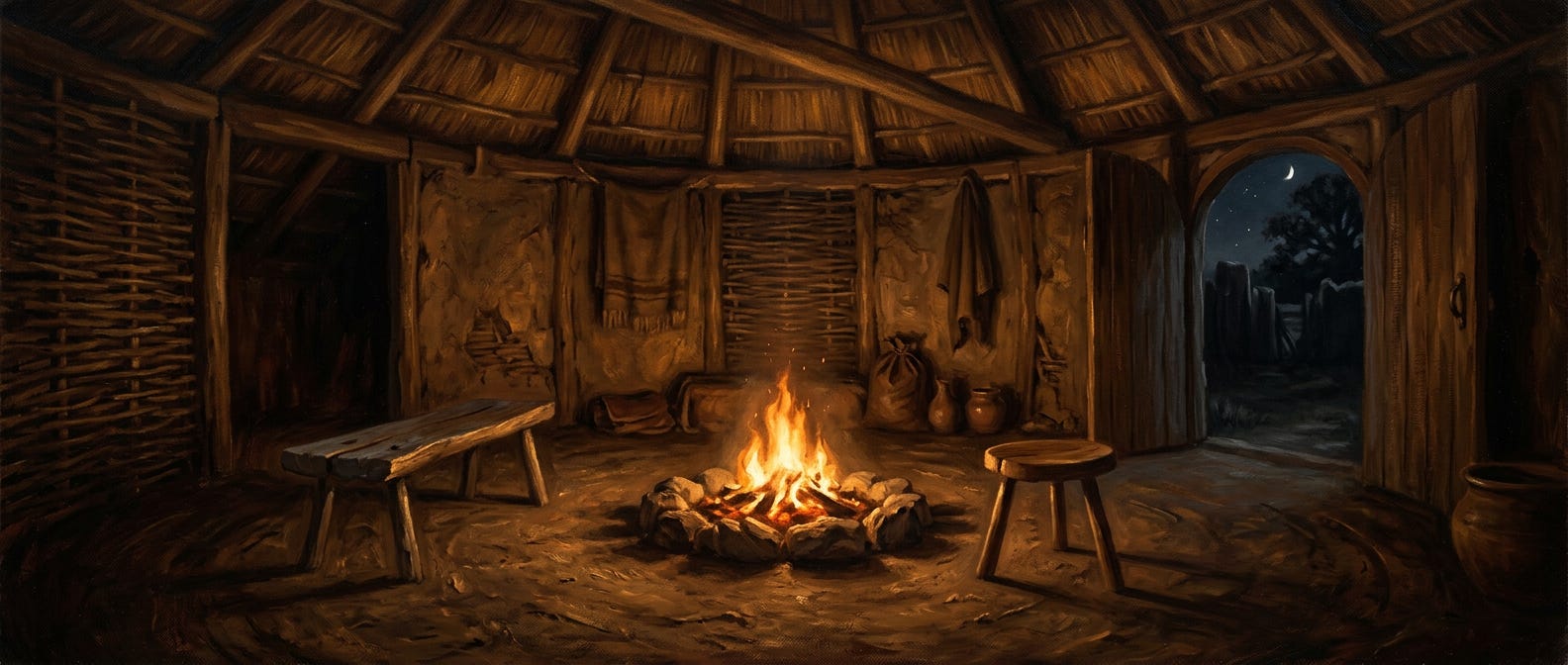
The fire was burning.
Brigid sat on the low wooden stool in the small round hut beside the perpetual fire, in the enclosure that the women of the community had built for it a long time ago now, and she watched the flames the way one watches something that has been alive as long as one has and that has not yet stopped being alive. The fire had been burning for many years. The sisters kept it in turns, nineteen of them, each taking a night, and the twentieth night was hers - though tonight the twentieth night had come round and she was here without a sister, because the young sister who would have relieved her had a fever and had asked to be excused, and Brigid had said yes gladly because she liked to sit alone with the fire on the nights when she could. She was seventy-three years old, or perhaps seventy-four - she had never been quite sure of the year of her birth - and she had lived to see her small oratory at the church of the oak become a great double monastery with a scriptorium and a hospice and a school for the children of the poor, and she had lived to see the plains of Kildare filled in the spring with pilgrims who came to her from every province of Ireland, and she had lived to see a way of life for women rooted in this island where no such way of life had been imagined a generation before. She was, she thought, near the end. The physicians told her she had months, not years. She had told the physicians she was not counting. She had let them believe what they wished to believe.
The fire crackled softly.
Beyond the round hut she could hear the small sounds of the monastery settling into its night - a low chant from the men’s oratory across the enclosure, the last calling of a lamb from the byre near the well, the wind in the great oak tree that stood at the center of the enclosure and that had given the place its name, Cill Dara, the church of the oak. She loved the oak. She had chosen the site because of the oak. The druids of the older Ireland had considered the oak sacred, and she had known when she chose the ground that she was choosing ground the pagan Irish already loved, and she had thought - as she had thought many times in her long life - that the Lord did not mind. The Lord had spent His public ministry among people who already loved certain trees and certain wells and certain hills, and He had not asked them to stop loving those things but had asked them only to see, in the loving of them, that they were already loving Him without knowing His name. The oak was hers now and the Lord’s. The oak was fine.
A man was standing in the doorway of the round hut.
She had not heard him come across the enclosure, and the guard-sister at the outer gate would not have admitted a stranger at this hour without waking her first, and yet a man was standing in the doorway, framed against the last twilight, in a rough dark tunic gathered at the waist by a cord. He was not tall. He was perhaps in his mid-forties. His hair and beard were dark and beginning to grey. His feet were bare and dusty. He looked like a man who had walked a great distance to arrive at her door, which was not, in itself, unusual - many people walked great distances to arrive at her door - but he looked like a man who had walked the distance in a way that was different from the way pilgrims walked distances, and she could not at first say what the difference was.
She looked at him for some while.
“Fáilte,” she said, in her own Irish, which was the language she thought in and prayed in. Welcome.
He did not respond in Irish.
He spoke in Latin. His Latin was Roman Latin, the Latin of a man who had been born and raised inside it, and Brigid’s Latin was less confident than her Irish but was serviceable, because she had learned it from the Roman priests who had come to Ireland in her girlhood and she had used it every day of her monastic life. She understood him.
He said, “Sister. I have come from a great distance. I am looking for a woman named Brigid.”
She almost smiled.
“You have found her,” she said, also in Latin, and the Latin was rougher in her mouth than in his but it worked. “Come in, brother. Sit by the fire. I do not think you have come to me on a matter of business at this hour. What matter has brought you.”
He stepped in. He crossed to the small wooden bench across from her stool, and he sat, and he laid his hands on his knees, and he looked at the fire for a while before he spoke. She watched him. The way he sat was the way a monk sat. The way he held his shoulders was the way a monk held his shoulders. He was one of hers, though he was not one of hers. She knew this in the way she had known many things over the years - not by reasoning to it but by a small quick recognition that ran under the reasoning.
“You are a monk,” she said.
“I am a monk.”
“You have not come from any monastery I know of.”
“No.”
“Where.”
“From a place called Subiaco. In the mountains east of Rome. I have been living there for perhaps twenty years, in a cave first, and then in a group of small huts with brothers who came to me because they wished to live a certain way. There was a problem last month. Some of them - not most, but some - decided that the way I was asking them to live was too strict, and they tried to poison me. They put something in my wine at the evening meal. I raised the cup, as I always do, to bless it before drinking. The cup shattered in my hand. I did not know at first why. I understood when I saw the faces of two of the brothers. I did not accuse them. I gathered my things the same night and I left. I have been walking since. I have been walking to think about what I am supposed to do next.”
Brigid was quiet.
“You have been walking a long time,” she said.
“About seven weeks.”
“Where are you going.”
“I do not know. I have been going west and north because those are the directions I have not yet been. I did not know I was coming to Ireland until three days ago, when the fishermen at the small port on the coast of Britain agreed to take me across in exchange for the labor of one day helping them mend their nets. I mended nets for a day. They took me across. I have walked from where they landed me. I heard, at a small church yesterday, that there was a woman in the middle of this country who had built a great house of prayer under an oak tree, and I asked to be pointed toward the oak, and I have been pointed at it for a day and a half now, and I have arrived. I did not know I was coming until I was coming. I still do not know why I have come. I only know that I have.”
She looked at him for a long moment.
“Tell me your name,” she said.
“Benedict. Of Nursia. It is a small town in the Sabine hills. I was born there. I have not lived there since I was fourteen.”
“Benedict,” she said, in her own accent, giving the Latin name the softer Irish shape her tongue naturally produced. “Benedetto in your own language, perhaps. Bennoicht in the Irish that will be spoken here in a hundred years. It is a good name. It means blessed.”
“Yes.”
“You are blessed.”
“I do not know.”
She smiled.
“I know,” she said. “You are blessed. You do not know it yet because you have been walking for seven weeks and you have not been given a place to stop, and the not-being-given-a-place makes a man forget he is blessed. Tonight you will stop. Tonight you are in Kildare. Kildare is a place of stopping. Kildare has been a place of stopping since before I built the oratory here, because the plain of the Curragh is a place where the roads of Ireland come together, and men have been stopping on this plain for a thousand years before the Lord came to us. You have stopped now. Rest here tonight. Rest as long as you need. The sisters will find you a mat in the guest house and there will be a meal for you at first light, and there will be Mass in the men’s oratory an hour after that, and you will be welcome at it. That is what I have to give you. That is what Kildare has to give you. Stay as long as you like.”
He bowed his head.
He did not speak for some while.
When he spoke his voice was rough.
“Thank you, sister.”
“Brother.”
The fire crackled. Somewhere across the enclosure the chant in the men’s oratory had ended, and the men were dispersing for the small evening meal, and Brigid could hear their voices faintly in the summer air. She looked at the man in her small round hut. She wondered what he would do next. She wondered what the poison in the cup at Subiaco meant for the church that was coming after her, the church of the next centuries, the church her Irish sisters and the men across the enclosure and the pilgrims on the Curragh and the small children in the school would all be part of after she was gone. She had spent her life building a house that would outlast her, and she knew - because she was a woman who had lived seventy-three years and had learned to notice such things - that the Lord did not build such houses in only one country. He built many. The house at Kildare was one house. The house the man across from her was walking toward, though he did not yet know where it was, was another. The two houses were not the same house. But they were, she suspected, one work.
“Brother Benedict,” she said.
“Sister Brigid.”
“I want to tell you something. I do not know whether you will want to hear it. But I have been sitting by this fire for many years and I have learned, over the years, that when the Lord sends a man to my door He usually sends him because there is something I am supposed to say to the man. I have not always known what to say. Sometimes I have said the wrong thing. But tonight I think I know what to say to you, and I will say it, and you may take it as you like.”
“Please.”
“You will start again.”
“What.”
“You will start again. You have been walking for seven weeks because you think, in the back of your mind, that what happened at Subiaco was the end of your work. It was not the end of your work. It was the end of that work. The Lord uses what is given to Him, brother, but sometimes the shape of what He wants requires that a first attempt be broken so that a second attempt can be made in a different place. Subiaco was your first attempt. It was not a wasted attempt. The men who tried to poison you were not the whole of the community; the community learned from them what strictness costs, and the ones who stayed with you learned what it is worth. That knowing will travel with you. But the place where you will do your second work is not Subiaco. It is somewhere you have not yet reached. It may not be here in Ireland. I do not think it is. I think you will walk south again, eventually, and you will find a hill somewhere that is right for a small community, and you will build there, and you will write down what you have learned. That is what I think. I am telling you because I do not want you to spend the rest of your walking believing that the poison was the ending. It was not. It was the small violence that clears the ground for the second thing.”
He was very still.
“How do you know this,” he said.
“I do not know it. I have guessed it. I have guessed it from watching the fire and from watching you. But I have guessed a great many things over the years and I have been right about most of them. Take it as a guess, brother. But take it seriously. The Lord does not waste what He has begun in a man. He does not throw away twenty years in a cave. He uses them. He is using yours.”
Benedict was crying.
She saw this though he did not lift his head. She saw the small wet mark on the wooden floor between his feet where a tear had fallen, and she saw the small movement of his shoulders, and she did not comment on it, because the crying of a strong man is a matter one does not comment on. She waited. He would speak when he was ready.
After a while he did.
“I have been afraid,” he said, quietly, “that I was foolish to leave. That I should have stayed at Subiaco and argued for what I had been building. That the walking was cowardice.”
“It was not cowardice.”
“How do you know.”
“Because you would not be here if it had been. Cowards do not walk seven weeks across three countries and one sea. Cowards go home. You did not go home. You went further out. You went out because the Lord was sending you further out, and you did not know it, but your feet knew it. Trust your feet, brother. They have been more obedient than the men you were trying to teach.”
He almost laughed. It was a very small laugh - it barely made a sound - but it was there.
“Sister,” he said.
“Brother.”
“You are the woman I was told to look for.”
“Am I.”
“I did not know until you said what you said. I have been told, on the walk, by a priest at a small church in Britain, that I should go to Ireland and find a woman under an oak. He said her name and I forgot the name because I was very tired. I remembered only under the oak. I have found the oak. I have found the woman. She has told me to start again. I will start again.”
Brigid looked at him.
She looked at him for a long time.
Then she said something she had not intended to say. She had not intended to say it because she was not sure it was hers to say. But she said it anyway, because she had learned, over the years, to trust when the words came.
“Brother Benedict. You will write something. You will write it in a small clear Latin. You will write it for the men who will come after you, and it will teach them how to live a common life, and it will be used - I do not know for how long, but it will be used for a very long time - by more communities than you can now count. You will be to the monks of the western world what I have been to the women of this small island. I do not know how I know this. I know it. I am telling you because you should hear it before you go on. The walking is not the work. The writing that comes after the walking is the work. Do not be afraid to write it. It will be needed.”
He looked at her.
His face was in the firelight and she could see it clearly, and the face was the face of a man who had been given something he had not asked for, and had not deserved, and had needed. He nodded, slowly. He nodded once. Then he wept without hiding it, for a small while, and she sat across from him and let him weep, and she added a piece of wood to the fire so it would not go out, and she listened to the wind in the oak beyond the hut.
After a while he was quiet again.
He said, “Sister.”
“Brother.”
“Will you pray for me. For the writing. For the second place. For the men who will come.”
“I have been praying for you. I did not know it was you I was praying for. I have been praying for many years for the man who was going to write the rule of the western monks, because I have known, in a way I do not entirely understand, that such a man was coming. I did not know his name. I know it now. Benedict. I will keep praying. I will keep praying after I am dead. I will keep praying until the rule is written and until it is being used and until the western church has been shaped by it, which will be many centuries, and I will keep praying after that too, because prayer does not end when a saint dies. It only becomes easier.”
He nodded.
They sat quietly for a while.
The fire burned steadily. The night was fully dark now and the small round hut was warm and the wind in the oak was gentle. Brigid was tired but she did not want to send the man away. She wanted to sit with him a little longer. She wanted to know him. She did not think she would see him again, in this life. She thought she would see him in the next life, in the room where the saints of both islands gathered, and she wanted to have already begun the friendship, so that the meeting in that room would be a meeting of friends and not of strangers.
After a while she said, “Tell me one thing, brother. Before you go to the guest house. Tell me one small thing about your Subiaco. About the cave. About what it was like to live there for those years.”
He thought for a moment.
Then he said, “It was very quiet. The stone was cold in the winter. There was a small spring that ran near the mouth of the cave, and I could hear the water at night when I could not sleep. I lived on bread that a monk from the monastery of Vicovaro brought me, and on herbs I gathered in the summer. I saw very few people. I prayed the Psalms. All of them. Every day. I did not always understand what the Lord was doing with me in those years. But I do not think, looking back, that any of it was wasted. The cave was a good cave. The spring was a good spring. The Psalms were the same Psalms. I was a young man when I went in and a middle-aged man when I came out, and the years were - the years were the Lord’s. He used them. He is still using them.”
Brigid smiled.
“Yes,” she said. “That is how it is.”
“Yes.”
He rose from the bench.
He bowed to her, in the small monastic bow. She inclined her head in return.
“Sister Brigid.”
“Brother Benedict.”
“I will not forget.”
“No. You will not forget. And I will not forget you. And in a great many years, when they read your rule at Kildare on the first evening of an autumn week, I will be somewhere watching. I will be very pleased.”
He almost smiled.
He turned and went out of the round hut, and she watched him cross the enclosure toward the guest house, and she saw one of the sisters come out to meet him and lead him in, and the door of the guest house closed behind him.
She sat by the fire for a long time.
She added another piece of wood.
The perpetual fire at Kildare burned steadily through that summer of 524, and through the following winter, and through the spring of 525, when Brigid died at her monastery on the first of February and was buried at the right of the high altar of the church of the oak. The fire kept burning after her death. It was kept by the nineteen sisters, each in her turn, for many centuries, until the Reformation extinguished it, and it was lit again in 1993, and it is still burning.
Benedict walked back south.
He arrived at Monte Cassino in the year 529. He founded there a small community. He wrote the Rule perhaps a decade later, in a small clear Latin, for the men who would come after him. The Rule was used. It is still used. It has shaped the western monastic tradition for fifteen hundred years and shows no sign of stopping.
He never mentioned, in any of his writings, the woman he had met under the oak.
Some things a monk keeps.
The fire at Kildare knew.
The lamp in the round hut burned out at dawn, as lamps do, on the morning Benedict left Ireland to walk south to what would become his second work.
Brigid, on the other side, in later years, would watch him work.
She was very pleased.
For your prayer this week: Saint Benedict of Nursia and Saint Brigid of Kildare, you who founded in Italy and you who founded in Ireland, you who wrote the Rule for the men of the West and you who kept the fire under the oak for the women of the Gael, pray for those of us who have had a first attempt that failed and who do not yet know what the second attempt will be. Grant us the grace to trust our feet, to keep walking when the Lord is sending us further out, and to believe that what was begun in the cave was not wasted. Amen.
Two Lamps returns next Friday: Saint Mary Magdalene and Saint Charbel Makhluf, the hermitage of Saints Peter and Paul at Annaya, Mount Lebanon, an evening in December 1898.
Two Lamps is a weekly short story braiding the lives of two or three saints across the centuries. Sometimes the meeting is rendered as an encounter in eternity. Sometimes as the older saint coming, in vision or in patronage, to the soul of the younger. The text does not decide for you. The Communion of Saints is the doctrine that holds these meetings as theologically real even when the meeting itself is imagined.
Two Lamps is written by Deacon Michael Halbrook, a permanent deacon of the Diocese of Springfield in Illinois, serving at St. Elizabeth Parish in Granite City. He writes personally at DeaconMichael.net, serves families through Domus Formation, and publishes the serial novel Ordo: A Chronicle of Lux Perpetua at LuxPerpetua.net. Two Lamps is co-conceived with his son Joseph.