

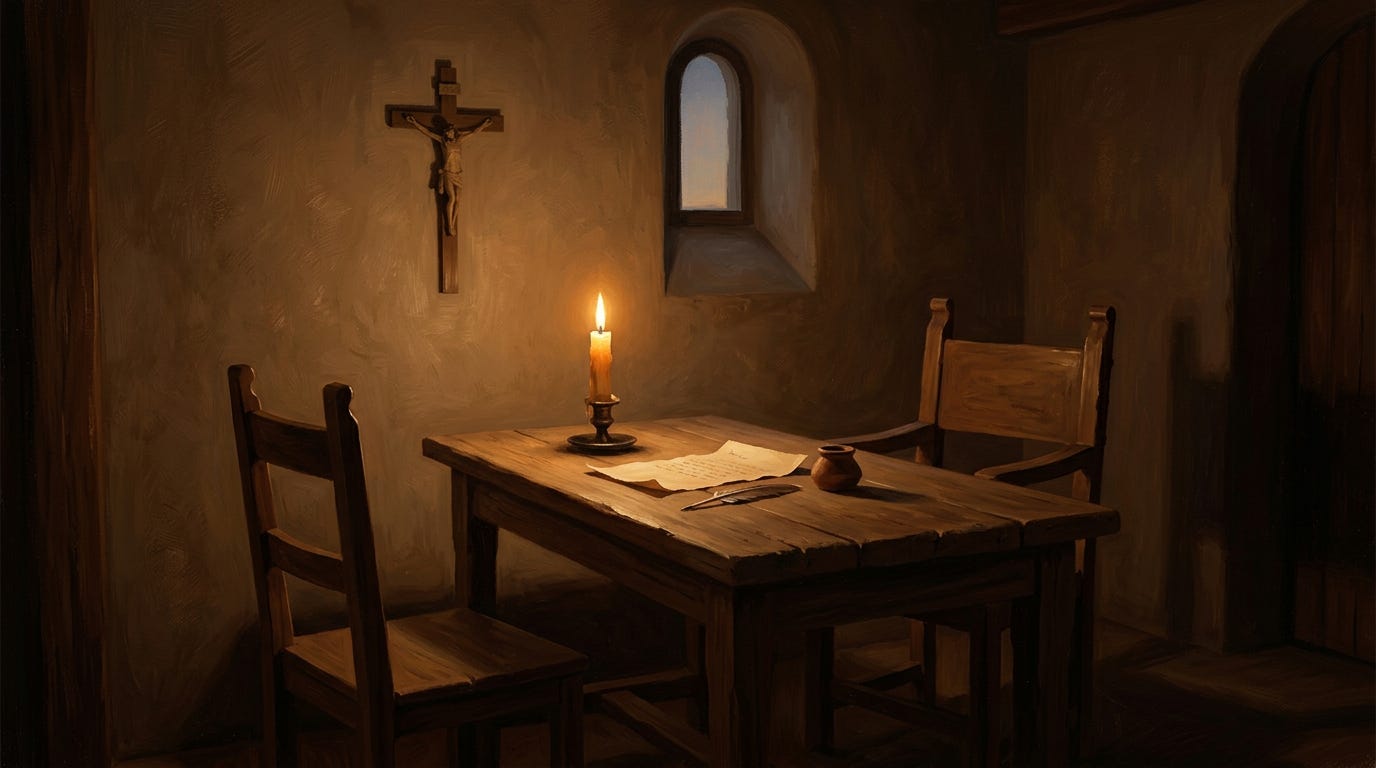
The letter to the Umbrian synod was almost finished.
Cardinal Borromeo sat at the plain wooden desk in his study on the upper floor of the archiepiscopal palace at Milan, in the room that had been his father-in-God Pius IV’s study when Pius had briefly resided there before his election to the See of Peter, in the room that had one high narrow window looking east toward the cathedral, in the room where Borromeo had done most of his writing for the last seventeen years. The letter had been requested by the bishops gathering at Assisi the following month to discuss the application of the Tridentine reforms in their province. They had asked him for practical guidance on the establishment of seminaries. He had been writing the letter for three evenings. It was almost finished. He had two more paragraphs to write. He was going to finish it tonight.
He was forty-five.
He was tired in the specific way that a man is tired who has been an archbishop for seventeen years, who has held five provincial councils and eleven diocesan synods, who has founded three seminaries and required his clergy to read the Pastoral Rule of Gregory the Great every year of their ministry, who has walked the streets of Milan barefoot during the plague of 1576 with the Blessed Sacrament in his hands, and who has known, for the past six months, that his body was not going to give him many more years of service. His body had been giving him signals through the summer. He had ignored most of them. He had increased his fasting rather than decreased it. He had shortened his sleep from four hours a night to three. He had continued the visitations. He was, he understood, spending down a reserve that would not be replenished in this life. He was not going to slow. There were still parishes to visit. There was still the letter to Assisi. There were still the seminaries to shape.
He whispered, in Latin, Domine. Da mihi vires ad finem.
Lord. Give me strength to the end.
He heard the sound of another chair being drawn up to his desk.
He did not turn immediately. He had learned, over many years of intense interior prayer, that some visitations announce themselves before they arrive and that the announcement is worth attending to before turning to the visitor. He sat with the announcement for a full breath. Then he turned.
There was an old monk sitting in the chair opposite him.
The monk was small, thin, and clearly ill - his skin had the yellowish cast of a man who has been suffering intestinal complaints for a long time, and his eyes had the sunken quality of a man who has slept poorly for many years. He wore a plain black Benedictine habit of an older cut than Borromeo had seen in the modern communities. His feet were in leather sandals. His head was tonsured, though the tonsure was ragged, as if he had cut it himself with a knife rather than letting a barber do it. His hands were folded in his lap. They were the hands of a man who had done much writing - the middle finger of the right hand had the callus that scholars develop from many years of holding the quill.
Borromeo knew the face.
He had seen it in the mosaic at San Clemente in Rome, and in the fresco at the monastery on the Caelian Hill where the man had been abbot before he had become pope, and in the various illuminated manuscripts of his works that Borromeo had collected over three decades. The face was recognizable even a thousand years later. The eyes were the same. The set of the mouth was the same. The illness in the face was more visible in person than it was in the mosaics; the mosaicists had been kind.
Borromeo whispered, “Sanctissime Pater.”
Most Holy Father.
The old monk raised one hand slightly.
“No, Carlo. Not tonight. Tonight I am Gregorio, the monk from Andrew’s monastery on the Caelian Hill. Not the Bishop of Rome. Not the servant of the servants of God. Just Gregorio. It is easier for me. The papacy was heavy while I wore it. I am glad to set it down for an hour when the Lord permits me to come to a brother bishop. Call me Gregorio. Or brother. Or nothing. It does not matter. Sit as you were sitting. Do not rise. You are tired. I have come precisely because you are tired.”
Borromeo did not rise. He did not know what to say. He sat with his hands on the arms of his chair and looked at the man he had been trying to imitate for the last thirty years.
He said, at last, “Brother Gregorio. You have read what I have been writing.”
“I have read what you have been writing. I have read all of it. I have been reading you, from where I am, since the day you were consecrated archbishop of this see. You have read me for even longer, since your uncle Pius gave you a copy of the Pastoral Rule when you were twenty-one. We have been reading each other for many years. Tonight the Lord has permitted the reading to become a conversation. I have wanted to speak to you for some time. I am glad to be here.”
Borromeo bowed his head.
He had, in fact, read the Pastoral Rule every year since his uncle had given it to him. He had underlined most of it. He had copied out passages into a small commonplace book he kept in the top drawer of the desk. He had modeled his entire episcopate on it - the visitations, the emphasis on clergy formation, the personal austerity, the accessibility to the poor, the constant preaching. He had required his priests to read it annually. He had preached about it at every diocesan synod he had convened. His whole understanding of what a bishop was for had come from that book. He had, in some interior way he had never quite admitted to himself, been trying to be Gregory the Great in the city of Milan for seventeen years.
He said, softly, “Brother Gregorio. I have been trying to be you.”
Gregory smiled.
The smile was small and tired but it was warm. It was the smile of a man who had lived on the same intestinal complaints for two decades and had learned, over those decades, to smile with a warmth that his body no longer entirely wanted to permit.
“I know you have been trying to be me. I want to speak to you about that. It is one of the things I have come to speak to you about. I hope you will hear it in the spirit in which I say it.”
“Please.”
Gregory leaned forward slightly. He rested his forearms on the desk between them. His sleeves fell back and Borromeo could see how thin his wrists were.
“Carlo. The Pastoral Rule was written in Rome in the year 591, in the second year of my pontificate, at the request of my brother John, the Bishop of Ravenna, who had written me a letter complaining that I had accepted the papacy too readily and that I ought to have refused it. I wrote him the Pastoral Rule partly as a response to his complaint and partly as a treatise on what a bishop was for, since I had spent the previous year discovering that most of what I had thought a bishop was for was wrong. I wrote the Rule in perhaps six months. I did not think it would be read for very long. I thought it was a book for the bishops of my own generation who needed practical guidance in a Church that had just been battered by plague and by Lombard invasion and by the collapse of the imperial administration in Italy. It was a book for the moment. It has, by the Lord’s arrangement, been read for a thousand years past its moment. I did not intend this. It has happened. I am grateful. I want to say to you: the Rule was written for you to apply. It was not written for you to imitate. There is a difference. I want to be careful about the difference.”
Borromeo was quiet.
He was listening. He was, he realized, receiving something he had not known he needed to hear.
Gregory continued.
“When I wrote in the Rule that a bishop should be austere in his personal life, I meant that a bishop should not live in luxury while his people live in want. I did not mean that a bishop should sleep on straw when a bed would help him serve better. I have seen you, Carlo. I have seen the straw pallet in your bedroom. I have seen the meals you have been not-eating. I have seen the three hours of sleep. I am not going to tell you that these are wrong in themselves. Some souls are called to that severity. I was called to some of it myself. What I want to say is that you have taken my writing as a prescription when it was intended as a principle. The principle is: do not let your comforts insulate you from your people. The prescription would have been: sleep on straw, eat once a day. I did not write the prescription. You have been living the prescription. You are dying of the prescription. I would like you to reconsider the prescription. The principle remains. The prescription does not. Your body was given to you to serve the Church. You are wearing it out faster than it needs to be worn out. There is another year available to you if you slow. There is not another year available to you if you do not.”
Borromeo felt something crack open inside his chest.
He had never been told this. He had been told the opposite by many of his advisors, who had understood that his austerity was one of his forms of holiness and had not wanted to interfere with it. He had understood himself that his austerity was one of his forms of holiness. He had not understood that his austerity was killing him a year earlier than his body required.
He said, softly, “Brother Gregorio. You are telling me I have been wrong.”
“I am telling you that you have been reading me too literally. You have not been wrong in the principle. You have been wrong in one of the prescriptions. It is a small correction. It is not a rebuke. I am pleased with your episcopate. I am pleased with your pastoral care. I am pleased with the seminaries. I am pleased with the plague ministry - I did something similar in Rome in the plague of 590, though the newspapers of that century did not exist and the reports were not preserved. I am pleased with almost everything. I am asking you to stop killing yourself faster than the work requires. That is all. Continue the work. Eat a little more. Sleep a little more. The work will not suffer. The work will be better done for the extra year.”
Borromeo nodded slowly.
He was, again, weeping. He had wept perhaps three times in the last decade. He was surprised by it. Gregory waited. Gregory had been an abbot before he had been a pope and had learned in the monastery how to wait while a younger brother wept without interrupting the weeping.
After some while Borromeo said, “Brother Gregorio. Tell me about the seminaries.”
Gregory smiled again.
“The seminaries are the thing you have done that I did not do. I did not think of them. It did not occur to me to establish a formal institution for the training of clergy. The clergy in my century were trained in the monasteries or in the cathedral schools or in the informal apprenticeship of one priest to another. It worked in the sixth century. It stopped working in later centuries as the Church grew and as the informal patterns broke down. The Council of Trent asked for seminaries and did not know what a seminary should look like. You have shown the Church what a seminary looks like. You have built three of them. You have written the constitutions. You have hired the faculty. You have established the curriculum. You have set the standards for admission and formation and ordination. The seminaries you have built in Milan will become the model for the universal Church over the next four centuries. Every priest ordained in the Catholic Church between now and the year 2026 will have been trained in an institution that was shaped, directly or indirectly, by the model you have established in Milan. I did not do this. I could not have done it. It required your century, your circumstances, your particular gifts. This is what an application of the Rule looks like when it has been done well. You have taken what I wrote and you have gone beyond what I wrote. This is what I hoped for when I wrote it. This is the fruit.”
Borromeo could not speak.
He had not thought of the seminaries this way. He had thought of them as practical necessities. He had not thought of them as the great work of his episcopate. He had thought the plague ministry was the great work, or the reform of the clergy, or the catechetical program. The seminaries had been, in his own mind, ordinary infrastructure. Gregory was telling him that the seminaries were the work that would outlast him by centuries.
He said, softly, “Brother. I did not know.”
“You did not need to know. The workers do not always see the largest thing they are doing. That is fine. The Lord sees it. The Lord is arranging it. The seminaries will continue. They will train priests in every century. They will train priests in countries that do not yet exist in your century. The model will be adapted many times. The core of what you have established will remain. You are, in this specific way, the shepherd of the shepherds of the universal Church for four centuries and counting. You do not need to know this to keep doing it. But I have been permitted to tell you tonight. I want you to know it, so that when you die - which will be in a year, on the third of November of next year, in this palace, at the age of forty-six - you may know that what you have built will endure. Some things last a season. Some things last a century. Some things last many centuries. Your seminaries are of the third kind. It is a great grace. It is not a grace you engineered. It is a grace you received and made room for. Rest in that.”
Borromeo bowed his head against his folded hands on the desk.
He wept for a long time.
He wept because he was tired. He wept because he was dying and had known for months that he was dying and had not said it to anyone and had now been told, plainly, when the death would come. He wept because the man he had spent thirty years trying to imitate had come across a thousand years of the Church to tell him that the imitation had gone wrong in one specific way and that the correction was to eat more and sleep more, and this was almost funny, and he was weeping partly out of that near-laughter. He wept because he had been named, for the first time, as the shepherd of shepherds for centuries, and because he had not known this, and because knowing it now, from a saint who had reason to know, was more consolation than his interior life had received in perhaps five years.
Gregory waited.
After a long while Borromeo lifted his head.
He said, “Brother Gregorio. I have been assuming, in the way one assumes things, that I would die at some point but that the point was not near. You have told me it will be a year from now. May I ask you something.”
“Ask.”
“Should I do anything differently in the year.”
Gregory shook his head slowly.
“Only what I have already said. Eat a little more. Sleep a little more. The extra year is possible if you do these things. If you do not do these things you will die this winter of a fever your body will not have the reserves to fight. If you do them you will live to the third of November of next year and will die peacefully in this palace with your community around you. Both are good deaths. The second is a slightly better death for the sake of the diocese, because you will be able to complete a few more visitations and to receive a few more of the letters that will need answering after your death - the Assisi bishops’ response to your letter tonight, for instance, will benefit from your reply. But the shorter timeline is also fine. The Lord will use either. I am not permitted to choose for you. I am permitted to tell you the two possibilities. You decide. There is no wrong choice. There is a slightly better choice for the sake of the work. That is what I have been sent to say about the timing.”
Borromeo nodded, slowly.
“I will eat more. I will sleep more.”
“Good.”
“For the sake of the letter to Assisi.”
“For the sake of the letter to Assisi. And for the sake of your body, which the Lord gave you and which you have been ungrateful to. Begin the gratitude tomorrow. Eat the breakfast your cook prepares. Do not send it back. The cook has been offended for years by your sending back the breakfast. Eat it. Say thank you. The gratitude for the body is the gratitude for the gift of the body. You have been theologically incomplete on this point. I am correcting you. Correct yourself accordingly.”
Borromeo laughed once - a short, surprised laugh, the laugh of a man who has not laughed in his study in some months.
“Brother Gregorio. You are more direct than I expected.”
“I was a Roman aristocrat before I was a monk. Romans are direct. Milanese are also direct, if I remember correctly. We can afford to be direct with each other. Please. Eat the breakfast.”
“I will eat the breakfast.”
They were quiet for some while. The candle on the desk had burned down another inch. The autumn evening had gone entirely. Outside the narrow window, the bells of the cathedral began the ringing for Compline.
Gregory rose.
“I must go. My hour has been longer than I expected. The Lord has been generous with the time. Before I leave I want to bless you. Please rise.”
Borromeo rose. He came around the desk. He knelt on the stone floor in front of Gregory.
Gregory laid both hands on Borromeo’s head - the hands were cool and thin and very steady - and he blessed him, in Latin, in the papal blessing he had used when he had been Bishop of Rome fourteen hundred years earlier.
“Benedicat te omnipotens Deus, Pater et Filius et Spiritus Sanctus. Custodiat te et servet te in via pastoris fidelis. Da tibi requiem, frater Carole. Amen.”
May almighty God bless you, the Father and the Son and the Holy Spirit. May he keep you and preserve you in the way of the faithful shepherd. Give you rest, brother Carlo. Amen.
Borromeo closed his eyes.
When he opened them the chair opposite the desk was empty.
The candle was still burning. The letter to Assisi was still on the desk, with two paragraphs still to write. The cathedral bells were still ringing for Compline. The palace was quiet.
Borromeo rose from the stone floor. He returned to his chair. He picked up his quill. He dipped it in the inkwell. He wrote the two remaining paragraphs of the letter to the Umbrian synod. He finished the letter. He sealed it. He set it aside for the courier who would take it to Assisi in the morning.
He rose. He went down to the chapel for Compline. He sang with his household. He returned to his study. He said his evening prayers. He blew out the candle. He went to his bedroom. He looked at the straw pallet on the wooden bed frame.
He looked at it for a full minute.
Then he called for his valet Francesco, who slept in the small room next to his own, and asked Francesco to bring him a mattress of feathers from the store rooms downstairs and to place it on top of the straw. Francesco, who had been trying for eleven years to persuade Borromeo to accept a mattress and had been told no every time, did not ask any questions. He fetched the mattress. He placed it on the bed. He asked whether His Eminence would like anything else. Borromeo, after a small hesitation, asked Francesco to bring him a plate of bread and cheese and a small cup of wine. Francesco brought them. Borromeo ate the bread and the cheese and drank the wine. He blessed Francesco. He said good night. He lay down on the feather mattress.
He slept for six hours.
In the morning he rose. He said Mass at six instead of five. He ate the breakfast his cook Bartolomeo had prepared - a bowl of polenta with a little butter and some fruit. He thanked Bartolomeo directly for the breakfast. Bartolomeo, who had not been thanked for a breakfast in fourteen years of service, wept in the kitchen after the archbishop had left. Borromeo went to his study. He worked on the diocesan business until midday. He ate a midday meal. He slept for one hour in the afternoon, in the feather mattress. He rose. He continued the diocesan business until Vespers. He ate a supper. He said his evening prayers. He slept for six hours.
He kept this pattern for the next twelve months.
He gained back some of the weight he had lost. His color improved. He was still tired but he was less tired. He completed six more parish visitations that he would not have completed on the old pattern. He completed the Instructiones Fabricae et Supellectilis Ecclesiasticae revision he had been meaning to complete for three years. He received and answered the response from the Assisi bishops, which arrived in December of 1583, and he corresponded with them through the spring about the establishment of their seminary. He preached at every diocesan feast. He continued the work.
He died on November 3, 1584, at the age of forty-six, in his bedroom in the archiepiscopal palace at Milan, exactly as Gregory had said. He was surrounded at his death by his household and by the members of his cathedral chapter. His last words, in Latin, were Ecce venio - Behold, I come. He died with the feather mattress under him. He did not know whether Gregory had approved of the mattress. He suspected that Gregory had approved. The suspicion was pleasant to die with.
He was canonized by Pope Paul V on November 1, 1610, twenty-six years after his death, in one of the fastest canonizations of the post-Tridentine era. His feast is November 4.
The seminary system he had built in Milan became the model for the universal Church, as Gregory had said it would. Every seminary founded in the Catholic world in the following four centuries was, directly or indirectly, shaped by the constitutions Borromeo had written. Every priest ordained in the Catholic Church between 1584 and 2026 was formed in an institution that traced its lineage back to the seminaries at Milan. Borromeo did not know this. He did not need to know it. He had done the work. The reception belonged to the Lord.
Saint Gregory the Great, in the room where he is, was very pleased.
He had been permitted to visit Borromeo that once. He had said what he had been sent to say. The eating of the breakfast, the sleeping on the feather mattress, and the extra year of pastoral work were, in the record of the room where Gregory is, some of the most productive gentle corrections the Lord had permitted him to deliver. Gregory continued to be read by bishops in every century. The Pastoral Rule remained in continuous use. Some bishops applied it well. Some bishops applied it poorly. Some bishops did not apply it at all. Gregory noted them all, in the way that the writers of foundational books note their readers across the centuries. He was fond of Borromeo. He was fond of many. The list of bishops who had received the Rule well was long. It was one of the deep consolations of the room where Gregory is that the list continued to grow.
The candle in the study at the archiepiscopal palace at Milan burned out at dawn, as candles do, on the morning after Gregory’s visit.
Borromeo woke rested.
He ate the polenta.
Bartolomeo wept in the kitchen.
The seminaries continued to shape the Church.
For your prayer this week: Saints Charles Borromeo and Gregory the Great, you who wrote the Pastoral Rule and you who applied it faithfully across a thousand years, pray for the bishops and pastors and shepherds of our own time who are exhausted from the reforms they have been asked to lead. Grant them the grace to know the difference between the principle and the prescription, to eat the breakfasts their cooks have prepared, to sleep in the beds their bodies require, and to trust that the work they have done will endure by the Lord’s arrangement long after they have completed it. Amen.
Two Lamps returns next Friday: Saints Frances Xavier Cabrini & Rose Philippine Duchesne, the mother house of the Missionary Sisters of the Sacred Heart in Chicago, an autumn evening in 1913.
Two Lamps is a weekly short story braiding the lives of two or three saints across the centuries. Sometimes the meeting is rendered as an encounter in eternity. Sometimes as the older saint coming, in vision or in patronage, to the soul of the younger. Sometimes as two friends meeting in one life. The Communion of Saints holds them all as one company.
Two Lamps is written by Deacon Michael Halbrook, a permanent deacon of the Diocese of Springfield in Illinois, serving at St. Elizabeth Parish in Granite City. He writes personally at DeaconMichael.net, serves families through Domus Formation, and publishes the serial novel Ordo: A Chronicle of Lux Perpetua at LuxPerpetua.net. Two Lamps is co-conceived with his son Joseph.