

The execution was in the morning.
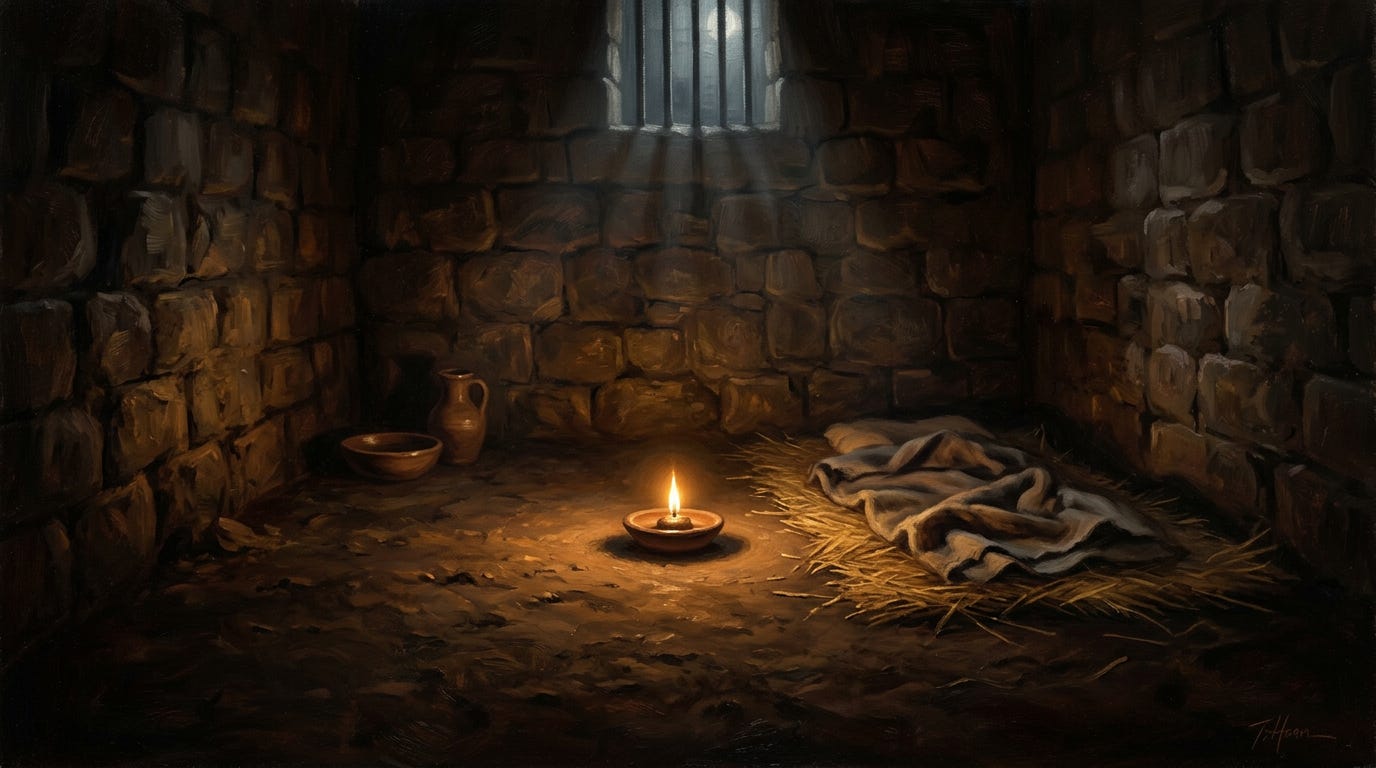
Father Andrew Dũng-Lạc sat on the packed earth floor of the small cell on the inner side of the central prison at Hanoi, in the cell he had shared for the past three weeks with Father Peter Thi who was now asleep against the far wall, in the Nguyễn dynasty prison that held perhaps sixty other prisoners that night of various sentences and various faiths, with the single iron-barred window high in the stone wall above his head letting in a little of the cold December night air of Tonkin. He had been arrested on November 10. He had been interrogated six times. He had refused each time to trample on the small bronze crucifix the magistrates placed on the floor in front of him. He had been sentenced to death by decapitation on December 19, the day before. The execution would take place at dawn the following morning at the Ô Cầu Giấy field outside the city walls. He was forty-four.
He was ready.
He had been ready for some years. He had been arrested three times before this arrest and had been released each time - once because the Christians of his parish had pooled their money to buy his freedom, twice because the magistrates had been unable to prove he was a priest. This fourth arrest had been different. The magistrates had Peter Thi with him. The magistrates had witnesses from a village in his former parish who had testified that they had seen him celebrate Mass. There would be no release this time. He had understood this within a few days of the arrest. He had used the subsequent weeks to pray and to hear Peter’s confession and to make his own confession to Peter and to compose a brief letter to his bishop which he had managed, through a sympathetic guard, to have carried out of the prison. The letter had asked the bishop to ordain more young men from the Vietnamese villages, because the persecution would get worse before it got better, and the Church in Tonkin would need many priests.
The letter had gone. The weeks had passed. The night before the execution had come. Peter had fallen asleep around the ninth hour of the evening. Andrew was awake. He had not slept in three days. He did not want to sleep tonight. He wanted the night.
He whispered, in Vietnamese - the language he preached in and prayed in and would die speaking tomorrow - Lạy Chúa. Con sẵn sàng. Xin Chúa ở cùng con đêm nay.
Lord. I am ready. Be with me tonight.
He heard a small sound at the door of the cell.
He did not turn. He assumed it was the guard making his rounds. The guards made rounds every hour or so and he had learned to ignore them. He continued his prayer.
Then he heard a voice, in Aramaic that he did not understand but that he recognized as a Semitic language from somewhere in the eastern Mediterranean.
“Andrew. I may come in?”
He turned his head.
An old man was standing inside the cell, inside the closed door. He had not opened the door. He was simply there.
The old man was perhaps in his sixties, wearing a plain brown tunic that came to the knee with a short grey cloak thrown over one shoulder. His feet were in leather sandals worn thin at the sole. His hair was grey and cropped short. His beard was grey and short. His face was weathered - the face of a man who had spent years on boats before he had spent years on roads. His hands were rough. He had the compact wiry build of a fisherman. His eyes were dark and very warm. He was watching Andrew Dũng-Lạc with the kind of recognition that happens between two men who share a name and a vocation, though neither has met the other before.
Andrew Dũng-Lạc understood, immediately, who the old man was.
He said, in Latin - the language of his seminary training at Kẻ Vĩnh and the only language besides Vietnamese he could speak with any fluency - “Apostolus. Tu venisti ad me.”
Apostle. You have come to me.
The old man smiled.
He answered in Latin, which Andrew Dũng-Lạc could hear he was speaking as a second language learned very long ago. “Andreas. I have come to you. I may sit with you tonight. The hours are long before an execution. You should not be alone. Peter is a good brother but Peter needs sleep. Peter will be beside you tomorrow at the field. Tonight, while Peter sleeps, I have been permitted to come. We are brothers also. Our names are the same name. Our Greek name. Andreas. The manly one. The one with courage. The Lord gave us the same name because He knew we would need the same courage.”
Andrew Dũng-Lạc looked at the old man.
He did not know what to say. He had been a priest for sixteen years. He had baptized perhaps a thousand Vietnamese. He had heard many thousands of confessions in the villages of Tonkin. He had never, in all those years, expected to be visited on his last night by the apostle whose name he had taken at his baptism. The baptism had been in 1807, when he was twelve, in his home village, with the French missionary who had catechized him choosing the name Andrew because he had thought the boy’s eagerness and strength reminded him of the first-called of the Twelve. The choice of name had shaped Andrew Dũng-Lạc’s whole priestly imagination. He had read the few passages about Andrew the Apostle in the New Testament hundreds of times. He had tried to pattern his ministry on what little the Gospels said - Andrew bringing his brother Peter to Jesus, Andrew bringing the boy with the loaves and fishes to Jesus, Andrew bringing the Greeks to Jesus. Andrew was, for him, the one who brought people. He had tried to be that kind of priest.
He said, softly, “Frater. I have tried to be your namesake. I do not know if I have been worthy.”
The apostle Andrew sat down on the packed earth floor near the younger Andrew. He crossed his legs in the manner of a man who had spent many years sitting on beaches and on roadsides and on the floors of small houses throughout Greece and Scythia and the lands around the Black Sea. He arranged his cloak. He looked at Andrew Dũng-Lạc for a long moment.
“You have been worthy. Let me say that first. The Lord is pleased with your ministry. He has sent me to tell you so. He knows the names you have baptized. He knows the villages you have reached. He knows the confessions you have heard. He knows the Masses you have said in secret in Vietnamese kitchens and in Vietnamese fields when the magistrates were looking the other way. He has received all of it. You have been the kind of priest the Vietnamese Christians have needed in this century. He is pleased. Do not die in the morning wondering whether your ministry was accepted. It was accepted. It is being accepted now, tonight, as we sit. The acceptance is complete.”
Andrew Dũng-Lạc bowed his head.
He had been carrying, through the past three weeks, the small quiet fear that his ministry had not been enough. He had not spoken this fear to Peter. He had barely spoken it to the Lord. He had carried it in the part of himself that priests carry such things. The apostle had named it. The naming dissolved it. He wept silently for a few minutes.
The apostle waited. The apostle had, in his own last hours before his own execution at Patras in Greece around the year 60, carried a similar fear and had been visited in his cell by Peter his brother, whose own crucifixion at Rome had happened a few years earlier, and he knew that the weeping of a priest on the night before his own death was a prayer that did not want to be interrupted.
After a while Andrew Dũng-Lạc lifted his head.
He said, in Latin, “Frater. I have one great desire tonight. May I speak it.”
“Speak.”
“I have never heard someone describe who the Lord was in the body. I have read the Gospels. The Gospels are not long. I have wondered my whole priesthood what it was like to walk with Him in the flesh. To see His face. To hear His voice. To eat with Him. I know the Gospels do not tell us these things in detail because the Gospels are not written for that purpose. Tonight I would like, before I die, to hear one who walked with Him tell me what He was like. May I ask this of you.”
The apostle Andrew’s face softened.
“You may ask. I have been permitted to answer. May I tell you what I remember.”
“Please.”
The apostle Andrew looked at the floor for a moment, gathering the memory. Then he looked up at Andrew Dũng-Lạc and he began to speak.
“I met Him first at the Jordan. I was with my teacher John the Baptist. John was baptizing. A man came toward us through the crowd on the riverbank. John stopped what he was doing. John pointed at the man. John said, in Aramaic, Behold the Lamb of God. I had never heard John say such a thing about anyone. I looked at the man John was pointing at. He was perhaps thirty. He was thin. He was wearing a plain brown tunic and a grey mantle. His feet were bare and were caked with the dust of the Jericho road. He had dark hair that he had cut himself, I could tell, with a knife. His beard was dark and short. His eyes were brown. He looked at us. He kept walking past. I left John where he stood and I followed the man. Another disciple of John followed with me. The man noticed us walking behind him. He turned. He asked us, What do you seek. We said, Rabbi, where are you staying. He said, Come and see. We went. We stayed with him that day and that night. I had understood, within the first hour of being with him, that he was the one John had been pointing to. I went back the next morning to my brother Peter, who was mending nets at Capernaum, and I told Peter, We have found the Messiah. I brought Peter to him. Peter met him. Peter became his. That was the beginning. I was the one who found Peter and brought Peter. This is one of the few things recorded about me in the Gospels. It is the truest thing I ever did.”
Andrew Dũng-Lạc was weeping quietly again. The apostle continued.
“He was not tall. He was not handsome in the way the Greeks later painted him. He was a working man from a small village in the hills of Galilee. He walked everywhere. He never tired of walking. He preferred to be with people rather than alone. He preferred to be outdoors rather than in a synagogue. He laughed often. He laughed especially at children, and at my brother Peter who was constantly saying ridiculous things, and at the small foolishness of the Twelve who were slow to understand what he was telling us. He was patient with us. He was more patient than any of us deserved. He got angry only at the hypocrisy of certain religious teachers who were making it harder for ordinary people to approach God. He did not get angry at ordinary people for their sins. He forgave them. He would say, Your sins are forgiven, and the person would weep, and he would hold them. He held people a great deal. He was a toucher. He touched the lepers. He touched the blind. He touched the children. He touched the dead. He was always touching. When he raised the daughter of Jairus he took her hand. When he gave his hand to the sick he was giving them himself through the hand. His hands were working hands. They had been a carpenter’s hands. They did not look like priestly hands. He was the Lord. He did not look like the Lord. That was one of the many things about him that we did not understand until later.”
Andrew Dũng-Lạc had set down his hands. He was listening with his whole body.
The apostle Andrew continued.
“He broke bread with us many times. At every meal he would take bread into his own hands and he would say the blessing in Aramaic, the blessing we all knew from our own homes - Baruch atah Adonai Eloheinu melech ha’olam ha’motzi lechem min ha’aretz. Blessed are you, Lord our God, King of the universe, who brings forth bread from the earth. He said it every time. Then he would break the bread. Then he would give the pieces to us. On the night before he died he said the same blessing in the same Aramaic. Then he said something new. He said, This is my body, which is given for you. I did not understand what he meant. None of us did. We understood later. After the Resurrection when we met him at breakfast on the beach at Tiberias he broke bread with us again, and in the breaking we understood what he had meant at the supper. The Eucharist was already happening on that beach. It has been happening ever since. Every Mass you have said in Vietnamese fields in secret has been the same Eucharist. The same Lord. The same hands breaking the same bread. You have not been alone at any of your Masses. He has been present. The Twelve of us have been present with him. Every Mass is the same Mass. We are all at the same table. You have been at the table with us for sixteen years. You will be at the table with us tomorrow after you die. The table is where you are going. Do not fear.”
Andrew Dũng-Lạc was weeping now in a different way - not the weeping of fear or of grief but the weeping of a priest who had just been given, on his last night, the gift of being told that every Mass he had ever celebrated had been part of one Eucharist with the Twelve and with the Lord. He had hoped this was true. He had believed it. He had never been told it by one who had been at the original.
He said, after a long while, “Frater. Thank you. That is what I needed.”
“You are welcome. The Lord knew what you needed. He sent me. I am glad to come.”
They were quiet for a while.
Peter Thi stirred against the far wall in his sleep. The December cold had settled deeper into the cell. A rat scurried along the base of the opposite wall. The guard’s footsteps passed in the corridor outside.
Andrew Dũng-Lạc said, softly, “Frater. Tell me about your own death. The Gospels do not say.”
“I was crucified at Patras in the Greek Peloponnese around the year 60, under the governor Aegeates. I had been preaching in Greece and in Scythia for perhaps twenty-five years by that time. I was perhaps sixty-five. Aegeates had become angry with me because I had converted his wife Maximilla, and she had refused him her bed. He had me arrested. He had me scourged. He had me crucified. The tradition that I was crucified on an X-shaped cross is later. The cross was an ordinary cross. I was tied to it rather than nailed to it, which meant I took longer to die. I hung for two days. During those two days I preached to the crowd that had gathered. I told them who the Lord was. I told them what he had done. I told them what I had seen on the beach at Tiberias. Many believed. I died on the third day. I was not afraid. I had been expecting it for some years. I had been ready. The dying itself was not difficult. The being-tired of the two days of hanging was difficult. Tomorrow you will die more quickly. One stroke of the sword. It will be a mercy. The Vietnamese executioners are skilled. It will be quick. Do not fear the dying. The dying is a minute. The rest is forever.”
Andrew Dũng-Lạc nodded slowly.
“Frater. One more question. Will the Church survive here. In Vietnam. The persecution has been severe. There are not enough priests. The villages are frightened. I have been wondering whether the Vietnamese Church will still exist in a hundred years.”
The apostle Andrew smiled.
“The Vietnamese Church will still exist in a hundred years. The Vietnamese Church will still exist in two hundred years. In 1988, which is one hundred and forty-nine years from tomorrow, a Polish pope named John Paul II will canonize you together with one hundred and sixteen other Vietnamese martyrs. You will be canonized in Saint Peter’s Square in Rome with your name spoken aloud - Anrê Dũng-Lạc - and the names of all one hundred and seventeen will be read before a crowd of many thousands. You will be the proto-martyr of the Vietnamese by representation - the one whose name will be used to name the whole group, because you were a diocesan priest and Vietnamese and ordained and the magistrates had killed you precisely for being a Vietnamese priest. Your feast will be November 24. It will be celebrated in every Vietnamese parish in the world. There will be many Vietnamese parishes by 2026 - in Vietnam itself, in France and the United States and Australia and Canada and Germany and many other countries where Vietnamese Catholics will have settled after the wars of the twentieth century. The Vietnamese Church will not only survive. It will become, in the global Catholic imagination, one of the most beautiful churches of the East - known for its catechists and its martyrs and its strong family faith. All of this begins with what you do tomorrow at dawn. You and Peter Thi and the hundred and fifteen others in the coming decades. You are the foundation. The foundation is being laid tomorrow. Do not fear the laying. It is what you were made for.”
Andrew Dũng-Lạc bowed his head. He could not speak for a long while.
When he spoke he said only, “Frater. Thank you.”
“You are welcome.”
The apostle Andrew rose slowly from the earthen floor. He came to stand in front of the younger Andrew. He laid both hands on Andrew Dũng-Lạc’s head - the hands were rough and warm and smelled faintly of the Mediterranean - and he blessed him, in Aramaic, in the blessing that Peter his brother had given him on the beach at Tiberias after the Resurrection breakfast when the Lord had told Peter to feed his sheep.
“Shlama alach, achunan Andreas. Zel b’shlama. Hu amak. B’shem d’Maran Yeshua M’shicha. Amen.”
Peace to you, our brother Andrew. Go in peace. He is with you. In the name of our Lord Jesus the Christ. Amen.
Andrew Dũng-Lạc closed his eyes.
When he opened them the apostle was gone. Peter Thi was still asleep against the far wall. The small cell was still cold. The December night was still outside the iron-barred window.
Andrew Dũng-Lạc sat for a long time in the silence.
Then he lay down on the packed earth floor. He did not expect to sleep. He fell asleep almost immediately. He slept for perhaps three hours.
He woke at the fourth hour of the morning. He prayed matins quietly, from memory. He heard Peter’s confession when Peter woke. Peter heard his. They ate the small portion of rice the guards brought at dawn. They did not speak much. They did not need to.
The guards came for them an hour after sunrise.
They were led out of the prison in iron chains. They were taken through the streets of Hanoi. A small crowd followed - mostly Christians, some of whom had traveled from villages Andrew Dũng-Lạc had served. They walked quietly. Andrew Dũng-Lạc nodded to the ones he recognized. He did not speak. He wanted to save his voice for the end.
They arrived at the Ô Cầu Giấy field outside the city walls. The executioners were waiting. There was a wooden block set on the ground. There was a bowl for the blood. The magistrate read the sentence. Andrew Dũng-Lạc listened. He bowed his head when it was finished.
He asked, in Vietnamese, if he might speak. The magistrate permitted it.
Andrew Dũng-Lạc said, loudly enough for the crowd to hear, “I die for Christ Jesus. I die with joy. I die for the Vietnamese Church. May she endure. May she grow. May you who hear me come, in time, to the faith that I am dying for. The Lord is good. The Lord is with us. The Lord is with you.”
He knelt at the block. He laid his head on the block. He said, in Vietnamese, “Giêsu, Maria, Giuse.”
Jesus, Mary, Joseph.
The executioner struck. The stroke was clean. The dying was a minute, as the apostle had said. The rest began.
Peter Thi followed immediately after. He died as well as Andrew had. Their bodies were given to the Christians who had come to receive them. They were buried the following day in a secret grave outside Hanoi. The grave was marked only by a small stone that said nothing in Vietnamese and nothing in Latin. The Christians who had buried them remembered where. The memory was passed down. The relics were eventually recovered and are now preserved in various Vietnamese churches and in Rome.
The persecution continued for another twenty-three years. The count of Vietnamese Catholics killed in the persecutions of the nineteenth century reached tens of thousands - most of them lay Christians whose names are not individually recorded. The 117 whose cases were documented in sufficient detail for the Church’s canonization process were beatified between 1900 and 1951 and were canonized together by Pope John Paul II on June 19, 1988, exactly as the apostle had said. They are known collectively as the Vietnamese Martyrs - Các Thánh Tử Đạo Việt Nam. Their feast is November 24. Andrew Dũng-Lạc is named first among them because he was a Vietnamese diocesan priest killed for being precisely that. The feast is kept in every Vietnamese parish in the world.
The Vietnamese Church has grown. There are approximately seven million Vietnamese Catholics in Vietnam today. There are large Vietnamese Catholic diaspora communities in the United States, France, Australia, Canada, Germany, and many other countries. Vietnamese priests and religious serve in parishes across the world. The seminaries are full. The faith is alive. The foundation laid by Andrew Dũng-Lạc and his fellow martyrs has held.
Saint Andrew the Apostle, in the room where he is, continues to visit priests on the night before their martyrdom. The list is long. It has grown across every century. He has been permitted to visit many of them. Not all. He has been especially fond of visiting priests who share his name - there have been many, across many languages, and Andrew the Apostle keeps track of each of them. He was particularly pleased to visit Andrew Dũng-Lạc, because the Vietnamese Church was and is one of the churches dearest to the Lord, and because the specific courage required of a Vietnamese priest in the 1830s was courage of a kind the Lord was honoring in a particular way. Andrew the Apostle met Andrew Dũng-Lạc at the door of the room, as he had promised. He walked with him through the door. The dying was a minute. The rest is forever.
The oil in the small lamp at the central prison in Hanoi burned out at dawn, as lamps do, on the morning of December 21, 1839.
Andrew Dũng-Lạc had already gone to the field.
Peter Thi was with him.
The Vietnamese Church was being founded.
The foundation holds.
For your prayer this week: Saint Andrew the Apostle and Saint Andrew Dũng-Lạc, you who were named Andrew in Galilee and you who were named Andrew in a Vietnamese village twelve hundred years later, you who brought your brother Peter to the Lord and you who brought your Vietnamese neighbors to the same Lord, you who died at Patras and you who died at Ô Cầu Giấy field outside Hanoi, pray for the persecuted Church in every country where she is persecuted today, for every priest who is preparing interiorly for a martyrdom he does not yet know is coming, and for every one of us who is asked to lay a foundation we will not live to see completed. The dying is a minute. The rest is forever. Amen.
Two Lamps returns next Friday: Saints Francis Xavier & Thomas the Apostle, the Jesuit residence at Goa on the Malabar Coast, an evening in January 1548.
Two Lamps is a weekly short story braiding the lives of two or three saints across the centuries. Sometimes the meeting is rendered as an encounter in eternity. Sometimes as the older saint coming, in vision or in patronage, to the soul of the younger. Sometimes as two friends meeting in one life. The Communion of Saints holds them all as one company.
Two Lamps is written by Deacon Michael Halbrook, a permanent deacon of the Diocese of Springfield in Illinois, serving at St. Elizabeth Parish in Granite City. He writes personally at DeaconMichael.net, serves families through Domus Formation, and publishes the serial novel Ordo: A Chronicle of Lux Perpetua at LuxPerpetua.net. Two Lamps is co-conceived with his son Joseph.