

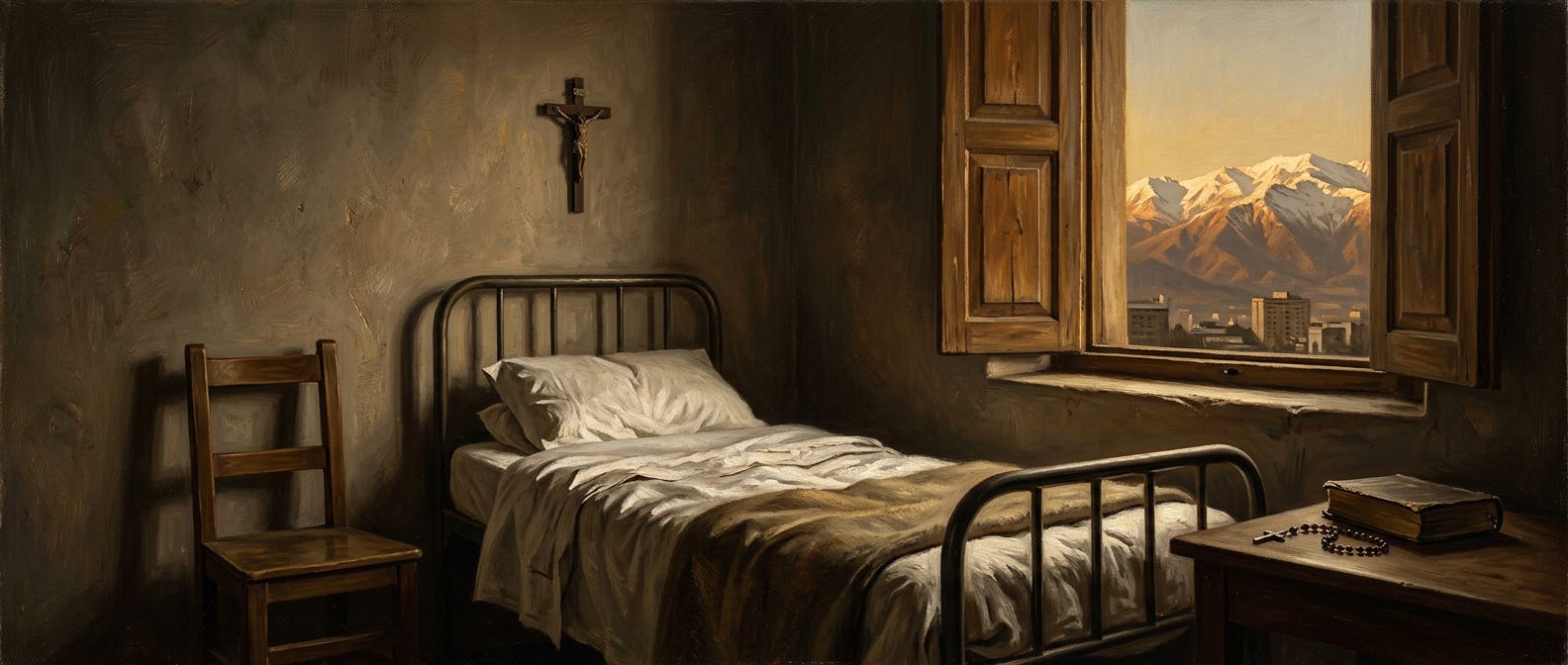
The window looked out on the mountains.
Padre Hurtado lay on the hospital bed in the small private room at the Hospital Clínico of the Pontifical Catholic University, on the fourth floor, with the shutters open because he had asked for them to be open, and the winter afternoon light coming in weak and cold across the coverlet. The Andes were dark blue in the far distance beyond the roofs of the city, and the small light on their peaks was the last piece of afternoon sun catching the snow. He had loved the mountains. He had climbed them in his younger years, in the summers when the Society of Jesus permitted him a few days of rest between one thing and the next. He had not climbed them in some years now. The work had grown too large. The Hogar de Cristo had opened its fortieth shelter last year. The Mensaje magazine had gone into its ninth year of publication. The Chilean Trade Union Association he had founded had begun to train real numbers of Christian labor leaders, and the training had begun to matter, in the way that quiet formation begins to matter after a decade or so. He had not had time for the mountains. He had told himself he would go again when things quieted. Things had not quieted.
He was fifty-one years old.
He had known, when the pain had come the first time in April, that it was something serious. He had not told anyone for perhaps two weeks. He had said the Mass each morning. He had continued his work. He had gone to the shelters. He had visited the workers. He had written the columns for Mensaje. The pain had come and gone. When it had come in July with a force he could not hide, he had allowed himself to be taken to a doctor. The doctor had done tests. The tests had come back. The doctor had told him, very gently, that it was cancer of the pancreas, and that there was nothing to be done, and that he had perhaps a month.
He had said, in the small hospital office where the doctor had told him, “Contento, doctor. Contento.”
The doctor had wept.
The Chilean newspapers had picked up the story within a week. He was not sure how they had learned. He had asked the Society not to publish anything and the Society had honored his request, but somehow the news had traveled anyway, and the country had begun to follow his dying with an attention he had not expected and did not welcome. He was becoming a national figure. He would have preferred to die quietly. But he understood, in the small distances of the interior peace he had been cultivating for many months, that the not-quietness was part of what he was being asked to give. The country needed to see a Chilean priest die well. He would do so. It would be his last small work.
The pain now was manageable. The doctors had learned, in the past week, the right amount of morphine to give him. He was clear-headed. He was, he thought, more clear-headed than he had been in years, when the daily work had crowded his mind with the small details of shelters and columns and meetings and letters. The dying had cleared the desk. He had been able to pray in a way he had not been able to pray since his novitiate. He was grateful.
He whispered, in Spanish, Contento, Señor. Contento.
There was a man standing at the foot of the bed.
Padre Hurtado had not heard him come in. The door of the hospital room had a squeak in the hinge that he had noticed on his first day, and the door had not squeaked. And yet a man was standing at the foot of the bed, in a coarse undyed woolen habit that reached to the floor, cinched at the waist with a rope belt. His head was bare. His hair and beard were grey and cut short in the way of a working monk. His feet were bare. His hands were folded in front of him in the small monastic posture of attention. He was tall. He was perhaps sixty. His eyes were very direct.
“Padre,” he said, in Latin.
Padre Hurtado’s Latin was the fluent working Latin of a Jesuit who had studied theology in Belgium and had said the Mass in it every day of his priesthood. He heard the Latin. He noticed also that the man’s Latin was not any Latin he had heard before - it was a Latin from somewhere older, from the twelfth century perhaps, with the compressed muscular quality of monastic Latin from the century of Anselm and Abelard and Bernard.
“Brother,” Padre Hurtado said, softly, in the same Latin.
“I have come to sit with you for a little while. May I.”
“Please. Sit.”
The man drew the small wooden chair from beside the door to the foot of the bed and sat, facing Padre Hurtado, with his back to the window and the mountains. The winter afternoon light fell on his shoulders. His shadow lay across the floor in the shape of a monk. Padre Hurtado looked at him carefully.
“Tell me your name, brother.”
“Bernard. Of Clairvaux.”
Padre Hurtado closed his eyes for a moment.
He knew the name. He had studied Bernard at the seminary in Belgium in the early 1930s. He had read the Sermons on the Song of Songs - had read them slowly, over a long winter, in the small library at Louvain, and had been changed by them in ways he had not entirely been able to articulate at the time. He had also read the De consideratione that Bernard had written for Pope Eugene III, in which the abbot of Clairvaux had told a former disciple who had become pope how to keep his soul while holding the highest office in Christendom. He had thought about that book often over the years. He had thought about it especially in the last decade, when he had been increasingly drawn into the corridors of power in Chile - meeting with cabinet ministers about labor legislation, arguing with newspaper editors about workers’ rights, sitting across from wealthy men trying to persuade them to fund the Hogar de Cristo. He had needed a Bernard in those years. He had not had one. He had read Bernard instead.
He opened his eyes.
“Padre Bernardo,” he said, in Spanish, the address slipping out before he could choose Latin again.
Bernard smiled, slightly.
“Padre Alberto.”
“You have been dead for eight hundred years.”
“About that, yes. I died on the twentieth of August in the year eleven hundred and fifty-three, at Clairvaux, in a small cell that I had not been able to leave for some months on account of illness. I was sixty-three. I was very tired. The Lord took me in the morning.”
“You come now.”
“I come now because you also are dying in the second half of August, and because you have read me, and because we have some things in common, and because when a monk dies who has spent his life trying to hold together the contemplative and the active he sometimes sends a monk who has done the same thing to sit with him at the end. That is what I am. I am the one being sent. Do not concern yourself with why. The Lord has His reasons. He has been fond of you for many years. He would like you to have some company for these last afternoons. I am the company.”
Padre Hurtado let out a slow breath.
The breath released a small tightness in his chest that he had been carrying, he realized, for several days. He had been visited by many people since the diagnosis had become public - by his brother Jesuits, by his mother, who had come from Viña del Mar and was staying in a small pensión nearby, by the cardinal, by the president’s wife, by the union men from the docks, by the young mothers from the shelters who had asked to come and had been permitted in shifts of two or three, by the newspapers who had asked for interviews he had gently declined. He had been kind to each visitor. He had been performing the small kindnesses that a dying priest owed to those who had loved him. He had been very tired.
Bernard was not asking him to perform. Bernard was simply sitting.
“Thank you,” Padre Hurtado said.
“For sitting.”
“For sitting.”
“It is what I have come to do. Rest, brother. Speak when you wish. I have all afternoon.”
They were quiet for a while.
Padre Hurtado looked at the mountains through the window. The small piece of afternoon sun on the snow of the higher peaks had moved slightly to the north. He had learned, as a boy in Viña del Mar and later in Santiago, to read the small movements of the sun on the Andean snow as a kind of clock. The sun would leave the highest peak within perhaps an hour. Then the light would be gone from the mountains altogether. Then the mountains would be blue-black against the dusk, and the city below them would begin to light its lamps for the evening. He had watched this happen a great many times in his life. He was watching it perhaps for the last time.
“Brother Bernard,” he said.
“Yes.”
“I have a question. I did not know I was going to ask it. But it is here now. May I ask it.”
“Ask, brother.”
Padre Hurtado thought for a moment. He was arranging the words carefully. He had learned, in the years of his ministry, that the questions that came unbidden were usually the most important ones, and that they deserved to be spoken carefully.
“Did you doubt,” he said, softly, “at the end. Did you doubt that the Hogar you built - your Cistercian houses, your reform, your preaching against the antipope, your walking to argue with popes about their popes - did you doubt that any of it had been the right shape. Did you die in peace with what you had done. Or did you die wondering.”
Bernard did not answer for some while.
He looked at Padre Hurtado with the very direct gaze that Padre Hurtado had noticed in the beginning. It was the gaze of a man who did not flinch from difficult questions, and who did not answer difficult questions quickly, and who understood that the answer required a moment of interior consultation before it could be given.
“I died wondering,” Bernard said, finally. “I will tell you the truth. I did not die in perfect peace. I died with several things unresolved. I had spent the last decade of my life in more controversies than a monk should be in - with Peter Abelard, with the antipope Anacletus, with the courts of France and Germany about the Second Crusade, which I had preached and which had failed catastrophically. The Second Crusade was the great wound of my last years. I had preached it because Pope Eugene had asked me to, and I had believed the preaching was the will of the Lord, and the Crusade had gone out under my preaching and had been destroyed in Anatolia and in Damascus, and thousands of men had died, and the Christian territories in the East had not been restored, and I had had to spend the years after the failure defending my own preaching and trying to explain why the Lord had permitted the disaster. I did not do this defense well. I did it in De consideratione better than in my other writings, but I did not do it fully well. I died with the failure of the Crusade weighing on me. I did not die in perfect peace. I want you to know this because I do not want you to think that the saints all die serene. Some of us die wondering. Some of us die with real questions. The Lord accepts the wondering. He does not require the serenity. The serenity is a gift He gives to some, and He does not give to others, and the giving is not a measure of the loving. He loved me. He was pleased with me. He did not give me the serenity at the end. He gave me instead a small quiet trust that He would sort out what I had done, in the century after me and in the centuries after that, and that my part had been to do what I had been given to do and to leave the sorting to Him. That trust was enough. It was not serenity. But it was enough.”
Padre Hurtado nodded slowly.
He was, he found, weeping. Not much. A small slow leak. The morphine had made him more emotionally available in the past days than he had usually been. He did not try to stop the leak.
“I have been wondering,” he said, “whether the Hogar de Cristo will continue after me. Whether the young men who have been formed by it will keep the shape I have tried to give them. Whether the shelters will drift into becoming institutional charities without the Eucharistic center that I have tried to insist on. I have been wondering whether the Mensaje magazine will keep its voice or will be captured by one political faction or another. I have been wondering whether the Trade Union Association will hold. I have been wondering, in the past several days, whether I have done anything that will last. I have not spoken of this wondering to anyone. I have been performing peace for my visitors. I have been saying contento to the newspapers. I have meant the contento, in some sense. But there is also this wondering. I have not known what to do with it.”
“You may keep it, brother. You do not have to resolve it. It is part of what you carry to Him.”
“You carried yours.”
“I carried mine. Right up to the small cell at Clairvaux where I died. I carried the Second Crusade with me the whole way. I have been asked, in the room where I am now, to tell you the following. You may share the wondering with me. I will help you carry it into what comes next. You do not have to hand it off to the Lord alone. He has given you a brother from Clairvaux to help with the carrying. That is one of the small kindnesses He arranges for the ones who are worried at the end about the durability of what they have built. He gives us to each other. He does not require us to arrive empty-handed. He knows we cannot arrive empty-handed. He accepts what we bring. Even the wondering. Even the failed Crusades. Even the Hogar de Cristo that we cannot guarantee will hold. He accepts all of it. He sorts it out. The sorting is His.”
Padre Hurtado was weeping more now.
He had not realized how much he had been carrying. The morphine, and the eight-hundred-year-old Cistercian at the foot of his bed, and the winter afternoon light on the mountains, had come together to make a small room in which he could weep about his life’s work without performing anything for anyone. He wept for perhaps five minutes. Bernard did not speak. Bernard sat with his hands folded in his lap and looked at him with the direct gaze that did not flinch. He was, Padre Hurtado thought, a very Bernardine sitting. He had read that Bernard was known for silence in the presence of grief. He was learning that the reading had been correct.
After a while Padre Hurtado stopped weeping.
He said, “The Hogar de Cristo will hold.”
“I have not been told whether it will.”
“I have been told. Not by the Lord directly. By something quieter. It will hold. It will grow after me. Chilean bishops will support it. Chilean laypeople will fund it. Chilean Jesuits will run it. It will spread. It will change with the centuries. It will not always look like what I have built. That is correct. I have not built it for one moment. I have built it for the shape of what Chile needs, and Chile will change, and the shape will change, and the Hogar will change with the shape. But it will hold. The center will hold. The Eucharist will remain at the center. The poor will remain the ones served. The dignity will remain the frame. It will hold. I know it will hold. I did not know it half an hour ago. I know it now.”
Bernard smiled again. It was a small smile. But it went deep into his beard.
“I am glad, brother.”
“You have taught me.”
“I have sat. The teaching was not mine. The teaching was the sitting. When you had been permitted to weep long enough, the knowing came. That is often how it works. The Lord uses the small companion to make the room in which the knowing can come. I have been that small companion tonight. I have been used. It is a pleasure to be used by Him in this way. It is one of the small joys of the room I have come from.”
Padre Hurtado closed his eyes for a long moment.
When he opened them again the light on the mountains was almost gone. The sun had moved further north. He could see, in the west, a small piece of golden light on the peak of Cerro El Plomo. The light would be gone in perhaps twenty minutes. The city was beginning to turn its lamps on. The evening was coming.
“Brother Bernard,” he said, softly.
“Padre Alberto.”
“How much longer.”
“Six days. On the eighteenth of August. In the morning. The Society will have gathered. Your mother will be here. You will say contento one more time. That will be the word. It will be the word for which you will be remembered in the small Chilean piety that will grow around your dying in the century after. It is a good word. It is the right word. Say it when the time comes. The Lord will be pleased. He is already pleased. He has been pleased for a long time.”
Padre Hurtado nodded.
“You will stay?”
“I will visit again. Not every afternoon. Some. I will be at the bedside on the morning of the eighteenth. You will not see me at that moment because you will be seeing something else. I will walk in beside you. Your father will be there. He has been dead a long time and has been very eager for you. He is a good man. He is looking forward. I will be a little behind him. I will be with you into the room. Then I will go, because your afternoon in the room will not be about me. You will be met by many. I will be one of the many. I have been very pleased, brother, to have been sent to sit with you these last days. It is a joy the Lord has given me. Thank you for allowing me to sit.”
He rose.
He came to the side of the bed. He laid his hand on Padre Hurtado’s forehead - the hand was cool and dry and steady - and he blessed him, in the small monastic blessing that Bernard had blessed his brothers with at Clairvaux for forty years, in Latin, quietly, so that only Padre Hurtado heard it.
“Vade in pace, frater. Custodiat te Dominus in perpetuum.”
Go in peace, brother. May the Lord keep you forever.
Padre Hurtado closed his eyes.
When he opened them the chair by the foot of the bed was empty. The window looked out on the mountains. The last small piece of light on the snow had gone. The city was lit. The evening had come.
He whispered, in Spanish, Contento, Señor. Contento.
He slept.
For the next six days he continued to receive visitors, to bless those who came, to speak the small kindnesses that a dying priest owed to those who loved him. He said contento many times. He said it to the newspapers, who reported it. He said it to his mother, who wept and then said contento back to him. He said it to Cardinal Caro, who blessed him. He said it to the young mothers from the shelters, who kissed his hands. He said it several times to the Society brothers who kept vigil with him. He said it because it was the truest word he had.
On the morning of the eighteenth of August, in the year nineteen fifty-two, at approximately half past eight, with the Society brothers around the bed and his mother holding his hand and Cardinal Caro standing at the foot, Padre Hurtado opened his eyes.
He said, Contento, Señor. Contento.
He closed his eyes.
He went.
Bernard walked in beside him.
His father was at the door.
His father was young. His father was smiling. His father was crying a little in the way fathers cry when a son they have not seen since the son was four years old finally arrives, forty-seven years later.
Padre Hurtado did not flinch. He walked into his father’s embrace. He was received.
The room received him.
The Lord laughed.
The lamp by the bed in the hospital room burned out at dawn, as lamps do, on the morning Padre Hurtado went home.
The Hogar de Cristo held.
It grew after him. It spread across Chile. It expanded to Uruguay and to other Latin American countries. It changed. Its shape shifted with the century. The center did not move. The Eucharist remained the center. The poor remained the ones served. The dignity remained the frame. By the beginning of the twenty-first century, over a hundred thousand people annually received some help from Hogar de Cristo. Volunteers by the tens of thousands staffed it. Chilean bishops supported it. Chilean laypeople funded it. Chilean Jesuits ran it.
Padre Hurtado, in the room, was pleased.
He was canonized by Pope Benedict XVI on October 23, 2005, in the fastest canonization of any Jesuit saint - fifty-three years from his death to his canonization. His feast is August 18. The Chilean Congress declared it the National Day of Solidarity. His Basque green pickup truck is preserved as a relic. Chileans still touch it and pray beside it. He is Chile’s second saint. The first was Saint Teresa of the Andes. He is unlikely to be the last.
Bernard of Clairvaux keeps his own list.
The list includes the ones he has sat with at the end.
The list is longer than most people would expect.
The list continues.
For your prayer this week: Saint Alberto Hurtado and Saint Bernard of Clairvaux, you who built shelters for the homeless of Santiago and you who reformed monasteries across twelfth-century Europe, you who died wondering whether what you had built would hold, pray for those of us who are worried, at the end of our own work, that what we have built will not last. Grant us the grace to keep the wondering when it is ours to keep, to trust the sorting to Him, and to say Contento, Señor, contento when our own hour comes. Amen.
Two Lamps returns next Friday: Saint Rose of Lima and Saint Bartholomew the Apostle, the small room in the Dominican tertiary quarter of Lima, Peru, the morning of August 24, 1617.
Two Lamps is a weekly short story braiding the lives of two or three saints across the centuries. Sometimes the meeting is rendered as an encounter in eternity. Sometimes as the older saint coming, in vision or in patronage, to the soul of the younger. The text does not decide for you. The Communion of Saints is the doctrine that holds these meetings as theologically real even when the meeting itself is imagined.
Two Lamps is written by Deacon Michael Halbrook, a permanent deacon of the Diocese of Springfield in Illinois, serving at St. Elizabeth Parish in Granite City. He writes personally at DeaconMichael.net, serves families through Domus Formation, and publishes the serial novel Ordo: A Chronicle of Lux Perpetua at LuxPerpetua.net. Two Lamps is co-conceived with his son Joseph.
Wow …. Again … wow