

She could not move her legs.
Rosa lay on the narrow bed in the small guest room at the back of the house of Don Gonzalo de la Maza, in the second courtyard of the house, in the room that Doña María had prepared for her three months ago when the illness had first made it impossible for her to walk back to her parents’ home in the evenings. The fever had been coming and going for weeks. The paralysis in her legs had begun some days ago now, and the physicians had come and had shaken their heads and had said what physicians say when they have run out of things to try. She had thanked them. She had asked them not to give her anything more for the pain. She had said, in the very small voice she had left, Señor, aumenta mis sufrimientos y aumenta con ellos tu amor en mi corazón. Lord, increase my sufferings and with them increase Your love in my heart. The physicians had bowed and gone. Doña María had cried in the corridor. Mariana had bathed her forehead with a cloth of cool water. Mariana had been bathing her forehead for eleven years, since Rose had joined the Third Order of Saint Dominic at twenty. Mariana had bathed her when she was a baby. Mariana was going to bathe her when she was dead.
The room was small.
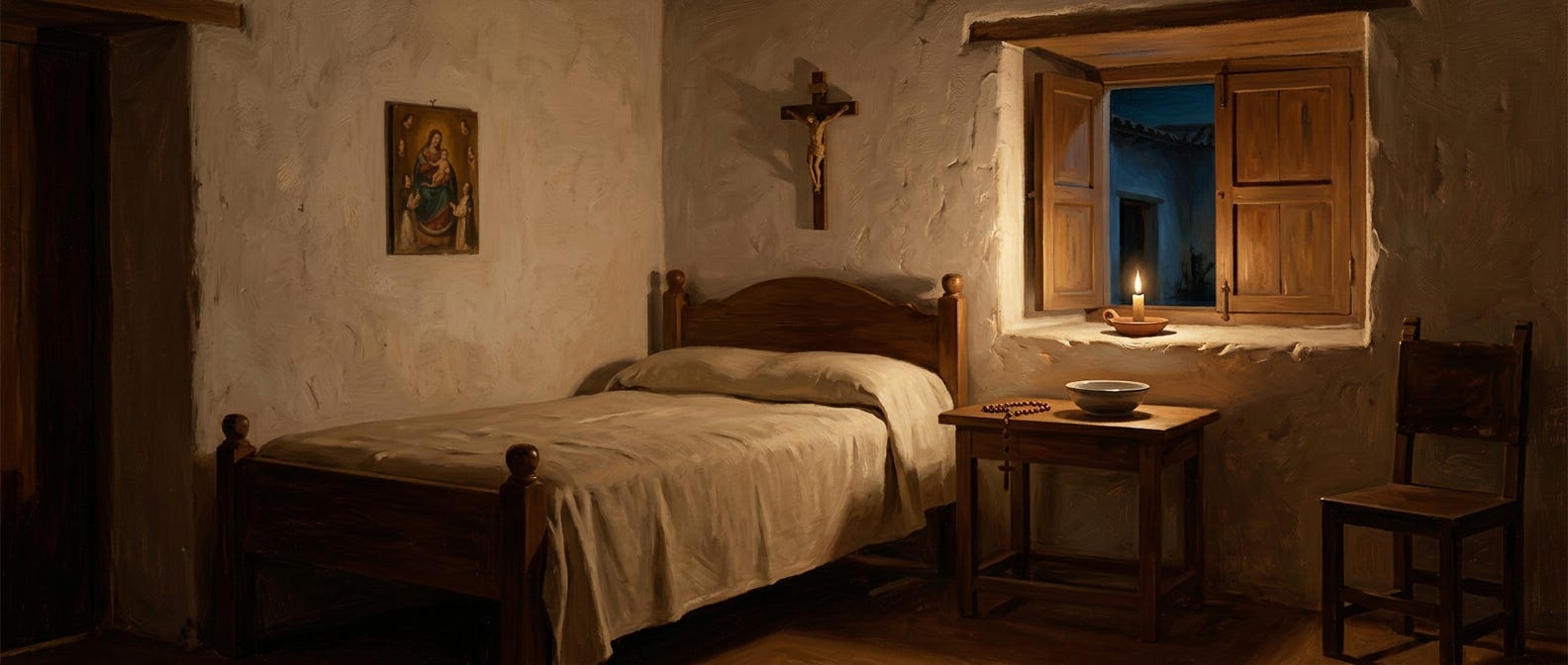
There was the bed, with its plain linen. There was the wooden chair by the window where Mariana sat. There was a small table by the bed with a wooden crucifix and a rosary and a shallow bowl of water. There was the small window with the wooden shutters half-closed against the night air. There was a candle burning in a clay dish on the sill. There was a small painting of Our Lady of the Rosary on the wall above the bed, which Rose had brought from her parents’ house when she had come here three months ago. That was all. That was everything she owned. She had been giving things away for years.
She was thirty-one years old.
She had been born in this city, on the twentieth or the thirtieth of April - her mother had never been certain which - in the year fifteen eighty-six, the daughter of a Spanish father and a Peruvian mother, the fifth of thirteen children. She had been baptized Isabel. She had been called Rosa since infancy, when a housemaid had looked into her cradle and said she is as lovely as a rose, and her mother had decided the housemaid was correct and had used the name ever after. She had spent her whole life in this city. She had never been more than a day’s walk from the house where she had been born. She had thought, when she was younger, that this smallness of geography was a small failing on her part. She had wanted to go on the missions. She had wanted to go to Japan with the Franciscans, or to the Amazon with the Jesuits, or to some frontier where the gospel had not yet been preached. She had asked Our Lord many times whether she might. He had said each time, in the small quiet voice she had learned to recognize, no, Rosa. Lima. Stay in Lima. The mission is here. She had stayed. She was now dying in Lima. She had understood, in the past several years, that the staying had been the mission. The city had needed her. The city had received her. She would leave the city having done what the city had needed her to do. The smallness of the geography had been the correct smallness. She would not have wanted a different one.
She heard Mariana breathing in the chair by the window.
Mariana was asleep. Mariana had been keeping the watch for many hours, and Rose had asked her, at midnight, whether she might sleep for an hour, and Mariana had refused, but at some point after midnight she had lost the fight to keep her eyes open, and now she was breathing the slow soft breath of a woman who has been keeping watch for someone she loves for many nights and who is finally sleeping a little. Rose was glad Mariana was sleeping. Mariana would need the sleep for what was coming. Rose was going soon. She was going, she thought, before dawn. The physicians had said it would be the morning. She thought it would be earlier than that. She thought it would be the small hours.
She whispered, in Spanish, Jesús, esposo mío, ven.
Jesus, my spouse, come.
There was a man standing at the foot of the bed.
She did not know when he had come in. The door was closed. The window was half-shuttered. Mariana was still breathing softly in the chair. And a man was standing at the foot of the bed. He was old. He was perhaps sixty. His skin was dark and weathered, the skin of a man who had spent his life in the sun of the eastern Mediterranean. He wore a plain garment of undyed linen that fell to his knees, cinched at the waist with a wide cloth belt, and a small mantle of coarser wool over his shoulders. His feet were bare. His hair and beard were grey and cut short. His hands were the hands of a man who had worked with his hands - a fisherman’s hands, or a boat-builder’s, or the hands of a man who had learned to sail small boats on a small sea in his youth and had never quite lost the shape of the sailing in his palms. His eyes were dark and very kind.
He said, in a language she did not know, “Sister.”
She heard him. She understood him. She could not have said what language he was speaking. It was not Spanish. It was not Latin. It was not Quechua, which she had learned some of as a girl from her mother’s family. It was a language of stones on a shore and of nets being folded, a language of water and of hands. She heard it. She understood.
“Brother,” she said back to him, in the same language, which she did not know she could speak.
“Sister Rosa. I have come to sit with you until you go.”
She looked at him steadily.
“Who are you.”
“I am one who has been waiting. I am one who was told, many centuries ago, that I would come and see the first of the Americas when she was going. I have been waiting. I did not know it would be a woman in Lima who was neither a nun nor a wife but a Dominican tertiary who lived in her parents’ garden and cared for the sick in a room of the family house. I did not know it would be someone who wore a silver crown of thorns and slept two hours a night. I did not know it would be someone whose beauty had been ruined with pepper and lime. I did not know. The Lord did not tell me until it was almost time. He told me a month ago. I have been preparing since. He gave me the permission tonight. I am here.”
Rose was quiet for a long moment.
“You are one of the Twelve,” she said.
“I am.”
“Which one.”
“Bartholomew. Some call me Nathanael. I was under the fig tree when Philip found me and brought me to him. He looked at me and said behold, a true Israelite, in whom there is no guile. I have wondered, in the two thousand years since, whether he was teasing me. I think he was, a little. He teased. He was gentle with the teasing. I did not always understand at the time. I have understood better in the centuries after.”
Rose almost smiled.
She had not smiled in some days. The muscles of her face were tired from many months of illness. But something in her face moved, and Bartholomew saw the moving, and he almost smiled back.
“You were flayed,” she said, softly. “They took your skin.”
“Yes. In Armenia. Under King Astyages, the brother of Polymios whom I had baptized. It was a long afternoon. They flayed me first and then they beheaded me. I did not enjoy the flaying. I want to say this because the icons and the paintings have made me look serene, and I was not serene. It hurt very much. I do not want you to think, sister, that the taking of the body is easy for anyone. It was not easy for me. It has not been easy for those who came after. It has not been easy for you, either. I know. The Lord knows. He is not asking us to pretend it is easy. He is asking us only to give the body when the time comes. I gave mine in one afternoon. You have been giving yours for eleven years. It is the same giving. He has been receiving both.”
Rose closed her eyes.
She was, she found, weeping. There were no tears - her body had run out of water some days ago - but the interior motion of weeping was there, and Bartholomew saw it, and did not comment on it, and let it pass.
After a while she opened her eyes.
“Brother Bartholomew.”
“Sister Rosa.”
“Tell me about the fig tree.”
“The fig tree.”
“The moment before. Before Philip found you. What were you doing under the fig tree. I have wondered for many years. The Gospel says Our Lord saw you there. He knew where you were. What was He seeing. What were you doing.”
Bartholomew looked at her for a long time.
He did not answer immediately. He seemed to be gathering something, in the way a man gathers something he has not spoken of in a long time and is finding the words for it slowly.
“I was praying,” he said. “I will tell you what I was praying. I was praying that the Messiah would come in my lifetime. I was thirty. I had been praying this prayer for many years - since I had been a boy, really, when my father had taught me to pray it. I had grown up in Cana, in Galilee, and I had spent my whole life praying that the Messiah would come and would find our people, and I had been praying, that afternoon under the fig tree, that if He came in my lifetime, I might be permitted to see Him. I had been praying it very hard that day. I had been fasting also. I was tired. I was leaning against the trunk of the fig tree with my eyes closed and I was saying, over and over, in the small quiet voice that is inside a man when he is very serious, Adonai, if He comes, let me see Him. Let me see Him. Adonai, please, let me see Him. And then Philip came running down the path from the direction of the river Jordan, breathless, and he was calling my name, and he said Nathanael, we have found Him, the one Moses wrote of and the prophets, Jesus of Nazareth, the son of Joseph. And I stood up from the fig tree and I went with Philip. And when we came to Him, He looked at me before Philip could introduce me, and He said behold, a true Israelite, in whom there is no guile. And I said how do You know me. And He said before Philip called you, when you were under the fig tree, I saw you. And I understood, in the small moment of the understanding, that He had heard the prayer. He had heard every word of it. He had been listening. He had come because I - and thousands of others, and my father before me, and my father’s father before him - had been praying for Him to come. He had come because we had asked. He had answered the prayer by walking down the road from the Jordan and letting Philip find Him. That is what I was doing under the fig tree, sister. I was asking Him to come. He was coming as I was asking. He was coming because I was asking. He has been coming, ever since, when the small quiet voices in the small quiet corners have asked Him to come. He comes still. He is coming tonight. He is coming to this room. He is coming for you.”
Rose was smiling now.
The smile stayed on her face for a long moment. It was, Bartholomew thought, the smile of a woman who had understood something she had suspected for years and had never quite had confirmed.
“He came for me too,” she said, softly.
“Yes.”
“When I was five, in the garden of my parents’ house, playing with a doll my mother had made for me from cloth scraps. He came. He said my name. I have never told anyone the exact words. I will not tell you either, brother. But He came. He has been coming to me ever since. I have been asking Him to come, in the small quiet voice, all my life. He has been coming.”
“Yes.”
“I have thought sometimes I was making Him up. Making up the coming. That the coming was a projection of my own longing and not a real coming.”
“You were not making Him up. He was coming.”
“You are sure.”
“I am sure. I have watched Him coming to you for thirty-one years. I have watched Him coming to the small children in Peru who prayed to Him in Quechua before your father was born. I have watched Him coming across the whole of the two continents you were the first-canonized of. He has been coming to the Americas since long before the Spanish arrived. He was here before them. He is here now. He is not brought by the missionaries. He is found by the missionaries in a place where He had already come. The missionaries think they have brought Him. That is a small honest mistake. He is always already here. He was under the fig tree with me. He was in the garden with you. He is in this room now. You will see Him in perhaps twenty minutes. He has been coming a long time. You will not have to wait much longer.”
Rose was silent for some time.
Mariana stirred a little in the chair, in the small way a sleeping woman stirs when the room around her changes without her waking, but she did not wake. Her breathing settled again. The candle on the sill guttered once and steadied.
“Brother Bartholomew,” Rose said, softly.
“Sister Rosa.”
“I have another question.”
“Ask.”
“The Americas. You are here because I am the first canonized of the Americas. That is what you said.”
“Yes.”
“There will be others. After me.”
“Many. In the centuries after you. From every part of the two continents. From the north and from the south. From peoples who do not yet call themselves peoples. From the mountains of Mexico and the valleys of Colombia and the plains of North America and the islands of the Caribbean and the forests of Brazil and the coasts of Chile. From languages that have not yet been born. From the descendants of the Spanish and the Portuguese and the Africans and the indigenous peoples and the mixed peoples the centuries will produce. Many. You are the first. You are not the last. The list will be long. You will be at the head of a great line. That is what a first-canonized is. She is not the only one. She is the one who opens the door. You have opened the door, sister. Many will come through it after you. Some are being born tonight. Some are still to be conceived in the next four hundred years. Some are being formed in seminaries in the twenty-first century as we speak. Some are being martyred in prisons and death squads and drug wars that the twentieth and twenty-first centuries will produce. Some are old women in villages in the Andes who will die known only to their families and unknown to the wider Church, but who will be counted in the Communion regardless, because the counting is much wider than the canonizing. The Americas are a long harvest. You are the first of it. The rest of it has been waiting to come. It is coming.”
Rose closed her eyes for a long moment.
When she opened them she looked at Bartholomew with something like the look of a woman who has just been told she has been made head of a family she had not known she had.
“I am not worthy,” she said.
“No one is worthy of being first. The firsts are not chosen for worthiness. They are chosen for openness. You were open. He came through the opening you made in yourself with the crown and the hair shirt and the eleven years in the garden and the two hours of sleep and the small infirmary in your parents’ house and the servants of the poor you attended and the mothers of the sick children you fed. He came through the opening. The opening is the door He came through. Others will come after you through the same door, but the door was opened by you. That is what being first means. It does not mean being the most worthy. It means being the one who opened the door.”
Rose was weeping again, without tears.
She was, she thought, ready.
“Brother,” she said. “Stay.”
“I will stay.”
“Until He comes.”
“Until He comes. Then I will step back. I will not be at the front when He arrives for you. He and you will have your moment. I will be in the back with the others who have been assembling. There are many. Catherine of Siena is here - she has been waiting for you since she died in thirteen eighty. She is very fond of you. She wants to meet you formally, as one Dominican tertiary who lived at home to another. She has been anticipating this night for two hundred and thirty-seven years. She will be at the door with me. She will nod. You will nod back. Then Our Lord will step forward. You will not need me from that point. I will slip out. It is the arrangement.”
Rose smiled again.
“Catherine.”
“Yes.”
“She was the reason I chose the third order and not the enclosed cloister. I read her Dialogue when I was fifteen. I decided if she could live at home in Siena and be a saint of the Lord, I could live at home in Lima and try to be one also. She has been the older sister I did not have. I am glad she will be at the door.”
“She is very glad also.”
They were quiet.
The candle guttered again. This time it did not steady. The flame narrowed. The small pool of wax in the clay dish was almost gone.
Rose whispered, Jesús, esposo mío. Aumenta mis sufrimientos y aumenta con ellos tu amor en mi corazón.
Bartholomew inclined his head.
“He is coming, sister.”
“Yes.”
She closed her eyes.
She heard, in the moment before the coming, the small quiet voice she had heard all her life, saying her name. She turned toward it. She did not need to turn her body. The turning was interior. The Lord was there. He was smiling. He was, as the boy from Numidia had told the two Maximilians and as the apostle from Cana had confirmed to her, laughing gently. The laughing was the welcome. She walked into it.
Bartholomew stepped back into the shadows.
Catherine of Siena was at the door in the Dominican habit, smiling.
Rose walked past her. Rose paused. Rose nodded. Catherine nodded back. Rose kept walking. She walked into the arms of Her Lord.
The candle in the clay dish on the sill guttered a final time and went out.
Mariana woke.
She looked at the bed. She saw immediately what had happened. She rose from the chair and came to the bed and knelt beside it and took Rose’s hand. Rose’s hand was still warm. Mariana held it. Mariana wept quietly, without waking the house, in the small dignified weeping of a woman who has been preparing for this moment for many months and has known it was coming and has still not been ready.
She prayed the small prayers for the newly dead in Spanish under her breath.
She kissed Rose’s forehead.
She rose and went to wake Doña María.
The house of Don Gonzalo de la Maza woke to the news within the hour. The city of Lima woke to it within the day. The funeral was held on the twenty-fifth. Every parish sent representatives. The archbishop presided. The Dominicans provided the burial. She was interred in the Church of Santo Domingo in Lima, where her remains have rested since.
Rose of Lima was beatified in 1667 by Pope Clement IX. She was canonized on April 12, 1671, by Pope Clement X - the first canonized saint born in the Americas. Her feast is August 23 in most of the Church, and August 30 in some Latin American countries. She is the patroness of Peru, of all of Latin America, of the Philippines, of the Indies, and of gardeners and embroiderers and florists.
Bartholomew keeps his list.
The list is long now. Many have come through the door Rose opened. The list has grown across four centuries: Martín de Porres, Toribio de Mogrovejo, Juan Diego, Rafael Guízar, Miguel Pro, Junípero Serra, Katharine Drexel, Kateri Tekakwitha, Elizabeth Ann Seton, Damien of Molokai, Oscar Romero, Alberto Hurtado, José Sánchez del Río, Rutilio Grande, José Gregorio Hernández, Carlos Manuel Rodríguez, and many, many others - some canonized, some beatified, some declared Servants of God, some known only in their villages and yet counted in the wider list that Bartholomew keeps and that only the Lord fully sees.
The list continues.
The door Rose opened has not closed.
Many are still coming through.
The lamp in the small guest room in the house of Don Gonzalo de la Maza burned out at dawn, as lamps do, on the morning Rose of Lima went home.
Bartholomew, on the other side, was very pleased.
He had been asked, once, whether he wanted to be shown the whole of the list of those who would come through the door of any given first-canonized. He had said yes. The Lord had shown him. He had wept for many days. He had said, when the weeping was finished, Adonai. I did not know. I had not known.
The Lord had said, gently, Nathanael. Now you know.
Bartholomew keeps watching.
The list keeps growing.
For your prayer this week: Saint Rose of Lima and Saint Bartholomew the Apostle, you who were the first canonized of the Americas and you who were among the first apostles, you who ruined your beauty with pepper and lime and you who were flayed alive at Armenia, you who opened the door and you who watch the door, pray for those of us who are the firsts of small things - the first in our families to believe, the first in our workplaces to speak, the first in our neighborhoods to try. Grant us the grace to trust that the opening of the door is the vocation, that many will come through it after us, and that the counting is much wider than the counting we have been told. Amen.
Two Lamps returns next Friday: Saint Gregory the Great and Saint Augustine of Canterbury, the small chapel at the monastery of St. Andrew on the Caelian Hill in Rome, the evening before Augustine's departure for the mission to the Angles, in the summer of 596.
Two Lamps is a weekly short story braiding the lives of two or three saints across the centuries. Sometimes the meeting is rendered as an encounter in eternity. Sometimes as the older saint coming, in vision or in patronage, to the soul of the younger. The text does not decide for you. The Communion of Saints is the doctrine that holds these meetings as theologically real even when the meeting itself is imagined.
Two Lamps is written by Deacon Michael Halbrook, a permanent deacon of the Diocese of Springfield in Illinois, serving at St. Elizabeth Parish in Granite City. He writes personally at DeaconMichael.net, serves families through Domus Formation, and publishes the serial novel Ordo: A Chronicle of Lux Perpetua at LuxPerpetua.net. Two Lamps is co-conceived with his son Joseph.
Just wonderful…and I to have always wondered what JESUS meant too