

He could not move his legs.
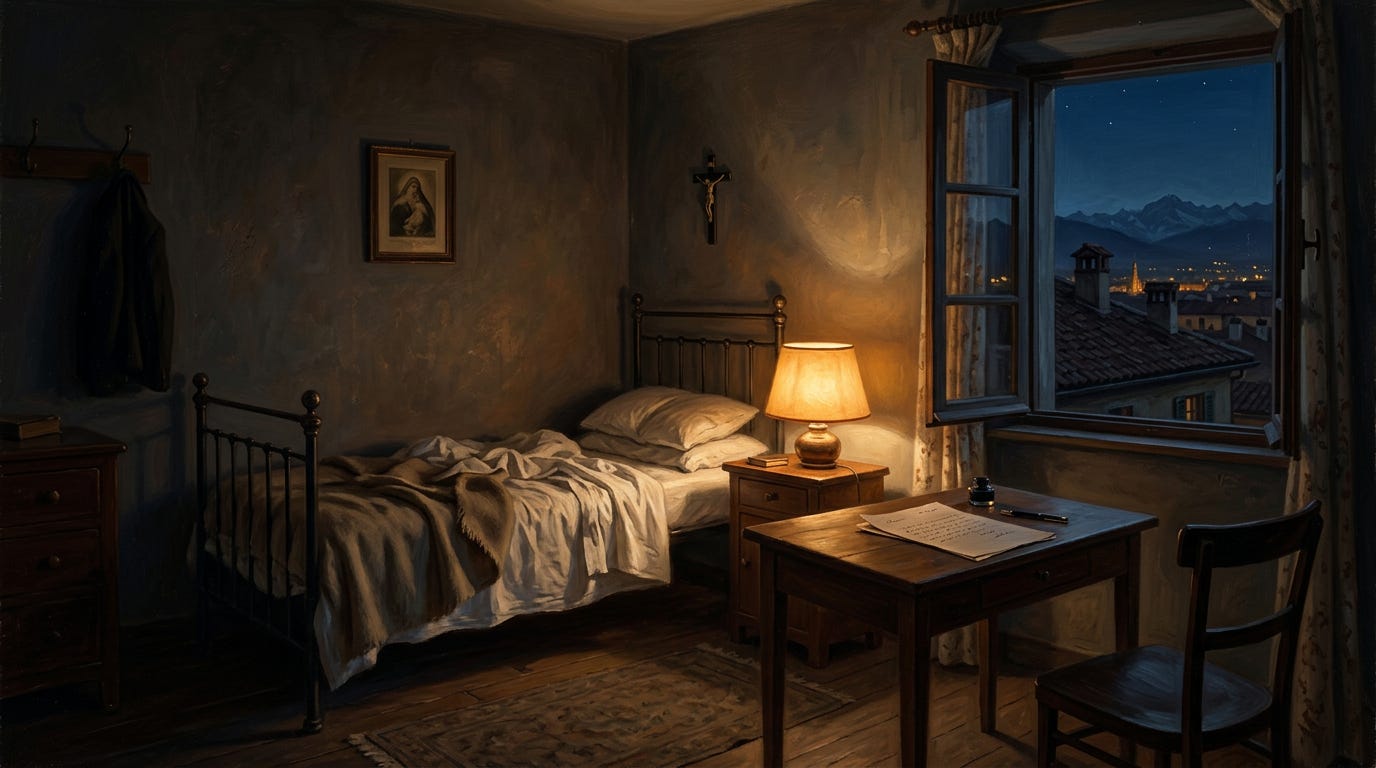
Pier Giorgio lay on his side in the narrow bed in the upstairs bedroom of his parents’ house on Via Lamarmora, with his right hand still working enough to hold the pencil and the small piece of paper, although the holding was effortful and the writing came out badly. He had asked Luciana to bring him the paper and the pencil an hour ago. She had brought them. She had cried a little when she set them on the bedside table. She had gone back downstairs. He had begun the note. The note was for Marco. Ecco le iniezioni per Converso. La polizza è di Sappa. L’avevo dimenticata; rinnovala per me. Here are the injections for Converso.
The pawn ticket is Sappa’s. I had forgotten it; renew it on my behalf. The writing had taken him perhaps twenty minutes. His handwriting, normally so confident, looked like a child’s. He did not mind. The note would be understood. Converso would get the medicine. Sappa’s pawn ticket would be renewed. Two small things would be taken care of. He could die.
He laid the pencil down.
It was a little after eleven at night. The house was quieting. His mother had gone to bed an hour ago in a state of distraction that was partly the polio and partly the death of his grandmother that afternoon. His grandmother had died at three. They had been so taken up with her dying that no one had noticed he was dying also. He had not wanted them to notice. He had told no one how bad it had become. He had let them grieve for his grandmother, who deserved it, and he had kept his own thing to himself, because he had decided some hours ago that the small dignity of dying without becoming the family’s main event was the last gift he could give them.
The doctor had come in the afternoon. The doctor had diagnosed fulminant poliomyelitis and had said, quietly, to his mother, that it would be a matter of hours rather than days. His mother had nodded. She had not yet been able to cry. The crying would come later. He understood his mother. He had spent his whole life understanding his mother. He had made it his business to understand both of his parents, because their marriage had been failing for some years and the small acts of understanding had been the only weapons he had ever found against the cold weather in the house.
He turned his face toward the window.
The window was open. The Turin summer night was warm and still and he could see, beyond the rooftops, the small lights of the city going up the hill toward the Basilica of Superga, where his grandmother would be buried in a few days, and where he supposed he would also be buried, although the burial was not his matter to arrange. He could hear, faintly, the bells of a distant parish church ringing the eleventh hour. He liked the bells. He had loved bells all his life. He had taken Communion every day for as long as the parish priests had let him, which was many years, and the bells had been part of the rhythm of those days, and the bells were the rhythm he would carry with him into whatever came next.
There was a young woman sitting on the small chair by the window.
He had not heard her come in. He turned his head slowly toward her, because the turning was now an effort, and he saw her in the lamp light from the small bedside lamp - the only light in the room, because his mother had thought too much light would tire him - and his first thought was that one of Luciana’s friends from the convent school had come up to sit with him, which would have been a kindness but a strange one at this hour. He looked more carefully.
She was not one of Luciana’s friends.
She was perhaps twenty, perhaps twenty-three, perhaps a little older or younger - he could not quite tell, in the way that one cannot quite tell the age of certain faces. Her skin was a deep brown. Her hair was very black and was bound in two braids that fell down past her shoulders. She wore a long simple dress of softened deerskin, with quill-work decoration along the hem and at the shoulders, and a small wooden cross on a cord around her neck. Her face was scarred. He could see the scars even in the soft light - small pitted marks across her cheeks and forehead, the marks of a smallpox a long time ago. Her eyes were dark and very steady. She was looking at him as though she had been looking at him for some while and would not be hurried.
He was twenty-four. He had spent a great deal of his life among the poor of Turin, and he had seen many kinds of people in many kinds of conditions, and he had become hard to surprise. He was not surprised now.
“Buona sera, signorina,” he said, very softly, in the voice he had left.
She did not answer in Italian.
She answered in a language he did not know. It was a soft language with many vowels, a language that moved like water moves over rocks. He understood her entirely. He could not have said how he understood her. He had spent his life among languages - Italian and Latin and French and a little German from his father’s diplomatic years - but this was not one of those languages. This was a language he had not learned and was nevertheless understanding.
She said: Brother. I have come to sit with you tonight.
He looked at her.
“You are not from here,” he said, also softly.
“No.”
“You have come a long way.”
“I have come no distance at all.”
“Then I have.”
“No,” she said. “You have not moved from your bed. I have come to where you are. That is what we do. We come to where one another are. It is how we know one another. It is what the room above the room is for.”
He did not understand what she meant about the room above the room. He let the phrase sit. He had spent his life learning to let things sit when he did not yet understand them. The understanding usually came later, if it came at all, and the not-understanding was not a defect.
“What is your name,” he said.
“In my language I was called Tekakwitha. She-who-bumps-into-things. They called me that because the smallpox had made my eyes weak and I could not see well in bright light and I would put my hand out in front of me when I walked, the way a child does, to keep from running into the doorframes. The name stayed with me even after my eyes had grown a little stronger. The Black Robes baptized me Catherine, after the saint of Siena who they thought I should love. I came to love her also. They called me by the form of her name in our language, which is Kateri. Kateri Tekakwitha. Catherine, she-who-bumps-into-things. That was my name in life. That is my name still.”
He looked at her.
“You are the Mohawk one,” he said.
“Yes.”
“The young woman. From the missions. In the New World.”
“Yes.”
“I have read about you. There is a small biography in the library at our parish. The Jesuit priests in Quebec wrote it after you died. I read it when I was sixteen. I was struck by it. I had not expected to be struck by it. I had thought it would be a story about a savage woman who had been civilized by the missionaries, because that is how the books at our school told these stories, and I had been prepared to be moved in a small condescending way. But the book was not that. The book was about a young woman who had heard the Lord through the people who were sent to her and who had then walked - I have not forgotten this - who had walked two hundred miles through the forest at the age of nineteen because the village she came from would not let her practice her faith. I have thought about you many times. I have not always known why I was thinking about you. I think perhaps I have been thinking about you because I have lived all my life in a house where it was a little difficult to practice the faith, and you walked two hundred miles to find a house where it would be easier, and I have admired the walking. I have not done it myself. I have stayed in the difficult house. The staying was my way. But I have admired the walking.”
She listened.
When he was finished she inclined her head.
“You have done your own walking,” she said.
“Have I.”
“You have. The walking does not have to be in the forest. The walking can be up and down the streets of Turin with a cart of clothes for the poor families that have been evicted. You have done a great deal of that walking. I have been watching it.”
“You have been watching.”
“Yes.”
“For how long.”
“Since you were a child. Since the time when you took your shoes off your own feet, in the doorway of your parents’ house, and gave them to the small boy who had no shoes. You were six years old. I was watching then. I was watching because the Lord had given me the watching of certain young people who were going to live shortened lives and were going to live them well. He gave me your watching when you were a baby. I have been at it for a long time, brother. I have been at it for twenty-four years.”
He closed his eyes.
He had not cried often in his life. He had been a young man of gladness, and his friends had called him Frassati of the Beatitudes because of the gladness, and the gladness had been real. But he was crying a little now. The crying was a small slow thing that he could not have stopped if he had wanted to, and he did not want to. He let it come. The young woman from the missions did not look away. She kept her eyes on him. The watching of him, she had said. She had been at the watching of him.
When he could speak again he said, “Why have you come tonight.”
“Because tonight is the night.”
“Yes.”
“And because I died at twenty-four also, brother. I was twenty-three years and some months. I had been ill for some time. The illness was not polio. It was, the priests thought, a fever that took me because my body had been weakened by smallpox in childhood and by the things I had done to my body afterward, which were not all of them wise. The Lord forgave me for the things that were not wise. The Lord has forgiven everyone for the things that were not wise. He does not hold them against us. I tell you this because I have been told that you also have done some small things to yourself that were not wise. You have given away your shoes more times than was prudent. You have given away your bus fare more times than was prudent. You have caught your polio because you went into the houses of the poor when the polio was in the houses, and you did not stop going. The doctor will think this was a small thing of imprudence. The Lord does not. The Lord uses what is given to Him. The shoes were given. The bus fare was given. The visits to the sick houses were given. You did not waste them. The Lord did not waste them either. He has used them. He is using them tonight. He is using them in the room above the room, where I have come from.”
He was quiet for a moment.
“Tell me about the room above the room,” he said.
She smiled, faintly.
“It is what we say, in the place where I am, when we speak of where we are. We are above the rooms of the living. We can see the rooms. We can see into them when the Lord lets us. We are not far. We are not in another world. We are in the room above the room. We attend the rooms below us. We pray for the people in them. We come down when we are sent. Tonight I have come down. I will go up again before the morning. You will come with me. We will go up together.”
“Together.”
“Together.”
He was quiet for a long time.
The bells of the distant parish church rang the half-hour. Eleven-thirty. The Turin night was deep around the house. Somewhere in the house, downstairs, he could hear his sister Luciana speaking very softly to someone - to the maid, perhaps, or to Marco who had come earlier. He could not make out the words. He did not need to.
“Sister Kateri,” he said.
“Brother Pier Giorgio.”
“I have a question.”
“Ask.”
“There is a girl. Her name is Laura. I have loved her for some time. I have not told her. I have not told her because my parents are unhappy with each other, and I did not want to add another difficulty to the house, and because I knew that my father would not have approved of her family, who are not of our social position, and because I have always been able to set aside what I want for what would keep the peace in the rooms I live in. I have set aside Laura. I have prayed for her. I have prayed that she will find a good husband and that the Lord will bless her with many children and that she will not waste her life waiting for someone who is not going to come. I have done all the right things. I think I have done them. But I am asking you. Did I do the right thing. Should I have told her. Should I have said to her, Laura, I love you, I would marry you if I were a different man with a different family. Should I have said it. I am asking because you will know.”
She was silent for some while.
“I will tell you what I think,” she said. “I will not tell you what is the case. The Lord will tell you what is the case, in a few hours, and He will not need my opinion. But I will tell you what I think, because you have asked.”
“Yes.”
“I think you did what you could. I think the love you carried was real. I think the love you did not declare was as real as the love you might have declared. I think Laura will know, when the Lord lets her know, that she was loved by you. I think she will be at peace with that knowledge. I think she will marry, in time, and she will have a good life. I do not think you wasted the love. The love was offered. It was offered silently, the way many of the best offerings are offered. I myself never married. I never had what is called the love of a husband. I had what was called instead the love of the Lord, and the love of the small community of women at Kahnawake who became my sisters. I have not regretted what I did not have. I think you also will not regret what you did not have. The Lord uses what is given to Him in whatever shape it comes. Your shape included an undeclared love for Laura Hidalgo. The undeclared love was part of the shape. The shape was good. It was the shape He wanted from you. Do not be afraid that you did wrong.”
He nodded, slowly, because the nodding was now also difficult.
“Thank you,” he said.
“Brother.”
“I have one more question.”
“Ask.”
“The mountains. I have loved the mountains. I have said, since I was a boy, Verso l’alto. I have said it to my friends and I have written it in my letters and I have meant by it both the mountains and the heaven they pointed toward. I have not climbed any mountains in the past months because my body was beginning to refuse them, and I have grieved that a little. I would have liked one more climb. I would have liked one more morning on the Grigna or one more afternoon at the Sanctuary of Oropa with my friends, with the wind in the larches and the long view toward Monte Rosa. I will not have it. I am asking. Will there be mountains.”
She smiled.
It was the first time she had smiled fully, and the smile transformed her face, and he saw, beneath the smallpox scars, the young woman she had been at twenty when the Jesuit Father de Lamberville had baptized her and she had stood in the longhouse of her uncle with the new name they had given her, Catherine, Kateri, and the smile had been on her face then also, and it was the same smile.
“Brother,” she said. “I lived all my life in forests. I lived between two rivers - the Mohawk in my homeland, the St. Lawrence in my exile. I lived with the cedars and the birches and the maples and the long autumns when the leaves go red. I died young, as you are dying young. I went up. I went up to the room above the room. And I will tell you a thing that I would not have believed if I had been told it in my longhouse at Ossernenon when I was a girl. There are mountains. There are more mountains than there are in your Italy or my America. There are mountains that have been made for the souls who loved mountains in their bodies. The Lord has not wasted what He put in us. The mountains in your body are about to become the mountains in your soul. Verso l’alto, brother. You said it for twenty-four years. You will say it for the rest of forever. The going up is what you were made for. The going up has been waiting for you. It begins tonight.”
He was crying again. He did not try to stop it.
He whispered, Grazie.
He whispered, Sister.
He whispered, Verso l’alto.
She rose from the chair by the window. She came to the bedside. She laid her brown hand on his forehead. The hand was cool. The fever, which had been climbing again, did not break but quieted. She stood beside him for a long moment. He closed his eyes. When he opened them she was gone.
The chair by the window was empty.
The window was still open. The Turin night was still warm. The bells of the distant parish church rang the three-quarter hour.
Luciana came up at midnight. He told her he was peaceful and that she should sleep. She kissed his forehead. She went down.
He lay quietly through the small hours.
At three in the morning the priest came. He made his last confession. He received the last anointing. He received the Eucharist. He thanked the priest. He said, very quietly, in the voice he had left: Jesus, Mary, Joseph; I give you my heart and my soul.
He drifted.
At seven in the evening of the fourth of July, in the year nineteen twenty-five, he died.
He was twenty-four years and three months old.
The streets of Turin were filled the next morning with thousands of the poor - the people he had served secretly all his life, whom his parents had never met, whom his sister had never quite understood - who came in long quiet rivers from every quarter of the city to the funeral cortege, and who walked behind the coffin all the way to the Frassati family tomb at Pollone, and who astonished the family by their numbers and by their grief and by the small whispered word that went through the crowd as the coffin passed: Frassati. Frassati. The young one.
In the room above the room, Kateri was waiting.
When he arrived she smiled, and she took his hand, and she turned him toward the mountains.
There were many mountains.
The going up began.
The lamp in the bedroom on Via Lamarmora burned out at dawn, as lamps do, on the morning of the funeral.
For your prayer this week: Saint Pier Giorgio Frassati and Saint Kateri Tekakwitha, you who died at twenty-four and you who died at twenty-four, you who walked the streets of Turin with carts for the poor and you who walked two hundred miles through the forest to find a house where you could practice your faith, pray for those of us who have loved young and have set aside what we could not have, who have served quietly without telling anyone, who are not always sure that what we have done has been received. Grant us the grace to trust that the shape we were given was the shape He wanted, that the love we offered silently was as real as the love we declared, and that there are mountains waiting for those who loved them. Amen.
Two Lamps returns next Friday: Saint Benedict of Nursia and Saint Brigid of Kildare, the small wooden cell at the monastery of Kildare, Ireland, an evening in the late summer of 524.
Two Lamps is a weekly short story braiding the lives of two or three saints across the centuries. Sometimes the meeting is rendered as an encounter in eternity. Sometimes as the older saint coming, in vision or in patronage, to the soul of the younger. The text does not decide for you. The Communion of Saints is the doctrine that holds these meetings as theologically real even when the meeting itself is imagined.
A note from the author: Saint Pier Giorgio’s motto Verso l’alto - “to the heights” - anchors a small leadership project of mine called Ad Alta Leadership. I have lived with that phrase for many years. To write this issue in his company has been an unexpected gift. He was canonized by Pope Leo XIV on September 7, 2025, alongside Saint Carlo Acutis. The Church is still adding saints to the long list, and the list reaches us in time to be a help to us.
Two Lamps is written by Deacon Michael Halbrook, a permanent deacon of the Diocese of Springfield in Illinois, serving at St. Elizabeth Parish in Granite City. He writes personally at DeaconMichael.net, serves families through Domus Formation, and publishes the serial novel Ordo: A Chronicle of Lux Perpetua at LuxPerpetua.net. Two Lamps is co-conceived with his son Joseph.