

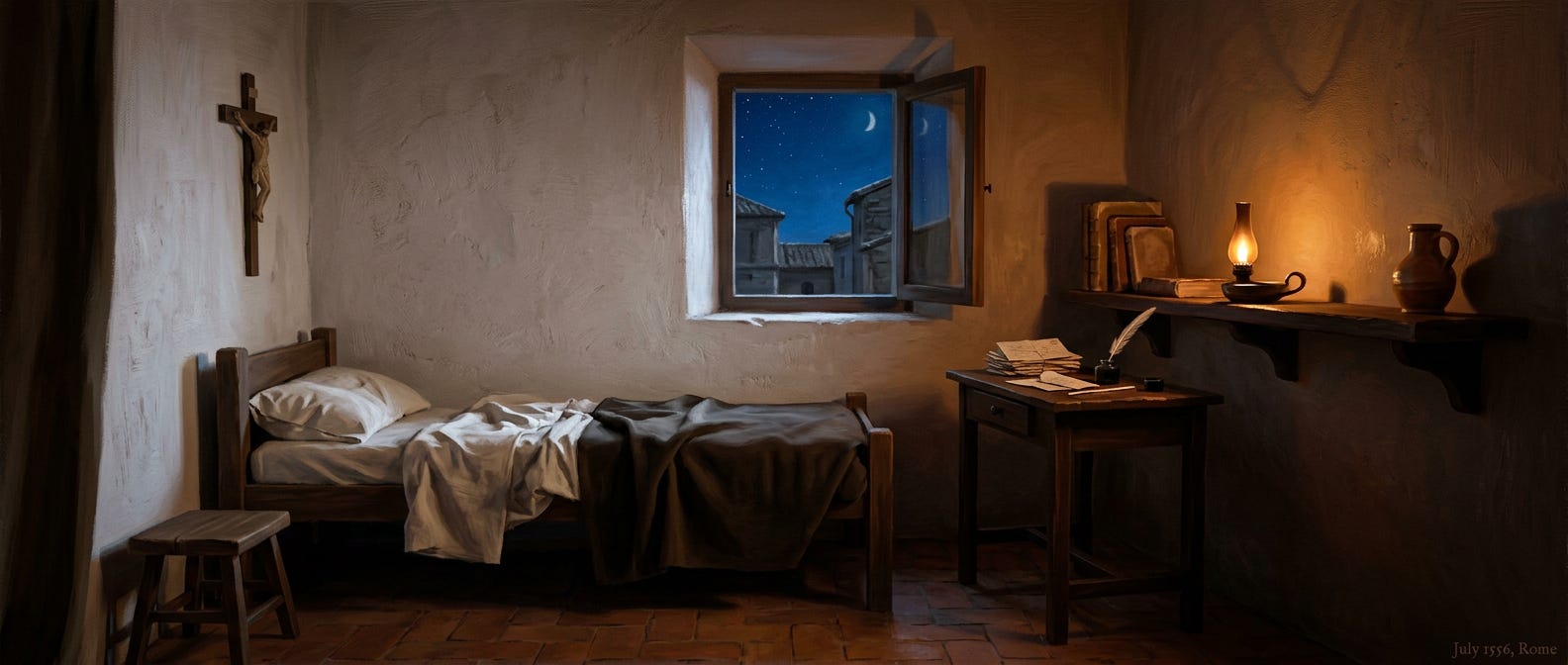
On the night of July 30 into July 31, 1556, the dying Ignatius of Loyola lay in his small room at Santa Maria della Strada in Rome, having asked for the papal blessing that his secretary would fail to send in time - and Saint Bridget of Sweden, who had died in Rome one hundred and eighty-three years earlier, came to sit with him and arrange the forgivenesses in advance.
He had asked for the blessing.
Ignatius lay on the narrow cot in the small room off the corridor at La Strada, in the house the Society had built beside the church of Santa Maria della Strada in the heart of Rome, and he had asked his secretary Juan de Polanco to send at once to Pope Paul IV for the apostolic blessing. It was the evening of the thirtieth of July. He had known since noon that he would not see another sunset. The knowing was not dramatic. It was the small quiet certainty that men who have been dying for a long time develop in the hours when the dying is finally finishing. He had asked for the blessing calmly. Polanco - who had been his secretary for many years, who had translated his correspondence and organized his notes and taken his dictation for the Constitutions and for the small autobiography he had reluctantly agreed to give in the years between 1553 and 1555 - had bowed and said he would send at once. Polanco had then stepped into the corridor and had not sent.
Ignatius did not know that Polanco had not sent.
Ignatius, who had spent his life training men to discern the movements of the Spirit in the smallest interior motions of the soul, could not discern that his own secretary had, in a small human failure of nerve, decided to wait until morning rather than trouble the Pope at dinner. Polanco loved him. Polanco was the last man in the world who would have wished him harm. Polanco had simply thought - as men often think in the hours when one they love is dying - that the request could be delayed a few hours, that the master would surely live until dawn, that the Pope’s dinner should not be interrupted, that it would be more seemly to send in the morning. Polanco was wrong. Polanco would understand at dawn that he had been wrong, and would carry the wrongness with him for the rest of his life, and would confess it to his own confessor many times over the years, and would receive absolution each time, and would still carry it. That was Polanco’s matter. It was not yet time for Polanco’s matter.
Ignatius, in the small room, lay in the summer heat.
The window was open. He could see, past the shoulder of the young brother who was sitting with him and watching for any request he might make, the small square of Roman night sky above the courtyard. The stars were out. The Romans had a summer sky in July, when the heat lifted in the evenings and one could see clearly to the constellations, and Ignatius had loved the Roman sky in the years since he had settled here. He had been in Rome for sixteen years. He had come in 1540, five years after Paris and Venice and Palestine and the long slow gathering of the men who had become the first companions. He had not left Rome since. The Society had grown around him. There were now more than a thousand priests wearing the black cassock of the Company, from the Congo to the Ganges, from Peru to Kyoto. He had directed them all from this small room, more or less, for sixteen years. The desk in the corner still had his letters piled on it in the small orderly way he had maintained to the last. He would not answer them. Polanco would answer some of them. The Society would answer the rest. It would go on without him.
He shifted slightly on the cot.
The pain in his abdomen, which had been his constant companion for the past six or seven years, was quiet tonight. He was grateful for the quietness. He had been in agony many times over the years - the gallstones, or whatever it was that the physicians had failed to diagnose, had visited him with sharp attacks that had left him white and shaking. The last months had been steadier. The pain had become continuous but low, a small dull weight that he had learned to carry without complaining. He had preferred the low continuous pain to the sharp episodic pain. The sharp had been more difficult to offer than the dull. The dull had become nearly a friend. He had, in the past year, sometimes thanked it in his prayer.
He whispered, in the Basque of his childhood, “Aita, ez naiz beldur” - Father, I am not afraid - and then, more quietly, in Castilian, “Dios mío. Dios mío.” My God. My God.
The young brother at the bedside heard him. The young brother wrote it down. The whisper would be preserved.
There was a woman standing in the corner of the room by the window.
Ignatius had not heard her enter, and the young brother had not seen her, and the door had not opened, and yet she was there. She was old. She was perhaps seventy. Her hair, under a simple black veil, was white. She wore a heavy dark habit of a cut he did not immediately recognize - a long tunic of grey wool over a black scapular, and over that a black cloak, and at her belt a small crown of five red stones on a leather cord. He looked at the crown for a long moment before he understood what it was: the five wounds, in the Bridgettine style. He had never seen the actual habit but he had read about it. He had corresponded, some years ago, with the abbess of a Bridgettine house in the Netherlands about a matter of the Roman rite. He knew the habit.
She was Bridget.
He knew this before she spoke. He knew it in the quick interior recognition that his own Spiritual Exercises had trained him to notice - the small movement of the soul when the true meets the true, before the reasoning gets to work on the recognition. The recognition happened. He accepted it. He looked at her steadily.
He tried to speak. His voice was very small now.
“Sister,” he said, in the Latin he had learned late in life at the University of Paris and which he had always spoken with a Spanish accent that he had never quite lost.
“Brother,” she said, in a Latin that was better than his - the Latin of a Swedish noblewoman who had spent twenty-four years in Rome and had learned it well.
The young brother did not turn his head. The young brother saw only Ignatius. Ignatius understood that the woman was here for him and not for the young brother, and that she was here quietly and did not wish to be observed by others. He accepted this too.
“You have come a long way,” he said.
“I have come no distance at all. I have not left Rome. This is where I died. This is where I am.”
“Yes. Of course. I am sorry. My mind is not working the way it usually works.”
“You are dying. Your mind does not need to work. My mind was worse than yours by the end, and I did not have your training. It did not matter. It does not matter tonight. Do not concern yourself with the working of your mind. It will not be asked of you tonight.”
He almost smiled.
The almost-smile moved across his face. She saw it. She did not smile back, but her eyes softened, and she came a small step closer to the cot. She stood beside him. She looked down at him. He was a small man in his last hours, sixty-four years old, with a Basque face and a Spanish beard and a body that had been carrying a limp since Pamplona in 1521 and a torment in the belly since the middle 1540s, and he looked to her as though he was ready to go. She was pleased that he was ready. Some were not, when she came for them. He was.
“I have come to sit with you for a little while,” she said. “The Pope will not send the blessing tonight. Your secretary meant to send it. He has not sent it. He has decided to wait until the morning. He is wrong to wait. He will grieve it, later. I tell you this so that you may forgive him now, in advance, so that when you meet him again in the room where I am waiting, the forgiveness will already have been arranged. He will not know the forgiveness is arranged. He will know it when he comes home. That is often how it works.”
Ignatius nodded, very slightly.
“Polanco,” he said.
“Yes. Polanco.”
“He is a good man.”
“He is a good man who made a small human decision that turned out to be a small human mistake. I have made many. So have you. So has every man who ever loved another and thought he was helping. I am telling you because your body is going to die without the apostolic blessing, and I do not want you to spend your last hours thinking, in the back of your mind, that this is a small failure at the end of your life. It is not a failure. The Lord does not need the Pope’s paper for you tonight. He has other paper. He has the paper you have been writing yourself for sixteen years in this room and for many years before that. He does not need to add his signature. His signature is already there. Rest, brother.”
Ignatius closed his eyes for a long moment.
When he opened them she was still there. The window behind her framed a small piece of the Roman sky. He could see one bright star just above her left shoulder.
“You are a mystic,” he said, slowly, choosing his words. “You saw many things in your life. Visions of Our Lord’s Passion. Revelations. Locutions. You wrote them down. Your daughter Catherine gathered them. They have circulated for two hundred years. I have read them, some of them. I have found them - “
He paused.
He did not want to say the wrong thing.
“You have found them difficult,” she said, calmly.
“Yes.”
“Because you did not experience the Lord that way. Because your training was different. Because you gave the world the discernment of spirits, which is the tool for men who do not have visions, which is most men, and my writings did not fit the shape of what you had learned to trust. I know this. I have known it for two hundred years. You are not the only Jesuit who has found me difficult. It is understandable. It is even correct, in a certain sense. You should not read my Revelations as a manual. They were not a manual. They were the Lord speaking to one woman, in one country, in the fourteenth century, about one set of matters. They were not meant to become a system. They were meant to be received by me, and to be preserved, and to be read by those to whom they would speak. To many they have not spoken. They have not needed to. They spoke to those they spoke to. That is how it works with visions. Not everyone needs the same food. I did not eat what you ate. You did not eat what I ate. The Lord fed us both.”
Ignatius nodded.
“I have wondered,” he said, “whether I should have written differently about the visions. In the Exercises. I wrote about the movements of the spirit. I did not write much about the direct vision of the Lord’s face. I thought it was a rare grace, and that most men should not seek it, and that the ordinary paths were the paths of consolation and desolation and the small interior movements that anyone could learn to notice. I stand by what I wrote. But I have wondered whether I underweighted the direct grace. I have wondered whether the Society, in the centuries to come, will underweight it because of what I wrote.”
She looked at him for a long moment.
“You wrote what you were given to write, brother. I wrote what I was given to write. The Church has both. The Church has needed both. There have always been contemplatives who saw the Lord’s face, and there have always been men and women who did not see the Lord’s face but who learned to feel Him moving in the small interior weather of their souls, and both are given by the same Spirit. The Church needs the Exercises. The Church needs the Revelations. It also needs neither, sometimes; the peasant woman who prays her rosary in a small church in Umbria does not need either the Exercises or the Revelations, but she is loved as much as we are. The Lord uses what is given to Him. He is not economical. He gives all the different ways of coming to Him because all the different ways of coming to Him are needed. Do not worry that you underweighted. You wrote for many. You did not write for all. That is the correct way to write, brother. No man writes for all. Only Scripture is for all. Everything else is for some.”
Ignatius let out a small breath.
The breath was a small releasing of a small worry he had carried for years, and had never quite named, and now had named because the woman across from him had helped him name it and had then answered it. He had not known she was going to answer it. He was, he found, grateful.
“Thank you, sister.”
“Brother.”
The young brother at the bedside stirred slightly. He was tired. He had been sitting with the Father General for many hours. He would be relieved by another brother at the third hour of the night, but the third hour was still an hour away. He looked at his master. The master was quiet. The master appeared to be praying with his eyes half open. The young brother did not disturb the praying. He shifted slightly on the wooden stool and continued his watch.
Ignatius looked at Bridget.
“You died in Rome.”
“Yes. In a house near the church of San Lorenzo in Panisperna. On the twenty-third of July. In 1373. I had been in Rome for twenty-four years. I had thought many times of returning to Sweden, and I had not gone. Rome held me. I did not entirely understand why. I understand better now.”
“Why.”
“Because certain saints are given to certain cities. I was given to Rome, in a way that only became clear after I died. My daughter Catherine took my body back to Sweden - I asked for that - but my soul had been anchored here, in the city of Peter, in the city where I had spent the last third of my life, and the anchoring did not move when my body moved. I have been in Rome ever since. I attend the Roman dying, sometimes, when the Lord sends me. Tonight He sent me for you. You are one of Rome’s now, brother. You have been for sixteen years. You will be, forever. The Society you founded is the Roman society in the deepest sense - it comes from here, it serves here, it is sent from here to the world. You have become one of the city’s own. Rome will hold you as it has held me. You will not go home to Loyola. You will go home to God, and the going will be from Rome, and Rome will keep a piece of you here. The Gesù will be built, in about thirty years. Your body will lie in it. Pilgrims will come to it for many centuries. You will not mind.”
Ignatius closed his eyes again.
He was very tired.
He was tired in the particular tiredness of a man who has been given many gifts in his last hours and who has now received all the ones he needed to receive, and who understands that the next thing is the sleep from which he will wake into the face of the Lord.
“Sister.”
“Brother.”
“Will you stay.”
“I will stay. I will stay until you go. And I will be there when you arrive, in the room where you are going. I will not be the first to greet you. Your companions will be first - Francis Xavier, Peter Faber, Diego Laínez when he comes, Alfonso Salmerón when he comes. They will be at the door. I will be a little behind them, in the back. I will nod to you when you see me. That is all. That is enough. I only wanted to have already sat with you before you came, so that when you saw me, you would know me. You will know me now. You will nod back.”
“Yes.”
He was quiet for a while.
The window showed the Roman sky. The bright star above her left shoulder had moved a small distance west across the frame of the window. The stars turned even when men did not watch them. The whole of God’s ordinary providence was turning tonight, the way it turned every night, and one small dying Jesuit was being carried through it in a small room off a corridor in a house in the heart of the city he had come to.
He murmured, “Dios mío. Dios mío.”
She heard it.
“Yes,” she said, softly. “He is here. He has been here. He is what you are saying. You are saying His name. That is the correct prayer for the hour. Say it as long as you need.”
He said it a few more times.
Then he said one more thing. He said it very quietly. The young brother did not quite catch it, and would not be able to reconstruct it for Polanco later, though Polanco would ask. But Bridget heard it, and she smiled - the first full smile she had allowed herself in the small room - and she inclined her head.
He said: “Ad maiorem Dei gloriam.”
To the greater glory of God.
It was the motto he had chosen for the Society. He had written it on many letters. He had signed it on many documents. He had used it to seal many of his personal notes. It had become, over the years, the small compass by which the men of the Company oriented their whole life. He said it now, quietly, in the smallest voice he had, as his last prayer.
Bridget bowed to him.
She turned toward the window. She stood there quietly.
The night went on.
At the third hour of the night the young brother was relieved by another. The new brother sat by the bed. Ignatius was still breathing. Ignatius was murmuring occasionally, small phrases in Spanish and Basque and Latin, small pieces of the prayers he had prayed all his life. The new brother listened for anything that might need to be recorded. He heard mostly Dios mío.
At the sixth hour, at the very edge of dawn, Ignatius stopped breathing.
He did not open his eyes. He did not speak a final coherent word. He simply stopped, quietly, the way old men often stop, and the room was suddenly still in a way it had not been still a moment before. The young brother rose. He touched Ignatius’s wrist. He crossed himself. He went to wake Polanco.
Polanco came at a run.
Polanco understood, at the doorway of the small room, what he had done. The blessing had not come. The blessing had not been sent for. The Father General had died without the apostolic blessing.
Polanco fell to his knees.
He would carry it for the rest of his life.
He would also, in the room where the saints are, be told by the Father General himself, in due course, that the blessing had not been needed and that Polanco had been forgiven before the failure had even happened, because Bridget of Sweden had arranged the forgiveness on the night before, in a small room in a house at La Strada, in the presence of the dying Ignatius, who had accepted the arrangement gladly. Polanco would not know this until he arrived. He would grieve, in the meantime, for many years. The grieving would not be wasted. It would be part of what shaped him into the man who could finish, with the other brothers, the work Ignatius had begun. The grieving is often what forms the ones who go on.
The Society continued.
By the end of the century the Society had grown to more than eight thousand priests, spread across every continent then known to Europe, from Paraguay to Japan. The Roman College became the Gregorian University. The Spiritual Exercises were translated into every major European language and into many others in the centuries following. The discernment of spirits became one of the great gifts of the Church to the whole world’s spiritual life. Ignatius was beatified in 1609. He was canonized in 1622, alongside Teresa of Ávila and Francis Xavier and Isidore the Farmer, in what came to be called the canonization of the four Spaniards. His body lies in the Gesù, in Rome, as Bridget had said it would.
Bridget of Sweden had died in Rome one hundred and eighty-three years before the night she came to Ignatius. She had been canonized by Pope Boniface IX in 1391. Her Revelations have been read continuously since. She was declared co-patroness of Europe by Pope Saint John Paul II in 1999, alongside Catherine of Siena and Teresa Benedicta of the Cross.
She was, as she had said, in the back of the room when Ignatius arrived.
She nodded.
He nodded back.
The Society of Jesus was, and continues to be, at work.
The small oil lamp in the room at La Strada burned out at dawn, as lamps do, on the morning the Father General went home to the Lord he had spent his life trying to serve.
Ad maiorem Dei gloriam.
For your prayer this week: Saint Ignatius of Loyola and Saint Bridget of Sweden, you who gave the Church the discernment of spirits and you who gave the Church the visions of the Passion, you who trained us to notice the small interior movements and you who saw the face of Our Lord directly, pray for those of us who do not always know which gift we have been given, who worry that we have underweighted one grace or overweighted another, who die without the blessings we had hoped to receive. Grant us the grace to rest in the Lord’s ordinary providence, to trust that His signature is already on the paper of our lives, and to arrive at the door where He is waiting for us, ready to nod to those who have gone before. Amen.
Two Lamps returns next Friday: Blessed Michael McGivney and Saint Cajetan of Thiene, the basement of St. Mary’s Church, New Haven, Connecticut, a winter evening in 1881.
Two Lamps is a weekly short story braiding the lives of two or three saints across the centuries. Sometimes the meeting is rendered as an encounter in eternity. Sometimes as the older saint coming, in vision or in patronage, to the soul of the younger. The text does not decide for you. The Communion of Saints is the doctrine that holds these meetings as theologically real even when the meeting itself is imagined.
Two Lamps is written by Deacon Michael Halbrook, a permanent deacon of the Diocese of Springfield in Illinois, serving at St. Elizabeth Parish in Granite City. He writes personally at DeaconMichael.net, serves families through Domus Formation, and publishes the serial novel Ordo: A Chronicle of Lux Perpetua at LuxPerpetua.net. Two Lamps is co-conceived with his son Joseph.