

The passage would not resolve.
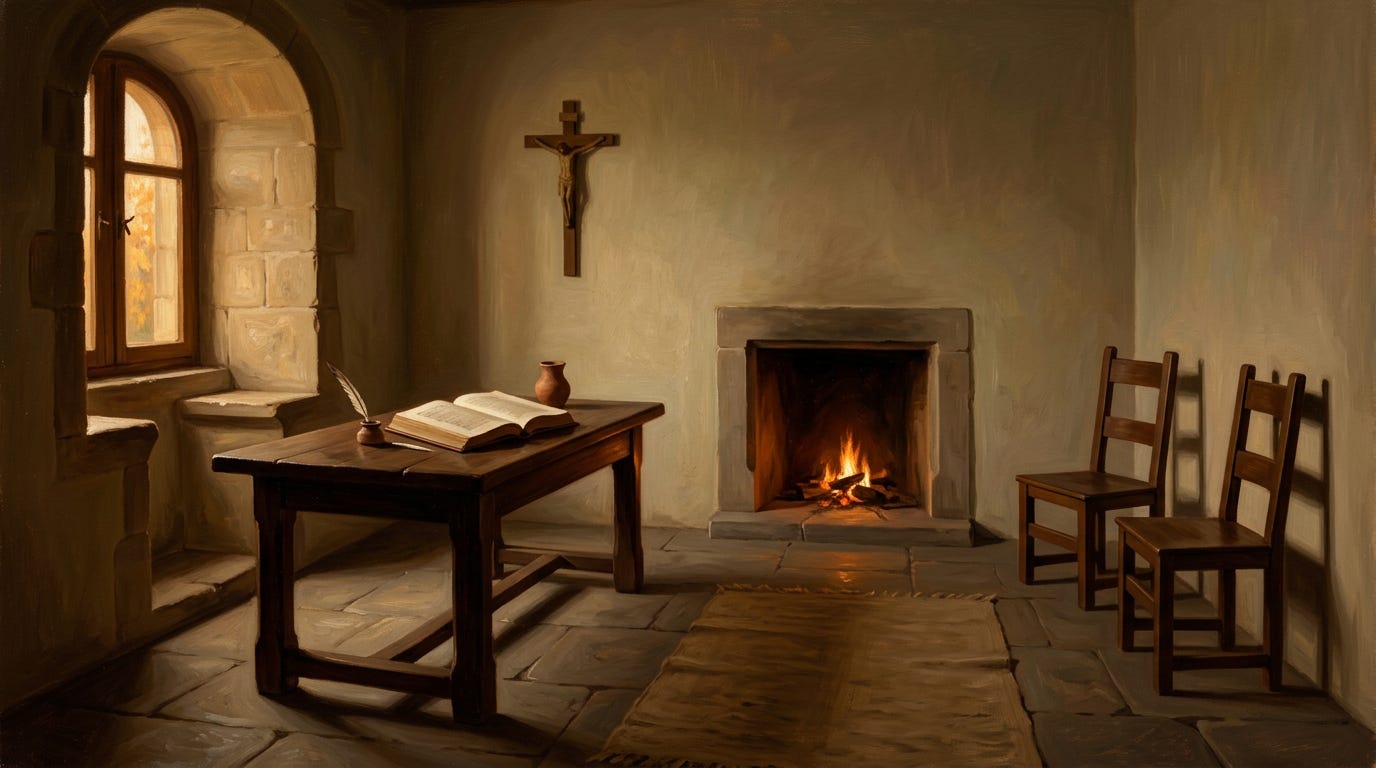
Anselm sat at the writing table in the guest study that Archbishop Hugh had given him in the archiepiscopal palace at Lyon, at the end of the corridor above the cloister where the canons went for their afternoon walk, in the room that had a west-facing window and a stone fireplace in which a low fire was burning against the autumn cold. He had been in Lyon for nearly a year. He had been in exile from Canterbury for slightly longer than that. He was sixty-five. He was tired in the specific way that a man is tired who has been an archbishop for four years and has been driven from his see by a king and has been living on the hospitality of an old friend and has been trying, at the same time, to finish a book he had begun three years earlier. The book was almost finished. It was a treatise in dialogue form - the interlocutor was his student Boso, who had followed him from Bec and who was at this moment saying the Office in the chapel two floors below. The book was called Cur Deus Homo. Why God Became Man. He was at the passage on satisfaction, in Book One, chapter twenty-something - he had lost count of the chapters and would have to renumber them when he prepared a fair copy - and the sentence he was trying to write was the one that would set up the whole argument of Book Two. He had been at it since after dinner. The autumn light through the west window was beginning to angle.
He set down his quill.
He had been going in circles. He had been trying to say that no created being could offer satisfaction for the debt owed by sin, because the debt was infinite and only a being of infinite dignity could offer an infinite payment. But the sentence he was writing kept collapsing into itself. It was too abstract. Boso, when he read it tomorrow, would raise his eyebrow and would say, in that gentle Norman way he had, Master, I think perhaps the reader will not follow. And Anselm would sigh and would rewrite it. He preferred to rewrite it now, tonight, so that Boso would not have to raise the eyebrow. Boso’s eyebrow was a small burden that Anselm was trying to spare him.
He whispered, in Latin, Domine. Da mihi verba.
Lord. Give me the words.
He heard footsteps in the corridor outside his door.
He heard them stop at his door. He heard a soft knock - not the knock of a canon or of Boso, both of which he knew. This was a knock he had never heard before. It was the knock of a stranger.
He said, in Latin, Intra.
Enter.
The door opened.
Two men came into the room.
They were both older - perhaps in their sixties or seventies - and both wore the traveling clothes of first-century Judean men: plain woolen tunics that came to the knee, dust-colored cloaks over the shoulders, leather sandals worn thin at the sole. The dust of a long road was on their feet. Their beards were long and grey. Their hair was cut short but roughly, as if by their own hands. Both were sun-dark. Both had the callused hands of men who had worked outdoors for many years. The taller of the two, who came in first, carried nothing. The shorter, who came in second, had a short wooden club tucked into the leather belt at his waist, in the way a traveler might carry a stick against dogs.
Anselm rose slowly from his writing table.
He knew them.
He had preached about them, twice, in his years as abbot of Bec - on the twenty-eighth of October each year, on their feast, when the community had gathered in the chapter house and he had spoken about the two apostles whose lives were so little known and whose witness was so foundational. He had, both times, said what preachers usually say about Simon and Jude: that we know very little of their lives, that tradition places them together in Persia where they were martyred, that they are among the twelve pillars of the Church even though the Gospels tell us almost nothing about them. He had, both times, felt slightly inadequate to the sermon. He had felt that the two apostles were near him during the preaching but that he could not quite say what he wanted to say about them. He had wanted to say more. He had not known what more to say. He had ended each sermon with something like: These are two of the pillars of the Church. That is enough. The Lord chose them. The Lord knows what He chose. We do not need to know more than the Lord chose them. And the community had received the sermon quietly and had gone to their cells, and Anselm had gone to his own cell, and he had felt that he had missed something.
Tonight the two apostles were standing in his study at Lyon.
He said, in Latin, “Fratres.”
Brothers.
The taller one - the one without the club - inclined his head. He spoke in Latin also, though with an inflection Anselm had never heard, the inflection of a Semitic language rendered into Latin by someone who had learned the Latin later and had never entirely gotten the vowels right.
“Frater Anselm. I am Simon. This is Jude. We have been sent.”
Jude nodded once. He did not speak yet. He was looking at the writing table. He was looking at the pages. He was looking at Anselm’s manuscript with what appeared to be a small, warm interest.
Anselm gestured at the two chairs opposite his writing table.
“Please. Sit. I have not - I did not expect - please sit. Both of you. I will pour you some wine. There is wine on the sideboard. It is very good wine. Archbishop Hugh keeps good wine. He gives it to me because he thinks I am not eating enough.”
The two apostles came into the room and sat in the two chairs. Their movement was quiet and economical, the movement of men who had walked many miles in their lives and had learned not to waste any motion of the body. Simon sat straight. Jude leaned back a little and let his cloak fall from his shoulders. Neither accepted the offered wine. Anselm sat down again at his writing table.
He did not know what to say.
He said, at last, the only thing that came to him.
“You have seen the Lord.”
Simon looked at him for a moment.
“We have seen the Lord,” he said. “We ate with Him. We walked with Him. We heard His voice for perhaps three years, from the shore of the Sea of Galilee to Jerusalem and back many times. We saw Him die. We saw Him after He rose. We ate with Him after He rose. We watched Him ascend. We knew Him. We know Him still, in the room where we are. We have come today, in part, to tell you what you have wanted to know about Him. You have wanted to know for a long time. You have prayed the questions in your cell at Bec and in your cell at Canterbury and now in this study at Lyon. You have not asked out loud because you have felt that it would be presumptuous. It is not presumptuous. Ask.”
Anselm sat very still.
He had, indeed, prayed these questions for many years. He had not spoken of them to anyone. He had not even entirely known that he was praying them. He had wanted, since his novitiate at Bec forty years ago, to know what Christ’s face looked like. He had wanted to know what Christ’s voice sounded like. He had wanted to know how Christ laughed. Whether Christ laughed. He had known that the questions were unanswerable in this life. He had prayed them anyway, silently, without noticing that he was praying them. Simon had noticed. Simon had come to answer.
He whispered, “What was His face like.”
Jude spoke for the first time. His Latin was rougher than Simon’s, but his voice was warmer.
“His face was the face of a Jewish carpenter from Nazareth. He was not tall. He was thin. He had dark hair and a dark beard, both trimmed by His own hand, not carefully. His eyes were brown. His skin was the color of the country - sun-darkened at the face and the arms, paler at the chest when He bathed. He had a scar on His left hand from a chisel that had slipped when He was perhaps thirteen. He had a scar on His right forearm from something He never explained. His teeth were even but were beginning to wear at the back, in the way that people’s teeth wore in our country because of the grit in the bread. His voice was medium - not high, not low. It carried. He could be heard from a long distance without shouting. He was thirty-three when we last saw Him in the body. He looked older than thirty-three. Life had aged Him. He had walked a great deal. He had slept poorly. He was often hungry. His face showed all of this. It was a face you would not have noticed in a crowd unless He were speaking. When He was speaking, you could not look at anyone else.”
Anselm was weeping.
He had not wept in his study in three years. He wept quietly now, the way a Benedictine of forty years’ formation weeps - controlled, contained, but real. Jude waited. Simon waited. Neither man was surprised. They had told this same thing to other saints across the centuries, in other rooms, and the weeping was familiar to them.
After a while Anselm said, “How did He laugh.”
Simon answered this one.
“He laughed with His whole body. He laughed when children were funny. He laughed when Peter said something ridiculous, which was often. He laughed at His own jokes, which most of us did not always understand. His humor was Galilean. It was direct. It sometimes involved animals. He was fond of the small foxes of the hill country and He made jokes about them occasionally. He laughed less in the last months. He laughed most on the road, when we were walking between villages, and He was in front of us, and He would turn back over His shoulder and say something and would laugh at whatever He had said, and we would laugh with Him even when we had not quite heard, because His laugh was contagious. He had, before Gethsemane, a very good laugh. After Gethsemane, and after the Resurrection, His laugh was different. It was quieter. It was more amused. It was the laugh of someone who had understood something none of us had yet understood. He laughed at the disciples on the Emmaus road when they finally recognized Him. He laughed when Peter jumped from the boat after the Resurrection and swam to shore. He laughed at Thomas. He laughed with great tenderness. The tenderness was new.”
Anselm was still weeping.
He nodded slowly.
He said, softly, “Thank you. Thank you. I have wanted to know this for forty years.”
Simon nodded once.
“We know. You are welcome. We have wanted to tell you for forty years also. We have not been permitted until tonight. Now we have told you. Do not try to write it down. What we have said is for you. It is not for the Cur Deus Homo. The Cur Deus Homo is a different work. We want to talk about that work now, if you will let us.”
Anselm reached for a piece of linen from the drawer of the writing table. He wiped his face. He composed himself. He was, again, the Archbishop of Canterbury in exile, working on his book. He was ready.
“The Cur Deus Homo. Yes. What would you say to me about it.”
Jude spoke.
“We would say two things, brother. The first is that we are pleased with it. It is a good book. It is doing something the Church has needed for a long time. The Church has been telling the story of the Incarnation for eleven centuries. The story is well told. The story is not the only thing the Church needs. The Church also needs the reason. Some souls come to the Lord through the story. Some come through the reason. You are writing for the ones who come through the reason. There are more of them than you know. There will be more of them in the centuries after you than in the centuries before you. Your book will still be read by such souls nine hundred years from now. It will still convince them. That is a great grace. Continue the writing.”
Anselm bowed his head slightly.
“Thank you.”
Simon spoke.
“The second thing we would say is a gentle correction. It is not a large correction. Your book is arguing, in the section you were working on this evening, that no created being could offer satisfaction for sin because the debt is infinite. This is correct. We agree. But you are stating the argument as if it were a matter of accounting only - as if the Lord were owed a certain quantity of honor and the ledger needed to be balanced. This is one true way to say it. It is not the whole way. The Lord did not become man because a ledger needed to be balanced. The Lord became man because He loved us so much that He could not bear to leave us where we were. The satisfaction is real. The love is why the satisfaction. Do not separate them in your text. Where you speak of the debt, speak also of the love. The reader who follows only the debt argument will understand the necessity of the Incarnation but will not understand the sweetness of it. You want your reader to understand both. The satisfaction and the sweetness. The rigor and the tenderness. Write the satisfaction as you have been writing it. Add a sentence or two, in the appropriate places, on the sweetness. Boso will see the improvement immediately. The reader in nine centuries will thank you.”
Anselm was quiet for some while.
He was looking at the manuscript. He was thinking about where in the argument he could add the sentences the apostle had suggested. He was seeing where. The passage he had been stuck on this evening - the passage on satisfaction - was exactly where such a sentence belonged. He had been writing about the debt without writing about the love that was paying it. That was why the sentence would not resolve. The sentence had been trying to hold both things at once and he had not been giving it permission to.
He picked up his quill.
He wrote a single Latin sentence in the margin of the page. He did not look at what he was writing while he wrote it - he wrote from what Simon had just said. When he finished the sentence he looked at it. It said, roughly: The Lord did not owe us satisfaction. He owed us nothing. He loved us anyway. He gave what He did not owe because the loving was what He is.
He looked up at the two apostles.
Both were smiling.
Jude said, “That is the sentence. Or a sentence near enough. You will refine it in the fair copy. It will find its place in Book One. The reader in nine centuries will read the Cur Deus Homo and will find that sentence sitting quietly in the middle of the debt argument, and the reader will understand that Anselm of Canterbury knew what the debt was for. We are pleased. That is what we came to say about the book. Thank you for letting us say it.”
Anselm nodded slowly.
“Thank you. Both of you. May I ask you one more thing.”
“Ask.”
“You preached in Persia. Both of you. Together. You died there. I have said sermons about it. I have not known what to say about it. Would you tell me. What was it like.”
Simon and Jude looked at each other for a moment.
Simon spoke. He looked at Anselm as he spoke.
“We preached in Persia for perhaps twenty years. We entered from the west, through the Parthian borderlands, in the year that would later be called 45 by your calendar. We were both then perhaps in our middle years. We had, before Persia, preached in Judea and in the Decapolis and briefly in Egypt. Persia was the place we spent the most time. We learned the language slowly. We were bad at it for the first three years. We got better. We made converts among the merchants first, then among the villagers, then among a small circle of the aristocracy at Ctesiphon. We had a house there. We wrote letters back to Antioch and to Rome when travelers came through who could carry them. Most of the letters have been lost. A few fragments survive. They are not remembered as scripture. It is fine. They were letters for the moment, not letters for the ages. The Church has enough letters for the ages. We were preachers, not writers. That was our vocation.”
Jude spoke.
“We were killed together in the year 65, in the summer, near the city of Suanir. Some traditions say we were killed by pagan priests. Some traditions say we were killed by soldiers of the shah. The truth is a bit of both - the pagan priests roused a crowd, and soldiers of a local lord led the crowd, and we were seized in the marketplace and taken to a small courtyard outside the city, and Simon was killed first, with a saw, and I was killed second, with a club. It was quick. We had known for some months that this was coming. We had been ready. We had continued to preach until the day of the seizure. I want to say to you, brother, that the twenty years in Persia mattered more than the death did. The death was very brief. The twenty years were long. The souls we baptized in those twenty years - most of them not remembered in any western record - were the fruit. The martyrdom was the end. Not the fruit. The fruit was the twenty years. When you preach about us next October twenty-eighth, tell that to your brothers at Canterbury. Tell them the martyrdom was brief and the preaching was long, and the preaching was what we were made for. This is what preachers are made for. You know this. You have been preaching in Canterbury and in Bec and now in your books. Your preaching is your fruit. The exile is brief. The exile will end. You will return to Canterbury. You will die in your see. Your book will preach after you. The preaching is the fruit. The death is only the end. Do not confuse them.”
Anselm was weeping again.
He wept for the two apostles who had preached in Persia for twenty years and had been killed in a courtyard outside Suanir in the year 65. He wept for himself, who had been driven from Canterbury and who was writing a book in a borrowed study in Lyon and who was homesick. He wept because he had been permitted to hear what the two apostles had come to tell him. He was, he realized, unlikely to be permitted again.
After a while Jude said, “Frater Anselm. We must go. We have said what we came to say. We have three more things to tell you before we leave. May we tell them.”
“Please.”
Simon said, “The first: William Rufus, the king who exiled you, will die on the second of August of the year 1100, in a hunting accident in the New Forest. His brother Henry will become king. Henry will invite you back. You will return. You will have three more years at Canterbury before another exile begins, and four more years after that final exile before your death on the twenty-first of April, 1109, at Canterbury. You will die in your see. You will die well. Do not fear the exile you are in now. It will end within eighteen months.”
Jude said, “The second: the young monk Boso, who has followed you from Bec and is at this hour saying the Office in the chapel below, will remain a Benedictine. He will not become an abbot. He will not become a bishop. He will be your companion for the rest of your life and will die a simple monk at Bec three years after you. He has been a great gift to you. The dialogue form of the Cur Deus Homo would not have been possible without him. Give him something before you die. He does not need much. Something small. A copy of the Proslogion in your own hand would please him greatly. Do not forget.”
Simon said, “The third: your book will be misread for several centuries. Some readers will take the satisfaction argument in ways you did not intend - in ways that make the Father seem cold, or the sacrifice mechanical. This will grieve some future theologians. It will not have been your fault. You have written what you have written. The reception is not yours to control. The Lord will use the book as He wills. Some will read it correctly. Some will read it wrongly. Both will be used by Him. Do not worry about the reception. Trust the Lord with it.”
Anselm bowed his head.
“I thank you. Both of you. I did not expect - “
Jude smiled.
“We know. That is how these things go. Now rise. We will bless you before we leave.”
Anselm rose from his writing table.
He came around and knelt on the cold stone floor in front of the two chairs. The two apostles rose. They came to stand in front of him. Simon laid his right hand on Anselm’s head. Jude laid his left hand beside Simon’s. Both hands were rough and warm. Simon spoke the blessing, in Aramaic - the language they had spoken with the Lord.
“Shlama alach, achunan. B’shem d’Maran Yeshua M’shicha. Amen.”
Peace to you, our brother. In the name of our Lord Jesus the Christ. Amen.
Anselm closed his eyes.
When he opened them the two chairs were empty. The two apostles were gone. The fire in the fireplace had burned down. The autumn light through the west window had gone entirely. The room was dim except for the candle on his writing table.
He rose from the stone floor.
He returned to the writing table. He sat down. He looked at the sentence he had written in the margin of the manuscript. He read it once. He nodded slowly. He picked up his quill. He continued writing.
He wrote for another two hours, until the bell rang for Compline. He integrated the sentence Simon had given him into the passage on satisfaction. He rewrote three paragraphs so that the debt argument and the love argument would sit together in the finished text. He would refine the passage tomorrow with Boso. Tonight he had it in a rough form. It was enough for tonight.
He rose. He went down to the chapel for Compline. He sang with the canons and with Boso. He returned to the study. He said his evening prayers. He blew out the candle. He slept in the small guest bedroom that adjoined the study.
He rose at four in the morning. He said the Office. He went to the chapel for Prime. He said Mass at six. He returned to his study. He worked on the Cur Deus Homo until midday. Boso came to him after the midday meal and they read together what Anselm had written the night before. Boso raised no eyebrow. Boso, in fact, praised the new passage. Anselm did not tell Boso where the sentence had come from. Anselm never told anyone where the sentence had come from. It remained between him and the two apostles.
He finished Cur Deus Homo by the end of 1098. He continued the exile at Lyon into the following year. William II Rufus died on August 2, 1100, in a hunting accident in the New Forest, exactly as Simon had said. Henry I became king. Henry invited Anselm to return. Anselm returned to Canterbury in September 1100.
He had three years at Canterbury before a second exile began in 1103 over investiture disputes with Henry. The second exile lasted four years. He returned in 1107. He had two more years at Canterbury.
He died on April 21, 1109, at Canterbury, in his own see, exactly as Simon had said. He was surrounded at his death by his monks. Boso, who was there, was the one who read the Passion narrative aloud at the bedside as Anselm was dying. Anselm had, some months earlier, given Boso a copy of the Proslogion in his own hand. Boso kept it until his own death at Bec three years later, exactly as Jude had said.
Cur Deus Homo was copied and disseminated across the Latin West throughout the twelfth century. It became one of the foundational works of scholastic theology. It has been read continuously ever since. It has, as Simon predicted, been misread by some readers in some centuries. It has also been read correctly by many others. The passage on satisfaction, in Book One, contains a single quiet sentence - added in a marginal revision at Lyon in the autumn of 1098 - about the love that was paying the debt. Careful readers have always noticed it. Some have made their whole reading of Anselm turn on it. The reading was correct.
Anselm was canonized in 1494 by Pope Alexander VI. He was declared a Doctor of the Church in 1720 by Pope Clement XI. His feast is April 21.
Saints Simon and Jude, in their room, continue to visit the theologians who systematize what they witnessed. The list is long. It has grown across every century. It included Anselm. It has included others. The apostles have been permitted to visit some. Not all. They accept whatever the Lord permits. They especially like visiting the ones who are stuck on a difficult passage in the middle of the afternoon. They arrive together. They speak alternately. One of them carries a wooden club at his belt. Neither has ever raised the club against anyone in a thousand years. The club is only for dogs.
The candle in the study at Lyon burned out at dawn, as candles do, on the morning after the two apostles’ visit.
Anselm was already at the writing table.
He was refining the passage on satisfaction.
The book was almost finished.
For your prayer this week: Saint Anselm of Canterbury and Saints Simon and Jude the Apostles, you who systematized the Incarnation through pure reason and you who preached it in Persia for twenty years and died in a courtyard outside Suanir, pray for those of us who are stuck on difficult passages in the middle of long afternoons, and for those whose vocations are longer than the deaths that will end them. Grant us the grace to write the debt and the love together in the same sentence, to trust the Lord with the reception of our work, and to remember that the preaching is the fruit and the death is only the end. Amen.
Two Lamps returns next Friday: Saints Charles Borromeo & Gregory the Great, the archiepiscopal palace at Milan, an autumn evening in 1583.
Two Lamps is a weekly short story braiding the lives of two or three saints across the centuries. Sometimes the meeting is rendered as an encounter in eternity. Sometimes as the older saint coming, in vision or in patronage, to the soul of the younger. Sometimes as two friends meeting in one life. The Communion of Saints holds them all as one company.
Two Lamps is written by Deacon Michael Halbrook, a permanent deacon of the Diocese of Springfield in Illinois, serving at St. Elizabeth Parish in Granite City. He writes personally at DeaconMichael.net, serves families through Domus Formation, and publishes the serial novel Ordo: A Chronicle of Lux Perpetua at LuxPerpetua.net. Two Lamps is co-conceived with his son Joseph.