

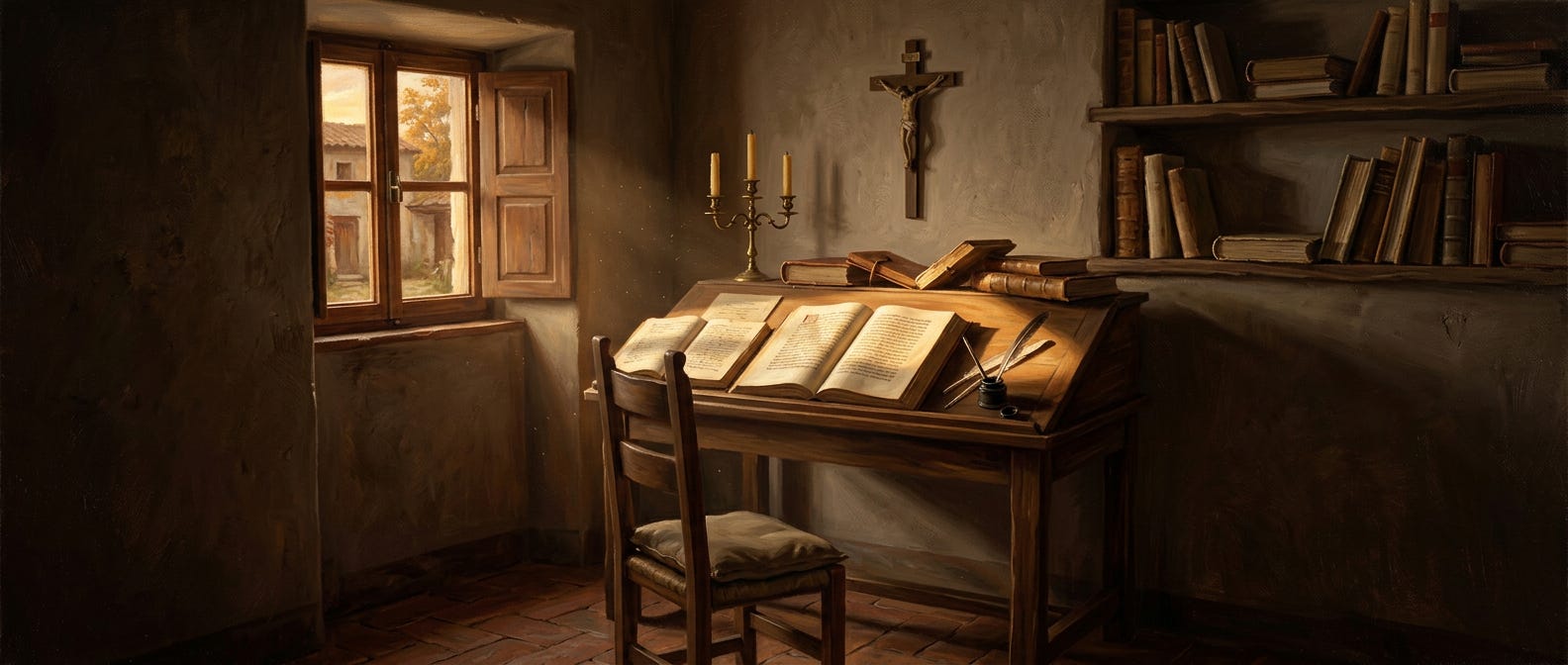
The sentence would not come.
Bellarmine had been sitting at his writing desk in the study on the third floor of the Roman College since after the midday meal, working on a passage of some difficulty in the volume that would be published, if the Lord willed and the printer at Ingolstadt was reliable, next year under the title Disputationes de Controversiis. The passage was in the section on the Roman pontiff. The passage was addressing a particular Protestant polemic that had been circulating in the pamphlet literature from Wittenberg for the last several years, according to which the Bishop of Rome was to be identified with the Antichrist described in the eleventh chapter of Daniel and the thirteenth chapter of the Revelation to John. The polemic had force among the German and English Protestants, and Bellarmine had been chosen for the chair of Controversies at the Roman College precisely because Pope Gregory had believed him capable of the patient work of addressing such polemics one by one, with the biblical texts fully in view, and in Latin clear enough that a Louvain-trained Lutheran could not honorably dismiss the argument.
He had been drafting the response for three days now.
The response required distinguishing what Scripture in fact said about the Antichrist, listing the criteria carefully - the Antichrist would deny that Christ had come in the flesh, would set himself up in the temple of God as though he were God, would perform false signs, would rule for three and a half years, would be destroyed at the coming of the Lord. The response then required showing, criterion by criterion, that these did not apply to the Bishop of Rome. The Bishop of Rome confessed that Christ had come in the flesh, in the words of the Nicene Creed at every Mass. The Bishop of Rome did not claim to be God. The Bishop of Rome ruled for the length of his life, which was rarely three and a half years and usually much longer or somewhat shorter. And so on. The argument was sound. The argument had been Aquinas’s argument, in substance, three centuries earlier, and had been the argument of many patristic writers before Aquinas. Bellarmine had been laying it out for three days. On the fourth day he had come to a particular sentence, and the sentence would not come.
The difficulty was small. The difficulty was one word.
He had written: Papa Romanus non est Antichristus, sed vicarius Christi. The Roman Pope is not Antichrist, but the vicar of Christ. This was correct. This was the argument’s conclusion. But the sentence was too flat. It stated the conclusion without carrying the weight of the reasoning that had led to it. A Louvain-trained Lutheran, reading the sentence at the end of a long chapter, would encounter it as an assertion rather than as the completion of an argument. He needed a word or a phrase that would carry the argument’s weight forward into the conclusion. He had been looking for the word for two hours.
He set down the quill.
He was tired. He was forty-three years old, and he had been writing all afternoon, and his headache - the headache that had visited him intermittently since his boyhood in Montepulciano - was beginning to return above his right eye. He closed his eyes. He listened, for a moment, to the sounds of the College at this hour. Somewhere on the floor below him a class was ending; he could hear the scrape of benches. A brother in the corridor outside was singing quietly to himself as he swept. The autumn light through the study window fell across the manuscript in a warm bar the color of honey, and dust hung visibly in the light, and the room was very quiet.
He opened his eyes.
There was a woman sitting in the wooden chair by the door.
Bellarmine did not startle. He had spent many hours in this study alone, and had experienced the phenomena that come to a scholar who has been staring at a page for a long time - the movements of shadow at the edge of the eye, the tricks of the tired mind - and he assumed at first that the woman was one of these. He blinked. He looked again. She was still there.
She was old. She was perhaps seventy, though her face had the quality of someone who could have been any age between fifty and eighty. She wore the black Benedictine habit with the wide black scapular and the wooden pectoral cross that he associated with the German houses of the Order. Her wimple was plain and well-worn. Her hands were folded in her lap. Her feet were in plain leather sandals of a cut he had not seen in Italy in his lifetime - the cut was older, the leather worked in the German way of many centuries ago. Her eyes were pale grey and very clear.
She was looking at him with the direct steady attention of a woman who had been waiting for him to notice her and was not at all offended that it had taken him a while.
She spoke.
“Frater Roberte,” she said, in Latin. Her Latin had a Rhineland German rhythm underneath it. “You have been at that sentence for two hours. It is not a bad sentence. It is only that you are looking for the wrong kind of word for it.”
Bellarmine sat very still.
He knew, before she said her name, who she was. He had read the Scivias as a novice at the Roman College twenty-five years ago, in the copy that had been in the College library since the early sixteenth century. He had read the Liber Divinorum Operum later. He had read her letters to Emperor Frederick Barbarossa in his student years at Padua. He had heard her music sung once at a monastery in Belgium in the years he had spent at Louvain. He knew the German cadence of her Latin because he had studied her writings, and the cadence was preserved even in the copyist’s hand.
He said, in Latin, “Mater Hildegardis.”
She inclined her head.
“You are a courteous man, Roberto,” she said. “You do not exclaim. You do not require the visitor to justify herself. That is a small grace of scholarly formation. I appreciate it.”
“Mater. Have you come to me from - “
“From where I am now, yes. I have been sent to sit with you for perhaps an hour. Not more. The Lord has other work for me tonight. But an hour is what I have been given, and I am glad of it. You have been reading me since you were a young man. I have been reading you also, though from the other side. It is time we met.”
Bellarmine bowed his head slightly.
He was, he realized, deeply moved. He had not expected to be moved. He had expected, if he ever met a Doctor of the Church of a previous age, that his response would be scholarly - questions about textual variants, questions about the reliability of certain manuscripts, questions of the sort a scholar develops after decades of working with texts. He had not expected the response to be affection. He was fond of her. He had not known he was fond of her. The fondness was there, arriving all at once, the way affection sometimes arrives when one meets in person a person one has known only through writing.
“Please,” he said. “May I offer you - “
“There is nothing to offer, Roberto. I am not present in the way that requires water or bread. Sit. Let me look at your sentence. I have been curious to see it.”
He nodded, slowly. He gestured toward the manuscript on the desk. She rose from the chair by the door and came across the room to stand at his shoulder. She did not walk in the way of a living person - there was no sound of the sandals on the boards. But she was there. She stood beside him. She bent slightly and read the sentence.
“Papa Romanus non est Antichristus, sed vicarius Christi,” she read aloud, in her Rhineland Latin. “Hm. Yes. The problem is not the sentence. The sentence is precise. You have written a precise sentence. The problem is that you are ending a long argument with a precise sentence, and a precise sentence is not what argument endings want. Argument endings want a small note of surprise. A small door opening onto a room the reader had not expected. You have closed the door instead. You have said the thing. You have not opened the room. That is why the sentence will not come.”
Bellarmine looked at the sentence.
He looked at it for a long moment.
Then he said, softly, “Yes. That is exactly it. Thank you, Mater.”
“You are welcome. I have written many sentences over my years, Roberto. Some of them opened doors. Some of them closed doors. The ones that closed doors were technically correct and were also, in the end, less useful than the ones that opened doors. The Lord wants us to open doors when we write. He wants the reader to be surprised into the room. If the reader is only informed, the reader has been given very little. If the reader is surprised into the room, the reader has been given the room. Give your Lutheran reader the room, Roberto. Do not only tell him he is wrong. Show him where he might, if he wished, come in.”
Bellarmine looked at her.
“How would you write the sentence,” he said.
She smiled, faintly.
“I would not write your sentence. Your sentence is yours. I would only tell you that the word you are looking for is not a scholastic word. It is a warmer word. Something like pastor. The Roman Pope is not the Antichrist. The Antichrist would devour the sheep. This one is charged with feeding them. That is the reversal. That is the door. Feeding, not devouring. Pasture, not slaughter. Put a shepherd where the Antichrist would be, and let the reader see the contrast. The contrast is the door. He can walk through it or not. But you have given him the door.”
Bellarmine sat very still for perhaps a full minute.
Then he picked up the quill. He dipped it. He wrote, below the sentence he had struggled with for two hours, another sentence: Antichristus enim gregem devoraturus est; Papa gregem pascit. The Antichrist will devour the flock; the Pope feeds it.
He looked at the two sentences together.
He whispered, “Yes.”
He set the quill down again. He turned in the chair to face Hildegard, who was still standing at his shoulder, and who was looking not at the manuscript but at his face, with the pleased expression of an elder who has watched a younger writer solve a problem she had known could be solved.
“Mater,” he said. “You have been sent to teach me to write.”
“I have been sent to sit with you for an hour. What I teach you within the hour is between you and the Lord. If it is useful, keep it. If it is not, forget it. I have my own ways. You have yours. The Lord uses both. I did not come here to make you write like a Rhineland abbess. Deo gratias for that. Rome does not need a Rhineland abbess. Rome needs a Roman Jesuit who thinks like a Roman Jesuit and writes like a Roman Jesuit and who occasionally, when the sentence will not come, remembers that there was once an abbess who noticed that arguments end better with pastures than with propositions.”
Bellarmine almost laughed. Almost.
He did smile, briefly. It was a small smile. He was not much given to smiling in his study. He was aware, in the moment, that he was smiling, and he was surprised at himself.
“You knew you were a Doctor of the Church,” he said, quietly.
“No,” she said. “I did not know I would be called that. It was not a title in my lifetime. It became a title only afterward. I was called Sibyl of the Rhine by some, and the German prophetess by others, and that dangerous woman by a few. I was corrected several times by bishops who did not entirely understand what I was trying to say. I was, briefly, interdicted by my own bishop near the end of my life for burying an excommunicated young man on convent grounds. I did not know what would come after me. I did not know that eight hundred and thirty-three years after my death, a Pope Benedict of the Sixteenth of that name would raise me to the altars of the universal Church in a canonization equivalent, and would then, a month later, declare me a Doctor of the Church, the fourth woman ever named so. I did not know. It has been a joy, over the centuries, to discover what the Lord has been doing with what I wrote. Some of it I did not know I had done. He knew.”
She paused.
“You will be a Doctor also, Roberto. You will not know it in your lifetime either. You will die in the year sixteen twenty-one, at the age of seventy-nine, in Rome, in a Jesuit house not far from this one. You will be beatified in nineteen twenty-three. You will be canonized in nineteen thirty. You will be declared Doctor of the Church in nineteen thirty-one, the year following your canonization. The century between your death and your beatification will be difficult - your work will be attacked by some who thought you had defended the papacy too little, and by others who thought you had defended it too much, and there was a period of about eighty years when it was less read than it deserved. It will come back. It will be read for many centuries after that. Do not concern yourself with the reception. The reception is not your work. Your work is the sentence you were struggling with an hour ago. Finish the sentence. Finish the volume. Finish the second and the third volumes also. The rest will happen without your management.”
Bellarmine bowed his head.
“Doctor of the Church,” he said, softly.
“Yes. It is a small thing, in a way. It only means the Lord has confirmed what many readers had already seen. It is not what makes you holy. What makes you holy is that you have loved the Church. What makes you holy is that you have written these three volumes not for your own credit but because you were asked by a pope, and because Lutherans were being misled by pamphlets, and because a boy in Bavaria who would read your Disputationes in a Jesuit school in the year sixteen forty-something would understand, from what you had written, that the Bishop of Rome was not Antichrist and that the pamphlets he had grown up hearing were wrong. That boy will be a father of many children, one of whom will be a priest, one of whom will be a Jesuit, and both because that one boy stopped believing what the pamphlets said. That is what your work is doing. That is what the Doctorate confirms. Do not chase the Doctorate. Chase the writing. The Doctorate will come. It always does when the writing is faithful.”
Bellarmine did not speak for some while.
He was looking at the manuscript on the desk. He was looking at the two sentences he had just written. He was thinking about the boy in Bavaria. He had not thought of a boy in Bavaria before. He had thought about arguments to defeat and propositions to disprove and pamphleteers to correct. He had not thought about a boy. The Lord uses what is written, he understood, in ways the writer does not always imagine. The Lord uses the writer’s careful sentences to reach a boy who is not yet born, in a country the writer will never visit, in a school the writer cannot picture. The reach is the Lord’s business. The writing is the writer’s business.
He turned to Hildegard.
“Mater,” he said. “Tell me one thing before you go. You wrote in a very different way than I do. Your visions - the Scivias, the Liber Divinorum Operum - they are not scholastic. They are not disputation. They are - “ he searched for the word - “they are sight. You wrote what you had been shown. I write what I have argued. Are these the same work?”
Hildegard looked at him for a long moment.
“Yes,” she said. “They are the same work. They do not look the same. They are not intended to look the same. I was shown what I was shown, and I wrote it down as I had been shown. You were given arguments, and you have written them down as you have thought them. The showing and the thinking are different in kind. But both are in service of the same Lord, and both are received by Him as the writing of His friends. The Church needs the visionaries and the Church needs the scholastics. It has always needed both. It is when the scholastics forget that there are visionaries, and when the visionaries forget that there are scholastics, that the Church begins to limp. Do not forget me, Roberto. I will not forget you. That is what the Communion of Saints is for. We do not compete. We remember each other. When you write your next difficult sentence, remember that there was once a woman who saw the living light and wrote it down in Latin she was still learning as she wrote. When I sang my next new song, in the room where I am, I will remember that there was once a young Roman Jesuit who was patient with the pamphlets of Wittenberg on my behalf. That is our common work. That is why we are both Doctors of the Church. Neither of us alone. Both of us together.”
Bellarmine was moved again. He did not weep - he was not much given to weeping in his study either - but something in his chest was warm, and he sat with the warmth for a moment before he replied.
“Mater. Thank you.”
“Roberto. You are welcome. I have my hour and my hour is almost gone. Return to your desk. Finish the sentence. Finish the volume. Live a long life. Serve your popes. Be kind to Galileo when the time comes - you will not be able to prevent what will happen, and you should not blame yourself for it, but be as kind as the office allows you to be. Die well. I will be at the door when you come, though I will not be first. Aquinas will be first. He has been very much looking forward to you. You have loved him a long time. He has been noticing.”
Bellarmine smiled again, more fully this time.
“Aquinas.”
“Yes. He is very fond of you. Do not tell him I said so; he will make a joke about it. He is more of a jokester in the room than his writings suggest. You will enjoy him. I will be a little behind him. So will several others. There is quite a crowd for you, Roberto. You have been generous with your teaching for many years. The ones you taught are the ones who will meet you. There are more of them than you know.”
Bellarmine did not speak. He was full.
Hildegard rose from where she had been standing at his shoulder. She came around to face him. She laid her hand on his forehead - the hand was cool and dry and steady, in the way a nurse’s hand is when the fever has been high - and she blessed him, in Latin, in the Benedictine blessing she had learned as a girl in her monastery at Disibodenberg eight hundred years before.
“Benedictio Domini super te. Iuvet te in scribendo, in oratione, in dilectione Ecclesiae. Amen.”
The blessing of the Lord be upon you. May He help you in writing, in prayer, in the love of the Church. Amen.
Bellarmine closed his eyes.
When he opened them the chair by the door was empty.
The autumn light through the window had moved further down the wall. The dust still hung visibly in it. The room was very quiet. The brother in the corridor had finished his sweeping and had moved on. The scrape of benches from the floor below had ended. Bellarmine was alone in his study, as he had been an hour ago.
He looked at the two sentences on the manuscript.
He picked up the quill.
He continued writing.
He worked for another three hours, until the light was fully gone from the window and he had to light the candles. He wrote well. The passage that had been giving him difficulty completed itself with unusual ease. He finished the section on the papacy that evening. He would finish the volume the following spring. It would be published at Ingolstadt in 1586. It would be read across Europe for the next three centuries.
The pamphlet arguing that the Bishop of Rome was Antichrist would continue to be published in Wittenberg, and in Geneva, and in London, and in Boston, and in many other cities in the years and centuries to come. But it would meet, in each city, a reader who had also read Bellarmine, or who had read a book that had drawn from Bellarmine, or who had been taught by a teacher who had been shaped by the Disputationes. The pamphlets would not fall silent. But they would meet resistance that they had not met before Bellarmine wrote. The resistance was patient. The resistance was Roman. The resistance was Bellarmine.
Bellarmine continued for many more years. He was made cardinal in 1599. He was made Archbishop of Capua in 1602 and served there for three years before being recalled to Rome. He was one of the most trusted theologians of three popes. He was, as Hildegard had said, involved in the Galileo case in 1616, and he was as kind as the office allowed him to be, which was more kind than history has always remembered. He died on the seventeenth of September, in the year sixteen twenty-one, at the age of seventy-nine, in the Jesuit house near the Roman College where he had spent much of his life. He was buried in the Church of the Gesù.
He was beatified in 1923. He was canonized in 1930. He was declared Doctor of the Church in 1931, as Hildegard had said. His feast is September 17.
Hildegard of Bingen, on the other side, was very pleased.
She had waited many centuries for her own official recognition. She had been called Doctor of the Church by Pope Benedict XVI on the seventh of October, 2012, in a ceremony at Rome that would have astonished the twelfth-century abbess of Rupertsberg. She was the fourth woman ever named Doctor of the Church, after Teresa of Ávila, Catherine of Siena, and Thérèse of Lisieux. Her feast, since her canonization equivalent that year, is September 17 - the same day as Bellarmine’s.
The two Doctors share a feast day.
They did not know this in their lifetimes. They did not know it because their lifetimes were four hundred years apart and because canonization schedules are the Lord’s business and not the saints’ own. But the sharing of the feast day is the Church’s quiet way of saying what Hildegard said in the study that afternoon: neither of us alone; both of us together. The scholastic and the visionary. The Roman Jesuit and the Rhineland abbess. The reasoner and the seer.
The candles in the study at the Roman College burned out at dawn, as candles do, on the morning Bellarmine finished the section on the papacy.
He rose. He knelt. He said his morning prayers. He went to the chapel for Mass. He returned to the study. He continued writing.
The volume would be published the following year.
Hildegard, in the room where she was, was smiling.
For your prayer this week: Saint Robert Bellarmine and Saint Hildegard of Bingen, you who wrote the careful arguments of the Counter-Reformation and you who wrote the visions of the living light, pray for those of us who sit at our desks with sentences that will not come. Grant us the grace to open doors rather than close them, to trust that our work reaches boys we will never meet in countries we will never visit, and to remember that the Church needs both the scholastics and the visionaries, and that we are not competing but remembering each other. Amen.
Two Lamps returns next Friday: Saint Padre Pio and Saint John Vianney, the small confessional at San Giovanni Rotondo, an evening in the mid-1930s after the last penitent has left.
Two Lamps is a weekly short story braiding the lives of two or three saints across the centuries. Sometimes the meeting is rendered as an encounter in eternity. Sometimes as the older saint coming, in vision or in patronage, to the soul of the younger. Sometimes as two friends meeting in one life. The Communion of Saints holds them all as one company.
Two Lamps is written by Deacon Michael Halbrook, a permanent deacon of the Diocese of Springfield in Illinois, serving at St. Elizabeth Parish in Granite City. He writes personally at DeaconMichael.net, serves families through Domus Formation, and publishes the serial novel Ordo: A Chronicle of Lux Perpetua at LuxPerpetua.net. Two Lamps is co-conceived with his son Joseph.