

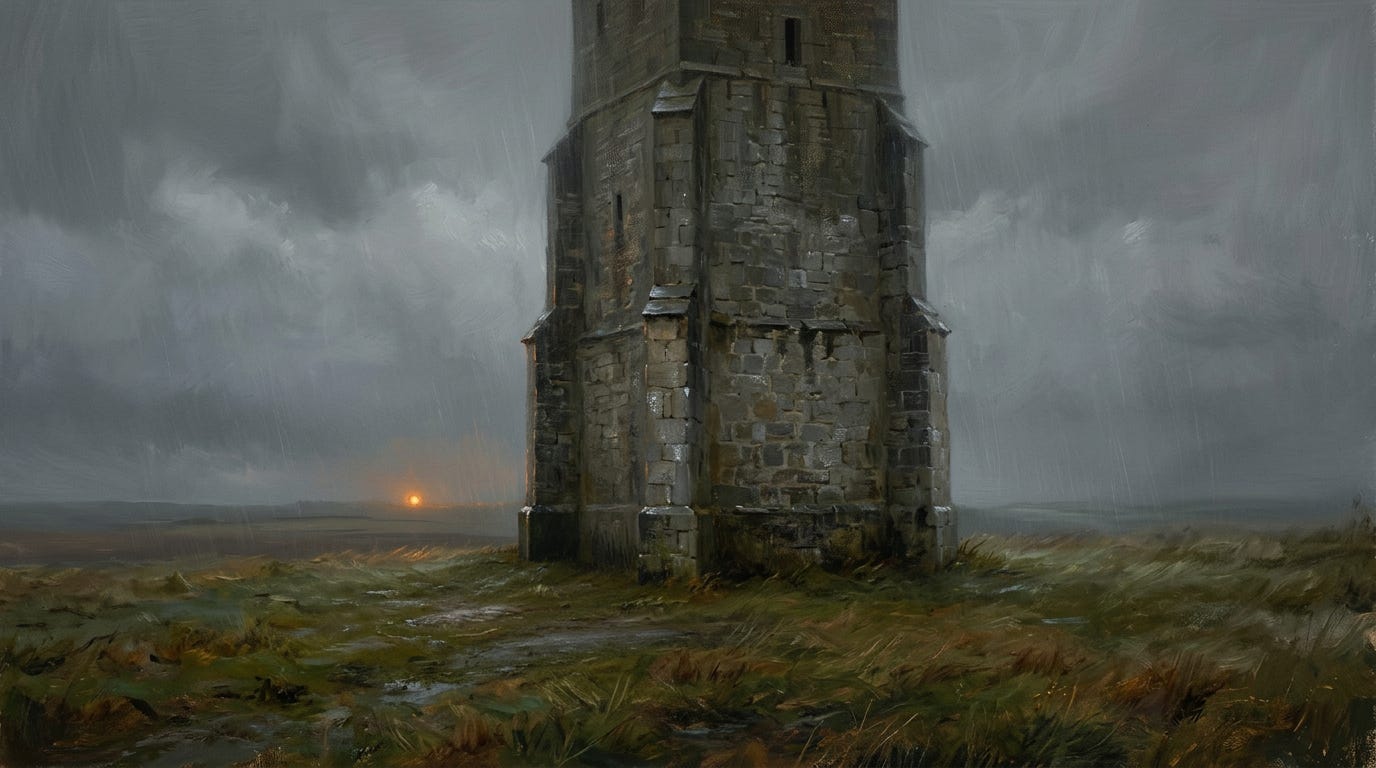
She had thought she would die.
That had not been the point of jumping. She wanted to be clear with herself about this, lying in the wet grass at the foot of the tower with her left side gone strange and her breath coming in pieces, because she would have to be clear with herself about it later, when they questioned her, and she would have to be clear with herself about it now, in case there was no later. The point of jumping had not been to die.
She had been told she was about to be sold to the English, and she had been told that her voices forbade the jump, and she had stood at the window of the prison room looking down at the courtyard and the field beyond, and she had jumped. The voices had said no. She had said yes. She did not know what she had said yes to. Perhaps to dying. Perhaps to not dying. Perhaps to neither, and to whatever the third thing was.
The grass was cold against her cheek. Above her the tower stood very tall and very plain and very gray, and somewhere up in it her cell window was open, and somewhere in the courtyard guards were beginning to shout, but the shouting was happening slowly, the way things happen slowly in dreams, and she could not yet tell whether she was inside a dream or outside of one.
A man was sitting in the grass beside her.
She turned her head, which hurt, and looked at him.
He was an old man, or not old, she could not tell. His face had the steadiness of a face that had stopped marking time some while ago. He was dressed in a short brown garment of a kind she had never seen before, simple, the way a fisherman dresses, the way the men in the country around Domrémy used to dress when she was small, only different. His hair was dark and his beard was not long. His hands were folded in his lap and he was looking at her without any expression that she could name, although his eyes were kind.
“Who are you,” she said. Her French was thick in her mouth. She had bitten her tongue.
“I am sitting with you,” he said.
His French was strange. It was not French. She understood him anyway. She would think about this later, when she could think.
“They will come down,” she said. “The guards. They will come.”
“Yes.”
“You should go.”
“No.”
She closed her eyes. When she opened them he was still there. The sky above the tower was gray and low and the autumn was already in the trees beyond the courtyard wall and a thin rain was beginning to come down, a rain that was barely more than a heaviness in the air. Her side was burning. She could not feel her left foot. She moved her right hand and it moved.
“I am alive,” she said.
“Yes.”
“My saints told me not to jump.”
“Yes.”
“I jumped anyway.”
“Yes.”
She turned her face into the grass and closed her eyes again. She wanted to say something to him about the saints, about Margaret and Catherine and Michael, about what they had told her and what she had done, but her mouth was full of the taste of blood and the words were not coming. She lay still for a while. He did not speak. The rain became a little heavier and then stopped.
“Are you one of them,” she said at last, without opening her eyes.
“No.”
“Are you a saint.”
“Yes.”
“Which.”
“You will not know me. I am from a long time ago.”
“Tell me your name.”
“Matthias.”
She opened her eyes. She knew the name. It came to her slowly, because everything was coming to her slowly, but it came. The apostle who replaced the one who hanged himself. The one chosen by lot in the upper room before the Spirit came at Pentecost. She had heard the story in church. Father Guillaume had told it once, when she was small, on a feast day she could no longer remember, and she had asked her mother afterward what a lot was and her mother had said it was a kind of stone you drew out of a bag.
“You are an apostle,” she said.
“Yes.”
“You are very far from home.”
He almost smiled. She saw the almost-smile move across his face and then settle.
“No,” he said. “I am very near.”
She did not understand this. She did not try to understand it. She had stopped trying, in the past months in this prison, to understand the things that happened to her. The trying had become a different kind of cell, smaller than the cell upstairs, and she had walked out of it some time ago. She lay in the wet grass with the apostle Matthias sitting beside her and she did not try to understand and the not-trying was the closest thing to peace she had felt in a year.
“Why are you here,” she said.
“To sit with you.”
“That is not an answer.”
“It is the only answer I have.”
She was quiet. Above her a bird crossed the gray sky and went on. She tracked it with her eyes until it was gone behind the line of the courtyard wall.
“My voices told me not to jump,” she said again.
“You said.”
“I jumped.”
“Yes.”
“What does that make me.”
He did not answer at once. She thought he was deciding what to say. Then she realized he was not deciding what to say. He was waiting for her to answer her own question, which she did not yet know how to do.
“They will say I despaired,” she said. “When they question me. The men in their robes. They will say I despaired and that the jump was a sin and that my voices were not from God because if they had been from God I would have obeyed them. They will use this against me, the way they use everything against me. I have learned how this works. They take what you have done and they hold it up and they ask you what it means and whatever you say they twist it into the shape they had already decided on before they asked.”
“Yes.”
“You know how it works.”
“I know how it works.”
“How.”
“They did the same to Him.”
She had forgotten, lying there, that this man had known Him. Had walked in the same dust. Had eaten with Him, perhaps, or watched Him eat. The realization came down on her quietly and she did not know what to do with it. She had spent the year being told that she was a heretic and a witch and a sorceress and a deceiver, and she had held the shape of her own faith against the words like a small lamp held against a great wind, and now there was a man sitting in the grass beside her who had heard the wind itself, who had heard it in the voice of the One they were both trying to follow, and the lamp she was holding suddenly felt smaller than it had felt a moment ago and also more real.
“Tell me about the lot,” she said.
“What about it.”
“How were you chosen.”
“There were two of us. Joseph and me. Joseph was called Barsabbas. He was a good man. He had been with the Lord longer than I had. I expected the lot to fall to him.”
“But it fell to you.”
“Yes.”
“Did you hear voices.”
“No.”
“Did you have a vision.”
“No.”
“Did you know you had been chosen by God.”
He was quiet for a moment.
“I knew the lot had fallen to me,” he said. “I did not know what God had done. There is a difference. I have spent my life inside the difference. I am still inside it.”
She looked at him. The rain was beginning again, a little, and his short brown garment was darkening in places where the rain was settling, and she thought it was strange that the rain settled on him at all, that he was solid enough for the rain, and then she thought that she did not know what was solid anymore, including herself.
“You never heard them,” she said.
“No.”
“Margaret and Catherine and Michael. The voices. The light. The certainty.”
“No. I had no light. I had no certainty. I had the lot, and I had the upper room, and I had eleven men who clapped me on the back and called me brother, and I had the work that came after, which I did because no one told me not to. I went to Judea and to Cappadocia and farther, and I preached, and I was killed, and I do not know to this day whether I was the right choice. I know that the Lord has not corrected the choice. I know that He has sat with me, the way I am sitting with you now, on the days when the not-knowing was the heaviest. That is what I have. It is not less than what you have. It is also not the same.”
“Then why are you here.”
“Because the lot fell to me to come to you.”
“Now.”
“Now.”
She closed her eyes. She felt the rain on her face. She felt her side, which was burning. She felt her left foot, which she still could not feel. She felt the grass beneath her and the gray autumn light above her and the man in the brown garment beside her, who was an apostle, and who had not heard voices, and who was sitting with her in the field below the tower from which she had jumped against the explicit command of the saints she had loved since she was thirteen years old.
“I confess it as a sin,” she said. “The jump. When they ask me, I will confess it as a sin.”
“Yes.”
“And I will also say that I would do it again.”
“Yes.”
“How can both be true.”
“I do not know,” he said. “I have spent a long time not knowing. I think that you are about to spend a long time not knowing. I think that the not-knowing is what you have been given, and that what you have been given is enough.”
“It does not feel like enough.”
“No. It does not feel like enough. It is enough.”
She turned her face toward him. The rain was on his face also, a few drops at his temple, and she thought again that it was strange that the rain found him, and she thought that she would remember this, that she would carry this with her into whatever came next, the rain on the face of an apostle who was not from her century and who had come because the lot had fallen to him to come.
“Brother Matthias,” she said.
“Sister.”
“Will you stay.”
“Until they come down.”
“They are coming down now.”
“Then I will stay until they come down now.”
She heard the gate of the courtyard open behind her, and she heard the boots of the guards on the wet stones, and she heard the voices calling for the Burgundian captain, and she did not turn her head. She kept her eyes on the apostle. He kept his eyes on her. The boots came closer.
“I do not want to go back up there,” she said.
“No.”
“I would rather have died in the fall.”
“I know.”
“Why did I not die.”
“That is not the question,” he said. “The question is what you do with the not-having-died. I have been working on the question of the lot for fourteen hundred years. You will work on yours. The Lord does not waste the lots He casts. He does not waste the jumps either. Whatever the jump was, it was not for nothing. You will know what it was for. You will not know it tonight, and you will not know it next month, and you may not know it before you die. That is not the problem you think it is.”
“It feels like the problem.”
“Yes.”
“Will you tell me, before they come down, that the saints were not lying. That the voices were real. That I am not damned.”
He looked at her.
“I will not tell you that,” he said. “I cannot tell you that. I do not know any of those things. I know only that you are here, and that I am here, and that the Lord is here, and that He is sitting with both of us, and that He is not finished.”
The boots were very close now. She could hear the captain’s voice, low and angry, asking what had happened, and she could hear another voice answering. She closed her eyes for the last time.
“Pray for me,” she said.
“I have been praying for you. I will not stop.”
When she opened her eyes the field was empty. The grass beside her was flattened in the shape of a man who had been sitting there, or so she thought, but she could not tell whether it was the shape of a man or only the shape of where the rain had not quite reached. The captain was standing over her. He was shouting at someone behind him. She could not understand what he was saying. She closed her eyes again.
They carried her up to a different cell. The fall had broken something in her side that did not heal cleanly. She was unconscious for several days. When she came to herself she was alone, and they had stripped her of the men’s clothing, and she was shivering, and her voices had returned, and her voices did not reproach her.
Margaret said only: We are with you still.
Catherine said only: We are with you still.
Michael said nothing, but she felt him near her, the way she had felt the apostle near her, and she understood that she had been given the same thing twice in different languages, and that the language did not matter.
In the spring she would be sold to the English.
In the summer she would be tried at Rouen.
In May of the following year, on the thirtieth, she would be burned in the marketplace of that city.
But in the autumn of 1430, in a strange field beside a tower from which she had jumped against the command of her saints, she had sat for an hour with an apostle who never heard a voice, and who had told her that the not-knowing was enough, and she had believed him, and the believing was the small thing she would carry with her, hand-warmed and steady, into everything that came after.
The lot had fallen to her also.
She had not known it before.
She knew it now.
For your prayer this week: Saint Matthias and Saint Joan of Arc, you who were chosen by lot and you who were chosen by voices, pray for those of us who do not always know which we have been given, who jump when we have been told not to, who survive what we expected to end us. Grant us the grace to remain in the place we have been given, and to trust the lot we did not draw. Amen.
Two Lamps returns next Friday: Saint Vincent of Lérins and Saint John Henry Newman, a first-class compartment, the London and North Western Railway, somewhere between Birmingham and London, an evening in the autumn of 1888.
Two Lamps is a weekly short story braiding the lives of two or three saints across the centuries. Sometimes the meeting is rendered as an encounter in eternity. Sometimes as the older saint coming, in vision or in patronage, to the soul of the younger. The text does not decide for you. The Communion of Saints is the doctrine that holds these meetings as theologically real even when the meeting itself is imagined.
Two Lamps is written by Deacon Michael Halbrook, a permanent deacon of the Diocese of Springfield in Illinois, serving at St. Elizabeth Parish in Granite City. He writes personally at DeaconMichael.net, serves families through Domus Formation, and publishes the serial novel Ordo: A Chronicle of Lux Perpetua at LuxPerpetua.net. Two Lamps is co-conceived with his son Joseph.