

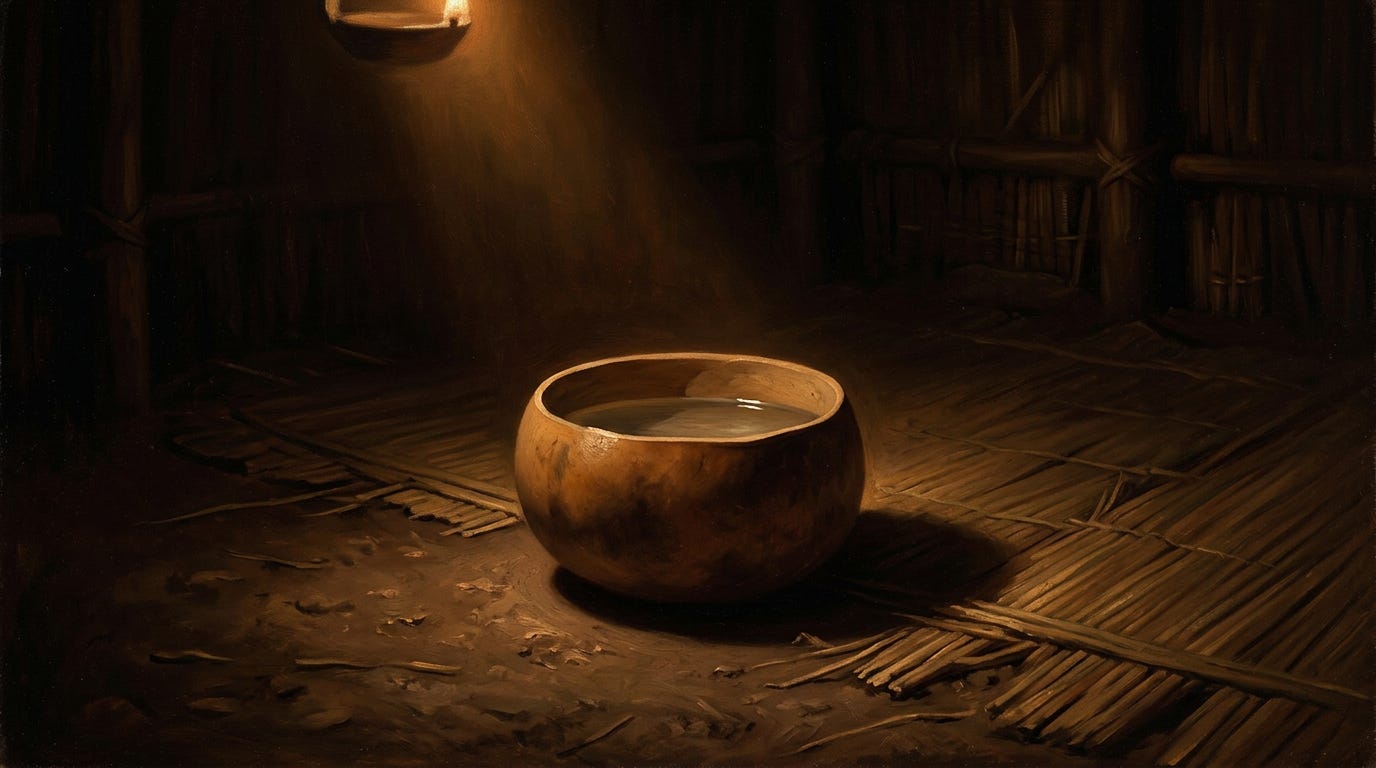
The water was in a gourd.
Charles had taken the gourd from the cookhouse before the boys were locked in for the night, and he had filled it from the spring behind the kitchen yard, and he had carried it under his cloth so the guards would not see it, and now he was sitting in the long room where the pages slept and the gourd was on the dirt floor between his bare feet. The room was not lit. The king had ordered the lamps put out at sunset, in all the pages’ quarters, since the troubles had begun.
There were thirty-one boys lying on their mats around him, breathing the unsteady breathing of young men who knew that their breathing was being counted. Not all of them were sleeping. Most of them were not. Charles could hear the small sounds of one boy weeping into his cloth at the far end of the room, and he could hear the prayers of two others muttered very quietly in Luganda, and he could hear the boy beside him, Kizito, whispering the Our Father over and over the way a child says a song to himself in the dark to keep from being afraid.
Charles was twenty-six years old. He was the Kabaka’s head page. He was also, since the beheading of Joseph Mukasa eight months ago, the leader of the Catholic catechumens of the court. Twelve of the boys around him in the dark had not yet been baptized. He had been instructing them. He had been waiting for the priest, Father Lourdel, to come back from Buddu and finish what Charles had begun, but the priest had been ordered out of the country by the king last month, and there was no priest now in the court at Munyonyo, and tomorrow at dawn the boys were going to be marched out the gates and along the road to Namugongo, where the king’s executioners had been told to burn them.
There would not be a priest tomorrow either.
The king, Mwanga of Buganda, had given his orders in the early afternoon. Charles had not been there to hear them but he had heard about them within the hour, the way news traveled in the court, hand to hand and mouth to mouth, faster than the king could prevent. The king had decided. The Christians among the pages were to be killed. The killings would happen at Namugongo, two days’ march away, because the king did not want them to happen at the court itself, where their families could see. The pages would be marched in a single file. The ones who recanted on the road would be spared. The ones who did not would be wrapped in reed mats and burned alive on a single pyre at the place of execution. Charles had been told all this. Charles had told the boys, gently, in the late afternoon when they had come back from the king’s audience and were sitting in the page yard. Most of them had already known. None of them had recanted.
The twelve unbaptized boys had come to him after sunset.
They had not asked. They had only come and sat near him on the floor of the long room when the lamps were put out, and they had waited, and Charles had understood, and he had said in a very quiet voice, I will baptize you tonight. We must do it before the guards make their second round, which will be at the eleventh hour. We have perhaps two hours. And the boys had nodded, in the dark, although he could not see them nod, and he had heard the small movements of nodding because the room was that quiet.
He had gone for the water. He had come back. He was sitting now on the dirt floor with the gourd between his feet and the twelve boys arranged in a small half-circle around him and the other nineteen boys lying or sitting on their mats pretending in various ways not to be listening, although all of them were listening. The room smelled of woodsmoke and of the matoke that had been the evening meal and of the bodies of thirty-two young men who had been sweating with fear since the afternoon.
Charles laid his hand on the gourd.
He was suddenly afraid.
He had been a catechumen himself only four years. He had been baptized by Father Lourdel in 1885. He had never baptized anyone. He knew the form. He had memorized the form. Father Lourdel had taught it to all the senior catechumens because the priest had known he might be expelled and had wanted his catechists to be able to do this work in his absence. Charles knew the words. He knew the words in Luganda and he knew the words in Latin, although his Latin was poor, and Father Lourdel had said the Luganda was acceptable when there was no priest. Charles knew all of this. But he had not done it. The doing of it, in the dark, with the boys watching him, with the executioners at Namugongo waiting for the dawn, with the king’s guards at the door of the long room - the doing of it was a different thing from the knowing. He sat with his hand on the gourd. He did not move. The boys waited.
A man was sitting beside him.
Charles had not heard him come in. The door of the long room was bolted. The shutters were closed. There had been no one beside him a moment ago and now there was. The man was older, perhaps forty-five, perhaps older - it was hard to tell in the dark - and he was wearing a tunic that was not Bugandan and not Arab and not any clothing Charles knew. The tunic was rough wool. It came to the man’s knees. He was barefoot. His hair was gray and his beard was short. He was sitting cross-legged on the dirt floor in the way the men of the court sat when they were at ease, and his hands were resting open on his knees, and he was waiting in the same way the boys were waiting.
Charles looked at him.
The boys did not look at him. The boys could not see him. Charles understood this without being told. The man was visible to him alone. The man had come for him alone.
“Brother,” the man said in Luganda.
Luganda was not the man’s language. Charles could hear that it was not. The man was speaking in a way that suggested he was speaking through Luganda from somewhere underneath it, the way a man’s hands move under cloth. But the Luganda was clear and Charles understood it.
“Brother,” Charles answered.
“You are about to baptize them.”
“Yes. I do not know if I am permitted to do this. I am only a catechist.”
“You are permitted. The Lord has permitted. The Church has always permitted. When there is no priest or deacon and the souls are about to die, any baptized person - in fact, any person - may baptize. This is the law from the beginning. I knew it when I was alive.”
Charles was quiet.
“You are not alive now,” he said.
“No.”
“You are a saint.”
“Yes.”
“Which?”
“My name is Justin. I lived in Rome. I was a teacher of philosophy before I was a Christian and a teacher of philosophy after, although the philosophy after was not the same as the philosophy before. I was beheaded in Rome by the prefect Junius Rusticus in the year that I think you would call one hundred and sixty-five. I have been waiting a long time. I have come tonight because I would like to help you.”
“To help me?”
“Yes.”
“With the water.”
“With the water. You are afraid you will not do it correctly. You will do it correctly. I will sit beside you and I will pray the words with you, and the words will be in two tongues and the tongues will not matter. The Lord does not require Latin. The Lord does not require Greek. The Lord does not require the Luganda you are about to use. The Lord requires the water and the words and the willing of the soul. You have all three. I have come because I would like to be near the water with you.”
Charles looked at the gourd.
He looked at the twelve boys.
He looked back at Justin.
“Why you?” he said.
“What?”
“Why have you come? Out of all the saints. There are many. Why has the lot fallen to you tonight?”
Justin almost smiled.
“Because I was the first,” he said quietly, “to be killed by an emperor who said I had refused to honor him. Because I died for the same refusal these boys are dying for. Because the Kabaka is also an emperor. Because an emperor has been killing baptized men for refusing him since the beginning, and I was one of the first, and these boys will be among the latest, and the long line between us is one line, and I have come because I belong on it, and so do they.”
Charles understood.
He looked once more at Justin and then he looked at the twelve boys, who were waiting, and he leaned toward the gourd and he laid his hand against its smooth gourd-side, and he said, in Luganda, in a low clear voice that the boys at the far end of the room could just hear:
“Brothers. Come close. We will do it now.”
The twelve boys moved closer. They did not speak. They had decided, over the past hours, the order in which they would come. The youngest was Kizito, who was fourteen. He had asked to be last, because he wanted to watch the others first to see how it was done. He had said this in the late afternoon, in the page yard, when they had been sitting in the sun and trying to be brave, and the older boys had laughed at him a little, the way older brothers laugh at a youngest, and Kizito had laughed too, and now in the dark Kizito was sitting at the back of the half-circle and waiting for his turn.
The first boy came forward. His name was Achilleus.
He knelt in front of Charles and he bowed his head and Charles dipped his hand in the gourd and he poured the water over Achilleus’s head three times and he said the words, Ndakubatiza mu linnya lya Kitaffe ne lya Mwana ne lya Mwoyo Mutukuvu, which is I baptize you in the name of the Father and of the Son and of the Holy Spirit in Luganda, and as he poured Justin spoke the same words beside him in Greek, baptizo se eis to onoma tou Patros kai tou Huiou kai tou Hagiou Pneumatos, which were the words Justin had heard Justin’s own godfather say in a house in Ephesus in the year one hundred and thirty when Justin had been baptized by a hand that no one now remembered, and the two languages went into the gourd and into the water and onto Achilleus’s bowed head and the boy looked up and his face was wet and he was crying without sound and Charles said Achilleus, brother, and Achilleus said brother, and Achilleus moved to the side and the next boy came.
The next boy was Mukasa, named for the catechist Joseph Mukasa who had been killed eight months ago for the same faith. He had taken the name when he had begun his catechumenate. He bowed. The water was poured. The words were said. He was a Christian.
The third boy.
The fourth.
The fifth.
The water held. There was a moment, around the seventh boy, when Charles thought the gourd was running low, and he tilted it toward the lamp that was not there, and Justin laid his hand on Charles’s wrist, and the water did not run out. Charles understood that the water would not run out. He poured for the eighth boy and the ninth.
The tenth boy was a young man named Mbaga. He was the son of one of the king’s executioners. His own father, in the morning, would be among the men who lit the pyre at Namugongo. Charles knew this. The boy knew this. Mbaga had been told by his father, that afternoon, that he would be spared if he spoke a single word of recantation. Mbaga had not spoken the word. He had come back to the long room and he had asked Charles, in the page yard, whether the water could still be given to him. Charles had said yes. Charles had said yes without any hesitation at all. Now Mbaga knelt before the gourd and he bowed his head and the water came down over his hair and Charles said Mbaga, brother, and Mbaga did not look up at first, and when he did look up his face was older than it had been a moment before, the way the faces of young men become older when they have made a decision their fathers will not be able to forgive them for.
The eleventh.
Then Kizito.
The youngest boy came forward last, as he had asked. He was small for his age and his eyes were very large in the dark and he knelt and he did not bow his head, he looked up at Charles, and Charles smiled at him, and Kizito smiled back, and Charles poured the water and said the words and Justin said the words and the water came down over the small fourteen-year-old face and Kizito closed his eyes and opened them and said in a clear voice:
“Brother.”
“Brother.”
The twelve were Christians.
Charles set the gourd on the floor. He sat back. The boys around him were quiet now in a different way than they had been quiet before. The boy who had been weeping at the far end of the room was no longer weeping. The two boys who had been muttering prayers were silent. The whole long room was holding the moment together, the way a hand holds a small bird.
Justin was still beside him.
“You have done well,” Justin said.
“It was the water,” Charles said. “It was not me. It was the water and it was the Lord.”
“Yes. And you. You are part of it. The Lord uses what is given to Him. You gave Him your hands. He gave you the water. The boys gave Him their lives. Tomorrow they will give Him their bodies. Tonight they have been given His name. The work that was begun in them tonight will be finished in them tomorrow. The two are one work.”
Charles was quiet. The fear in him had not gone away. The fear was still there, low and steady, in the place behind his ribs where fear lived in him in those last days. But the fear was no longer the only thing in that place. There was something else there now. He did not have a word for it. He thought it was perhaps what the boys had felt when the water came down over their heads. He thought it was perhaps what Justin had felt when his own godfather had baptized him in Ephesus seventeen hundred and fifty-six years ago, in a house no one now remembered, by a hand whose name was lost. He thought the not-having-a-word was acceptable.
“Will you stay until the morning?” Charles said.
“I will stay until the guards come for the second round.”
“Why not until morning?”
“Because in the morning you will not need me. You will have the boys. The boys will have you. The Lord will have all of you. I have come for the water. The water is finished. I will go when the guards come, and I will come back when the fire is lit, but in a different form, and you will know me when you see me, although you will be too taken up with the burning to think about who I am, and that is correct, that is what is meant to happen. Do not look for me at Namugongo. Look for the Lord. I will be looking with you.”
“Yes.”
“Brother.”
“Brother Justin.”
The bolt of the door rattled. The eleventh hour. The guards were coming for the second round. Charles turned his head toward the door, and when he turned back the place beside him on the dirt floor was empty, and the gourd was still there with the water in it, although the water was slightly less than it had been a moment before, only slightly, the way water is slightly less when a hand has been dipped in it twelve times.
The guards came in with a torch. They counted the boys. They went out. They bolted the door behind them.
The long room slept, those who could.
In the morning the guards came again, with rope, and the thirty-one Christian pages were tied in a line and marched out the gates of Munyonyo and along the road north to Namugongo, where they would arrive in the late afternoon of the next day, and where they would be wrapped in reed mats and burned alive on a single pyre on the morning of the fourth, although three of the older catechumens, including Charles himself, would be killed separately, by sword or by individual burning, in the days surrounding. Twenty-two of them would be canonized by the Catholic Church in 1964 by Pope Paul VI. Their feast is celebrated on the third of June.
The water at Munyonyo did not run out.
The thread did not break.
The fire at Namugongo, when it was lit, was not the only fire burning that day. The same fire was burning, somewhere, in a Roman courtyard in the year one hundred and sixty-five, and the same fire was burning, somewhere, in every century between, and the same fire is burning still, in every place where a baptized man or woman is asked to refuse the One who has named them, and refuses to refuse, and the lamp has not yet gone out, and will not.
For your prayer this week: Saint Charles Lwanga and Saint Justin Martyr, you who refused the king and you who refused the emperor, you who poured the water in a long room in Buganda and you who heard the words of baptism in a house in Ephesus seventeen hundred years before, pray for those of us who are asked to refuse what we have been told to honor and who do not always have the courage to do so. Grant us the grace to know that the long line between you is the line we are also on, and that the water has been given for us also. Amen.
Two Lamps returns next Friday: Saint Ephrem the Syrian and Saint Anthony of Padua, the small chapel at the hermitage of Camposampiero, near Padua, an afternoon in early June 1231.
Two Lamps is a weekly short story braiding the lives of two or three saints across the centuries. Sometimes the meeting is rendered as an encounter in eternity. Sometimes as the older saint coming, in vision or in patronage, to the soul of the younger. The text does not decide for you. The Communion of Saints is the doctrine that holds these meetings as theologically real even when the meeting itself is imagined.
This week’s story is set in Uganda, where the Catholic Church remains young, vibrant, and desperately under-resourced. Deacon Michael Halbrook serves as President of the Archdiocese of Mbarara Foundation, a 501(c)(3) supporting the work of the Church in Mbarara, Uganda - the seminary, the parishes, the schools, and the mission of the Gospel in a country where the blood of the Uganda Martyrs is still warm in the soil. If this story moved you, please consider supporting that work at 4mbarara.org. Every gift is a small thread carried by hand into the long line that runs from Charles Lwanga to today.
Two Lamps is written by Deacon Michael Halbrook, a permanent deacon of the Diocese of Springfield in Illinois, serving at St. Elizabeth Parish in Granite City. He writes personally at DeaconMichael.net, serves families through Domus Formation, and publishes the serial novel Ordo: A Chronicle of Lux Perpetua at LuxPerpetua.net. Two Lamps is co-conceived with his son Joseph.